

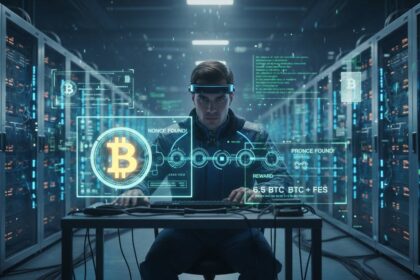

Bitcoin mining is the process by which new bitcoins are created and transactions are verified and added to the public ledger known as the blockchain. It involves powerful computers solving complex mathematical puzzles to confirm transactions and secure the network. In return for this work, miners receive newly minted bitcoins and transaction fees.
This process forms the backbone of Bitcoin's decentralized monetary system, eliminating the need for traditional banks or financial institutions to validate transactions. Understanding how mining works is essential for anyone looking to grasp the fundamentals of cryptocurrency or potentially participate in the network themselves.
Key Insights
- Bitcoin mining creates new coins while securing the entire network through cryptographic verification
- Mining difficulty adjusts every 2016 blocks (approximately every two weeks) to maintain a consistent block discovery rate
- Individual mining has become largely unprofitable for beginners due to competition and energy costs
- The Bitcoin network currently processes approximately $10-15 billion in transactions weekly
- Mining rewards have decreased from 50 BTC per block in 2009 to 3.125 BTC as of April 2024
Understanding the Basics of Bitcoin Mining
At its core, Bitcoin mining serves two critical purposes: issuing new currency and maintaining the integrity of the transaction ledger. Unlike traditional money creation, which involves central banks printing currency, Bitcoin's protocol mathematically determines new coin creation through mining.
The term "mining" comes from the analogy of extracting precious metals from the earth. Just as gold miners expend effort to uncover gold, Bitcoin miners dedicate computational resources to discover new coins. However, the computational work serves a functional purpose beyond mere creation—it secures the network against fraudulent transactions.
What Miners Actually Do
Miners collect pending transactions from the Bitcoin network and bundle them into blocks. Each block contains a cryptographic hash of the previous block, creating a chain of verified transactions. This structure makes altering historical transactions practically impossible, as doing so would require recalculating every subsequent block.
The mathematical puzzles miners solve are called "proof-of-work" problems. These require significant computational effort to solve but are relatively easy to verify once a solution is found. This asymmetry ensures that miners have genuinely expended resources to add blocks, making the system resistant to spam and manipulation.
When a miner successfully solves the puzzle and their block is accepted by the network, they receive two types of rewards: the block subsidy (newly created bitcoins) and transaction fees paid by users whose transactions are included in the block. This dual reward system incentivizes miners to prioritize transactions with higher fees while ensuring the network remains secure.
Why Mining Exists
Bitcoin was designed as a decentralized currency without a central authority. Without banks or governments managing the money supply, the network needed a way to reach consensus on which transactions are valid. Mining provides this consensus mechanism through mathematical proof rather than trust in institutions.
The proof-of-work system ensures that no single entity can control the blockchain. To manipulate the ledger, an attacker would need to control more than 50% of the network's total mining power—a feat requiring billions of dollars in specialized hardware and electricity. This security model has kept Bitcoin operational since its inception in 2009 without any major network compromises.
How Bitcoin Mining Actually Works
The technical process behind Bitcoin mining involves several interconnected components working together to maintain the blockchain. Understanding these mechanics reveals why mining is both computationally intensive and economically significant.
The Mining Process Step by Step
Step 1: Transaction Collection
Miners monitor the Bitcoin network for unconfirmed transactions. Users broadcasting transactions pay fees to incentivize miners to include their payments in the next block. The miner assembles a candidate block containing hundreds or thousands of these transactions.
Step 2: Header Construction
The miner creates a block header containing the version number, previous block's hash, Merkle root of all transactions, timestamp, difficulty target, and a random number called the "nonce."
Step 3: Hash Calculation
The miner repeatedly hashes the block header using SHA-256 cryptographic function. Each attempt produces a unique output called a hash. The goal is to find a hash that meets the current difficulty target—essentially finding a specific pattern in the output.
Step 4: Difficulty Adjustment
The Bitcoin protocol automatically adjusts difficulty approximately every two weeks (every 2016 blocks). If blocks are being solved too quickly, difficulty increases; if too slowly, it decreases. This mechanism ensures new blocks are added roughly every 10 minutes regardless of total network hash rate.
Step 5: Block Validation
When a miner finds a valid hash, they broadcast their block to the network. Other nodes verify the block's validity by confirming the hash meets requirements and all transactions within are valid. Once verified, the block is added to the blockchain, and the successful miner receives their reward.
Understanding Hash Rate and Difficulty
Hash rate measures the total computational power dedicated to Bitcoin mining, typically expressed in hashes per second (H/s). The current global Bitcoin hash rate exceeds 600 exahashes per second (EH/s)—an astronomical figure representing hundreds of trillions of calculations per second.
| Metric | Value | Context |
|---|---|---|
| Network Hash Rate | 600+ EH/s | As of late 2024 |
| Block Time | ~10 minutes | Target frequency |
| Difficulty Adjustment | Every 2,016 blocks | ~14 days |
| Current Difficulty | ~90 trillion | All-time high |
The difficulty target represents how difficult it is to find a valid hash compared to the easiest possible hash. When difficulty increases, miners must attempt more hashes on average to find a valid block. This arms race has driven massive innovation in mining hardware over Bitcoin's lifetime.
The Economics: Costs, Rewards, and Profitability
Bitcoin mining operates as a competitive market where miners balance operational costs against potential rewards. Understanding these economics helps explain why mining has evolved into a specialized industry.
Block Rewards and Halving Events
Bitcoin's protocol includes programmed supply limits—only 21 million bitcoins will ever exist. New coins are created through block subsidies that decrease over time in events called "halvings," occurring approximately every four years.
| Period | Block Reward | Total BTC Minted |
|---|---|---|
| 2009-2012 | 50 BTC | 10,500,000 |
| 2012-2016 | 25 BTC | 5,250,000 |
| 2016-2020 | 12.5 BTC | 2,625,000 |
| 2020-2024 | 6.25 BTC | 1,312,500 |
| 2024-2028 | 3.125 BTC | 656,250 |
The April 2024 halving reduced block rewards from 6.25 to 3.125 BTC, making mining significantly less profitable for operators with high electricity costs. This reduction forces miners to become more efficient or exit the market, concentrating operations among those with cheap power.
Operational Costs
The primary costs for mining operations include:
Electricity: The single largest expense for most miners. Modern ASIC miners consume 20-100 joules per terahash (J/TH), with operations running thousands of units simultaneously. Electricity costs ranging from $0.03 to $0.10 per kilowatt-hour often determine profitability.
Hardware: Application-Specific Integrated Circuit (ASIC) miners cost between $2,000 and $10,000+ depending on efficiency and hash rate. These machines have 2-5 year lifespans before becoming obsolete or unprofitable to operate.
Cooling and Facilities: Large mining operations require significant cooling infrastructure, particularly in warm climates. Industrial facilities may also require specialized electrical setups, security systems, and physical space for thousands of machines.
Maintenance: Hardware failures, firmware updates, and operational management require ongoing labor and replacement costs. Professional mining facilities employ staff for continuous monitoring and maintenance.
Profitability Variables
Individual mining profitability depends on several factors:
- Electricity cost: The primary variable affecting margins
- Hardware efficiency: Measured in joules per terahash (lower is better)
- Bitcoin price: Higher prices increase revenue but also attract more competition
- Difficulty: Increasing difficulty reduces individual chances of finding blocks
- Transaction fees: Variable based on network congestion
Hardware: From CPUs to ASICs
The evolution of Bitcoin mining hardware illustrates the intense competition driving the industry. Understanding this progression explains why personal mining has become nearly impossible for average users.
Hardware Generations
CPU Mining (2009-2010): In Bitcoin's early days, anyone could mine using a standard computer processor. The network hash rate was measured in megahashes per second (MH/s), and home computers could successfully find blocks. As more people joined the network, this became unviable.
GPU Mining (2010-2012): Graphics Processing Units proved far more efficient at SHA-256 calculations, offering 10-100x improvement over CPUs. This era saw the emergence of mining farms and the first professional miners, though hobbyists could still participate profitably.
FPGA Mining (2012-2013): Field-Programmable Gate Arrays provided another efficiency leap, offering improved performance with lower power consumption. However, these devices were complex to configure and were quickly superseded.
ASIC Era (2013-Present): Application-Specific Integrated Circuits are chips designed specifically for Bitcoin mining, offering orders-of-magnitude improvements in efficiency. Modern ASICs like the Antminer S21 Pro achieve 234 terahashes per second while consuming 3,621 watts. This hardware has made previous mining methods completely obsolete.
Current Market Leaders
| Model | Hash Rate | Power Draw | Release |
|---|---|---|---|
| Bitmain Antminer S21 Pro | 234 TH/s | 3,621 W | 2024 |
| Bitmain Antminer S19 XP | 140 TH/s | 3,010 W | 2022 |
| MicroBT Whatsminer M66S | 298 TH/s | 5,433 W | 2023 |
The specialized nature of ASIC hardware creates significant barriers to entry. Unlike general-purpose computers, ASICs cannot be repurposed for other tasks, making them risky investments if Bitcoin becomes unprofitable to mine.
Mining Pools: Collaborating for Consistent Rewards
Individual mining has become so competitive that solo miners rarely find blocks. Mining pools emerged as a solution, allowing participants to combine computational resources and share rewards proportionally.
How Pools Work
In a mining pool, participants contribute their hash rate to collectively solve blocks. When the pool successfully mines a block, the reward is distributed among members based on their contributed share of total hash rate.
This approach provides more consistent, predictable earnings compared to solo mining, where a miner might go months without finding a block. Pools typically charge fees of 1-3% of earnings for providing this service.
Major Mining Pools
| Pool | Market Share | Location |
|---|---|---|
| Foundry USA | ~25% | US |
| AntPool | ~18% | China/Global |
| ViaBTC | ~12% | China/Global |
| F2Pool | ~10% | China/Global |
| Binance Pool | ~8% | Global |
Pool selection involves tradeoffs between size (larger pools provide steadier income), fees, payout methods, and geographic location. Some miners prefer smaller pools to avoid contributing to excessive concentration of hash rate.
Payout Methods
Pools offer various payout structures:
Pay-Per-Share (PPS): Provides fixed payments regardless of whether the pool finds blocks. Lower variance but often lower effective earnings due to pool fees.
Full Pay-Per-Share (FPPS): Similar to PPS but includes transaction fees, providing more complete earnings.
Pay-Per-Last-N-Shares (PPLNS): Rewards depend on recent shares contributed, creating higher variance but potentially better returns during lucky periods.
Environmental Impact and Sustainability Concerns
Bitcoin mining's energy consumption has attracted significant attention from environmentalists, regulators, and the public. Understanding both the concerns and the industry's responses provides balanced perspective on mining's sustainability.
Energy Consumption Facts
Bitcoin's annual electricity consumption rivals that of some small countries. Recent estimates suggest the network consumes approximately 150-180 terawatt-hours annually—comparable to countries like Norway or Argentina. This figure has grown substantially as the network's hash rate has increased.
However, energy consumption alone doesn't tell the complete story. Key considerations include:
Grid Impact: Mining operations can provide valuable demand response services, consuming electricity during periods of excess supply and helping stabilize grids. Some facilities specifically locate near renewable energy sources or wasted gas flaring operations.
Energy Sources: Studies suggest 40-60% of Bitcoin mining uses renewable energy, with hydroelectric, solar, and wind power prominent in regions like China (historically), Iceland, and parts of the United States and Canada.
Efficiency Gains: Hardware efficiency has improved dramatically, with modern ASICs requiring approximately 1/100th the energy per hash compared to early GPU mining.
Industry Developments
The Bitcoin mining industry has increasingly focused on sustainability:
Renewable Integration: Major mining companies have committed to carbon neutrality and increased renewable energy usage. Several publicly traded mining firms now report sustainability metrics and ESG compliance.
Grid Services: Some mining operations negotiate agreements with utilities to shut down during peak demand periods, effectively acting as controllable loads that support grid stability.
Methane Capture: A small but growing segment of mining operations capture waste methane from oil and gas operations, converting problematic emissions into electricity for mining.
Getting Started with Bitcoin Mining
For individuals interested in mining, several options exist with varying levels of commitment and technical knowledge requirements.
Cloud Mining
Cloud mining allows users to rent hash rate from remote data centers without purchasing physical hardware. Users pay a contract fee and receive mining rewards proportional to their rented capacity.
Pros: No hardware to maintain, no electricity costs, immediate start
Cons: Contracts often unprofitable long-term, counterparty risk, limited control
Cloud mining is generally considered the highest-risk option for beginners, with many companies proving fraudulent or offering unfavorable contract terms. Those interested should thoroughly research providers and read the fine print on contracts.
Home Mining
Operating a personal ASIC miner is possible but rarely profitable in 2024. Successful home mining requires:
- Electricity costs below $0.06/kWh
- Suitable space with cooling and noise management
- Initial capital of $2,000-5,000+ for hardware
- Technical comfort with networking and troubleshooting
Home miners typically join pools to receive consistent payouts. Profitability calculators exist online but depend heavily on assumptions about future Bitcoin price and difficulty changes.
Industrial Mining
Large-scale mining operations represent the majority of network hash rate. These facilities benefit from economies of scale, cheap electricity contracts, and professional management. Publicly traded mining companies offer investment exposure without operational complexity, though stock investing carries different risks than mining itself.
The Future of Bitcoin Mining
Bitcoin mining continues evolving through technological advancement, regulatory changes, and market forces. Several trends are shaping the industry's trajectory.
Technological Trends
Hardware Innovation: Manufacturers continue developing more efficient ASICs, though the pace of improvement has slowed. The next generation of machines may offer 20-30% efficiency gains over current models.
Heat Recovery: Some operations are exploring ways to repurpose mining heat for commercial or residential heating—a concept gaining traction in colder climates.
Edge Computing Integration: Mining facilities increasingly host other compute-intensive workloads during periods of low network activity, improving facility utilization.
Regulatory Considerations
Various jurisdictions have taken different approaches to mining:
United States: Generally mining-friendly, with several states hosting major operations. Regulatory clarity remains evolving, particularly around energy usage and financial implications.
China: Effectively banned mining in 2021, driving significant hash rate migration to other countries.
Kazakhstan, Russia, Canada, and others: Have attracted migrated mining operations, though regulatory environments vary.
Potential future regulations could impact mining profitability through restrictions on energy sources, noise ordinances, or financial regulations. Miners increasingly locate in jurisdictions with clear, favorable rules.
Frequently Asked Questions
How long does it take to mine one Bitcoin?
With the current network difficulty and average hash rates, it would take an individual miner with a single ASIC approximately 100 years to find a block solo. This is why miners join pools—to receive consistent, smaller payments rather than waiting years for a random block reward.
Is Bitcoin mining profitable in 2024?
Profitability depends heavily on electricity costs, hardware efficiency, and Bitcoin's price. Mining can be profitable for those with electricity costs below $0.06 per kWh using modern ASIC hardware. However, many variables affect outcomes, and significant investment is required for meaningful returns.
Can I mine Bitcoin on my phone?
No. Mobile devices cannot compete with specialized ASIC hardware. Any "mobile mining" apps or cloud services claiming to mine Bitcoin on phones are either scams or provide negligible rewards that rarely cover the electricity costs.
How much electricity does Bitcoin mining use?
Bitcoin mining consumes approximately 150-180 terawatt-hours annually, roughly comparable to the electricity usage of countries like Norway or Argentina. However, this figure represents a tiny fraction of global electricity production, and the network provides verifiable security for a monetary system serving millions.
Does mining waste electricity?
This depends on perspective. Bitcoin mining uses electricity to secure a monetary network, process transactions, and maintain censorship resistance. Whether this constitutes "waste" is subjective. Many argue that the utility of a decentralized, censorship-resistant currency justifies the energy expenditure, particularly when powered by otherwise wasted or renewable energy sources.
Conclusion
Bitcoin mining represents a revolutionary approach to money creation and transaction verification. Through competitive proof-of-work mathematics, the network maintains security without central authority, enabling peer-to-peer value transfer across borders.
For beginners understanding the basics, key takeaways include: mining creates new bitcoins while securing the network; the process requires specialized, expensive hardware; profitability depends primarily on electricity costs; and the industry has evolved into a professional, capital-intensive sector.
Whether you're considering participation as a hobbyist, investor, or simply seeking to understand cryptocurrency fundamentals, mining illustrates how Bitcoin achieves its unique properties. The combination of economic incentives, cryptographic security, and decentralized governance creates a novel monetary system that continues reshaping discussions about money, trust, and value in the digital age.