

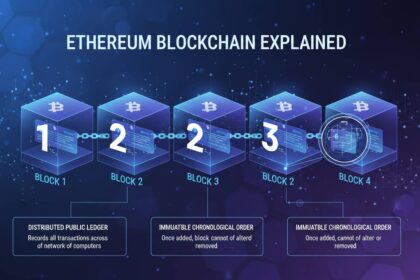

Ethereum is a decentralized, open-source blockchain platform that enables developers to build and deploy decentralized applications (dApps) and smart contracts. Launched in 2015 by programmer Vitalik Buterin, Ethereum serves as the foundation for a worldwide ecosystem of digital assets, decentralized finance (DeFi) protocols, and blockchain-based applications. Unlike Bitcoin, which functions primarily as a digital currency, Ethereum was designed as a programmable blockchain—a flexible platform where anyone can create custom rules, applications, and economic systems without requiring permission from any central authority.
Key Insights
- Ethereum is the second-largest cryptocurrency by market capitalization, behind Bitcoin
- Over 3,000 decentralized applications operate on the Ethereum network
- Ethereum completed "The Merge" in September 2022, transitioning from proof-of-work to proof-of-stake
- The platform processes approximately 1-1.5 million transactions daily
- Ethereum's native cryptocurrency, Ether (ETH), serves as both a store of value and fuel for network operations
Understanding Ethereum's Core Architecture
Ethereum operates as a global computer that maintains a distributed ledger—a shared database across thousands of computers worldwide. This architecture eliminates the need for intermediaries like banks or servers, allowing users to interact directly with each other through code rather than institutions.
The Ethereum Virtual Machine (EVM)
At the heart of Ethereum lies the Ethereum Virtual Machine (EVM), a runtime environment that executes smart contracts. Think of the EVM as a massive, distributed virtual machine running on every node in the Ethereum network. When a developer deploys a smart contract, the EVM ensures that the code executes exactly as written, regardless of where it's run. This deterministic behavior means that given the same inputs, the EVM will always produce the same outputs—eliminating disputes about whether transactions were processed correctly.
The EVM processes instructions called "opcodes," each performing specific tasks such as arithmetic operations, cryptographic functions, or blockchain interactions. Every node in the network runs these calculations independently, reaching consensus on the final state of the blockchain through a rigorous mathematical protocol.
Blockchain Structure and Blocks
Ethereum's blockchain consists of blocks containing three primary components: the block header, a list of transactions, and ommer blocks (previously called "uncle blocks"). The block header contains crucial metadata including the previous block's hash (creating the blockchain's chain structure), the merkle root of all transactions, the state root, timestamp, difficulty level, and other technical parameters.
Each block on Ethereum contains approximately 15-20 transactions on average, though this number fluctuates based on network demand and block size limits. Unlike Bitcoin's 10-minute block time, Ethereum targets approximately 12-14 seconds per block, enabling faster transaction confirmations for users.
Ether (ETH): More Than Just Digital Money
Ether serves two primary functions within the Ethereum ecosystem: it acts as a digital currency and as "fuel" for network operations. Understanding ETH requires distinguishing between these roles.
ETH as a Store of Value and Medium of Exchange
As a cryptocurrency, Ether can be transferred between addresses, held as an investment, or used to purchase goods and services from merchants who accept it. Many major corporations, including Microsoft, PayPal, and Whole Foods, have integrated cryptocurrency payment options that include ETH. Institutional investors have also shown growing interest, with major asset managers like Grayscale and BlackRock offering Ethereum investment products.
Ether's monetary policy underwent significant change with EIP-1559, an upgrade implemented in August 2021 that introduced a base fee burn mechanism. This change makes ETH deflationary under certain network conditions, as a portion of every transaction fee is permanently removed from circulation rather than paid entirely to miners (now validators).
Gas: The Fuel That Powers Ethereum
Every operation on Ethereum—from simple transfers to complex smart contract executions—requires computational resources. "Gas" measures the amount of computational work required, with more complex operations consuming more gas. Gas prices fluctuate based on network demand, typically ranging from 10 Gwei to over 100 Gwei during periods of high activity (1 Gwei equals 0.000000001 ETH).
Understanding gas is crucial for users because it directly impacts transaction costs. During the 2021 NFT boom, some users paid hundreds or even thousands of dollars in gas fees for simple transactions. Layer-2 scaling solutions like Arbitrum and Optimism have since emerged to address these cost concerns by processing transactions off the main Ethereum network before settling them on the main chain.
Smart Contracts: Self-Executing Digital Agreements
Smart contracts represent one of Ethereum's most revolutionary features—self-executing programs stored on the blockchain that automatically enforce terms when predetermined conditions are met. These digital agreements eliminate the need for traditional legal enforcement or trusted intermediaries.
How Smart Contracts Work
A smart contract is essentially code that runs at a specific address on the Ethereum blockchain. When someone sends a transaction to interact with a smart contract, the EVM executes the code and updates the blockchain state accordingly. Because the code and all interactions are recorded on the blockchain, smart contracts are transparent, tamper-resistant, and permanently auditable.
Consider a simple example: Party A wants to bet Party B that the temperature in New York will exceed 100°F next summer. They could create a smart contract that accepts both bets, automatically retrieves weather data from an oracle (a data feed connecting real-world information to blockchains), and distributes winnings to the correct party without requiring any human intervention or trust in either participant.
Real-World Smart Contract Applications
The versatility of smart contracts has enabled numerous applications across industries. In decentralized finance, lending protocols like Aave and Compound use smart contracts to match borrowers with lenders, automatically calculating interest rates and collateral requirements. Decentralized exchanges like Uniswap use automated market maker (AMM) algorithms powered by smart contracts to facilitate trading without traditional order books.
Non-fungible tokens (NFTs) represent another prominent use case, with smart contracts creating unique digital collectibles that can be bought, sold, and verified as authentic. Gaming applications leverage smart contracts for in-game asset ownership, play-to-earn mechanics, and transparent randomized item generation.
Decentralized Applications (dApps)
Decentralized applications differ from traditional software in that they run on peer-to-peer networks rather than central servers. dApps leverage Ethereum's infrastructure to create services that are censorship-resistant, transparent, and accessible to anyone with an internet connection and a compatible wallet.
Categories of dApps
The Ethereum ecosystem hosts thousands of dApps across multiple categories. Decentralized finance applications handle billions of dollars in total value locked (TVL), enabling activities like lending, borrowing, trading, and yield farming without traditional financial institutions. As of 2024, DeFi protocols on Ethereum maintain over $50 billion in TVL.
Gaming and NFT platforms represent another major category, with blockchain-based games offering true ownership of in-game assets and play-to-earn economic models. Social media platforms built on Ethereum allow users to own their data and content, potentially monetizing their contributions without intermediary platforms taking cuts.
Decentralized autonomous organizations (DAOs) represent a governance innovation enabled by Ethereum, allowing groups to organize, vote, and manage shared resources through smart contracts rather than traditional corporate structures.
Interacting with dApps
To use dApps, users need a Web3 wallet like MetaMask, Rainbow, or Coinbase Wallet. These browser extensions or mobile apps store private keys locally on the user's device, enabling them to sign transactions and interact with the blockchain directly. When a user wants to execute an action within a dApp—like swapping tokens or voting on a governance proposal—the wallet prompts them to confirm the transaction, displaying details including the expected gas cost before execution.
Ethereum vs. Bitcoin: Understanding the Differences
Many newcomers conflate Ethereum with Bitcoin, but these platforms serve fundamentally different purposes and employ distinct technical approaches.
| Feature | Ethereum | Bitcoin |
|---|---|---|
| Primary Purpose | Programmable blockchain, dApps, smart contracts | Digital money, store of value |
| Consensus | Proof-of-stake (Post-Merge) | Proof-of-work |
| Block Time | ~12 seconds | ~10 minutes |
| Token Symbol | ETH | BTC |
| Max Supply | No fixed cap (currently deflationary) | 21 million maximum |
| Transaction Capability | Smart contracts, diverse operations | Primarily transfers |
Bitcoin functions primarily as a digital currency and store of value, often called "digital gold." Its scripting language intentionally limits what users can build on top of it. Ethereum, conversely, was designed from the ground up as a general-purpose computing platform that happens to include a cryptocurrency.
The Evolution of Ethereum: From Proof-of-Work to Proof-of-Stake
Ethereum has undergone significant technical transformations since its launch, with the most consequential being "The Merge" in September 2022.
Proof-of-Work Era
Initially, Ethereum used proof-of-work (PoW) consensus, similar to Bitcoin. Miners competed to solve complex mathematical puzzles, with the first to find a valid solution earning the right to add the next block and receive newly minted ETH as a reward. This process required substantial electricity consumption—Ethereum's PoW network previously consumed energy comparable to some small countries.
The Merge and Proof-of-Stake
The Merge represented Ethereum's transition to proof-of-stake (PoS), fundamentally changing how the network achieves consensus. Instead of miners competing through computational work, validators stake their own ETH as collateral to propose and validate blocks. This approach reduces Ethereum's energy consumption by approximately 99.95%, making it far more environmentally sustainable.
Validators who act honestly earn staking rewards (currently yielding 4-6% annually for stakers), while those who behave maliciously risk losing a portion or all of their staked ETH through "slashing." This economic incentive structure secures the network while reducing the environmental footprint.
Future Upgrades
Ethereum continues evolving through additional upgrade phases. "Sharding," planned for implementation in coming phases, will split the blockchain into multiple "shards" to increase transaction throughput dramatically. Currently limited to approximately 15-30 transactions per second, Ethereum aims to eventually process tens of thousands of transactions per second through these scaling solutions.
How to Buy and Store Ethereum
For those interested in acquiring ETH, numerous regulated exchanges make purchasing straightforward, though users should understand the importance of self-custody for long-term holdings.
Purchasing Ether
Major cryptocurrency exchanges including Coinbase, Kraken, Binance.US, and Gemini allow users to purchase ETH using traditional payment methods like bank transfers or debit cards. After purchasing, users can maintain their ETH on the exchange or transfer it to a personal wallet for enhanced security.
For those preferring peer-to-peer transactions, decentralized exchanges like Uniswap enable direct swapping between cryptocurrencies without centralized intermediaries. However, decentralized trading requires more technical knowledge and carries different risk profiles than using regulated exchanges.
Wallets and Security
Cryptocurrency wallets store the private keys that authorize transactions, making wallet security absolutely essential. Hot wallets—software applications connected to the internet—offer convenience but carry greater security risks. Cold wallets (hardware devices disconnected from the internet when not in use) provide superior security for significant holdings.
Regardless of wallet type, users must securely store their "seed phrase" (a series of 12 or 24 words that can regenerate the wallet). Anyone with access to the seed phrase controls the funds, and lost seed phrases mean permanently losing access to stored assets—unlike traditional banking, no customer service can recover forgotten passwords.
Risks and Considerations
While Ethereum offers revolutionary possibilities, prospective users should understand the inherent risks involved in cryptocurrency investments and blockchain technology.
Volatility
Ethereum's price has experienced dramatic fluctuations since its launch, with periods of 50% or greater drawdowns common during market corrections. The cryptocurrency market remains speculative, and investors should only allocate capital they can afford to lose entirely. Past performance provides no guarantee of future results.
Regulatory Uncertainty
Governments worldwide continue developing cryptocurrency regulations, and future rules could significantly impact Ethereum's functionality or the ability to use certain features. Recent enforcement actions against cryptocurrency exchanges and protocols demonstrate that regulatory clarity remains evolving.
Technical Risks
Smart contract vulnerabilities have resulted in billions of dollars in losses across the crypto ecosystem. While Ethereum's core protocol has proven remarkably secure, applications built on top of it occasionally contain bugs or exploits. Users should thoroughly research any protocol before committing funds and consider starting with small test transactions.
Frequently Asked Questions
What is the difference between Ethereum and Ether?
Ethereum refers to the entire blockchain platform—the technology infrastructure, network, and ecosystem. Ether (ETH) is the native cryptocurrency that powers the Ethereum network. When people say "Ethereum" in casual conversation, they often mean the cryptocurrency, but technically Ethereum is the platform while Ether is its token.
Is Ethereum a good investment?
Whether Ethereum constitutes a good investment depends on individual financial circumstances, risk tolerance, and investment timeline. Ethereum has delivered substantial returns for early investors but also experienced significant drawdowns. Prospective investors should conduct thorough research, understand the risks, and consider consulting financial advisors before investing. Never invest more than you can afford to lose.
How long does an Ethereum transaction take?
Ethereum block times average 12-14 seconds, meaning transactions typically confirm within that timeframe under normal network conditions. However, during periods of high demand, users may need to pay higher gas fees to prioritize their transactions. Final settlement (when transactions are considered irreversible) occurs after a block is finalized, which in Ethereum's proof-of-stake system takes approximately 12-15 minutes.
What are gas fees on Ethereum?
Gas fees are payments users make to compensate for the computational resources required to process transactions and execute smart contracts on Ethereum. The fee consists of a base fee (set by the network based on demand) plus a priority fee (tip paid to validators). During busy periods, gas fees can spike significantly—sometimes exceeding $100 for simple transactions during major market events.
Conclusion
Ethereum represents far more than another cryptocurrency—it's a foundational platform enabling a new paradigm of decentralized applications, financial instruments, and organizational structures. From its humble beginnings in 2015 to its current position as the leading smart contract platform, Ethereum has demonstrated both remarkable innovation and the growing pains typical of emerging technologies.
For beginners seeking to understand this space, starting with the fundamentals proves essential: Ethereum is a programmable blockchain, Ether (ETH) is its fuel, smart contracts are self-executing programs, and dApps are applications built without traditional intermediaries. As the ecosystem continues evolving through scaling solutions, improved usability, and wider adoption, understanding these core concepts provides a foundation for navigating the broader Web3 landscape.
Whether you're interested in decentralized finance, digital collectibles, blockchain-based gaming, or simply understanding the technology shaping our digital future, Ethereum offers a gateway into a rapidly expanding frontier of possibility.