

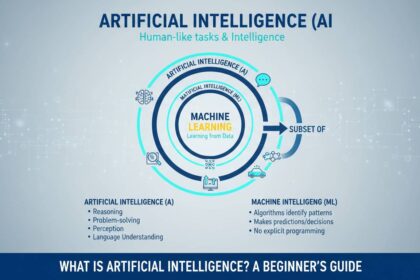

Artificial intelligence has rapidly become one of the most transformative technologies of the 21st century, reshaping industries, economies, and daily life in ways previously confined to science fiction. From the recommendations streaming services make to the voice assistants in our pockets, AI systems are increasingly embedded in the fabric of modern existence. Understanding what artificial intelligence is, how it works, and its implications for society has therefore moved from an academic exercise to a practical necessity. This comprehensive guide explores the fundamentals of AI, its evolution, applications, and the questions it raises about our technological future.
Defining Artificial Intelligence
At its core, artificial intelligence refers to the simulation of human intelligence by machines programmed to think, learn, and solve problems like humans do. The term encompasses a broad range of technologies that enable computers to perform tasks typically requiring human cognition, including visual perception, speech recognition, decision-making, and language translation. AI systems process vast amounts of data, identify patterns within that data, and use those patterns to make predictions or take actions without explicit programming for every possible scenario.
The field distinguishes between narrow AI and general AI. Narrow AI, also known as weak AI, is designed to handle specific tasks within limited domains. Virtual assistants like Siri and Alexa, recommendation algorithms on Netflix or Amazon, and facial recognition systems all represent narrow AI—they excel at particular jobs but cannot transfer their capabilities to unrelated tasks. General AI, sometimes called strong AI, remains theoretical at this point. It would possess the ability to understand, learn, and apply knowledge across a wide variety of tasks, matching or exceeding human cognitive flexibility. Researchers have not yet achieved general AI, and experts debate whether it is achievable or how long it might take.
A Brief History of AI
The concept of intelligent machines has ancient roots in mythology and philosophy, but the modern discipline of artificial intelligence emerged in the mid-20th century. In 1956, a group of researchers including John McCarthy, Marvin Minsky, and Allen Newell convened the Dartmouth Conference, widely considered the founding event of AI as an academic field. Early optimism led to predictions that machines would equal human intelligence within decades, though those expectations proved premature.
The subsequent decades brought cycles of excitement and disappointment known as "AI winters," periods when funding and interest declined after failed promises. However, the 21st century has witnessed remarkable progress, driven by advances in computing power, the availability of massive datasets, and improvements in machine learning algorithms. Breakthroughs in deep learning, a subset of machine learning that uses neural networks with many layers, have enabled dramatic improvements in image recognition, natural language processing, and game-playing capabilities. AlphaGo's 2016 victory over world champion Lee Sedol in the complex game of Go marked a watershed moment, demonstrating that AI could master intuitive tasks previously thought to require human creativity.
How AI Systems Learn
Machine learning forms the foundation of most modern AI applications, representing a departure from traditional rule-based programming. Rather than explicitly coding every step needed to complete a task, developers create algorithms that learn patterns directly from data. The more relevant data an AI system processes, the better it typically becomes at its designated task. This data-driven approach has proven particularly powerful for tasks involving complex patterns that are difficult for humans to explicitly define.
Several learning approaches exist within machine learning. Supervised learning uses labeled datasets where the correct answers are known, teaching algorithms to map inputs to outputs. This method underlies spam filters, medical diagnosis assistants, and credit scoring systems. Unsupervised learning works with unlabeled data, discovering hidden patterns or structures without predefined categories—useful for customer segmentation or anomaly detection. Reinforcement learning involves an agent learning through trial and error by interacting with an environment, receiving rewards or penalties for its actions. This technique has proven effective for robotics, game-playing, and optimization problems.
Deep learning has pushed the boundaries of what AI can accomplish by using artificial neural networks inspired by the structure of the human brain. These networks consist of interconnected layers of nodes that process information, with each layer transforming data into increasingly abstract representations. Deep learning has driven breakthroughs in computer vision, speech recognition, and natural language processing, enabling applications like autonomous vehicles, real-time translation, and sophisticated chatbots.
Real-World Applications of AI
Artificial intelligence has permeated virtually every sector of the economy, transforming how businesses operate and how individuals interact with technology. In healthcare, AI systems analyze medical images to detect diseases, predict patient outcomes, and accelerate drug discovery. Algorithms can identify early signs of conditions like cancer or diabetic retinopathy that might escape human notice, potentially saving lives through earlier intervention. The pharmaceutical industry uses AI to screen millions of compounds virtually, dramatically reducing the time and cost of developing new medications.
The financial sector employs AI for fraud detection, algorithmic trading, risk assessment, and customer service. Banks analyze transaction patterns to identify suspicious activity in real time, while investment firms use machine learning to identify market trends and execute trades at optimal moments. Consumer-facing applications include chatbots that handle routine inquiries and personal finance apps that help users manage their money more effectively.
Entertainment and media companies leverage AI to personalize content recommendations, generate targeted advertising, and even create content. Streaming services analyze viewing habits to suggest shows and movies, while news organizations use AI to generate certain types of automated reports, particularly for data-heavy topics like financial earnings or sports scores. The creative industries are exploring AI-generated art, music, and writing, raising questions about authorship and authenticity.
Transportation stands on the cusp of major transformation through autonomous vehicles. Self-driving cars use combinations of cameras, lidar, radar, and sophisticated AI software to navigate roads and respond to changing conditions. While fully autonomous vehicles are not yet widespread, advanced driver assistance features like adaptive cruise control and lane-keeping assistance have become common in modern cars. The logistics industry similarly embraces AI for route optimization, demand forecasting, and fleet management.
The Impact on Work and Society
The spread of AI raises profound questions about the future of work and the nature of human labor. Automation has historically created new categories of employment even as it displaced existing jobs, but the scope and speed of AI-driven changeprompt concern about whether this pattern will continue. Jobs involving routine cognitive tasks, data analysis, and predictable processes face particular risk of automation, while roles requiring creativity, emotional intelligence, complex problem-solving, and interpersonal skills remain more resistant.
Economists project that AI will both eliminate and create millions of jobs globally over the coming decades. New occupations are emerging in AI development, data annotation, ethics oversight, and human-machine collaboration. The transition will require significant workforce retraining and education reforms to prepare workers for an economy increasingly shaped by intelligent systems. Governments, businesses, and educational institutions are grappling with how to manage this transition equitably.
Beyond employment, AI affects privacy, security, and civil liberties in complex ways. Surveillance systems powered by facial recognition raise questions about privacy and the potential for abuse. Algorithmic decision-making in areas like lending, hiring, and criminal justice can perpetuate or amplify existing biases if the training data reflects historical discrimination. The concentration of AI capabilities among a small number of large technology companies creates concerns about market power and access to the benefits of artificial intelligence.
Ethical Considerations and Future Directions
The development of AI raises ethical questions that philosophers, technologists, and policymakers increasingly grapple with. Bias in AI systems represents a significant challenge, as algorithms learn from historical data that may encode societal prejudices. Facial recognition systems have demonstrated higher error rates for women and people with darker skin tones, while hiring algorithms have reproduced gender discrimination present in past hiring decisions. Addressing these issues requires diverse teams developing AI, careful auditing of systems, and ongoing monitoring for disparate impacts.
Autonomous weapons systems present another ethical frontier, with debates about whether and how AI should be used in military applications. The prospect of lethal autonomous weapons that can select and engage targets without human intervention raises concerns about accountability and the potential for uncontrolled escalation. International discussions about AI governance and arms control continue, though reaching consensus has proven difficult.
Looking ahead, researchers pursue advances toward more capable and general AI systems. Explainable AI aims to make the reasoning behind AI decisions transparent and interpretable, crucial for high-stakes applications where understanding why a system reached a particular conclusion matters. AI safety research explores how to ensure that advanced AI systems remain aligned with human values and operate reliably. The long-term trajectory of artificial intelligence remains uncertain, but its influence on society will almost certainly continue to grow.
Frequently Asked Questions
What is the simplest definition of artificial intelligence?
Artificial intelligence is the ability of machines to perform tasks that typically require human intelligence, such as learning from experience, recognizing patterns, making decisions, and understanding language. It encompasses various techniques that enable computers to mimic cognitive functions humans associate with the human mind.
How is AI different from machine learning?
Machine learning is a subset of AI that focuses on systems that learn from data to improve at specific tasks. All machine learning is AI, but not all AI involves learning—some AI systems use explicitly programmed rules rather than learning from data. Machine learning has become the dominant approach to AI in recent years due to its effectiveness with complex problems.
Can AI replace human jobs entirely?
While AI will automate many tasks, most experts believe it is unlikely to fully replace human workers in the near term. Instead, AI will likely change the nature of many jobs, handling routine aspects while humans focus on creativity, complex decision-making, and interpersonal interactions. The workforce will need to adapt through education and training, but human skills remain valuable across many domains.
Is AI dangerous?
AI poses risks that require careful management, including algorithmic bias, privacy erosion, and potential misuse for harmful purposes. However, the technology itself is not inherently dangerous. Responsible development practices, appropriate regulations, and ongoing research into AI safety aim to minimize risks while maximizing benefits. Advanced AI systems that could pose more significant challenges remain speculative at this point.
How does AI learn?
AI systems learn primarily through processing large amounts of data and identifying patterns within that data. In supervised learning, systems are trained on labeled examples with correct answers. In unsupervised learning, systems find patterns without labeled data. In reinforcement learning, systems learn through trial and error, receiving feedback on their actions. The learning process adjusts internal parameters to minimize errors or maximize desired outcomes.
What is the future of AI?
The future of AI likely involves increasingly capable systems integrated more deeply into daily life, business, and public services. Researchers continue advancing AI capabilities while working on safety and alignment with human values. Debates about governance, ethics, and regulation will shape how AI develops and deployed. While predictions about specific timelines for major breakthroughs remain uncertain, AI will almost certainly play an increasingly central role in society.