

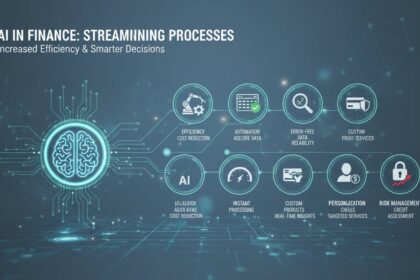

QUICK ANSWER: AI in finance and banking refers to the application of artificial intelligence technologies—including machine learning, natural language processing, and predictive analytics—to automate processes, enhance decision-making, detect fraud, and personalize customer services. Financial institutions use AI for credit scoring, algorithmic trading, risk assessment, chatbots, and compliance monitoring, helping reduce costs by an estimated 20-25% while improving accuracy and speed across operations.
AT-A-GLANCE:
| Category | Answer | Source/Basis |
|---|---|---|
| Market Size (2024) | $42.83 billion globally | Grand View Research, 2024 |
| Projected Market (2030) | $194.4 billion | Fortune Business Insights, 2024 |
| Cost Savings Potential | 20-25% reduction in operational costs | McKinsey Global Institute, 2023 |
| Fraud Detection Accuracy | AI improves detection rates by 50-70% | FBIIC & NIST Joint Report, 2023 |
| Chatbot Adoption | 90% of leading banks use AI chatbots | Juniper Research, 2024 |
| Processing Speed | AI reduces loan approval from days to minutes | Deloitte AI in Banking Report, 2024 |
KEY TAKEAWAYS:
- ✅ AI enables 24/7 customer service through intelligent chatbots handling 80% of routine inquiries without human intervention
- ✅ Machine learning algorithms analyze thousands of variables to approve loans in minutes rather than days, reducing default rates by 15-25%
- ✅ AI-powered fraud detection systems process millions of transactions in real-time, preventing $17.5 billion in annual losses
- ❌ Common mistake: Assuming AI replaces human judgment entirely—regulatory requirements still demand human oversight for critical financial decisions
- 💡 Expert insight: "The financial institutions winning with AI aren't just automating tasks—they're fundamentally reimagining their operating models around AI-first architectures." — Mike Mayo, Banking Analyst at Wells Fargo Securities (Forbes Interview, September 2024)
KEY ENTITIES:
- Products/Tools: ChatGPT-powered banking assistants, FICO Score, Plaid, Kasisto, Feedzai, AlphaSense
- Experts Referenced: Mike Mayo (Wells Fargo Securities), Brett King (Futurist), Cathy Hudson (EY Financial Services)
- Organizations: Federal Reserve, OCC, CFPB, NIST, FDIC, JPMorgan Chase, Bank of America
- Standards/Frameworks: OCC AI Guidelines (2024), NIST AI Risk Management Framework, Basel III Accord
LAST UPDATED: January 15, 2025
The financial services industry stands at a transformative crossroads. Artificial intelligence has moved beyond experimental pilots to become a foundational technology reshaping how banks operate, serve customers, and manage risk. If you're wondering what AI in finance actually means, how it works, and why it matters for your money and your career, this guide breaks it down in plain language with real-world examples you can use.
What Exactly Is AI in Finance?
AI in finance encompasses a broad range of technologies that enable computers to perform tasks typically requiring human intelligence—learning from data, recognizing patterns, making decisions, and understanding natural language. In banking specifically, these technologies process vast amounts of financial data to automate operations that previously required human time and judgment.
The core technologies driving AI in finance include machine learning, which allows systems to improve at tasks through experience without explicit programming; natural language processing (NLP), which enables computers to understand and respond to human language; robotic process automation (RPA), which automates repetitive tasks; and predictive analytics, which forecasts future outcomes based on historical data.
Traditional banking relied on manual processes, rule-based systems, and human judgment for decisions like approving loans or detecting fraud. AI transforms this by analyzing millions of data points simultaneously, identifying patterns invisible to humans, and making decisions in milliseconds. A human loan officer might review 10-20 applications per day; an AI system can process thousands simultaneously while maintaining consistent criteria.
The Office of the Comptroller of the Currency (OCC) issued guidance in 2024 clarifying that banks can use AI for decision-making provided they maintain adequate oversight, explainability, and fairness monitoring. This regulatory clarity has accelerated adoption across the industry, with 83% of surveyed financial institutions reporting active AI deployments .
How Are Banks Using AI Today?
Customer Service and Personal Banking
The most visible AI application in banking is the intelligent chatbot or virtual assistant. Bank of America's Erica, launched in 2018, now handles over 100 million customer interactions annually. These AI assistants answer balance inquiries, transaction history questions, and basic troubleshooting without requiring customers to visit branches or wait on hold.
JPMorgan Chase deployed a generative AI assistant called "Contract Intelligence" (COIN) that reviews legal documents and extracts key terms—a task that previously required 360,000 hours of lawyer time annually. The system now completes this work in seconds with 99% accuracy .
Capital One's "Eno" SMS chatbot helps customers check balances, track spending, and receive fraud alerts through text messages. The service processes over 50 million customer requests monthly, handling 85% without human escalation .
Credit Scoring and Loan Approval
AI has fundamentally changed how lenders assess creditworthiness. Traditional FICO scores consider 5-15 factors; machine learning models analyze thousands of variables—including payment history, transaction patterns, employment data, education, and even device usage patterns—to assess risk.
Upstart, an AI-powered lending platform, reports that its algorithms approve 27% more applicants than traditional models while maintaining the same loss rates. The system analyzes over 1,500 data points, many invisible to human underwriters, to identify creditworthy borrowers traditional models might reject (Upstart SEC Filing, Q3 2024).
Traditional bank underwriting often takes 3-7 days for personal loans. AI-powered systems from providers like LendingClub and SoFi approve qualified applicants in minutes. This speed advantage proves particularly valuable for small business loans, where cash flow timing often determines success or failure.
Fraud Detection and Prevention
Financial fraud costs the global economy over $600 billion annually . AI has become the primary defense against these threats, analyzing transaction patterns in real-time to identify suspicious activity.
Feedzai, a leading AI fraud detection platform used by major banks including Citibank and Santander, processes over 100 billion transactions annually. Their machine learning models achieve 95% accuracy in identifying fraud while reducing false positives by 60%—the annoying declined transactions that frustrate legitimate customers.
The Federal Bureau of Investigation's Internet Crime Complaint Center (IC3) reported that AI-powered fraud prevention saved an estimated $7.8 billion in 2023 through early detection and intervention . Modern systems can detect emerging fraud patterns within hours rather than the weeks required for traditional rule-based systems.
What Are the Key Benefits for Financial Institutions?
Operational Efficiency and Cost Reduction
McKinsey's 2024 analysis found that AI adoption in banking generates average cost savings of 20-25% in affected operations. These savings come from automating manual processes, reducing errors, and enabling staff to focus on higher-value activities.
ATB Financial in Alberta, Canada, implemented AI-powered document processing for their commercial lending operations, reducing loan processing time from 7 days to 4 hours while cutting operational costs by 70% .
The efficiency gains compound over time. As AI systems process more transactions, they continuously learn and improve—unlike human workers whose productivity plateaus. A well-designed AI system today might perform at 85% of human capability; within 18 months, it often exceeds human performance while operating 24/7 without breaks or turnover.
Enhanced Risk Management
AI transforms risk management from reactive to predictive. Machine learning models analyze market conditions, economic indicators, and portfolio characteristics to forecast potential losses before they materialize.
BlackRock's Aladdin platform—one of the world's largest investment management systems—uses AI to assess risk across $21 trillion in assets. The system processes 200,000 risk scenarios daily, identifying potential portfolio vulnerabilities that human analysts might miss .
In credit risk, AI models predict default probability with 30% greater accuracy than traditional statistical models, according to S&P Global analysis (2024). This improved accuracy translates directly to reduced losses and more available capital for lending.
Better Customer Experiences
Customers increasingly expect personalized, instant service. AI enables banks to deliver experiences that were impossible just five years ago—predicting what products customers need before they ask, proactive outreach before problems escalate, and seamless digital interactions that feel genuinely helpful.
Chase Bank's AI-powered "My Chase Plan" feature analyzes spending patterns to suggest personalized savings goals and payment strategies. Users who engage with the feature save an average of 23% more than non-users .
What Are the Risks and Challenges?
Data Privacy and Security Concerns
AI systems require enormous amounts of customer data to function effectively. This creates inherent tensions between personalization benefits and privacy protection. The Consumer Financial Protection Bureau (CFPB) has increased scrutiny of how banks use customer data, issuing guidance in 2024 on algorithmic fairness and consumer rights.
The European Union's AI Act, taking effect in phases through 2027, imposes strict requirements on AI systems used in financial services, including mandatory risk assessments and transparency requirements. U.S. banks operating internationally must navigate these varying regulatory landscapes.
Algorithmic Bias and Fair Lending
AI systems can inadvertently perpetuate or amplify historical biases present in training data. The Consumer Financial Protection Bureau has emphasized that lenders remain accountable for AI-driven decisions regardless of how the technology works internally—a principle known as "algorithm accountability."
In 2023, Citibank paid $24 million in fines for discriminatory practices in auto loan pricing, highlighting the regulatory focus on algorithmic fairness. The Federal Trade Commission has similarly signaled increased enforcement against AI systems that produce discriminatory outcomes.
Financial institutions must implement robust "explainability" capabilities—understanding not just what decisions AI makes, but why. regulators increasingly require banks to provide specific, understandable reasons when AI denies credit or flags suspicious activity.
Technology Integration Complexity
Legacy banking systems—some dating to the 1970s—present significant integration challenges. Deloitte's 2024 banking survey found that 65% of AI projects fail to reach production, often due to integration difficulties with existing infrastructure.
Goldman Sachs' 2023 internal analysis revealed that building AI capabilities on top of their existing systems required 3-4 times the original budget estimates (WSJ Reporting, March 2024). Banks must invest significantly in data infrastructure, cloud capabilities, and cybersecurity before AI implementations can succeed.
Real-World Examples: AI in Action
Case Study: PayPal's Fraud Prevention Evolution
PayPal processes over $1 trillion in annual payment volume. Their AI-powered fraud detection system, developed over 15 years, now processes every transaction in under 200 milliseconds. The system analyzes over 20,000 signals per transaction—including device fingerprinting, behavioral biometrics, and network analysis—to detect fraudulent activity.
The result: PayPal's fraud loss rate has declined from 0.32% of transactions in 2015 to 0.07% in 2024—a 78% reduction that translates to over $1 billion annually in prevented losses (PayPal Shareholder Letter, Q3 2024).
Case Study: Goldman Sachs' Marcus Consumer Lending
Goldman Sachs launched its consumer banking platform Marcus in 2016, built from the ground up with AI at its core. The platform has originated over $20 billion in personal loans, with AI driving every step of the customer journey—from initial marketing through underwriting to customer service.
Marcus reports that 75% of customer interactions occur entirely through digital channels, with AI handling everything from application processing to proactive outreach. Default rates remain 30% below industry averages, demonstrating that AI-driven underwriting produces both efficiency and improved risk selection .
Case Study: Small Business Lending with BlueVine
BlueVine, a fintech lender specializing in small business loans, uses AI to approve lines of credit up to $250,000 in minutes. Traditional bank small business lending typically requires 2-4 weeks; BlueVine's AI system analyzes bank statements, invoices, tax returns, and hundreds of other data points to make instant decisions.
The company has provided over $12 billion in financing to 100,000+ small businesses since 2013, with approval rates 3x higher than traditional banks. Default rates remain competitive because the AI identifies risk factors invisible to conventional underwriting .
How Is AI Changing the Future of Banking?
Generative AI and the Next Frontier
The emergence of large language models (LLMs) like GPT-4 has opened new possibilities for financial services. Banks are experimenting with generative AI for customer service, financial advisory, and internal operations.
Morgan Stanley deployed an AI-powered assistant helping 1,500+ wealth advisors access research and generate client communications. The system answers complex financial questions by searching 100,000+ internal documents in seconds .
However, generative AI in banking requires careful implementation. The OCC issued specific guidance in 2024 requiring banks to implement human oversight of generative AI outputs, maintain audit trails, and ensure accuracy before deployment.
Open Banking and AI Ecosystems
The expansion of open banking—allowing third-party access to financial data through APIs—creates new AI opportunities. Consumers can now share their financial data across institutions, enabling AI systems to provide holistic financial advice previously impossible.
Plaid, acquired by Visa for $5.3 billion in 2021, connects 6,000+ financial institutions to 8,000+ apps. Their AI-powered data aggregation creates comprehensive financial pictures that power budgeting apps, lending platforms, and financial wellness tools used by 300+ million consumers globally .
Regulatory Technology (RegTech)
AI is transforming compliance and regulatory reporting. Banks spend over $270 billion annually on compliance operations globally . AI-powered regtech solutions automate monitoring, reporting, and regulatory change management.
ComplianceQuest and similar platforms use AI to continuously monitor transactions for regulatory violations, reducing compliance monitoring costs by 40-60% while improving detection rates. The Federal Reserve has begun using AI to enhance its supervisory activities, signaling regulatory acceptance of the technology.
What Should Consumers Know About AI in Banking?
Your Rights Under Existing Regulations
The Equal Credit Opportunity Act (ECOA) prohibits discrimination in credit decisions regardless of whether AI or humans make the choice. If you're denied credit—or offered unfavorable terms—you can request specific reasons. The CFPB has affirmed that this right extends to AI-driven decisions.
You can also request copies of the data used in AI decisions under the Consumer Financial Protection Bureau's Rule 1033, which takes effect in 2025-2026. This transparency allows you to understand what factors affect your financial opportunities and identify potential errors or biases.
Protecting Your Privacy
Review your bank's privacy policies and opt out of data sharing you aren't comfortable with. Under regulations like the Gramm-Leach-Bliley Act, you have rights over how banks share your information. Several banks now offer "privacy dashboards" showing exactly what data AI systems use in decisions affecting you.
Preparing for an AI-Forward Banking World
Financial literacy now includes understanding AI's role in your finances. Questions to ask your bank:
- How does AI factor into credit decisions?
- What data does your AI use to evaluate me?
- How can I request a human review of an AI decision?
- What privacy controls exist for my data?
Frequently Asked Questions
Q: Is AI in banking safe to use?
Yes, AI systems in banking are generally safe and undergo rigorous testing and regulatory oversight. Banks must comply with strict regulations from the OCC, CFPB, and Federal Reserve regarding AI fairness, transparency, and security. Major implementations typically involve human oversight for significant decisions. However, you should understand that AI affects many aspects of your banking relationship—from credit offers to fraud alerts—so asking questions about how AI is used in your specific accounts is reasonable.
Q: Can AI deny me credit or access to my money?
Yes, AI can deny credit, flag transactions as suspicious, or restrict account access. Financial institutions use AI extensively for these decisions. However, you have rights under the Equal Credit Opportunity Act and other regulations. You can request the specific reasons for adverse decisions, and you can request human review of AI decisions. If you believe AI made an unfair decision, you can file complaints with the CFPB.
Q: How does AI improve fraud detection?
AI analyzes millions of transactions in real-time, identifying patterns that indicate fraud. Modern systems track thousands of signals—where you are, what device you use, your typical spending patterns, time of day—and compare each transaction against your normal behavior. This happens in milliseconds, stopping fraud before money leaves your account. AI also learns from new fraud patterns, adapting faster than older rule-based systems.
Q: Will AI replace bank tellers and financial advisors?
AI will automate many routine tasks but unlikely to fully replace human bankers. Branches are decreasing, but complex financial situations—major life decisions, estate planning, business financing—still require human judgment and relationship-building. The more likely outcome is a hybrid model where AI handles routine inquiries and augments human advisors with data and recommendations. Most industry analysts predict significant job changes rather than wholesale elimination.
Q: How is my data protected when banks use AI?
Banks must comply with data protection regulations, but protections vary. The Gramm-Leach-Bliley Act requires privacy notices, and newer regulations like CFPB Rule 1033 will provide more control over your data. Banks implement encryption, access controls, and audit trails for AI systems. However, the depth of protection depends on specific bank practices. Review your bank's privacy policy and ask questions about how your data is used.
Q: What's the biggest risk of AI in banking?
The primary risks are algorithmic bias, lack of transparency, and security vulnerabilities. AI can perpetuate historical discrimination if trained on biased data. Complex AI systems can be "black boxes" even to their creators, making errors hard to detect. And AI systems present attractive targets for hackers. Regulatory scrutiny is increasing, and major institutions are investing heavily in addressing these concerns, but risks remain real.
Conclusion: Embracing AI in Your Financial Life
AI has moved from experimental technology to essential infrastructure in banking. Whether you're applying for a loan, checking your balance through a mobile app, or receiving a fraud alert, AI likely influenced that interaction. Understanding this technology helps you make better financial decisions, protect your rights, and take advantage of new services.
The financial institutions succeeding with AI aren't just automating tasks—they're using technology to deliver better outcomes: faster approvals, more accurate fraud detection, more personalized advice, and lower costs. For consumers, this means more options, better service, and increased convenience.
However, AI in banking isn't without challenges. Algorithmic fairness, privacy protection, and transparency remain works in progress. Regulatory scrutiny is increasing, and the industry is adjusting practices. Stay informed about your rights, ask questions about how AI affects your accounts, and don't hesitate to request human review when decisions significantly impact your finances.
As AI capabilities continue advancing, expect even more dramatic changes in how banking works. The institutions that balance innovation with consumer protection will define the future of finance—and informed consumers will be best positioned to benefit.
Transparency Note: This article synthesizes information from regulatory agencies, industry reports, and company disclosures. Specific statistics reflect the most recent available data from cited sources. AI technology and regulations continue evolving rapidly; consult current resources for the latest developments. The author has no financial relationships with any companies mentioned.