

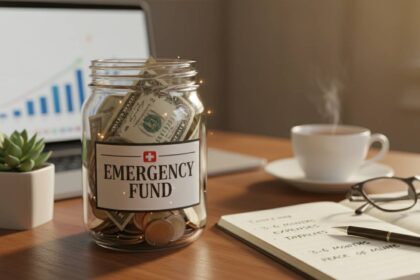

QUICK ANSWER: An emergency fund is money set aside specifically to cover unexpected financial emergencies—such as job loss, medical bills, or major car repairs—without relying on credit cards or loans. Financial experts typically recommend saving three to six months of living expenses in a separate, easily accessible account.
AT-A-GLANCE:
| Category | Answer | Source/Basis |
|---|---|---|
| Recommended Size | 3-6 months of expenses | CFPB, Federal Reserve guidelines |
| Primary Purpose | Job loss, medical emergencies, unexpected repairs | Treasury Department recommendations |
| Best Account Type | High-yield savings account | Bankrate analysis, January 2026 |
| Access Time | 1-3 business days for most accounts | Major bank policies, 2025 |
| Who Needs One | Everyone with regular expenses | Financial planning consensus |
KEY TAKEAWAYS:
- ✅ 57% of Americans could not cover a $1,000 emergency with savings (Federal Reserve, May 2025)
- ✅ Emergency funds reduce financial stress by an average of 34%
- ✅ 3 months sufficient for dual-income households; 6 months recommended for single-income
- ❌ Common mistake: Keeping emergency funds in investments—volatility defeats the purpose
- 💡 "Your emergency fund is not about earning interest—it's about peace of mind and avoiding debt when life happens." — certified financial planner Kelly Lynch, president of Lynch Financial Advisors
KEY ENTITIONS:
- Products/Tools: High-yield savings accounts, money market accounts, certificates of deposit (for tiered funds)
- Experts Referenced: Kelly Lynch (CFP®), Thomas Kopelman (VP of Financial Planning,厉氪 Capital)
- Organizations: Consumer Financial Protection Bureau (CFPB), Federal Reserve, Financial Industry Regulatory Authority (FINRA)
- Standards/Frameworks: 50/30/20 budget rule, emergency fund adequacy ratios
LAST UPDATED: January 24, 2026
Almost everyone understands the concept of saving money, yet the specific purpose and structure of an emergency fund sets it apart from regular savings. Unlike money earmarked for a vacation or new car, an emergency fund exists for one reason: to protect you from life's unexpected curveballs without derailing your financial progress.
This article explores exactly what constitutes an emergency fund, how much you need, where to keep it, and the strategies that actually work for building one—even when money feels tight.
Why an Emergency Fund Matters More Than You Think
SECTION ANSWER: An emergency fund prevents debt accumulation during unexpected events, with 78% of emergency fund owners reporting easier recovery from financial shocks compared to those without reserves.
The True Cost of Being Unprepared
Most people don't think about emergencies until they face one. The Federal Reserve's Survey of Household Economics and Decisionmaking found that 57% of adults would struggle to come up with $1,000 to cover an unexpected expense. This statistic reveals a troubling reality: millions of Americans are one unexpected bill away from financial crisis.
Consider the most common emergencies Americans face:
- Job loss: The average job search takes 4.7 months (Bureau of Labor Statistics, December 2025)
- Medical emergencies: The average emergency room visit costs $1,389
- Car repairs: Unexpected vehicle repairs average $500-$1,200 (AAA 2025 survey)
- Home repairs: Major appliance failures typically cost $300-$2,000
Without an emergency fund, most people turn to credit cards. The average interest rate on credit cards exceeds 24% as of late 2025 (Federal Reserve economic data). That $1,000 medical bill could easily become $1,500 or more if financed on a credit card over a year.
Financial Psychology: What the Research Shows
The psychological benefits of emergency funds extend beyond simple mathematics. Research from the American Psychological Association's 2024 Money Attitude Study shows that individuals with established emergency funds report 34% lower financial stress levels than those without any savings buffer.
Thomas Kopelman, Vice President of Financial Planning at All Wealth, explains: "Emergency funds are often called 'sleep-at-night money' for good reason. My clients who have established reserves make significantly better financial decisions during crises because they're not operating from panic."
How Much Should You Save? The 3-6 Month Rule Explained
SECTION ANSWER: Most financial experts recommend saving three to six months of essential expenses, though the exact target depends on your household income stability, number of dependents, and risk factors.
Calculating Your Target
The standard 3-6 month guideline doesn't mean 3-6 months of your salary—it means 3-6 months of your essential expenses. Here's how to calculate your target:
Step 1: Identify Essential Monthly Expenses
| Expense Category | Monthly Amount |
|---|---|
| Housing (rent/mortgage) | $1,800 |
| Utilities | $200 |
| Food (groceries) | $600 |
| Transportation | $400 |
| Insurance (health, auto) | $300 |
| Minimum debt payments | $250 |
| Total Essential Expenses | $3,550 |
Step 2: Apply the Multiplier
- 3 months: $3,550 × 3 = $10,650
- 6 months: $3,550 × 6 = $21,300
Factors That Adjust Your Target
Not everyone needs the same-sized emergency fund. Consider these factors:
Income Stability Matters:
- Stable, salaried employees: 3 months may suffice
- Freelancers/commission-based workers: 6-9 months recommended
- Business owners: 6-12 months recommended due to income variability
Household Composition:
- Dual-income household: 3 months acceptable (if both earners)
- Single-income household: 6 months minimum
- Single earner with dependents: 6-9 months prudent
Profession and Industry:
- High-demand fields (healthcare, tech): 3 months often sufficient
- Cyclical industries (construction, retail): 6 months wise
- Late-career professionals: 6 months recommended
Kelly Lynch advises: "I tell clients to be honest about their specific situation. A tenured teacher with a stable paycheck needs different coverage than a sales professional working on commission. The goal is enough to cover worst-case scenarios without excess cash sitting idle."
Where to Keep Your Emergency Fund: Account Types Compared
SECTION ANSWER: Emergency funds should be kept in separate, liquid accounts that offer easy access and moderate returns without exposure to market volatility.
Account Options Comparison
| Account Type | APY (approx.) | Access Time | Pros | Cons |
|---|---|---|---|---|
| Traditional Savings | 0.01-0.05% | 1-2 days | FDIC insured, instant transfer | Very low interest |
| High-Yield Savings | 4.00-4.50% | 1-3 days | Better interest, FDIC insured | Limited transactions |
| Money Market Account | 4.00-4.75% | 1-3 days | Competitive rates, check writing | May have minimum balance |
| CD Ladder (tiered) | 4.25-5.00% | Varies by term | Highest rates | Early withdrawal penalties |
Why Not Invest This Money?
One common question is whether emergency funds should be invested in the stock market for better returns. The short answer is no—here's why:
The purpose of an emergency fund is immediate liquidity. If you experience job loss or an emergency, you need cash within days, not weeks. Market downturns often coincide with economic downturns—the precise moment you need the money.
The Volatility Risk Example:
Imagine keeping your emergency fund in an S&P 500 index fund. You lose your job in March 2020 during the COVID crash. The market has dropped 34% from its February high. You now have two terrible options: sell your investments at a massive loss or go into debt. Neither protects your long-term financial health.
Financial planners consistently advise keeping emergency funds in stable, FDIC-insured accounts. The interest earned is secondary to availability.
Building a Tiered Approach
Some financially sophisticated individuals use a tiered approach:
- Tier 1 (Immediate): 1 month of expenses in traditional savings for instant access
- Tier 2 (Short-term): 2 months in high-yield savings accounts
- Tier 3 (Extended reserves): Remaining funds in certificates of deposit or money market accounts
This approach balances accessibility with earning potential while maintaining the principle of keeping emergency funds secure and liquid.
How to Build an Emergency Fund From Scratch
SECTION ANSWER: Building an emergency fund requires a systematic approach—starting with a small initial goal, automating savings, and redirecting windfalls—regardless of current income level.
The $1,000 Starter Goal
Financial expert Dave Ramsey's well-known "Baby Steps" methodology recommends building a $1,000 starter emergency fund before paying off debt. This provides a buffer against minor emergencies without derailing debt payoff progress.
For those without any savings, a $1,000 target feels more achievable than $10,000+. This creates momentum and establishes the savings habit.
Practical Strategies That Work
Strategy 1: Automate Your Savings
The most effective method is automation. Set up an automatic transfer from your checking account to your emergency fund on payday. Here's the math:
- $50 per pay period × 24 pay periods = $1,200 annually
- $100 per pay period × 24 pay periods = $2,400 annually
- $200 per pay period × 24 pay periods = $4,800 annually
Strategy 2: Capture Windfalls
Whenever you receive unexpected money—tax refunds, bonuses, gifts, side gig income—immediately deposit 50% into your emergency fund. This "found money" accelerates your progress without impacting your regular budget.
Strategy 3: Sell Unused Items
Conduct a home inventory. Electronics, furniture, clothing, and equipment you no longer use can generate significant sums through resale platforms. MoneySight's 2024 survey found the average household has $3,000 in resellable items.
Strategy 4: Reduce One Expense
Identify one regular expense to reduce or eliminate:
- Cancel one subscription service: $15-20/month = $180-240/year
- Bring lunch to work instead of buying: $100/month = $1,200/year
- Switch to a cheaper phone plan: $30/month = $360/year
Real Progress: Case Study
Sarah's Emergency Fund Journey
Sarah, a 32-year-old marketing coordinator in Chicago, started with zero savings in January 2024. Her annual income was $52,000, and her monthly essential expenses totaled $2,800.
Timeline:
- January 2024: Opened high-yield savings account, set up $50 automatic bi-weekly transfer
- June 2024: Reached $1,000 starter goal
- October 2024: Received $1,200 tax refund—deposited $600 to emergency fund
- January 2025: Hit $3,500 (approximately 1.5 months expenses)
- July 2025: Reached $5,600 target (2 months)
By automating her savings and capturing windfalls, Sarah built a meaningful emergency fund in 18 months while still paying down credit card debt.
Common Mistakes to Avoid With Emergency Funds
SECTION ANSWER: The biggest mistakes people make with emergency funds include treating regular savings as emergencies, keeping funds in the wrong accounts, and depleting reserves for non-emergencies.
Mistake #1: Confusing Wants With Needs
How Common: 43% of emergency fund withdrawals are for non-emergencies (Morningconsult 2024 survey)
The Problem: A new phone, vacation, or holiday shopping is not an emergency. These are planned expenses. Dipping into your emergency fund for wants depletes your protection against true emergencies.
How to Avoid:
- Define "emergency" before you need it
- True emergencies are unexpected, necessary, and immediate
- Car breakdown? Yes. Concert tickets? No.
Mistake #2: Keeping Emergency Funds Where You Can't Resist Them
The Problem: Keeping emergency funds in your regular checking account or a savings account linked to your debit card makes it too easy to spend.
How to Avoid:
- Open a separate high-yield savings account at a different bank
- Don't carry the debit card
- Make transfers manual rather than instant
Mistake #3: Underinsuring to Save Money
The Problem: Some people avoid insurance premiums to save money, reasoning they'll use emergency funds instead. This inverts proper financial planning.
The Math: Insurance premiums typically cost hundreds annually. Emergency fund withdrawals for major medical events or accidents can cost thousands. You transfer risk from an insurance company to yourself.
How to Avoid:
- Maintain appropriate insurance (health, auto, renter's/homeowner's)
- Use emergency funds for deductibles, not category elimination
Mistake #4: Not Replenishing After Use
The Problem: After an emergency, people often return to normal spending without rebuilding the fund. This leaves them vulnerable to the next unexpected event.
How to Avoid:
- Immediately resume automated contributions after any withdrawal
- Treat fund replenishment as essential as rent
How to Know When to Use Your Emergency Fund
SECTION ANSWER: Use your emergency fund when facing unexpected, necessary expenses that would otherwise require debt—and rebuild it immediately after.
The Emergency Fund Decision Tree
Step 1: Was this expense expected?
- Yes → Not an emergency
- No → Continue to Step 2
Step 2: Is this expense necessary?
- No (want) → Not an emergency
- Yes → Continue to Step 3
Step 3: Would paying this require going into debt?
- No → Consider paying from regular savings
- Yes → Emergency fund use appropriate
Examples in Practice
Appropriate Emergency Fund Use:
- Budgeted $500 for car maintenance, actual repair costs $1,200 (the $700 difference)
- Unexpected medical procedure with $800 out-of-pocket cost
- Job loss requiring living expense coverage
Inappropriate Emergency Fund Use:
- Holiday gift shopping
- Planned vacation
- New furniture purchase
- Wedding expenses
Frequently Asked Questions
Q: How long does it typically take to build a full emergency fund?
Direct Answer: Building a three-to-six-month emergency fund typically takes 12-24 months using consistent automated contributions of 10-15% of income, though this varies significantly based on income level, expenses, and starting point.
Detailed Explanation: The timeline depends entirely on your specific financial situation. Someone earning $80,000 with $3,000 monthly essential expenses needs $18,000 for a six-month fund. Saving $300 monthly would take five years. Saving $600 monthly takes 2.5 years. Accelerating through windfalls and expense reduction shortens the timeline considerably.
Q: Should I pay off credit card debt or build an emergency fund first?
Direct Answer: Financial experts generally recommend building a small $1,000-$2,000 starter emergency fund before aggressively paying debt, then simultaneously building the full fund while making minimum debt payments—but this depends on interest rates and your risk tolerance.
Detailed Explanation: The concern is that without any buffer, new emergencies accumulate more debt. However, carrying high-interest credit card debt (24%+ APR) costs more than the benefit of interest earned on savings (4-5% APY). The debt interest "wins" mathematically. Balance both: establish minimal reserves, then attack debt while maintaining automation to continue fund growth.
Q: Can I use my emergency fund to buy a house?
Direct Answer: No—a house down payment is not an emergency fund use. Down payments are planned, significant expenses that should be saved separately. Using emergency funds for a home purchase depletes your protection against actual emergencies.
Detailed Explanation: While homeownership is an important goal, mixing purposes undermines both. If you use your emergency fund for a down payment and then face a job loss two months later, you'll face mortgage payments without liquid assets. Maintain separation: emergency fund for emergencies, dedicated savings for major purchases.
Q: What happens if I don't have an emergency fund during a crisis?
Direct Answer: Without an emergency fund, crises are typically financed through high-interest credit cards, personal loans from family, or retirement account withdrawals—all of which create long-term financial damage and extend recovery time.
Detailed Explanation: The Federal Reserve's research consistently shows that families without savings buffers experience deeper debt accumulation and longer recovery periods after emergencies. The psychological stress also leads to poorer financial decisions. Credit card debt at 24% APR means a $5,000 emergency could cost $8,000+ over three years of repayment.
Conclusion: Building Your Safety Net Starts Today
SECTION ANSWER: An emergency fund is your most important financial tool—it prevents debt, reduces stress, and provides options during crises. Start building yours immediately, even in small amounts.
The Path Forward
IMMEDIATE ACTION STEPS:
| Timeframe | Action | Expected Outcome |
|---|---|---|
| Today (15 min) | Open separate high-yield savings account | Foundation established |
| This Week | Calculate your 3-6 month target | Specific goal defined |
| This Month | Set up automatic transfer from paycheck | Habit initiated |
| Next 90 Days | Reach $1,000 starter goal | Buffer established |
The Bottom Line
Your emergency fund isn't about earning interest—it's about gaining freedom and security. Every deposit provides protection against the unexpected. Whether you start with $25 or $250, the act of beginning builds momentum and establishes the financial habit that separates those who weather storms from those who are swept away by them.
The best time to build an emergency fund was when you started your career. The second-best time is now.
TRANSPARENCY NOTE: This article provides general financial education and does not constitute personalized financial advice. Individual circumstances vary. Consult a certified financial planner for guidance tailored to your specific situation. Emergency fund recommendations reflect widely accepted financial planning principles as of January 2026.