

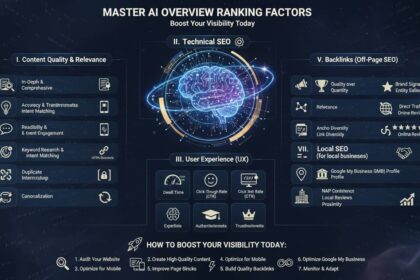

Google's AI Overviews have fundamentally transformed how users consume information in search results. Since rolling out to all US users in 2024, these AI-generated summaries now appear for a wide range of queries, dramatically shifting organic traffic patterns and forcing SEO professionals to rethink their optimization strategies. Understanding the specific ranking factors that determine which content gets featured in AI Overviews has become essential for anyone seeking visibility in modern search.
The emergence of AI Overviews represents Google's largest search interface change in years. Unlike traditional blue-link rankings, AI Overviews synthesize information from multiple sources, presenting answers directly at the top of search results. This means your content must not only rank well in traditional SERPs but also satisfy the complex criteria that Google's AI evaluates when selecting sources for these prominent placements.
Key Insights
- AI Overviews appear for approximately 15-20% of queries across industries
- Content with strong E-E-A-T signals shows higher inclusion rates
- Topically comprehensive pages outperform narrow, single-topic content
- Structured data significantly improves chances of AI Overview selection
- User engagement signals influence source selection
This guide examines the documented and observed ranking factors that determine which webpages Google selects for AI Overview inclusion, offering actionable strategies to optimize your content for this new search paradigm.
Understanding AI Overview Technology
AI Overviews represent Google's application of large language models to search result generation. When Google determines a query could benefit from an AI-generated response, the system scans numerous web sources to compile a concise summary that addresses the user's question directly. This technology draws from Google's Gemini AI model, which processes both the query intent and potential source content to generate coherent, cited responses.
The fundamental difference between traditional ranking systems and AI Overview selection lies in how content gets evaluated. Traditional SEO focuses heavily on keyword matching and backlink profiles. AI Overview selection, by contrast, emphasizes semantic understanding, contextual relevance, and the ability of content to provide authoritative answers to complex questions. Google needs sources that not only contain relevant information but present it in ways that its AI can confidently synthesize and attribute.
What makes AI Overviews particularly significant for SEO professionals is their placement. These summaries appear above traditional organic results, meaning users may never scroll past them to reach individual website listings. Understanding the ranking factors behind AI Overview selection has therefore moved from an advanced tactic to an essential competency for digital visibility.
The Role of E-E-A-T in AI Overview Rankings
Experience, Expertise, Authoritativeness, and Trustworthiness—collectively known as E-E-A-T—have always been central to Google's quality assessment, but their importance has amplified considerably with AI Overviews. Google's AI explicitly prioritizes sources demonstrating high E-E-A-T signals when generating responses, as the company faces significant reputational risk if its AI provides inaccurate or harmful information.
Experience signals prove particularly crucial for AI Overview inclusion. Content created by individuals with direct, first-hand experience with the subject matter receives preferential treatment. Google has explicitly stated that content reflecting real-world experience carries more weight in quality assessments. This manifests in AI Overviews through preferential selection of sources where authors demonstrate practical knowledge rather than mere theoretical understanding.
Expertise evaluation extends beyond formal credentials. While professional expertise matters for YMYL (Your Money Your Life) topics, Google also values demonstrated expertise through content depth, accuracy, and the ability to explain complex topics clearly. For AI Overview purposes, content that shows genuine mastery of a subject—through comprehensive coverage, nuanced discussion, and accurate terminology—gets selected more frequently.
Authoritativeness encompasses both site-level authority and page-level credibility. Established websites with strong reputations, robust backlink profiles, and consistent publishing histories tend to see higher AI Overview inclusion rates. However, newer sources can overcome this through demonstrable expertise and specialized niche authority. The key is establishing yourself as a go-to resource within your specific domain.
Trustworthiness serves as the foundation of E-E-A-T. This includes accurate information, transparent sourcing, clear author attribution, secure website protocols, and factual correctness. AI Overviews specifically favor sources that clearly attribute claims, cite credible references, and maintain transparency about limitations or uncertainties.
Content Quality and Comprehensiveness Factors
The depth and breadth of your content significantly influence AI Overview selection. Google's AI seeks sources that can provide complete answers rather than fragmented information requiring users to visit multiple pages. This preference has led to the emergence of "hub" content strategies—comprehensive resources that thoroughly address broad topics rather than thin pages targeting narrow keywords.
Content that demonstrates topical authority receives substantial preference in AI Overview selection. When Google evaluates potential sources, it assesses whether a page represents the most comprehensive treatment of its subject available. Comprehensive content that covers related concepts, anticipates follow-up questions, and provides genuine value beyond basic information performs markedly better than superficial treatments.
The structure of your content matters as much as its substance. AI systems more easily parse and extract information from well-organized content with clear hierarchical headings, logical flow, and explicit answers to likely follow-up questions. Content that bury key information beneath excessive narrative or fail to directly address common questions gets passed over in favor of more accessible alternatives.
Semantic richness describes content that uses varied terminology, related concepts, and natural language that mirrors how users actually ask questions. Rather than keyword stuffing, semantic optimization involves naturally incorporating synonyms, related terms, and question-based phrasing that helps AI systems understand your content's full relevance to user queries.
| Content Factor | Impact on AI Overview Selection |
|---|---|
| Comprehensive topic coverage | High positive impact |
| Clear, direct answers | Critical importance |
| Updated information | Significant preference |
| Original analysis/insights | Moderate positive impact |
| Multiple perspectives | Helps for controversial topics |
Technical Optimization for AI Overview Visibility
Technical SEO remains relevant for AI Overview optimization, though its role has evolved. Google's AI must be able to effectively crawl, parse, and understand your content—requirements that depend on solid technical foundations.
Structured data markup provides explicit signals to Google's AI about your content's structure and meaning. Implementing Schema.org vocabulary helps AI systems understand entity relationships, content types, and factual assertions within your pages. Particularly valuable schemas include FAQ schemas, HowTo schemas, Article schemas, and Organization schemas that establish authorship and expertise claims.
Page speed and mobile optimization continue influencing overall search visibility, though their direct impact on AI Overview selection is less definitively documented. Ensuring fast load times and excellent mobile experiences remains important for maintaining traditional rankings that AI Overviews sit above, creating indirect benefits for AI Overview visibility through overall search performance.
Core Web Vitals signals, while primarily affecting traditional rankings, may indirectly influence AI Overview selection by affecting how Googlebot crawls and processes your content. Pages that render slowly or present challenges for crawling may be deprioritized when Google's AI seeks sources to cite.
Indexability requirements for AI Overview inclusion are straightforward: your content must be crawlable and indexable. Ensure your robots.txt settings allow Googlebot access, implement proper canonical tags to consolidate authority, and avoid blocking resources necessary for content rendering. JavaScript-heavy content may present challenges if not properly implemented.
Query Type and Intent Matching
Not all queries trigger AI Overviews, and understanding which query types activate this feature helps prioritize optimization efforts. Google tends to deploy AI Overviews for informational queries, complex questions, and topics where synthesizing multiple sources provides clear user value.
How-to queries represent one of the most reliable AI Overview triggers. When users search for instructions or procedures, Google frequently generates AI summaries outlining key steps before linking to detailed sources. Optimizing for these queries requires clear, step-by-step content that directly addresses the procedural question.
Comparison queries frequently trigger AI Overviews as users seek to understand differences between options, products, or approaches. Content that explicitly addresses comparisons—providing pros and cons, side-by-side analysis, or clear differentiation between options—aligns well with AI Overview generation patterns.
Definition and explanation queries often activate AI Overviews, particularly for complex topics where users need background before making decisions. Content that clearly explains concepts, provides context, and establishes foundational knowledge performs well for these triggers.
News and current event queries increasingly trigger AI Overviews that synthesize multiple sources covering developing stories. Timely, accurate reporting with clear attribution stands the best chance of inclusion for these time-sensitive queries.
The alignment between your content's intent and the query types you target significantly influences AI Overview visibility. Conduct thorough keyword research to identify query patterns in your niche that consistently trigger AI Overviews, then develop content specifically addressing those information needs.
User Engagement and Behavioral Signals
While Google has not explicitly confirmed user engagement signals as direct AI Overview ranking factors, observable patterns suggest behavioral metrics influence which sources get selected and featured. The logic is straightforward: if users consistently engage with (or ignore) particular sources in AI Overviews, this feedback likely influences future selection decisions.
Click-through behavior from AI Overview links provides Google with immediate feedback about source quality. Links that receive higher click-through rates may be prioritized in future AI Overviews, while links users ignore could be deprioritized. This creates an incentive to craft compelling