

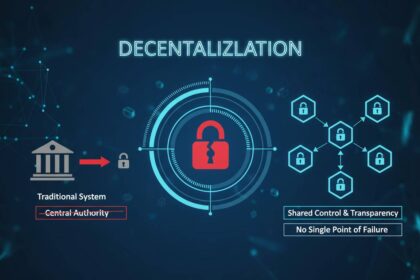

Blockchain is a way to record information across many computers at once. Once something is recorded, it's extremely difficult to change later. This makes it useful for any situation where people need to trust a shared record without relying on a single authority.
The technology first became famous as the system behind Bitcoin in 2009, but since then it's found uses in everything from tracking shipping containers to managing medical records.
Understanding Blockchain Fundamentals
A blockchain is a digital ledger that's duplicated across thousands of computers worldwide. When someone makes a transaction—sending cryptocurrency, recording a contract, tracking a product—the network verifies it and adds it to a "block" of recent transactions. Each block contains the data, a unique code called a hash, and the hash of the previous block. This creates a chain: tamper with one block, and you break the chain.
Because the ledger exists on so many computers simultaneously, there's no single point of failure. No bank or company controls it. If someone tries to change a past record, they'd need to control more than half of all the computers in the network and change every block that came after—a practically impossible task for any major blockchain.
How Blockchain Networks Work
When you initiate a transaction, it broadcasts to all computers (called nodes) on the network. These nodes check that the transaction is valid—typically by running mathematical puzzles or proving you have the funds you claim to have. Once enough nodes agree, the transaction gets added to a new block.
Different blockchains handle this differently. Bitcoin uses "proof of work," where miners compete to solve complex puzzles. This process uses a lot of energy. Ethereum switched to "proof of stake" in 2022, where validators put up their own cryptocurrency as collateral instead of computing power. This uses roughly 99% less energy.
Smart contracts are programs that run on the blockchain automatically. If certain conditions are met—someone sends money, a shipment arrives, a deadline passes—the contract executes without anyone needing to manually process it. This is what enables things like decentralized finance: financial services that work without traditional banks.
Users identify themselves through cryptography. Each person has a public address others can see and a private key that acts like a password. Lose your private key, and you lose access forever. There's no "forgot password" button because no central authority can reset it.
Types of Blockchains
Public blockchains like Bitcoin and Ethereum let anyone participate. You can run a node, validate transactions, or build applications. These are the most secure and decentralized, but they're also slower because so many computers need to agree on every transaction.
Private or permissioned blockchains restrict who can participate. Companies often use these for internal operations—tracking inventory, settling trades between banks, managing supply chains. They're faster and more private, but you're trusting a smaller group of validators.
Layer 2 solutions are add-ons that handle transactions separately from the main blockchain, then bundle them together to settle later. This lets networks process far more transactions while keeping the security of the underlying blockchain.
Real-World Applications
Beyond cryptocurrency, blockchain helps track products through supply chains. Walmart uses it to trace food—finding the source of contamination takes seconds instead of days. Luxury brands use it to verify authenticity. Diamond companies track stones from mine to jewelry store.
Healthcare is another major area. Patient records on blockchain can move between hospitals with the patient's permission, cutting down on paperwork and duplicated tests. Patients control who sees their data rather than handing over control to a single hospital system.
Cross-border payments are faster through blockchain. Traditional international transfers can take days and cost $25 or more in fees. Crypto-based remittance services complete transfers in minutes for a few dollars in fees.
Voting systems, real estate deals, identity verification, and energy trading are all being tested on blockchain. NFTs (non-fungible tokens) proved you can use blockchain to prove ownership of digital items, whether that's art, music, or game items.
Where Things Are Going
Scalability remains the biggest technical challenge. Right now, most blockchains handle far fewer transactions per second than Visa or Mastercard. Various solutions—better consensus mechanisms, layer 2 networks, splitting the blockchain into partitions called shards—are making progress.
Getting different blockchains to talk to each other is another priority. Right now, moving from Ethereum to Bitcoin or Solana requires conversion steps. Cross-chain bridges aim to make this seamless.
Regulators are paying attention. The EU has rules for crypto. The US is still figuring things out. Clearer laws could help institutions adopt blockchain more confidently.
Blockchain is also starting to mix with other technologies—AI, Internet of Things devices, decentralized finance protocols. Some see a future where your digital identity, assets, and agreements all run on distributed systems rather than companies' servers.
Common Questions
What's blockchain in simple terms?
A shared digital recordbook that thousands of computers keep copies of. Once you write something in it, changing it later is extremely difficult. No bank or company runs it—everyone shares the responsibility.
How is blockchain different from a normal database?
Regular databases are controlled by one organization that can change or delete entries. Blockchain spreads copies across thousands of computers, making it nearly impossible to alter records without everyone knowing.
Do I need technical skills to use blockchain?
Most crypto apps are easy enough to use without understanding the technical side. But it's worth learning basics like how private keys work—lose those, and you're locked out for good.
Is blockchain only for cryptocurrency?
No. Healthcare, supply chains, finance, real estate, and more all use blockchain for tracking, verification, and record-keeping.
Are blockchain transactions private?
Public blockchains show every transaction to anyone who looks, but addresses aren't linked to real names—they're just strings of characters. Private blockchains can hide transaction details from outsiders.
Is blockchain secure?
The design is inherently secure—changing past records is computationally infeasible on major networks. But individual users still need to protect their private keys and use reputable services.
Conclusion
Blockchain solves a real problem: how do you create trust between strangers without a middleman? By distributing a record across thousands of computers, making it nearly impossible to alter, and letting anyone verify it independently.
It's not perfect. Energy use, transaction speed, and regulatory uncertainty are real issues. But for use cases where decentralization matters—financial services without banks, supply chains without opacity, ownership without a single company controlling it—blockchain offers something genuinely new.
Whether you're buying crypto, tracking a package, or just curious about where technology is heading, understanding blockchain helps you make sense of a significant shift in how digital systems work.