

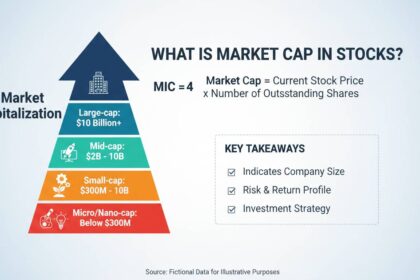

Market capitalization, commonly referred to as market cap, represents the total market value of a company's outstanding shares of stock. It serves as one of the most fundamental metrics investors use to gauge a company's size, worth, and relative position within the financial markets. When you see that Apple has a market cap of approximately $3 trillion or that a small startup trades at $500 million, these figures tell you exactly how much the market collectively values that company at any given moment.
Understanding market cap is essential for making informed investment decisions, building diversified portfolios, and comparing companies across industries. This metric appears in every financial publication, trading platform, and investment analysis, yet many new investors struggle to grasp what it truly represents and how to use it effectively.
How Market Cap Is Calculated
The calculation of market capitalization is straightforward: you multiply the current share price by the total number of outstanding shares. This formula can be expressed as:
Market Cap = Share Price × Outstanding Shares
For example, if a company has 1 billion shares outstanding and its stock trades at $50 per share, the market capitalization equals $50 billion. This figure represents what investors collectively believe the company is worth—the price they are willing to pay for ownership stakes in the business.
Several important factors influence this calculation. Outstanding shares include both restricted shares held by insiders and institutionally owned shares, but they exclude treasury shares that the company has repurchased. Companies can also issue new shares or conduct buybacks, which changes the outstanding share count and subsequently affects market cap. Stock splits and reverse splits automatically adjust the share price and number of shares proportionally, leaving market cap unchanged despite the shift in individual share price.
It's crucial to understand that market cap reflects market sentiment and share price valuation, not the company's actual assets, revenue, or book value. A company with modest physical assets can command an enormous market cap if investors believe strongly in its future growth potential.
Market Cap Categories: Understanding Company Classifications
Financial markets categorize companies into distinct buckets based on their market capitalization, and each category carries different characteristics, risks, and investment considerations.
Large-Cap Companies
Large-cap corporations typically have market capitalizations exceeding $10 billion, with mega-cap companies valued at over $200 billion. These established enterprises generally offer more stability, consistent dividends, and lower volatility compared to smaller counterparts. Major large-cap companies include Apple, Microsoft, Amazon, and Berkshire Hathaway—household names that dominate their respective industries. Large-cap stocks tend to weather economic downturns more effectively because they have diversified revenue streams, strong balance sheets, and established market positions.
Mid-Cap Companies
Mid-cap companies usually fall within the $2 billion to $10 billion range. These firms often represent businesses experiencing growth phases, having moved beyond startup volatility but still possessing significant expansion potential. Mid-cap stocks frequently offer a balance between the growth opportunities found in small-caps and the stability of large-caps. They may have stronger growth trajectories than established companies but also face higher risks as they compete against larger competitors.
Small-Cap Companies
Small-cap companies typically have market capitalizations between $300 million and $2 billion. This category includes many emerging companies, niche players, and businesses in growth industries. While small-caps offer substantial growth potential—some will grow into tomorrow's mid-cap and large-cap success stories—they also carry elevated risks, including less liquidity, narrower business diversification, and greater vulnerability to economic downturns.
Micro-Cap and Nano-Cap
Companies valued below $300 million fall into micro-cap or nano-cap categories. These smallest publicly traded companies often trade with lower liquidity and higher volatility. Many represent early-stage businesses or companies facing significant challenges. Investment in this category requires thorough research and tolerance for elevated risk.
Why Market Cap Matters for Investors
Market cap serves as a critical sorting mechanism for investors constructing portfolios and evaluating opportunities. The metric provides immediate context about a company's scale relative to competitors and the broader market.
Portfolio Construction and Diversification
Understanding market cap helps investors build diversified portfolios that balance risk across different company sizes. A common strategy involves allocating investments across large-cap, mid-cap, and small-cap categories to capture different market dynamics. Large-caps often serve as portfolio anchors, providing stability during market stress, while smaller companies contribute growth potential.
Research has demonstrated that small-cap stocks have historically generated higher average returns than large-caps over very long periods, though with considerably more volatility. This risk-return tradeoff means market cap classification directly influences portfolio risk profile.
Comparative Analysis
When evaluating whether a stock is expensive or cheap, investors frequently use valuation ratios that incorporate market cap. The price-to-earnings (P/E) ratio divides market cap by earnings, while price-to-sales (P/S) ratio compares market cap to revenue. These metrics allow investors to compare companies of different sizes within the same industry—determining whether a company trades at a premium or discount relative to its peers.
Index Fund Understanding
Most market indices weight companies by market cap. The S&P 500, for instance, is a market-cap-weighted index, meaning the largest companies have the greatest influence on index performance. Understanding market cap helps investors comprehend how index funds function and why the performance of mega-cap technology companies heavily influences broad market returns.
Market Cap Versus Stock Price: A Critical Distinction
A common misconception equates high stock price with a large, valuable company and low stock price with a smaller, less valuable one. This assumption frequently leads to incorrect investment conclusions.
Stock price alone tells you almost nothing about company value. A company with 10 billion shares trading at $1 has a $10 billion market cap, while a company with 10 million shares trading at $100 has a $1 billion market cap—dramatically different valuations despite similar share prices.
Companies control their share prices through corporate actions like stock splits, reverse splits, and share buybacks. A $1,000 stock price might indicate a large, established company that hasn't split its shares, or it might simply reflect a company with fewer outstanding shares. Market cap, not share price, provides the accurate measure of total company value.
This distinction becomes particularly important when comparing stocks across different countries, where share prices may appear dramatically different due to different corporate structures and share counts.
Real-World Examples Across Market Cap Categories
Large-Cap Example: Microsoft
Microsoft Corporation trades as a large-cap stock with a market capitalization exceeding $2.5 trillion. This valuation reflects investor confidence in the company's diverse revenue streams spanning cloud computing (Azure), productivity software (Office 365), gaming (Xbox), and enterprise solutions. The company's consistent profitability, strong cash flow, and dominant market position justify its premium valuation. For investors seeking stability and dividend income, large-cap tech leaders like Microsoft often serve as core portfolio holdings.
Mid-Cap Example: Etsy
Etsy, the online marketplace for handmade and vintage goods, operates as a mid-cap company with a market capitalization typically ranging between $5 billion and $10 billion. The company occupies a unique niche between massive e-commerce platforms and small specialty retailers. Etsy offers growth potential as it expands its seller ecosystem and fulfillment capabilities, while carrying more risk than established e-commerce giants due to its smaller scale and narrower focus.
Small-Cap Example: Yeti Holdings
YETI, the outdoor product company known for coolers and drinkware, represents a small-cap stock typically valued between $2 billion and $5 billion. The company has demonstrated strong brand loyalty and product innovation but faces competition from larger consumer goods companies with greater resources. Small-cap investors who research YETI's market position, growth strategies, and competitive landscape may find attractive opportunities if they believe the company can continue gaining market share.
Limitations and Caveats of Market Cap
While market cap serves as an invaluable metric, investors must recognize its limitations to avoid misinterpreting company values.
Market Sentiment Versus Fundamental Value
Market cap reflects what investors are willing to pay, not necessarily what a company is objectively worth. During speculative bubbles, market caps can soar far beyond reasonable valuations based on fundamentals. Conversely, during market crashes, quality companies may trade at significant discounts to their intrinsic value. Market cap captures market sentiment but doesn't measure assets, earnings potential, or cash flows.
Illiquidity Concerns
For smaller companies, market cap may not represent a realistic liquidation value. If an investor attempted to sell their entire position in a small-cap stock, the act of selling would likely drive down the share price substantially. The market cap represents the value of small transactions at the current price, not large block trades.
Corporate Actions and Distortions
Companies can manipulate their market cap through share buybacks, which reduce outstanding shares while potentially supporting stock price. Conversely, issuing new shares dilutes existing shareholders but may fund growth initiatives. Market cap doesn't distinguish between value creation through business performance and value changes from financial engineering.
International Considerations
Comparing market caps across countries requires accounting for currency fluctuations and different accounting standards. A Japanese company with ¥10 trillion market cap doesn't directly compare to a $10 billion U.S. company without considering exchange rates and economic conditions.
How to Use Market Cap in Your Investment Strategy
Incorporating market cap analysis into your investment process involves several practical applications that improve decision-making.
First, use market cap to establish universe boundaries. Determine which company sizes align with your risk tolerance and investment objectives. Conservative investors may focus primarily on large-cap stocks, while growth-oriented investors might allocate significantly to mid-cap and small-cap opportunities.
Second, apply market cap context when evaluating valuation metrics. A P/E ratio of 25 might appear expensive for a large-cap utility company but quite reasonable for a high-growth small-cap tech firm. Context matters, and market cap provides that context.
Third, consider market cap weightings when building index-based portfolios. Understanding that the largest 10 companies represent a significant portion of major indices helps investors comprehend concentration risk and sector biases in their investments.
Fourth, monitor changes in market cap over time. Companies graduating from small-cap to mid-cap status often represent successful growth stories. Tracking these transitions can identify investment opportunities as companies mature and expand.
The Dynamic Nature of Market Capitalization
Market cap is not a static figure—it changes continuously as stock prices fluctuate and companies issue or repurchase shares. A company's market cap can change dramatically within hours during earnings announcements, product launches, regulatory decisions, or broader market movements.
This dynamic quality means market cap serves as a snapshot of current market valuation rather than a permanent characteristic. A company that ranks as a mid-cap today might grow into a large-cap company over several years, or decline in value due to competitive pressures or operational challenges. The classification system exists to provide useful frameworks, not rigid definitions.
Understanding this fluidity helps investors recognize that market cap categories represent useful analytical buckets rather than permanent company classifications. The most successful investors watch not just current market cap, but the trajectory of a company's value creation over time.
Frequently Asked Questions
Does market cap represent the actual worth of a company?
Market cap represents what investors collectively believe a company is worth based on current stock prices, not its actual liquidation value or book value. It reflects market sentiment and expectations for future performance rather than tangible assets or current cash flows. A company could have significant intellectual property and growth potential that isn't captured on its balance sheet, or it could be overvalued relative to its fundamentals during speculative periods.
Can market cap be manipulated by companies?
Companies can influence their market cap through share buybacks (reducing outstanding shares), issuing new shares (potentially diluting value), or stock splits (which don't change market cap but do adjust share price). However, the primary driver of market cap remains investor perception and willingness to pay for shares. Companies cannot artificially inflate market cap indefinitely without underlying business performance supporting the valuation.
Is a higher market cap always better?
Not necessarily. While a higher market cap often indicates a more established, stable company, it also typically means slower growth potential. Large-cap companies have usually captured their primary market opportunities, while small-cap companies may have substantial growth runway. The "better" choice depends on your investment goals, risk tolerance, and time horizon.
How often does market cap change?
Market cap changes continuously during trading hours as stock prices fluctuate. The closing market cap is calculated based on the end-of-day stock price, but intraday changes can be substantial, especially during major news events or market volatility. Companies also periodically update their outstanding share counts through SEC filings, which can cause market cap adjustments.
Should I only invest in large-cap stocks?
Not necessarily. Large-cap stocks offer stability and lower volatility, making them suitable for conservative investors or those near retirement. However, small-cap and mid-cap stocks historically offer higher long-term growth potential, though with greater risk. Many financial advisors recommend diversifying across market cap categories to balance growth potential with portfolio stability.
How do I find a company's market cap?
Every major financial website displays market cap prominently in stock quotes. Sites like Yahoo Finance, Google Finance, Bloomberg, and your brokerage platform all show market capitalization for any publicly traded company. You can also calculate it yourself by multiplying the current stock price by the total outstanding shares, though this figure is readily available in seconds through any financial data source.