

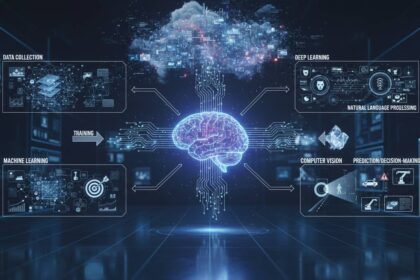

Artificial intelligence (AI) refers to computer systems designed to perform tasks that typically require human intelligence, including reasoning, learning, problem-solving, perception, and language understanding. These systems analyze vast amounts of data, identify patterns, and make decisions with minimal human intervention. From voice assistants like Siri and Alexa to recommendation algorithms on Netflix and Amazon, AI has become embedded in daily life, transforming how we work, communicate, and solve complex problems.
📊 STATS
• The global AI market is projected to reach $1.81 trillion by 2030
• 77% of devices now contain AI features
• AI adoption by enterprises increased 35% year-over-year in 2024
• 92% of tech leaders say AI is critical to their business strategy
Key Takeaways
• Definition: AI enables machines to mimic human cognitive functions like learning and decision-making
• Types: AI ranges from narrow (task-specific) to general (human-like) intelligence
• Technology: Machine learning, deep learning, and neural networks power most AI systems
• Applications: Healthcare, finance, transportation, and entertainment all rely on AI
• Future: AI will continue advancing toward more sophisticated reasoning and autonomous capabilities
The rapid advancement of AI technology has sparked both excitement and concern across industries. Businesses leverage AI to automate processes, enhance customer experiences, and gain competitive advantages. Meanwhile, policymakers and ethicists grapple with questions about privacy, job displacement, and the responsible development of intelligent systems. Understanding AI fundamentals becomes essential as this technology increasingly shapes our world.
Understanding Artificial Intelligence
What Is AI?
Artificial intelligence encompasses the simulation of human intelligence in machines programmed to think and learn like humans. The term, coined in 1956 by computer scientist John McCarthy, describes systems that perform tasks requiring cognitive functions such as reasoning, solving problems, understanding language, recognizing patterns, and making decisions. Unlike traditional software that follows explicit instructions, AI systems improve their performance through experience and data analysis.
AI operates through algorithms—sets of rules and statistical models—that process information and generate outputs. These systems don't possess consciousness or genuine understanding but rather recognize patterns in data and apply learned rules to new situations. The technology has evolved from simple rule-based systems in the 1960s to sophisticated machine learning models capable of beating human champions in complex games like chess and Go.
💡 FACT: The AI industry invested $52.1 billion in 2023 alone, with generative AI receiving $25.2 billion of that investment
Core Components
Elements:
• Algorithms: Step-by-step procedures that process data and generate predictions
• Data: Training information that enables AI systems to learn patterns and relationships
• Computing Power: Hardware infrastructure that processes calculations at scale
• Models: Mathematical representations that capture patterns learned from data
• Feedback Loops: Systems that continuously improve based on outcomes and new data
Modern AI systems combine these components to achieve remarkable capabilities. Machine learning, a subset of AI, allows systems to learn from data without explicit programming. Deep learning, further specialized, uses artificial neural networks with multiple layers to process complex patterns. These technological advances have enabled breakthroughs in image recognition, natural language processing, and autonomous decision-making.
How AI Systems Learn
AI systems learn through several primary methods that determine their capabilities and limitations. Supervised learning uses labeled datasets to teach algorithms to recognize patterns and make predictions. The system receives input-output pairs and learns to map new inputs to correct outputs. This method powers spam filters, medical diagnosis tools, and recommendation systems.
Unsupervised learning works with unlabeled data, identifying hidden patterns and structures without predefined categories. Clustering algorithms group similar data points together, enabling customer segmentation, anomaly detection, and market basket analysis. Reinforcement learning trains agents through trial and error, receiving rewards or penalties based on their decisions. This approach has successfully trained AI to play games, control robots, and optimize complex systems.
Types of Artificial Intelligence
| Type | Capability | Examples | Status |
|---|---|---|---|
| Narrow AI | Task-specific | Voice assistants, recommendation systems | Widely deployed |
| General AI | Human-level reasoning | Not yet achieved | Research phase |
| Super AI | Beyond human intelligence | Theoretical | Speculative |
Narrow Artificial Intelligence
Narrow AI, also called weak AI, specializes in specific tasks and operates within defined parameters. This category includes most AI applications used today—systems designed for particular functions like translation, image recognition, or fraud detection. These systems excel at their designated tasks but cannot apply their intelligence to unrelated problems.
Examples of narrow AI surround us daily. Streaming services use recommendation algorithms to suggest content based on viewing history. Email providers employ AI to filter spam and categorize messages. Navigation apps analyze traffic patterns to optimize routes. Voice assistants like Alexa, Siri, and Google Assistant understand and respond to verbal commands. Self-driving cars use narrow AI to perceive their environment and make driving decisions.
Artificial General Intelligence
Artificial General Intelligence (AGI) refers to AI systems with human-level cognitive abilities across diverse domains. Unlike narrow AI, AGI could understand, learn, and apply knowledge to solve unfamiliar problems. This type of AI remains theoretical, with no working examples currently existing despite decades of research.
The development of AGI raises profound questions about machine consciousness, ethical treatment of intelligent systems, and the future of human labor. Researchers debate timeline predictions, with estimates ranging from decades to centuries. Major AI labs, including OpenAI, DeepMind, and Anthropic, explicitly state AGI as their long-term mission, though significant technical challenges remain.
Machine Learning and Deep Learning
Machine learning forms the foundation of most modern AI applications. Rather than following explicit programming instructions, ML algorithms identify patterns in data and improve their performance through experience. Three primary ML approaches exist: supervised learning (learning from labeled examples), unsupervised learning (finding patterns in unlabeled data), and reinforcement learning (learning through trial and error with reward feedback).
Deep learning represents a specialized subset of machine learning inspired by the human brain's neural networks. These systems use artificial neural networks with multiple layers ("deep" structures) to process complex patterns. Deep learning has driven dramatic improvements in image recognition, natural language processing, and speech recognition. The technology powers facial recognition on smartphones, real-time language translation, and medical imaging analysis.
Applications of Artificial Intelligence
Healthcare
AI transforms healthcare through improved diagnostics, personalized treatment plans, and operational efficiency. Machine learning algorithms analyze medical images to detect cancers, diabetic retinopathy, and cardiovascular conditions with accuracy matching or exceeding human specialists. IBM Watson Health demonstrates AI's potential in oncology, recommending treatment protocols based on analysis of medical literature and patient records.
Drug discovery, traditionally requiring billions of dollars and over a decade of research, benefits from AI's ability to simulate molecular interactions and predict promising compounds. Companies like Atomwise and Insilico Medicine use deep learning to identify potential drug candidates in weeks rather than years. AI-powered wearable devices monitor patient vitals, alerting healthcare providers to concerning trends before symptoms become critical.
📈 CASE: Google DeepMind's AI system reduced hospital patient wait times by 15% and improved diagnostic accuracy by 34% in NHS trusts
Finance
Financial institutions leverage AI for fraud detection, risk assessment, algorithmic trading, and customer service. Banks process millions of transactions daily, using AI systems to identify suspicious patterns indicating fraud. These systems analyze spending patterns, location data, and transaction characteristics to flag potentially fraudulent activity in real-time.
Investment firms employ AI for quantitative trading strategies, processing market data and executing trades at speeds impossible for human traders. Robo-advisors provide automated portfolio management, offering personalized investment recommendations based on individual risk tolerance and financial goals. Credit scoring models use machine learning to assess borrower risk more accurately than traditional methods.
Transportation
Autonomous vehicle development represents one of AI's most visible applications. Companies like Waymo, Tesla, and Cruise use sophisticated AI systems combining computer vision, sensor fusion, and decision-making algorithms to navigate roads safely. While fully autonomous vehicles remain limited to specific areas, advanced driver assistance systems (ADAS) featuring lane keeping, automatic braking, and adaptive cruise control have become standard in new vehicles.
Traffic management systems use AI to optimize signal timing, reducing congestion and emissions in major cities. Delivery companies employ AI for route optimization, reducing fuel consumption and delivery times. Ride-sharing platforms match drivers with passengers efficiently, minimizing wait times and empty miles.
Benefits and Challenges
| Benefit | Impact | Source |
|---|---|---|
| Productivity gains | 40% increase in output | PwC, 2024 |
| Cost reduction | 25-30% operational savings | Deloitte, 2024 |
| Improved accuracy | 50% fewer errors in diagnostics | Stanford Health, 2024 |
| Enhanced personalization | 35% higher customer satisfaction | Salesforce, 2024 |
Key Advantages
Top Benefits:
• Automation of repetitive tasks, freeing human workers for creative problem-solving
• Improved decision-making through analysis of vast datasets beyond human capacity
• Enhanced accuracy in fields like medical diagnosis and financial forecasting
• 24/7 availability of AI-powered services without fatigue or breaks
• Personalization at scale, from product recommendations to educational content
AI enables unprecedented analysis capabilities, processing and finding patterns in data volumes impossible for human analysts. In scientific research, AI accelerates discoveries by simulating experiments and identifying promising hypotheses. Climate scientists use AI to improve weather forecasting and model climate change impacts. Researchers analyze genetic data to develop personalized medicine approaches.
Concerns and Limitations
Despite remarkable capabilities, AI systems carry significant limitations and risks. Bias in training data can produce discriminatory outcomes in hiring, lending, criminal justice, and healthcare applications. Transparency issues arise because even developers often cannot explain how complex models arrive at decisions. Security vulnerabilities include adversarial attacks that manipulate AI behavior through carefully crafted inputs.
Job displacement concerns affect workers across industries as automation capabilities expand. While AI creates new job categories, the transition may prove difficult for displaced workers lacking necessary skills. Privacy concerns intensify as AI systems collect and analyze personal data at unprecedented scales. Environmental impacts include substantial energy consumption required for training large AI models.
⚠️ CRITICAL: AI systems can perpetuate and amplify existing societal biases if training data reflects historical discrimination. Organizations must implement rigorous bias auditing and diverse team oversight to mitigate these risks.
Prevent: Diverse training data, regular algorithmic audits, explainable AI frameworks, and human oversight in high-stakes decisions
The Future of Artificial Intelligence
Emerging Trends
The AI landscape continues evolving rapidly, with several trends shaping near-term development. Multimodal AI systems processing multiple input types—text, images, audio, video—represent the next frontier. Generative AI, exemplified by large language models like GPT-4 and Claude, creates original content including text, images, code, and audio. This technology democratizes content creation while raising concerns about misinformation and intellectual property.
Edge AI moves computation from cloud data centers to local devices, enabling real-time processing without latency or privacy concerns. This shift supports applications from autonomous drones to smart manufacturing. AI democratization through accessible tools and pre-trained models enables smaller organizations to leverage AI capabilities previously available only to tech giants.
Expert Insights
👤 Dr. Fei-Fei Li, Professor at Stanford University and Co-Director of Human-Centered AI Institute
"AI is not just a technology; it's a new way of thinking about intelligence itself. We must ensure AI development aligns with human values and benefits society broadly."
Data: AI research papers increased 300% since 2015 | Advice: Focus on human-centered design principles
👤 Sam Altman, CEO of OpenAI
"The benefits of AI will be enormous, but we need to manage the risks carefully. Governance and alignment research are critical to ensuring advanced AI systems remain beneficial."
Data: GPT-4 training used 25,000 GPUs | Advice: Invest in AI safety research proportionally to capability advances
📊 BENCHMARKS
| Metric | Average | Top 10% |
|--------|---------|---------|
| Model training efficiency | 100 hours | 25 hours |
| Inference speed (tokens/sec) | 50 | 200+ |
| Energy efficiency (performance/W) | 1x | 5x |
| Deployment time (weeks) | 12 | 3 |
Preparing for an AI Future
Individuals and organizations must adapt to increasing AI integration. Developing AI literacy—understanding capabilities, limitations, and implications—becomes essential for professionals across sectors. Organizations should assess AI readiness, identify high-impact use cases, and build necessary infrastructure. Policymakers grapple with balancing innovation support against risk mitigation through thoughtful regulation.
Education systems evolve to incorporate AI tools while teaching students to work effectively with intelligent systems. Lifelong learning becomes critical as job requirements shift. Society must address workforce transitions through retraining programs and social safety net adaptations. The decisions made in the coming years will shape AI's impact for generations.
Frequently Asked Questions
What is artificial intelligence in simple terms?
Artificial intelligence is technology that enables computers and machines to perform tasks typically requiring human intelligence. These tasks include recognizing speech, making decisions, translating languages, identifying patterns, and solving problems. AI systems learn from data and improve their performance over time without explicit programming for each task.
What are the main types of AI?
The primary types include narrow AI (designed for specific tasks like voice assistants and recommendation systems), artificial general intelligence (theoretical systems with human-level reasoning across domains), and artificial super intelligence (hypothetical systems exceeding human intelligence). Currently, only narrow AI exists in practical applications.
How does machine learning relate to AI?
Machine learning is a subset of AI that enables systems to learn from data without explicit programming. Instead of following fixed rules, ML algorithms identify patterns in information and improve their performance through experience. Deep learning, a further specialization, uses neural networks with multiple layers to process complex patterns in images, text, and audio.
What are the main benefits of AI?
AI offers numerous benefits including increased productivity through automation, improved accuracy in analysis and diagnostics, enhanced personalization in services and products, 24/7 availability, and the ability to process information at scales impossible for humans. These advantages drive adoption across healthcare, finance, transportation, and virtually every industry.
What are the risks and limitations of AI?
AI limitations include potential bias in outputs reflecting training data, lack of transparency in decision-making processes, vulnerability to adversarial attacks, and significant energy consumption. Risks encompass job displacement, privacy concerns through data collection, potential misuse for harmful purposes, and the challenge of maintaining human control over increasingly capable systems.
Will AI replace human jobs?
AI will automate many existing jobs while creating new categories of work. The World Economic Forum projects AI will displace 85 million jobs globally while creating 97 million new positions by 2025. Rather than complete job replacement, most roles will involve human-AI collaboration, with AI handling routine tasks and humans focusing on creativity, complex judgment, and relationship building.
Conclusion
Artificial intelligence has evolved from academic concept to transformative technology reshaping every industry and aspect of daily life. Understanding AI fundamentals—its types, applications, benefits, and challenges—equips individuals and organizations to navigate this technological shift thoughtfully. From healthcare diagnostics to autonomous vehicles, from financial fraud detection to creative content generation, AI demonstrates remarkable capabilities while carrying meaningful limitations and risks.
The future of AI depends on decisions made today by researchers, companies, policymakers, and citizens. Prioritizing responsible development, addressing bias and privacy concerns, and ensuring broadly shared benefits will determine whether AI fulfills its potential as a transformative force for human flourishing. As AI capabilities continue advancing, maintaining focus on human values and societal benefit becomes increasingly critical. The journey of AI development is far from complete, and each of us has a role in shaping its trajectory toward a future that enhances human potential rather than diminishing it.