

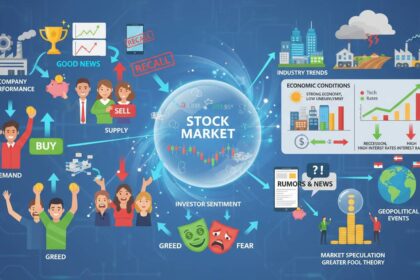

The stock market can feel like a roller coaster. One day your portfolio is up 3%, and the next day it's down 2%. This volatility confuses many investors, especially newcomers who wonder: why do stocks go up and down so unpredictably?
The answer lies in understanding that stock prices represent the collective judgment of millions of investors constantly evaluating a company's worth. Every time you buy or sell a stock, you're participating in a massive, ongoing debate about what that company is truly worth. When more people want to buy than sell, the price rises. When more people want to sell than buy, the price falls.
This article breaks down the fundamental forces that drive stock prices up and down in simple, easy-to-understand terms.
Key Insights
- Stock prices move based on the interaction between supply and demand
- Company earnings and financial health directly influence stock valuations
- Economic factors like interest rates and inflation impact entire markets
- Investor psychology and sentiment create short-term price fluctuations
- External events—from geopolitical developments to regulatory changes—can trigger significant market movements
The Foundation: What Determines a Stock's Price
At its core, a stock represents ownership in a company. When you buy a share, you own a tiny piece of that business. The price you pay reflects what other investors believe that ownership is worth.
Supply and Demand: The Basic Engine
The law of supply and demand governs all financial markets, and stocks are no exception. When institutional investors, individual traders, and everyday shareholders collectively decide to buy a particular stock, they create demand. This increased buying pressure pushes the price upward.
Conversely, when investors decide to sell—perhaps because they're worried about the company's prospects or need cash for other investments—the supply of shares available increases while demand decreases. This pushes the price down.
📊 MARKET REALITY
- The New York Stock Exchange alone sees billions of shares traded daily
- On high-volume trading days, market activity can exceed 10 billion shares
- Individual stocks can move 5% or more in a single trading session based on news
Intrinsic Value vs. Market Price
Experienced investors often distinguish between a stock's intrinsic value (what the company is actually worth based on its earnings, assets, and growth potential) and its market price (what investors are currently willing to pay). This gap explains why stocks can become overvalued or undervalued.
Warren Buffett, one of the most successful investors in history, describes his approach as buying "wonderful businesses at fair prices rather than fair businesses at wonderful prices." This philosophy reflects the ongoing tension between intrinsic value and market perception that drives daily price movements.
Company Performance: The Primary Driver
The most fundamental factor influencing individual stock prices is the underlying company's performance. Investors reward successful companies with higher prices and punish struggling ones with lower valuations.
Earnings Reports and Revenue Growth
When a company releases its quarterly earnings report, the market responds dramatically. If a company reports earnings that exceed analyst expectations, investors often bid the stock price higher. If earnings miss expectations, the stock typically declines.
How earnings affect prices:
- Positive earnings surprises can drive stocks up 5-15% in a single day
- Consistent earnings growth typically supports steadily rising stock prices
- Declining earnings or losses often lead to sustained price decreases
👤 Expert Insight
"Earnings are the language of the market. When companies do well, their stocks tend to do well. When corporate profits decline, stock prices typically follow." — Thomas Lee, Chief Market Strategist at Fundstrat Global Advisors
Revenue and Growth Metrics
Beyond earnings, investors closely watch revenue growth, customer acquisition rates, and market share expansion. A company might be profitable today, but investors price stocks based on expected future performance. A fast-growing tech company that reinvests all its profits into expansion might have low current earnings but a high stock price because investors expect massive future profits.
Company News and Developments
Individual company news creates significant daily price movements:
- Product announcements: Revolutionary new products can send stocks soaring
- Leadership changes: New CEOs with strong track records often boost stock prices
- Legal issues: Lawsuits, regulatory investigations, or compliance problems can tank stock prices
- Partnerships and acquisitions: Strategic deals can create substantial value
Economic Factors: The Market Backdrop
Beyond individual company performance, broader economic conditions significantly impact stock prices across entire markets.
Interest Rates and Federal Reserve Policy
The Federal Reserve's decisions on interest rates represent one of the most powerful influences on stock valuations. When the Fed raises interest rates, borrowing becomes more expensive for companies and consumers alike. This slows economic growth and reduces corporate profits, typically pushing stock prices down.
When the Fed lowers interest rates, cheap borrowing stimulates economic activity, boosts corporate profits, and makes stocks more attractive relative to bonds—typically driving prices higher.
📊 HISTORICAL PERSPECTIVE
- Following the 2008 financial crisis, the Fed kept interest rates near zero for seven years, contributing to one of the longest bull markets in history
- In 2022, the Fed's aggressive rate hikes (from near 0% to over 5%) helped trigger the worst year for stocks since 2008
- Historical data shows a general inverse relationship: when bond yields rise, stock prices often fall
Inflation and Its Impact
Inflation erodes purchasing power and forces the Fed to raise interest rates, creating a double whammy for stocks. High inflation also increases companies' operating costs, squeezing profit margins.
Inflation's effects on stocks:
- Moderate inflation (2-3%) is generally considered healthy for stocks
- High inflation (>5%) typically creates market uncertainty and volatility
- Deflation (falling prices) signals economic weakness and usually hurts stocks
Gross Domestic Product (GDP) Growth
The overall health of the economy, measured by GDP growth, correlates strongly with stock market performance. When the economy is expanding, companies generate more sales and profits, supporting higher stock prices. Economic contractions typically drag stocks down.
| Economic Condition | Typical Stock Market Response |
|---|---|
| Strong GDP growth (+3%+) | Bullish - stocks generally rise |
| Moderate growth (1-3%) | Mixed - selective performance |
| Negative growth (recession) | Bearish - stocks generally fall |
Employment and Consumer Confidence
The job market and consumer confidence directly impact corporate revenues. When unemployment is low and consumer confidence is high, people spend more money, companies earn more profit, and stocks tend to rise. High unemployment and low consumer confidence signal reduced spending, hurting corporate profits and stock prices.
Market Sentiment: The Psychological Factor
Beyond fundamentals, investor psychology creates significant short-term price movements that don't always align with underlying company values.
Fear and Greed
The legendary investor Warren Buffett famously advised being "fearful when others are greedy and greedy when others are fearful." This captures how emotional investing drives prices away from rational valuations.
During periods of greed, investors chase rising prices, pushing stocks far above their intrinsic values. During fear-driven selloffs, panic causes investors to dump stocks at bargain prices. Understanding this emotional cycle helps sophisticated investors identify opportunities.
📈 CASE STUDY: COVID-19 Crash and Recovery
- In March 2020, the S&P 500 fell 34% in just 33 days due to pandemic panic
- By August 2020, the market had recovered all losses and reached new highs
- Investors who sold during the panic lock in losses, while those who bought during the crash profited from the subsequent recovery
herd Mentality and Momentum
Humans are social creatures, and investors often follow the crowd. This creates momentum—the tendency for rising stocks to keep rising and falling stocks to keep falling, at least in the short term.
Technical analysts study price charts and trading patterns to identify momentum trends, attempting to profit from these psychological patterns.
Market Overreactions
Markets frequently overreact to news, both positive and negative. A minor setback for a company might trigger a 10% stock decline, while a modest success might spark a 15% rally. These overreactions create opportunities for patient investors who understand that short-term price movements often detach from long-term fundamentals.
External Factors and Market Events
Numerous outside factors create volatility in stock markets, often without warning.
Geopolitical Events
Wars, political instability, trade disputes, and international conflicts impact markets by creating uncertainty. Investors hate uncertainty, and geopolitical tensions often trigger market selloffs as investors seek safer assets.
Recent examples include the ongoing conflicts in Ukraine and Middle East tensions, which have periodically caused market volatility despite having limited direct economic impact on most companies.
Natural Disasters and pandemics
Natural disasters can disrupt supply chains, destroy inventory, and damage infrastructure—all negative for stocks in the short term. The COVID-19 pandemic provides the most dramatic recent example, causing the fastest bear market in history before the subsequent recovery.
Regulatory Changes
Government regulations directly impact specific industries. New environmental regulations might hurt fossil fuel companies while benefiting renewable energy firms. Stricter financial regulations typically hurt banks, while deregulation often boosts financial sector stocks.
Technology and Disruption
Technological changes can transform entire industries overnight. The rise of streaming devastated video rental companies like Blockbuster while boosting Netflix. Electric vehicles are challenging traditional automakers. Investors must understand how technological trends affect the companies they own.
How All These Factors Interconnect
The stock market is a complex system where numerous factors interact simultaneously. Understanding how these forces combine helps explain why prices move in seemingly unpredictable ways.
The Compound Effect
Multiple factors rarely move in isolation. A company might report excellent earnings (positive), but if interest rates also spike (negative) and the broader economy slows (negative), the stock might still decline. Conversely, mediocre earnings might be overshadowed by excitement about a new product pipeline, causing the stock to rise.
Leading and Lagging Indicators
Some factors predict market movements, while others confirm them. Leading indicators—like housing starts, manufacturing surveys, and consumer confidence—suggest where the economy is heading. Lagging indicators—like unemployment rates and corporate profits—confirm what has already happened.
Savvy investors study leading indicators to anticipate market movements before they fully materialize in stock prices.
Sector and Industry Movements
Different sectors respond differently to economic conditions. During economic expansions, consumer discretionary and technology stocks often outperform. During recessions, utilities and consumer staples typically hold up better because people still need electricity and food regardless of economic conditions.
Understanding these sector rotations helps investors position their portfolios for different economic environments.
Common Misconceptions About Stock Movements
Many investors harbor misconceptions about how stocks work, which can lead to poor investment decisions.
Misconception #1: Stock Prices Always Reflect Company Value
Reality: Stock prices reflect what investors think a company is worth, not necessarily what it's actually worth. Emotions, speculation, and market dynamics can drive prices far from fundamental values for extended periods.
Misconception #2: Daily News Explains Market Movements
Reality: After the fact, analysts always find a "reason" for market movements. However, studies show that daily news explains only a small fraction of daily price changes. Much of daily volatility is random noise.
Misconception #3: Past Performance Predicts Future Results
Reality: A stock that went up 50% last year has no obligation to perform similarly next year. Past performance provides no guarantees about future returns.
Misconception #4: Stocks Only Go Up Over Time
Reality: While the stock market has generated positive returns over very long periods, this doesn't mean stocks go up every year. There have been decades where the market generated negative returns, and individual investors can lose significant money if they buy at peaks and sell during downturns.
Building a Strategy Amid Market Volatility
Understanding why stocks go up and down is only valuable if it helps you make better investment decisions.
Time in the Market Beats Timing the Market
Attempting to predict short-term market movements is extremely difficult, if not impossible. Historically, investors who stay invested through market ups and downs have generally outperformed those who try to time their entry and exit points.
Diversification Reduces Volatility
Holding a variety of stocks across different sectors and asset classes smooths your portfolio's performance. When some stocks decline, others may rise, reducing overall volatility.
Focus on Long-Term Fundamentals
Rather than obsessing over daily price movements, successful investors focus on whether the underlying companies they own are becoming more valuable over time. Stock prices fluctuate in the short term, but quality companies tend to deliver value over decades.
Frequently Asked Questions
Why do stock prices change every second?
Stock prices update continuously because millions of investors are constantly placing buy and sell orders. Every transaction represents someone valuing the stock differently than the previous transaction. This continuous auction process creates second-by-second price changes, especially for heavily traded stocks.
Can you predict when stocks will go up or down?
No one can consistently predict short-term stock movements. Even professional investors with sophisticated tools and research teams underperform the market regularly. Successful investing focuses on long-term company fundamentals rather than short-term predictions.
Do stocks go up more than they go down over time?
Over very long periods (decades), the stock market has generally trended upward because the economy grows over time and companies become more valuable. However, this doesn't mean stocks go up every year or even every decade. Historical data shows significant periods of flat or negative returns.
Why do stocks fall faster than they rise?
Market psychology explains this phenomenon. Fear is a more powerful emotion than greed, causing investors to panic-sell more quickly than they celebrate. Additionally, institutional investment strategies often include automatic selling when prices decline beyond certain thresholds, accelerating downward movements.
How do earnings affect stock prices?
When a company reports earnings that exceed analyst expectations, investors often bid the stock higher because the company is performing better than anticipated. Conversely, when earnings miss expectations, investors sell, pushing the price down. The market looks forward, so current earnings affect expectations for future performance.
Should I buy stocks when they're going down?
Buying during market declines can be profitable if you're buying quality companies at reduced prices. However, stocks can continue falling, and there's no guarantee that prices will recover quickly. Dollar-cost averaging—investing fixed amounts regularly regardless of market conditions—is a strategy that reduces the risk of bad timing.
Conclusion
Stock prices move up and down because millions of investors constantly evaluate companies, economic conditions, and world events, then collectively decide what prices reflect those assessments. Company performance, economic factors, investor sentiment, and external events all interact to create the continuous price fluctuations we see daily.
Understanding these forces won't make you perfectly predict market movements—no one can do that consistently. But understanding why stocks move helps you avoid panicked decisions during volatility and focus on what matters: investing in quality companies for the long term.
The best approach for most investors is simple: diversify across quality companies, invest regularly regardless of market conditions, and maintain a long-term perspective. The stock market's daily movements will always be unpredictable, but history shows that patient investors who stay the course are rewarded over time.