

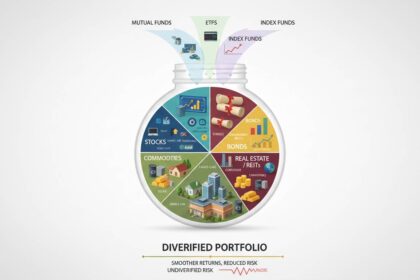

Diversification is an investment strategy that involves spreading your money across different assets to reduce risk and protect your portfolio from market volatility. Rather than putting all your capital into a single stock, bond, or sector, diversification distributes investments across various asset classes, industries, and geographic regions. This approach ensures that poor performance in one investment doesn't devastate your entire portfolio.
The fundamental principle behind diversification is simple: different assets respond differently to the same economic event. When one investment declines, another may rise, creating a natural hedge that smooths your overall returns over time.
📊 KEY STATS
- 72% of American investors believe diversification is essential to retirement planning
- $2.3 trillion is held in diversified index funds across US markets
- Portfolio diversification can reduce volatility by up to 40% compared to single-asset portfolios
The Core Concept: Why Putting All Eggs in One Basket Backfires
The phrase "don't put all your eggs in one basket" perfectly captures the essence of diversification. When you invest entirely in a single company or sector, your financial future becomes tied to that one outcome. If that company faces difficulties—whether from competitive pressures, regulatory changes, or shifts in consumer behavior—your entire portfolio suffers.
Consider the 2008 financial crisis as a stark example. Investors who had concentrated their portfolios in financial stocks saw their holdings plummet by 50% or more. Meanwhile, those with diversified portfolios across multiple sectors experienced significantly smaller losses and recovered more quickly.
Modern portfolio theory, developed by Nobel Prize-winning economist Harry Markowitz in 1952, mathematically demonstrated that diversification is essentially a "free lunch" in investing. By combining assets with different risk characteristics, investors can reduce overall portfolio risk without necessarily sacrificing expected returns.
How Diversification Works: The Mathematics Behind the Strategy
Diversification operates on the principle of imperfect correlation between assets. When two assets have low or negative correlation, they tend to move independently of each other—or even in opposite directions—during market stress.
Correlation coefficients measure how closely two investments move together. A coefficient of +1.0 means perfect positive correlation (they move identically), while -1.0 indicates perfect negative correlation (they move oppositely). The goal of diversification is to combine assets with correlation coefficients below +1.0.
| Correlation Level | What It Means | Example |
|---|---|---|
| +0.8 to +1.0 | High correlation | Two energy sector stocks |
| +0.3 to +0.7 | Moderate correlation | Stocks and corporate bonds |
| -0.3 to +0.3 | Low correlation | US stocks and international stocks |
| -0.3 to -1.0 | Negative correlation | Stocks and Treasury bonds (sometimes) |
The key insight is that you don't need negatively correlated assets to benefit from diversification. Even modest differences in how investments behave can significantly reduce overall portfolio volatility.
Types of Diversification You Need to Understand
Asset Class Diversification
This is the broadest form of diversification—spreading investments across different categories such as stocks, bonds, real estate, and cash equivalents. Each asset class responds differently to economic conditions:
- Stocks generally perform well during economic growth
- Bonds often provide stability during market downturns
- Real estate can hedge against inflation
- Cash provides liquidity and safety
Most financial experts recommend holding a mix of at least three to four different asset classes, with the specific allocation depending on your age, risk tolerance, and goals.
Geographic Diversification
Investing across different countries and regions protects your portfolio from country-specific risks. Economic conditions, political stability, and currency values vary significantly across borders. US investors who only held domestic stocks missed significant opportunities in international markets during various periods.
Sector and Industry Diversification
Even within the stock market, spreading investments across multiple sectors—such as technology, healthcare, financials, consumer goods, and energy—protects against sector-specific downturns. The tech bubble burst in 2000 devastated tech-heavy portfolios, while more balanced portfolios weathered the storm.
Individual Security Diversification
Holding multiple securities within each sector reduces company-specific risk. This is why index funds and ETFs have become so popular—they provide instant diversification across dozens or hundreds of companies within a single purchase.
The Evidence: What Research Shows About Diversification
Decades of academic research consistently support diversification as a sound investment strategy. A landmark study by Vanguard found that diversification becomes most effective when combining 20 to 30 stocks across different sectors.
The research reveals several key findings:
| Portfolio Composition | Annual Volatility | Worst Year (1929-2022) |
|---|---|---|
| Single stock | 45-60% | -80% |
| 10 stocks | 30-40% | -55% |
| 30 stocks | 20-28% | -40% |
| S&P 500 Index | 15-20% | -37% |
| 60/40 Stock/Bond | 10-15% | -25% |
👤 Warren Buffett, Berkshire Hathaway CEO
"Wide diversification is only required when investors do not understand what they are doing."
This famous quote emphasizes an important point: diversification is partly a confession of uncertainty. If you have deep expertise in a particular industry or company, concentrated bets may make sense. For most people, diversification is the prudent approach.
👤 Ray Dalio, Bridgewater Associates Founder
"Don't let your need to be right outweigh the need to be diversified."
Dalio, who manages the world's largest hedge fund, built his success partly on diversification across asset classes, strategies, and time horizons.
How to Build a Diversified Portfolio: A Step-by-Step Approach
Step 1: Assess Your Risk Tolerance
Before diversifying, understand how much volatility you can emotionally and financially handle. Younger investors with decades until retirement can typically tolerate more stock exposure, while those near retirement need more stability.
Step 2: Determine Your Target Allocation
A common starting point is age-based allocation: hold your age in bonds and the rest in stocks. A 30-year-old might hold 70% stocks and 30% bonds, while a 60-year-old might shift to 40% stocks and 60% bonds.
Step 3: Choose Your Investment Vehicles
| Vehicle | Best For | Diversification Level |
|---|---|---|
| Index Funds | Broad market exposure | Very High |
| ETFs | Sector-specific exposure | High |
| Mutual Funds | Professional management | High |
| Individual Stocks | Targeted bets | Low |
| Bonds | Stability | Varies |
Step 4: Implement and Rebalance
Once you've established your allocation, review your portfolio annually. Market movements will shift your allocation away from your targets, so rebalancing—selling winners and buying laggards—keeps your risk level consistent.
Common Diversification Mistakes to Avoid
Mistake #1: False Diversification
Simply owning multiple stocks in the same sector isn't true diversification. Owning five different tech companies provides little protection if the entire technology sector declines.
Mistake #2: Over-Diversification
Holding too many investments can dilute returns without providing additional risk reduction. Research suggests diminishing returns beyond 20 to 30 stocks.
Mistake #3: Ignoring Correlation
Some investments that appear different may actually move together during market stress. During the 2008 crisis, nearly all asset classes fell simultaneously, revealing that true diversification is harder to achieve than it appears.
Mistake #4: Neglecting to Rebalance
Without periodic rebalancing, your portfolio slowly drifts toward your highest-performing asset class, potentially increasing risk beyond your intended level.
Advanced Diversification Strategies
For investors seeking to deepen their diversification approach, several advanced strategies exist:
Foreign Currency Diversification involves holding assets denominated in multiple currencies, which can protect against dollar weakness.
Factor-Based Diversification spreads investments across different factors like value, growth, size, and momentum.
Alternative Investments including commodities, private equity, and hedge funds can provide returns uncorrelated with traditional stocks and bonds.
Dividend Diversification focuses on building a portfolio of dividend-paying stocks across sectors, creating income stability alongside growth potential.
The Bottom Line: Is Diversification Still Relevant?
Despite periodic claims that diversification is obsolete—especially during extended bull markets—the strategy remains foundational to prudent investing. The 2022 market downturn, where both stocks and bonds declined together, tested diversification's limits, but the strategy still provided better outcomes than concentrated positions.
Diversification works not because it guarantees profits—it doesn't—but because it reduces the probability of catastrophic losses. For most investors, the peace of mind that comes from knowing your portfolio can weather various economic scenarios is invaluable.
The key is understanding that diversification is a trade-off: you sacrifice the possibility of extraordinary gains from perfect timing in exchange for reduced risk of extraordinary losses. This trade-off makes sense for investors who prioritize long-term wealth preservation alongside growth.
Frequently Asked Questions
Does diversification guarantee positive returns?
No, diversification does not guarantee positive returns or protect against all losses. During severe market downturns, nearly all asset classes can decline simultaneously. However, diversification significantly reduces the likelihood of catastrophic losses and typically results in more stable, consistent returns over time.
How many different investments do I need for proper diversification?
Research suggests that 20 to 30 stocks across different sectors provide most of the diversification benefit available through individual securities. Using index funds or ETFs, you can achieve broad diversification with far fewer holdings. Most financial experts recommend holding at least 10 to 15 different securities, with the exact number depending on your specific situation.
Is diversification still important in a high-inflation environment?
Yes, diversification becomes particularly important during high-inflation environments because different assets respond differently to inflation. While cash loses purchasing power, real estate and commodities often increase in value. A diversified portfolio including inflation-hedging assets helps protect your purchasing power.
Should I diversify my retirement accounts differently from my taxable accounts?
The tax treatment of different account types can influence your diversification strategy. Tax-advantaged accounts like 401(k)s and IRAs are ideal for holdings you want to keep long-term, while taxable accounts might benefit from investments that generate tax-efficient income. However, the core diversification principle remains the same across account types.
How often should I rebalance my diversified portfolio?
Annual rebalancing is typically sufficient for most investors and balances maintaining your target allocation with minimizing transaction costs and tax implications. Some investors rebalance quarterly, while others use a "threshold" approach—rebalancing only when allocations drift 5% or more from targets.