


The financial landscape is undergoing a profound transformation as technology continues to reshape how people store, send, and invest money. At the center of this revolution lies a concept that has generated both excitement and confusion: Decentralized Finance, commonly known as DeFi. For those unfamiliar with the term, understanding what DeFi represents and how it works can feel like navigating a complex maze of technical jargon. However, breaking down this revolutionary financial system into simple terms reveals an accessible framework that could fundamentally change how anyone interacts with money. This article provides a comprehensive yet easy-to-understand exploration of DeFi, examining its core concepts, practical applications, benefits, risks, and what the future holds for this rapidly evolving sector.
Understanding the Basics of DeFi
DeFi stands for Decentralized Finance, a term that describes a movement to recreate traditional financial services using blockchain technology. In simple terms, DeFi refers to financial applications built on decentralized networks, primarily Ethereum, that operate without intermediaries such as banks, brokers, or other traditional financial institutions. These applications enable users to perform many of the same functions they would at a conventional bank—including earning interest, borrowing money, trading assets, and purchasing insurance—but through automated smart contracts that execute transactions when predetermined conditions are met.
The concept emerged from the broader cryptocurrency ecosystem, leveraging the security, transparency, and immutability that blockchain technology provides. Unlike conventional finance, where centralized authorities control and regulate financial transactions, DeFi aims to create an open, permissionless financial system where anyone with an internet connection and a digital wallet can participate. This fundamental shift removes the need for trust in institutional intermediaries, replacing it with trust in code and cryptographic verification.
How DeFi Differs from Traditional Finance
To fully grasp what DeFi is in simple terms, it helps to contrast it with the traditional financial system most people use daily. When someone deposits money in a bank, that institution uses those funds to lend to other customers, charging borrowers higher interest rates than it pays to depositors. The bank acts as a trusted intermediary, managing risk, facilitating transactions, and maintaining records. This system, while functional, concentrates power in institutional hands and often excludes individuals who lack access to traditional banking services.
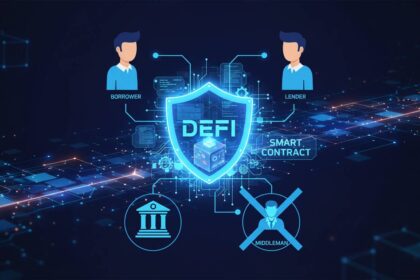
DeFi disrupts this model by removing the middleman entirely. Instead of trusting a bank to manage funds, users interact directly with self-executing smart contracts—computer programs stored on a blockchain that automatically enforce the terms of an agreement. When someone lends cryptocurrency through a DeFi platform, smart contracts match them with borrowers, set interest rates, and automatically distribute repayments. Every transaction is recorded on a public blockchain that anyone can verify, creating unprecedented transparency.
Another significant difference lies in accessibility. Traditional financial services require extensive documentation, credit checks, and often impose minimum balance requirements. DeFi platforms, by contrast, require only a digital wallet and cryptocurrency holdings. This open-access approach has particularly compelling implications for the approximately 1.4 billion adults globally who remain unbanked, according to World Bank data.
Key DeFi Concepts Explained
Understanding DeFi requires familiarity with several foundational concepts that form the building blocks of this ecosystem. Smart contracts represent the most critical innovation driving DeFi adoption. These self-executing programs automatically carry out specific actions when certain conditions are fulfilled, eliminating the need for human intervention or oversight. For example, a smart contract might release cryptocurrency to a borrower once collateral is deposited, or distribute interest to lenders automatically at predetermined intervals.
Decentralized exchanges, or DEXes, constitute another essential component. Unlike traditional cryptocurrency exchanges that hold user funds, DEXes enable peer-to-peer trading directly from users' wallets. This arrangement reduces counterparty risk and typically provides greater privacy. Popular DEXes like Uniswap and SushiSwap have facilitated billions of dollars in trading volume, demonstrating significant market demand for decentralized trading infrastructure.
Yield farming represents a strategy where users move their cryptocurrency between different DeFi protocols to maximize returns. By staking or lending assets on various platforms, users can earn multiple streams of interest and token rewards. While potentially lucrative, yield farming involves complex mechanics and substantial risk, as the value of reward tokens can fluctuate dramatically.
Liquidity mining rewards users who provide funds to DeFi platforms, essentially turning everyday users into stakeholders in the financial infrastructure. This innovative incentive model has accelerated DeFi adoption but also contributed to market volatility as users rapidly move capital in search of the highest yields.
Popular DeFi Applications and Use Cases
The DeFi ecosystem has produced numerous applications that demonstrate the practical potential of decentralized finance. Lending platforms like Aave and Compound allow users to deposit cryptocurrency as collateral and borrow against it, earning interest on their deposited assets simultaneously. These platforms typically offer variable interest rates determined by supply and demand, often providing returns significantly higher than traditional savings accounts.
Decentralized exchanges have revolutionized how users trade cryptocurrencies. Rather than placing orders through a centralized order book, many DEXes use automated market maker systems that calculate prices algorithmically based on the ratio of assets in liquidity pools. This mechanism enables continuous trading without requiring a traditional buyer and seller match, making markets more efficient and accessible.
Stablecoins represent another critical DeFi application. These cryptocurrencies maintain a fixed value, typically pegged to the US dollar, providing a reliable medium of exchange within the volatile crypto markets. Popular stablecoins like USDC and DAI enable users to hold digital assets without experiencing the price fluctuations common to Bitcoin or Ethereum, facilitating trading and lending activities.
Synthetic assets, created through platforms like Synthetix, allow users to gain exposure to the price movements of real-world assets like stocks, commodities, or fiat currencies without actually owning them. This innovation opens global markets to anyone with an internet connection, potentially democratizing access to financial instruments traditionally reserved for institutional investors.
The Benefits and Risks of DeFi
DeFi offers several compelling advantages over traditional financial systems. The removal of intermediaries typically results in lower fees for users, as platforms can operate with leaner business models. Transaction speeds can also exceed those of traditional systems, particularly for cross-border transfers that might otherwise take days to clear. The transparency inherent in blockchain technology allows users to verify exactly how their funds are being managed, reducing information asymmetry that often disadvantages consumers in traditional finance.
According to industry analysts at Delphi Digital, total value locked in DeFi protocols exceeded $300 billion at its peak, demonstrating substantial market confidence in these innovations. This growth occurred despite the technology's relative novelty, suggesting strong underlying demand for decentralized financial services.
However, DeFi carries significant risks that users must understand before participating. Smart contract vulnerabilities have resulted in hundreds of millions of dollars in losses across the ecosystem. Code bugs or exploits can allow hackers to drain funds from protocols, and the irreversible nature of blockchain transactions means these losses typically cannot be recovered. The volatility inherent in cryptocurrency markets can also result in rapid losses, particularly for users who borrow against collateral that suddenly loses value.
Regulatory uncertainty presents another concern. Governments worldwide continue evaluating how to apply existing financial regulations to DeFi applications, and future enforcement actions could impact certain protocols or use cases. Users must stay informed about developing regulatory frameworks in their jurisdictions.
The Future of Decentralized Finance
The trajectory of DeFi suggests continued growth and innovation in the coming years. Major financial institutions have begun exploring blockchain technology, with several prominent banks announcing plans to offer cryptocurrency services to customers. This institutional involvement could bring greater legitimacy and stability to the sector while introducing DeFi concepts to mainstream audiences.
Technological improvements are also addressing current limitations. Ethereum's transition to a proof-of-stake consensus mechanism, known as "The Merge" and subsequently "The Surge," aims to dramatically increase transaction throughput and reduce costs. These upgrades could make DeFi applications more practical for everyday transactions, potentially driving mass adoption.
Cross-chain interoperability represents another frontier for development. As different blockchain networks improve their ability to communicate with each other, users may gain seamless access to DeFi applications across multiple platforms. This interconnected ecosystem could unlock additional liquidity and functionality while reducing the fragmentation that currently characterizes the space.
Conclusion
DeFi represents a fundamental reimagining of how financial services function in the digital age. By leveraging blockchain technology and smart contracts, it offers an alternative to traditional banking that is more accessible, transparent, and efficient in many respects. While significant risks remain, including security vulnerabilities and regulatory uncertainty, the rapid growth of the ecosystem demonstrates substantial demand for decentralized financial options. As technology continues evolving and institutional adoption increases, DeFi may well become an integral part of how people worldwide interact with money. Understanding these fundamentals provides a foundation for evaluating whether participating in this emerging financial system makes sense for individual circumstances and risk tolerance.
Frequently Asked Questions
What does DeFi stand for?
DeFi stands for Decentralized Finance, which refers to financial services built on blockchain technology that operate without traditional intermediaries like banks.
Is DeFi safe to use?
DeFi carries various risks including smart contract vulnerabilities, cryptocurrency price volatility, and potential regulatory changes. Users should only invest what they can afford to lose and conduct thorough research before participating.
How do I start using DeFi?
To begin using DeFi, you need a cryptocurrency wallet like MetaMask, some cryptocurrency (typically Ethereum or tokens on Ethereum-compatible networks), and familiarity with the specific platform you wish to use. Start with small amounts to learn the mechanics.
Can I make money with DeFi?
Yes, users can earn money through DeFi by lending assets, providing liquidity, or yield farming. However, returns are not guaranteed and significant losses are possible, especially during periods of market volatility.
What is the biggest advantage of DeFi over traditional banking?
The primary advantages include greater accessibility (anyone with internet can participate), typically lower fees, higher potential interest rates on deposits, and increased transparency regarding how funds are managed.
Which DeFi platforms are most popular?
Popular DeFi platforms include Aave and Compound for lending, Uniswap and Curve for trading, and MakerDAO for stablecoin generation. These platforms have collectively facilitated billions of dollars in transactions.