

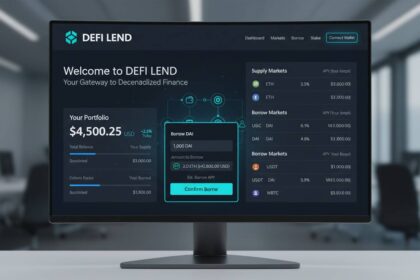

Decentralized Finance, commonly known as DeFi, is changing how people think about money and financial services. Built mostly on Ethereum, DeFi apps let you do things like lend, borrow, trade, and earn interest—but without banks or other traditional intermediaries. Instead of relying on institutions, DeFi uses smart contracts: programs that automatically run when certain conditions are met. This guide covers what DeFi is, how it works, what you can do with it, and where it's heading.
Understanding DeFi: The Fundamentals
DeFi is a broad term for financial apps built on blockchain networks, mainly Ethereum. These apps work without the usual intermediaries—banks, brokers, insurance companies. The idea is to recreate familiar financial tools (lending, borrowing, trading, earning interest) using smart contracts that execute automatically. You don't need a bank to approve a loan or a broker to facilitate a trade. Instead, code handles everything.
"Decentralized" means no single company or institution controls the system. Instead, the network runs across many computers worldwide. This makes it harder for any one entity to censor transactions or shut things down. You keep control of your money in your own wallet and interact with DeFi protocols directly, without asking anyone for permission.
One practical advantage: DeFi works across borders with relatively few obstacles. Someone in a country with limited banking access can lend money to a stranger overseas, earn interest on crypto holdings, or use financial services that would otherwise be unavailable. This accessibility is a big part of what makes DeFi different from traditional finance.
How DeFi Works: Technology Behind Decentralized Finance
DeFi runs on blockchain technology and smart contracts. The blockchain acts as a shared, public record where every transaction gets stored permanently. Smart contracts are pieces of code that automatically carry out financial agreements—say, when you lend crypto, the contract calculates interest, sends payments, and manages the whole process without any human involvement.
Ethereum is the main blockchain for DeFi because its smart contract system is well-developed and many developers already build on it. Other blockchains—Solana, Binance Smart Chain, Avalanche, Polygon—also host DeFi apps, each with different trade-offs in speed and cost. All together, these networks hold billions of dollars in what's called total value locked (TVL), which measures how much crypto people have deposited into DeFi protocols.
Decentralized exchanges (DEXs) are among the most used DeFi apps. They let you trade crypto directly from your wallet, without handing your money over to a centralized exchange like Coinbase. DEXs use automated market makers (AMMs)—mathematical formulas that set token prices based on supply and demand in liquidity pools. If you add money to a liquidity pool, you earn a share of the trading fees.
Yield farming is another major activity in DeFi. It involves moving your crypto between different protocols to chase higher returns. Some platforms reward you with extra tokens for providing liquidity or staking your assets. These strategies can be profitable, but they come with real risks—most notably impermanent loss, where the value of your deposited assets shifts unfavorably compared to when you put them in.
Major DeFi Use Cases and Applications
Lending and borrowing are the most basic DeFi use cases. Platforms like Aave, Compound, and MakerDAO let you deposit crypto as collateral and take out loans. You earn interest on what you deposit, and borrowers can get funds without going through credit checks. Interest rates adjust based on supply and demand, and they're often more competitive than what banks offer. For people who can't access traditional banking, this is a significant alternative.
Stablecoins are another key piece of the DeFi ecosystem. These are crypto tokens pegged to the US dollar (or other fiat currencies)—USDT, USDC, DAI are examples. They stay at roughly $1 value, unlike Bitcoin or Ethereum which swing wildly. Stablecoins let you trade, lend, and send money within DeFi without worrying about your holdings suddenly losing half their value.
Decentralized insurance is a newer category. These protocols pool user money to cover losses from hacks, smart contract bugs, or other technical failures. If something goes wrong and you're covered, you can get compensated from the pool. It's insurance, but without a traditional insurance company.
Prediction markets and synthetic assets are other DeFi innovations. They let people create and trade financial instruments that track real-world assets, sports outcomes, elections, or stock indexes—all on the blockchain.
Benefits and Risks of Decentralized Finance
DeFi offers several advantages beyond just access. Transactions happen on public blockchains, so anyone can verify what's going on—no need to just trust a company when they say they're handling your money correctly. Blockchain transactions are pseudonymous, giving you more privacy than most traditional banks. Most DeFi protocols are open-source, meaning developers and users can review the code themselves.
But the risks are serious. Smart contract bugs have led to millions of dollars in losses. Hackers exploit vulnerabilities, and sometimes the money is gone for good because code can't be changed after the fact. DeFi isn't regulated in the traditional sense, so if you lose money to a hack or a scam, you probably have no recourse. And because crypto prices move so fast, the value of collateral in lending protocols can drop quickly—triggering automatic liquidations that wipe out your holdings.
Regulation is another unknown. Governments are still figuring out how to handle DeFi. Future rules could restrict how these protocols work, limit access to certain tokens, or change how the whole space operates. Plus, using DeFi requires technical know-how—setting up wallets, understanding gas fees, navigating unfamiliar interfaces. That's a real barrier for many people.
The Future of DeFi in Cryptocurrency
DeFi is likely to keep growing and evolving. Solutions that speed up transactions and lower fees are making DeFi more practical for regular use. More institutions are getting involved, exploring DeFi for things like cross-border payments and treasury management.
DeFi is starting to blend with other crypto trends—NFTs, DAOs, and tokenizing real-world assets like real estate or company stock. These combinations could bring DeFi beyond purely digital-native applications and into everyday finance. Some projects are building bridges between traditional banks and decentralized protocols.
Education matters a lot here. The more people understand how DeFi actually works—the risks, the mechanics, the trade-offs—the better positioned they'll be to use it safely. It's still early, and the space changes fast, but DeFi is already reshaping how people think about money and who controls it.
Conclusion
DeFi uses blockchain technology to build open, accessible financial systems that skip traditional intermediaries. Whether you're lending crypto, borrowing against your holdings, trading on a DEX, or earning yield, DeFi offers tools that didn't exist a few years ago. The risks are real—hacks, volatility, regulatory unknowns—but the space continues to develop. If you want to understand where finance is going, DeFi is a good place to start.
Frequently Asked Questions
What does DeFi stand for?
DeFi stands for Decentralized Finance. It refers to financial applications built on blockchain that operate without banks or other middlemen.
How do I start using DeFi?
You'll need a crypto wallet like MetaMask, some cryptocurrency (usually ETH or tokens on Ethereum-based networks), and familiarity with the specific protocols you want to use. Start by researching platforms, understand gas fees, and try small amounts first.
Is DeFi safe to use?
DeFi involves significant risk. Smart contracts can have bugs, hacks happen, and you can lose your entire investment. Only invest money you can afford to lose, research protocols thoroughly, and consider using a hardware wallet for large amounts.
What is total value locked (TVL) in DeFi?
TVL measures how much cryptocurrency is currently deposited in DeFi protocols. It's a rough gauge of how big the DeFi ecosystem is, though it doesn't tell you everything about a protocol's safety or success.
Can I earn interest on DeFi?
Yes. Common methods include lending your crypto on platforms like Aave or Compound, providing liquidity to DEXs, and yield farming. Returns vary widely and can change quickly depending on market conditions.
What is the difference between CeFi and DeFi?
CeFi (Centralized Finance) means traditional financial services run by companies—banks, exchanges, brokerages. DeFi runs on code and protocols instead. CeFi tends to offer more customer protection and easier interfaces, while DeFi offers more transparency, privacy, and direct control over your funds.