

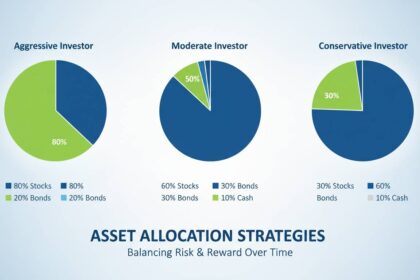

Asset allocation is the practice of dividing your investment portfolio among different asset classes—such as stocks, bonds, and cash—to balance risk and potential returns based on your financial goals, timeline, and risk tolerance. Rather than putting all your money into a single investment, asset allocation spreads your capital across multiple categories, creating a diversified foundation designed to weather market fluctuations while targeting your specific objectives.
Key Insights
- portfolios with proper asset allocation have historically shown lower volatility than single-asset portfolios
- the exact mix you choose should reflect when you need your money and how much market movement you can emotionally and financially tolerate
- your allocation isn't permanent—it should evolve as your life circumstances and goals change
This guide walks you through the fundamentals of asset allocation, explains why it matters for every investor, and provides practical steps to build an allocation strategy that fits your unique situation.
Why Asset Allocation Matters: The Risk-Return Relationship
The primary purpose of asset allocation is managing the relationship between risk and potential return. Different asset classes behave differently under various market conditions, and understanding this dynamics is central to building a resilient portfolio.
The Role of Asset Classes
Stocks represent ownership in companies and generally offer the highest long-term growth potential. However, they come with significant short-term volatility—their value can rise or fall dramatically based on company performance, economic conditions, and investor sentiment.
Bonds function as loans to governments or corporations. They typically provide steadier, more predictable returns than stocks, though generally lower over very long periods. Bonds often move inversely to stocks, meaning when stocks decline, bonds may hold steady or even increase in value.
Cash and cash equivalents (including money market funds and certificates of deposit) offer the lowest risk and most stable values, but they also provide the lowest returns over time and can lose purchasing power to inflation.
Research from Vanguard indicates that asset allocation determines approximately 90% of portfolio return variability over time, while individual security selection and market timing contribute far less. This finding underscores why thoughtful allocation decisions deserve careful attention.
Diversification Within Asset Classes
True diversification extends beyond simply holding stocks and bonds. Within stocks, you might own domestic large-cap companies, international growth stocks, and small-cap value stocks. Within bonds, you might hold government securities, corporate bonds, and municipal bonds with varying maturities.
This layered diversification means that when one segment of your portfolio struggles, other segments may perform better, smoothing your overall returns and reducing the emotional turbulence of market volatility.
Understanding Your Investment Profile
Before determining which asset allocation suits you, you need to honestly assess two critical factors: your risk tolerance and your investment timeline.
Time Horizon: When Will You Need the Money?
Your time horizon significantly influences appropriate asset allocation. Generally, longer time horizons allow for more aggressive (stock-heavy) allocations because you have more time to recover from market downturns.
| Timeline | Typical Allocation Approach |
|---|---|
| Under 3 years | Conservative—emphasis on cash and bonds |
| 3-7 years | Moderate—balanced mix |
| 7-15 years | Growth-oriented—majority stocks |
| 15+ years | Aggressive—heavily weighted to stocks |
Someone investing for retirement 30 years away can reasonably tolerate significant portfolio fluctuations, knowing history suggests markets recover and grow over extended periods. Conversely, money needed for a house down payment in two years shouldn't be heavily exposed to stock market volatility.
Risk Tolerance: What Can You Actually Handle?
Risk tolerance isn't just about numbers—it's deeply personal. Some investors lose sleep when their portfolio drops 5%, while others remain calm during 20% declines. Be honest about your emotional capacity.
Consider this scenario: imagine your $100,000 investment portfolio loses 30% of its value in a market crash, dropping to $70,000. Would you sell everything in panic, do nothing, or view it as a buying opportunity? Your answer reveals your actual risk tolerance, which may differ from what you think you can handle.
A 2023 Gallup survey found that 41% of U.S. adults expressed discomfort with investments in stocks and stock mutual funds—near historical highs reflecting recent market volatility. This emotional reality must factor into your allocation decisions, regardless of theoretical "optimal" strategies.
Common Asset Allocation Strategies
Several established frameworks guide investors in determining their ideal asset mix. Each approach has merit depending on individual circumstances.
Target-Date Funds
Target-date funds automatically adjust their allocation over time, becoming more conservative as the target date approaches. If you plan to retire in 2050, a "2050 fund" starts aggressive and gradually shifts toward bonds and cash as 2050 approaches.
The appeal lies in simplicity—you make one investment decision, and professional managers handle rebalancing. However, these funds vary significantly in their glide path (how quickly they shift toward conservatism), so examining the specific methodology matters.
The 60/40 Portfolio
The classic 60/40 allocation—60% stocks, 40% bonds—has long served as a benchmark for balanced portfolios. This mix aims to capture stock market growth while limiting volatility through bond holdings.
While the 60/40 faced scrutiny in 2022 when both stocks and bonds declined together (an unusual occurrence), many financial experts note it remains a reasonable starting point for many investors seeking balance.
Age-Based Allocations
A simple rule of thumb suggests holding your age (or age minus 10 or 20) in bonds. A 30-year-old might hold 70-80% stocks, while a 60-year-old might hold 40-50% stocks. This approach aligns allocation with decreasing time horizons.
However, this formula doesn't account for other factors like existing savings, pension income, or personal risk preferences. It serves as a starting point rather than a final prescription.
All-Weather and Risk-Parity Approaches
Ray Dalio's "All Weather" portfolio gained popularity for its focus on four economic environments: growth rising, growth falling, inflation rising, and inflation falling. The allocation includes stocks, long-term bonds, intermediate-term bonds, and commodities.
These sophisticated approaches aim to perform reasonably well across various economic scenarios rather than maximizing returns in ideal conditions. They require deeper understanding but offer philosophical guidance for building resilience.
How to Create Your Asset Allocation
Building an effective asset allocation involves several practical steps beyond simply choosing percentages.
Step 1: Define Your Goals
List your financial goals with specific timelines: retirement at 65, buying a home in five years, funding children's education in 12 years. Each goal may warrant a different allocation within your overall portfolio.
Step 2: Assess Your Current Situation
Calculate your net worth, existing investments, expected income, and anticipated expenses. Understanding your complete financial picture prevents over-concentration in any single strategy.
Step 3: Determine Your Ideal Allocation
Based on your goals, timeline, and risk tolerance, decide on target percentages for each asset class. Many online tools and robo-advisors offer questionnaires to help calibrate appropriate allocations.
Step 4: Select Investments
Choose specific investments that represent each asset class. Index funds and exchange-traded funds (ETFs) offer broad diversification within each category at low cost. A three-fund portfolio—domestic stocks, international stocks, and bonds—provides simple diversification for many investors.
Step 5: Implement and Monitor
Put your plan into action, then establish a monitoring schedule. Annual reviews allow you to assess whether your allocation remains appropriate or requires rebalancing due to market movements or life changes.
The Importance of Rebalancing
Over time, market movements cause your portfolio's actual allocation to drift from your targets. When stocks perform well, they may grow to represent 70% of your portfolio instead of your intended 60%. This drift increases your risk exposure beyond what you originally planned.
Rebalancing restores your target allocation by selling overweighted positions and buying underweighted ones. This disciplined approach forces you to "buy low and sell high" by design.
Rebalancing Methods
Calendar rebalancing occurs at set intervals—quarterly, semi-annually, or annually. This straightforward approach provides structure but may trigger trades at inopportune moments.
Threshold rebalancing triggers trades when allocations drift beyond a certain percentage (typically 5%). This method responds to market movements but requires more ongoing attention.
Many modern robo-advisors automatically rebalance portfolios, removing this burden from individual investors.
Common Asset Allocation Mistakes to Avoid
Understanding what not to do proves as important as knowing correct strategies.
| Mistake | Consequence | Solution |
|---|---|---|
| Ignoring inflation | Cash loses purchasing power over time | Maintain stock exposure for growth |
| Over-concentration | Increased vulnerability to single-market crashes | Diversify across asset classes and sectors |
| Chasing performance | Buying assets after they've already risen | Stick to long-term allocation strategy |
| Emotional reactions | Selling low and buying high | Establish rebalancing rules and follow them |
| Neglecting to rebalance | Risk profile drifts over time | Review allocation annually |
One particularly costly mistake is abandoning a well-planned allocation during market downturns. The temptation to "protect" remaining capital by selling often leads to locking in losses and missing subsequent recoveries.
Factors That Should Change Your Allocation
Your asset allocation shouldn't remain static throughout life. Several life events warrant reassessment.
Approaching major milestones—retirement, college funding deadlines, or planned large purchases—typically calls for more conservative allocations to protect capital.
Career changes affecting income stability may shift your risk tolerance. Job loss or significant income reduction often suggests reducing risk exposure.
Inheritance or windfalls suddenly change your financial situation, potentially requiring allocation adjustments to reflect new circumstances.
Major market shifts every decade or so warrant evaluation, though not necessarily action. The key is distinguishing genuine structural changes from temporary volatility.
A common guideline suggests reviewing your allocation annually and adjusting when life circumstances change significantly.
Frequently Asked Questions
What is the simplest asset allocation strategy for beginners?
A three-fund portfolio consisting of a total U.S. stock market fund, an international stock fund, and a U.S. bond fund provides excellent simplicity and diversification. A common beginner allocation might be 60% U.S. stocks, 30% international stocks, and 10% bonds, adjusted based on age and risk tolerance.
Does asset allocation guarantee profits?
No investment strategy guarantees profits, including asset allocation. However, thoughtful allocation historically reduces volatility and risk of catastrophic losses compared to concentrating in a single asset class. The goal is not eliminating risk but managing it appropriately for your situation.
How often should I rebalance my portfolio?
Annual rebalancing typically suffices for most investors. Quarterly rebalancing may incur unnecessary transaction costs, while going years without rebalancing allows significant drift from your intended risk profile. If your allocation drifts more than 5% from targets, consider rebalancing regardless of timing.
Should I include international stocks in my allocation?
Most financial experts recommend including international stocks for true global diversification. U.S. and international markets don't always move together, and international exposure reduces concentration risk. A common approach holds 20-30% of your stock allocation in international markets.
What is the difference between strategic and tactical asset allocation?
Strategic asset allocation maintains fixed target percentages over long periods, relying on rebalancing to return to targets. Tactical allocation temporarily adjusts weights based on short-term market predictions—essentially attempting to outsmart the market. Strategic approaches are more common for individual investors.
Can I change my asset allocation over time?
Absolutely. Your allocation should evolve as you approach goals and life circumstances change. Younger investors typically hold more stocks for growth, gradually shifting toward bonds and cash as they near retirement. This evolution is a feature of sound investing, not a failure.
Building Your Investment Future
Asset allocation isn't a one-time decision but an ongoing relationship between your money and your life goals. The specific percentages matter less than the discipline of maintaining a thoughtful, diversified approach through market ups and downs.
Start with a reasonable allocation based on your timeline and risk tolerance, commit to regular reviews, and resist the urge to make dramatic changes based on short-term market movements. History demonstrates that patient, diversified investors who maintain consistent strategies over decades build meaningful wealth despite inevitable market disruptions.
Whether you manage your allocation independently, use a robo-advisor for automated management, or work with a financial advisor, the fundamental principle remains: thoughtful distribution across asset classes provides the foundation for sustainable long-term investing.