

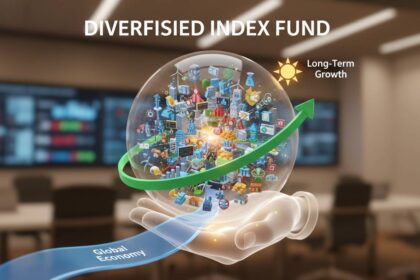

Index funds have revolutionized how Americans invest, transforming from a niche strategy into the backbone of retirement portfolios for millions. If you've ever wondered whether there's a simpler way to build wealth without spending hours researching individual stocks, understanding index funds could change your financial trajectory.
What Exactly Is an Index Fund?
An index fund is a type of investment fund designed to track a specific market index by holding the same securities in roughly the same proportions as that index. When you invest in an index fund tracking the S&P 500, you're essentially buying tiny pieces of the 500 largest U.S. companies—from Apple and Microsoft to Berkshire Hathaway and Johnson & Johnson—all in a single investment.
Key Insight: Instead of trying to pick winning stocks (a strategy where even professionals often underperform), index funds give you automatic exposure to an entire segment of the market.
The concept originated in 1971 when John "Jack" Bogle, founder of The Vanguard Group, created the first index fund available to individual investors. His radical idea was simple: most active fund managers fail to beat the market after fees, so why not simply match the market's returns at a fraction of the cost?
The Three Pillots of Index Fund Design
Every index fund operates on three fundamental principles:
-
Passive Management: Fund managers don't actively buy and sell securities based on research or predictions. They simply replicate the index's holdings.
-
Low Costs: Because there's minimal trading and no army of analysts researching stocks, operating expenses remain dramatically lower than actively managed funds.
-
Broad Diversification: A single index fund can hold hundreds or thousands of securities, instantly spreading your risk across entire sectors or even the global economy.
How Index Funds Work: The Mechanics
Understanding how index funds generate returns requires grasping the relationship between the fund and its benchmark index.
When you purchase shares of an index fund, your money pools with other investors. The fund then uses this pool to purchase securities that mirror the index it tracks. If the index contains 500 stocks, the fund owns shares in all 500—or a statistically significant sample that performs nearly identically.
The Replication Process:
Most index funds use full replication, holding every security in the index in proportion to its market weight. For the S&P 500, this means owning more Apple (the largest company) than a smaller company like Etsy. Some funds tracking broader or more obscure indices use sampling, holding a representative subset of securities that closely matches the index's performance.
📊 At-a-Glance: Index Fund Mechanics
| Component | What It Means | Investor Benefit |
|---|---|---|
| Pooled Investment | Your money combines with other investors | Access to entire market with minimal capital |
| Automatic Rebalancing | Fund adjusts holdings as index changes | No action required when companies rise or fall |
| Price Fluctuation | Fund share price moves with index | Direct market participation |
| Daily Valuation | Net Asset Value calculated each trading day | Transparent pricing |
The Role of Expense Ratios
Every index fund charges a small annual fee called the expense ratio, which covers the fund's operating costs. This is where index funds dramatically outperform their actively managed counterparts.
The average actively managed U.S. equity mutual fund charges an expense ratio of approximately 0.68%, while the average index fund charges around 0.05% to 0.15%. That difference might sound negligible, but over decades, it compounds into hundreds of thousands of dollars in lost returns.
The Key Benefits That Make Index Funds Stand Out
The case for index funds rests on several powerful advantages that directly impact your bottom line.
1. Consistent Market Matching
Rather than gambling on unpredictable active management, index funds deliver returns that closely track their benchmark. Over any 10-year period, approximately 90% of actively managed large-cap funds underperform the S&P 500, according to data from SPIVA (S&P Indices Versus Active).
This isn't because active managers are incompetent—it's simply that the odds are stacked against beating the market after accounting for higher fees, transaction costs, and the mathematical reality that for every winner there must be a loser.
2. Unprecedented Diversation
Top Advantages of Index Fund Diversification:
- Instant sector coverage: A single fund can spread investments across technology, healthcare, finance, energy, and consumer goods
- Geographic diversification: International index funds provide exposure to foreign markets without requiring currency expertise
- Risk reduction: When one company struggles, others in the index may thrive, smoothing your overall returns
- Simplicity: No need to research individual companies or worry about concentration risk
A 2023 study by Fidelity Investments found that investors who used diversified index funds experienced 40% less portfolio volatility than those with concentrated stock positions.
3. Dramatically Lower Costs
The math on fees is relentless but straightforward. Consider an investor putting $10,000 annually into a retirement account over 30 years:
| Scenario | Annual Return | Expense Ratio | Final Balance |
|---|---|---|---|
| Index Fund | 7% | 0.10% | $1.08 million |
| Active Fund | 7% | 0.75% | $980,000 |
| Difference | — | — | $100,000+ |
That $100,000 doesn't disappear—it stays in your pocket when you choose low-cost index funds.
4. Tax Efficiency
Because index funds have lower turnover—they don't constantly buy and sell securities—they generate fewer capital gains distributions. This tax efficiency advantage shows up particularly in taxable accounts, where active trading can trigger significant annual tax bills.
The Internal Revenue Service data indicates that index fund investors pay an average of 0.3% annually in taxes on their investments, compared to 0.8% for actively managed equity funds.
5. Time Liberation
Perhaps the most undervalued benefit is what you don't have to do: spend hours researching companies, monitoring quarterly earnings, worrying about headlines, or second-guessing your picks. Index funds let you build wealth while focusing on your career, family, or simply living your life.
Warren Buffett's Advice: The legendary investor has repeatedly recommended index funds for everyday investors. In his 2023 letter to Berkshire Hathaway shareholders, he wrote: "Consistently buy an S&P 500 low-cost index fund… keep buying it through thick and thin, and especially through thin."
Index Funds vs. Active Funds: A Critical Comparison
The debate between index funds and actively managed funds represents one of the most significant decisions in investing.
The Core Distinction:
Active funds employ professional managers who attempt to outperform the market by selecting securities they believe will rise. They charge higher fees for this expertise. Index funds simply track the market, accepting market returns in exchange for minimal costs.
| Factor | Index Funds | Active Funds |
|---|---|---|
| Management Style | Passive | Active |
| Typical Expense Ratio | 0.03% – 0.15% | 0.50% – 1.50% |
| Goal | Match market returns | Beat market returns |
| Tax Efficiency | High | Lower |
| Minimum Investment | Often $1 or less | Often $1,000+ |
| Performance Consistency | Matches benchmark | Variable |
The Data Verdict: According to the SPIVA U.S. Report, over the 20-year period ending December 2023, approximately 95% of large-cap active funds underperformed the S&P 500.
This doesn't mean active management is always wrong—some skilled managers do outperform, and certain market conditions may favor active approaches. However, identifying those managers in advance is nearly impossible, making index funds the statistically superior choice for most investors.
Types of Index Funds Every Investor Should Know
The index fund universe has expanded dramatically since Bogle's pioneering effort, offering options for nearly every investment objective.
U.S. Stock Index Funds
These funds track American indices like the S&P 500, Russell 2000 (small companies), or Wilshire 5000 (total market). They're the foundation of most index fund portfolios.
Best For: Core U.S. equity exposure
International Stock Index Funds
These provide exposure to foreign markets—developed economies like Japan, the UK, and Germany, as well as emerging markets in Asia, Latin America, and elsewhere.
Best For: Geographic diversification beyond U.S. borders
Bond Index Funds
While stocks get most attention, bond index funds offer stable, lower-volatility returns. They track indices of government bonds, corporate bonds, or municipal bonds.
Best For: Income generation and portfolio stabilization
Sector Index Funds
These focus on specific industries—technology, healthcare, real estate, energy. They allow targeted exposure without picking individual companies.
Best For: Tilting your portfolio toward sectors you believe will outperform
Target-Date Funds
A popular choice for retirement investing, these funds automatically adjust their allocation from stocks to bonds as you approach a specific target date (such as "2050").
Best For: Hands-off investors who want a complete portfolio in one fund
Getting Started with Index Fund Investing
Beginning your index fund journey requires understanding several practical steps.
Opening an Account
To invest in index funds, you'll need a brokerage account. Options include:
- Traditional brokerages: Charles Schwab, Fidelity, Vanguard (where index funds originated)
- Robo-advisors: Betterment, Wealthfront, M1 Finance (automated, low-minimum)
- Retirement accounts: 401(k) plans often include index fund options; IRAs at brokerages offer unlimited choices
Determining Your Allocation
Your ideal asset mix depends on factors like age, risk tolerance, and goals. A common guideline is the "120 minus your age" rule: invest that percentage in stocks, the remainder in bonds.
Example Allocation for a 35-Year-Old:
| Asset Class | Index Fund Example | Allocation |
|---|---|---|
| U.S. Total Market | Vanguard Total Stock Market (VTI) | 50% |
| International Stocks | Vanguard Total International (VXUS) | 30% |
| Bonds | Vanguard Total Bond Market (BND) | 20% |
Investing Consistently
Dollar-cost averaging—investing a fixed amount regularly regardless of market conditions—remains one of the most effective strategies. It removes emotional decision-making and ensures you buy more shares when prices are low.
Practical Steps:
1. Set up automatic monthly contributions
2. Reinvest dividends automatically
3. Increase contributions as income grows
4. Review allocation annually
Common Mistakes to Avoid
Even with index funds' simplicity, investors can undermine their success through avoidable errors.
❌ Mistake #1: Chasing Performance
Just because an index fund outperformed last year doesn't predict future results. Every index fund will underperform its benchmark at times.
❌ Mistake #2: Paying Too Much Attention
Checking your portfolio daily creates unnecessary stress. Index funds are designed for long-term holding.
❌ Mistake #3: Ignoring Expense Ratios
A 0.50% expense ratio might seem small, but it adds up. Always compare costs before investing.
❌ Mistake #4: Overlooking International Exposure
U.S. markets haven't always outperformed international markets. Geographic diversification provides crucial protection.
❌ Mistake #5: Trying to Time the Market
Waiting for the "right moment" to invest usually results in missing market gains. Time in the market beats timing the market.
Frequently Asked Questions
What is the main advantage of index funds over individual stocks?
The primary advantage is instant diversification. Individual stocks carry significant company-specific risk—one company's failure can dramatically impact your portfolio. Index funds spread this risk across hundreds or thousands of securities, so poor performance from any single company has minimal impact on your overall returns.
Are index funds safe during market downturns?
Index funds decline during market downturns because they track the market. However, historically, markets have always recovered and reached new highs over long periods. Index funds don't eliminate market risk, but they do ensure you participate in market recoveries. During downturns, continuing to invest (dollar-cost averaging) actually positions you to gain more when markets rebound.
How much money do I need to start investing in index funds?
Many index funds have minimum investments of $1 or even $0 through brokerages that offer fractional shares. You can start building wealth with as little as $50 monthly through automatic contributions. The key is consistency rather than starting with a large sum.
Can I lose all my money in index funds?
While you cannot lose your entire investment in a diversified index fund (barring catastrophic failure of the entire market system), you can lose significant value during severe market downturns. The S&P 500 dropped approximately 38% during the 2008 financial crisis but fully recovered by 2013. Index funds are designed for long-term holding, not short-term trading.
How do I choose which index fund to buy?
Consider these factors: (1) Expense ratio—lower is better, (2) Tracking error—how closely the fund matches its index, (3) Fund size and age—larger, established funds tend to be more stable, (4) Your existing portfolio—choose funds that fill gaps in your diversification. For most investors, a simple three-fund portfolio (U.S. stocks, international stocks, bonds) using low-cost index funds from a single provider like Vanguard, Fidelity, or Schwab serves as an excellent foundation.
Conclusion: The Simplicity Advantage
Index funds represent one of the most powerful wealth-building tools available to individual investors. By offering broad diversification, rock-bottom costs, tax efficiency, and consistent market matching, they remove the complexity that trip up many investors while delivering returns that outperform the majority of actively managed alternatives.
The evidence is overwhelming: index funds have earned their place as the recommended investment vehicle for retirement accounts, taxable brokerage accounts, and virtually any long-term financial goal. Whether you're just starting your investment journey or seeking to optimize an existing portfolio, low-cost index funds provide a foundation that has helped millions of Americans build lasting wealth.
Your next step is simple: open an account, select a diversified index fund matching your goals, and commit to consistent contributions. The math works in your favor—and unlike picking individual stocks, the odds of success are overwhelmingly in your corner.