

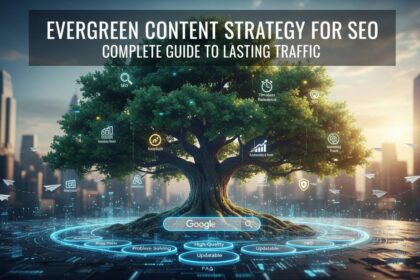

The average evergreen blog post generates traffic for 2-3 years after publication, with some pieces continuing to drive visitors for a decade or more. Yet most content teams spend 80% of their resources creating time-sensitive material that fades within weeks. This imbalance explains why many SEO strategies feel like running on a treadmill—constant effort, minimal lasting results.
This guide transforms that dynamic. You'll learn how to build a content engine that works for you continuously, not just when you publish.
What Is Evergreen Content and Why It Works
Evergreen content refers to articles, guides, and resources that remain relevant and valuable indefinitely. Unlike news articles, trend pieces, or time-sensitive announcements, evergreen content addresses persistent audience needs, fundamental questions, and core problems that don't change rapidly.
The SEO advantage is substantial. According to a 2023 analysis by Ahrefs, the top 10% of pages in search results are, on average, over 3 years old. This data point contradicts the assumption that fresh content always wins. Google's algorithm has evolved to favor content that demonstrates sustained relevance, not merely recent publication.
Key Characteristics of Evergreen Content:
- Addresses fundamental questions in your industry
- Provides comprehensive, actionable guidance
- Requires minimal updates to remain accurate
- Attractions steady search volume year-round
- Serves users at various stages of the buyer journey
- Builds authority and earns backlinks organically
The distinction between evergreen and temporal content isn't absolute. Even evergreen pieces require periodic review and minor updates. However, the maintenance investment pays dividends that temporal content cannot match—a single well-crafted evergreen article can generate thousands of monthly visits for years, while a timely news piece might peak at similar numbers before declining within days or weeks.
Identifying Topics That Withstand Time
Not all content deserves the evergreen investment. Selecting the right topics requires understanding what your audience consistently searches for and what will remain relevant as industry landscapes shift.
Topics With Sustained Search Demand
How-to guides and tutorials rank among the most durable content types. Questions like "how to write a business plan" or "how to improve credit score" maintain consistent search volume because the underlying need never disappears. The format evolves—video integration, interactive elements, updated screenshots—but the fundamental questions persist.
Fundamental concepts and explanations serve readers seeking to understand core principles. "What is SEO?" or "understanding copyright law" address enduring informational needs. These pieces become foundational resources that other sites link to repeatedly.
Comparison and decision-making content helps audiences evaluate options when they're ready to buy. "Best project management software for small teams" or "WordPress vs. Squarespace for e-commerce" serve decision-stage users consistently, provided you update pricing and feature information regularly.
Resource lists and curated collections compile valuable tools, tips, or examples. "50 productivity tools for remote workers" or "complete guide to workplace safety regulations" offer compounding value as you add new resources over time.
Evaluating Topic Viability
Before committing resources, assess each potential topic against these criteria:
| Criterion | Question to Ask | Red Flag |
|---|---|---|
| Longevity | Will this topic matter in 3-5 years? | Heavy dependence on current trends |
| Search Intent | Is the query fundamentally informational or transactional? | Navigational or purely social intent |
| Competition | Can I create something substantially better? | Top results are highly established |
| Update Frequency | How often must this content be revised? | Requires weekly or monthly updates |
| Audience Size | Does this serve a meaningful audience consistently? | Niche with minimal search volume |
Case Study: Backlinko's "Skyscraper Technique" article, published in 2013, continues ranking in the top 3 for related queries nearly a decade later. Brian Dean targeted a persistent problem—how to build backlinks—and provided a comprehensive, actionable framework. The piece receives an estimated 15,000 organic visits monthly, requiring only annual updates to maintain its position.
Building Content That Endures
Creating truly evergreen content requires more than selecting the right topic. The execution must anticipate both search engine evolution and reader expectations over time.
Comprehensive Depth
Search engines increasingly reward content that thoroughly covers a topic. The ideal evergreen piece becomes the definitive resource—the result users find and never need to click elsewhere. This requires anticipating related questions, addressing common objections, and providing actionable steps rather than surface-level overviews.
Aim for comprehensive treatment rather than artificial length. Every section should add value, not merely fill space. Research top-ranking competitors to identify gaps in their coverage, then build content that fills those gaps while maintaining higher quality across existing points.
Structural Elements That Support Longevity
Clear hierarchical organization helps both readers and search engines navigate your content. Use descriptive headings that reflect user search intent, not just keyword placement. Internal linking from related content establishes topical authority and helps users discover additional valuable resources.
Actionable guidance distinguishes evergreen content from abstract explanations. Readers should finish your piece with concrete steps they can implement immediately. This practical value drives engagement metrics that signal quality to search engines and encourages natural backlinks.
Visual aids and multimedia increase time on page and help explain complex concepts. Screenshots, diagrams, and videos illustrate processes that text alone cannot convey. These elements also provide opportunities for updates—replacing outdated screenshots or adding new videos—without restructuring the core content.
Writing for Sustainability
Your writing style directly impacts how long content remains relevant. Avoid trendy language, slang, and references that will date quickly. Instead, use precise, professional terminology that reflects industry standards.
Active voice and direct statements create more timeless prose than passive constructions or hedging language. Present established facts confidently while acknowledging where information may evolve.
Technical accuracy matters for credibility, but avoid over-specification that becomes obsolete. Describe principles and frameworks rather than version-specific instructions unless absolutely necessary.
Maintaining Your Evergreen Assets
Even the best evergreen content requires attention over time. Maintenance is not a sign of failure—it's a strategic investment that compounds returns.
Establishing a Review Cadence
Different content types require different review schedules:
| Content Type | Review Frequency | Key Focus Areas |
|---|---|---|
| How-to guides | Annual | Accuracy of steps, updated screenshots |
| Statistics/data posts | Quarterly | Current numbers, new research |
| Comparisons | Bi-annual | Updated pricing, new competitors |
| Definitions/concepts | Annual | Clarifications, new examples |
| Resource lists | Quarterly | New resources, dead links |
What to Update
When reviewing evergreen content, prioritize:
- Factual accuracy: Verify all statistics, dates, and claims
- Link integrity: Check both internal and external links
- Completeness: Add sections addressing questions you've since identified
- Formatting: Ensure compatibility with current best practices
- Search intent alignment: Confirm the content still matches user expectations
Document your updates with clear change notes. This helps teams understand what changed and why, and allows you to highlight significant revisions when repromoting the content.
Measuring Evergreen Content Success
Traditional content metrics focus on immediate performance—traffic within the first week or month after publication. Evergreen content requires a longer perspective and different success indicators.
Key Performance Indicators
Organic traffic growth: Track how each evergreen piece grows its search traffic over 6-12 month periods. Healthy evergreen content shows compound growth as it builds authority and earns more backlinks.
Search visibility: Monitor keyword rankings for target terms over time. Strong evergreen content typically achieves top 10 rankings within 6-12 months and maintains or improves that position with proper maintenance.
Backlink acquisition: Quality backlinks signal authority to search engines and drive direct referral traffic. Track new linking domains and the types of content earning links.
Engagement metrics: Time on page, scroll depth, and conversion rates indicate whether content actually serves readers. High-performing evergreen content shows strong engagement across all metrics.
Return traffic: A healthy ratio of returning visitors suggests content provides ongoing value that readers reference repeatedly.
Long-Term ROI Calculation
Compare the total traffic generated over a content's lifetime against the resources invested. A piece requiring 20 hours of initial creation plus 2 hours annually of maintenance might generate 50,000 annual visits by year three. That represents exceptional efficiency compared to temporal content requiring constant creation to maintain equivalent traffic levels.
Common Evergreen Content Mistakes
Understanding what undermines evergreen content helps you avoid costly errors.
Targeting Trending Topics
Chasing trends creates temporal content by definition. Even if you execute perfectly, the content will decline as interest fades. Focus on persistent problems and questions rather than current events or passing fads.
Insufficient Depth
Shallow content cannot become definitive resources. If your piece doesn't offer substantially more value than existing top results, it won't earn the authority needed for sustained rankings. Invest in comprehensive treatment of your chosen topic.
Ignoring Updates
Publishing evergreen content is the beginning, not the end. Content that becomes outdated loses credibility with both users and search engines. Budget maintenance time from the start.
Poor Internal Linking
Evergreen content gains authority when connected to related content within your site.孤立 content misses opportunities to build topical clusters and guide users through your content ecosystem.
Neglecting User Intent
Ranking metrics matter less than serving actual user needs. Content that ranks but fails to satisfy visitors will eventually decline. Prioritize genuine value over keyword optimization tricks.
Frequently Asked Questions
How long does it take for evergreen content to start ranking?
Evergreen content typically begins ranking within 3-6 months, with significant traffic growth occurring between months 6-12 as the piece builds authority through backlinks and engagement signals. Patience is essential—evergreen content is a long-term investment, not a quick wins strategy.
Should I update or replace underperforming evergreen content?
First, analyze why content underperforms. If the topic is sound but execution is weak, update thoroughly—improving depth, structure, and comprehensiveness. If the topic has inherently low demand or excessive competition, create new content targeting a different angle rather than replacing the existing piece.
How many evergreen articles should I create?
Quality matters more than quantity. Start with 10-15 comprehensive evergreen pieces targeting your most important topics and keywords. Expand based on performance data and audience needs. Most sites achieve significant results with 30-50 well-executed evergreen articles rather than hundreds of shallow pieces.
Can evergreen content work for competitive industries?
Yes, but the bar is higher. In competitive niches, evergreen content must be exceptional—truly the definitive resource on its topic. Focus on underserved angles, superior depth, and unique original insights or data. Building authority takes longer but the resulting traffic is more valuable.
How do I promote evergreen content after publishing?
Promote evergreen content consistently rather than heavily immediately after publication. Share on social media periodically, include links in relevant newer content, reach out to sites that might benefit from linking to your resource, and ensure internal linking from related content on your site.
What's the difference between evergreen content and pillar content?
Evergreen content describes temporal relevance—content that remains valuable over time. Pillar content describes structural role—comprehensive hub pages that organize related content. A pillar page can be evergreen if it addresses a persistent topic, but the terms describe different dimensions of content strategy.
Building Your Evergreen Content Engine
The strategies in this guide work because they align with how search engines actually evaluate content quality and how users genuinely find value. By focusing on persistent audience needs, creating genuinely comprehensive resources, and maintaining those investments over time, you build an asset base that compounds.
Start by auditing your existing content. Identify pieces with evergreen potential that are currently underperforming due to insufficient depth or poor maintenance. Prioritize your highest-value topics, then commit to creating genuinely definitive resources. The initial investment is significant, but the long-term traffic returns justify the effort.
Remember: every piece of evergreen content you create is an employee that works for you indefinitely. Invest accordingly.