

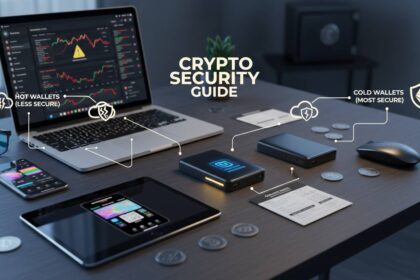

Cryptocurrency investments have grown from a niche interest into a mainstream asset class worth over $2 trillion globally. Yet with this growth comes an alarming reality: crypto investors lost approximately $4.2 billion to hacks, scams, and fraud in 2023 alone (Chainalysis, February 2024). Unlike traditional bank accounts protected by the FDIC or securities regulated by the SEC, cryptocurrency holdings often lack fundamental consumer protections. This guide provides actionable strategies to secure your digital assets against theft, loss, and human error.
Understanding Cryptocurrency Security Fundamentals
Unlike conventional financial assets, cryptocurrency exists entirely in digital form and relies on cryptographic keys for access. When you own Bitcoin, Ethereum, or any other cryptocurrency, what you actually possess is a private key—a 256-bit number that proves your ownership and authorizes transactions. Losing this key means losing your funds permanently. Someone stealing it gains complete control.
The security challenge breaks down into three primary threat vectors. First, external attackers including hackers, malware, and phishing schemes target vulnerable systems. Second, exchange failures and insolvency have devastated investors, as seen when FTX collapsed in November 2022, leaving customers unable to access an estimated $8.9 billion in funds. Third, user error accounts for a significant portion of losses, whether through accidental deletion, forgotten passwords, or sending funds to incorrect addresses.
Understanding these threats shapes your security strategy. No single solution provides complete protection—rather, you must implement layered defenses addressing each vulnerability.
Hot Wallets vs. Cold Wallets: Choosing Your Storage Method
Your choice of wallet storage fundamentally determines your security posture. Crypto wallets divide into two categories: hot wallets connected to the internet and cold wallets kept offline.
Hot wallets include exchange-provided wallets, mobile apps, and browser extensions. They offer convenience for frequent trading but remain perpetually vulnerable to online attacks. Major exchanges including Coinbase and Binance implement security measures like two-factor authentication and cold storage for customer funds, yet they remain attractive targets for hackers. In 2024 alone, crypto exchanges experienced 27 major security breaches (Security.org, December 2024).
Cold wallets store your private keys entirely offline, making them immune to remote hacking. Hardware wallets like Ledger and Trezor devices generate and store keys within secure chips, requiring physical access to authorize transactions. Software wallets configured for offline storage on air-gapped computers provide another cold storage option.
For most investors, the optimal approach uses both: keep small amounts in hot wallets for active trading while storing the majority of holdings in cold storage. Financial experts consistently recommend keeping no more than 5-10% of crypto holdings in hot wallets (CoinDesk Analytics, October 2024).
Hardware Wallets: The Gold Standard for Crypto Security
Hardware wallets provide the strongest individual defense for cryptocurrency holdings. These physical devices store private keys in isolated secure elements, specialized chips designed to resist tampering and extraction attempts.
The leading hardware wallets include several proven options:
| Device | Security Features | Price | Best For |
|---|---|---|---|
| Ledger Nano X | Secure element chip, Bluetooth, 100+ coin support | $149 | Mobile users, multiple assets |
| Trezor Model T | Open-source firmware, touchscreen, Shamir backup | $169 | Security transparency advocates |
| Ledger Nano S Plus | Secure element, compact design, 5,500+ coins | $79 | Budget-conscious users |
| Ellipal Titan | Air-gapped design, metal construction | $169 | Maximum offline security |
When selecting a hardware wallet, purchase exclusively from the manufacturer—never from third-party sellers on Amazon or eBay, where counterfeit devices have been documented. Ledger and Trezor both explicitly warn against unauthorized resellers (Ledger.com, 2024; Trezor.io, 2024).
Setup requires generating a new recovery seed rather than importing existing keys, ensuring your device has never been compromised. Write down your 12 or 24-word recovery phrase on paper—never digitally—and store it in multiple secure locations, ideally in a safe deposit box or home safe.
Implementing Multi-Layer Security Practices
Beyond wallet selection, effective cryptocurrency security requires implementing multiple protective measures simultaneously.
Two-factor authentication (2FA) represents your first line of defense on exchanges and wallets. However, not all 2FA methods provide equal protection. SMS-based 2FA has become vulnerable to SIM-swapping attacks, where criminals transfer your phone number to their device. Use authenticator apps like Google Authenticator or Authy instead, or better yet, use hardware security keys like YubiKey for accounts that support them (FBI Public Service Announcement, May 2023).
Strong, unique passwords prevent unauthorized access. Never reuse passwords across crypto platforms—data breaches regularly expose credentials that attackers then test across multiple services. Password managers like 1Password or Bitwarden generate and store unique passwords securely.
Email security often gets overlooked. Your email account essentially serves as the keys to your kingdom—compromised email allows attackers to reset passwords on exchanges and wallets. Enable 2FA on your email provider and consider using a dedicated email address specifically for cryptocurrency activities.
VPN usage protects against man-in-the-middle attacks when accessing crypto accounts on public networks. Always use a reputable VPN when transacting on unfamiliar networks.
Protecting Against Common Scams and Phishing
Cryptocurrency's pseudonymous nature creates fertile ground for scams. Understanding attacker tactics helps you recognize and avoid threats.
Phishing attacks trick you into revealing credentials through fake websites, emails, or messages. Attackers create convincing replicas of exchange login pages or wallet interfaces. Always verify URLs carefully—check for subtle misspellings or unexpected domains. Bookmark your exchange URLs directly rather than clicking links.
Fake support accounts proliferate on Twitter, Discord, and Telegram. Official support teams never initiate contact asking for passwords, recovery phrases, or remote computer access. The Ledger data breach in 2020 exposed customer information, leading to years of targeted phishing attacks against Ledger owners (The Block, January 2021).
Rug pulls and fraudulent projects plague decentralized finance. Research any project thoroughly before investing—check for audited smart contracts, verified team members, and legitimate use cases. The average lifespan of a cryptocurrency scam project is under 30 days .
Investment schemes promising guaranteed returns or doubling your crypto should immediately raise suspicion. Cryptocurrency investments carry no FDIC insurance and no legitimate investment guarantees returns.
Backup and Recovery: Protecting Against Data Loss
Human error causes more cryptocurrency losses than hacking. Implementing proper backup procedures protects against accidental loss.
Your recovery seed phrase represents the ultimate backup. This list of 12 or 24 words can recreate your private keys on any compatible wallet. Treat this phrase with extreme care:
- Write it on paper—multiple copies stored in different secure locations
- Consider steel backup plates like CryptoSteel or Billfodl for fire and water resistance
- Never photograph or store digitally
- Never share with anyone, including family members or "support" representatives
- Store separately from your hardware wallet—if someone finds both, they have complete access
Diversify your backup locations. One copy in your home, one in a safe deposit box, one with a trusted family member in another location. Geographic distribution protects against fire, theft, or natural disasters affecting your primary location.
Document your setup thoroughly. Create a secure document listing which wallets you use, approximate balances, and recovery procedures for your designated beneficiaries. This protects against losing access if something happens to you.
Insurance and Regulatory Considerations
While cryptocurrency lacks traditional banking protections, some insurance options exist.
Exchange-provided insurance varies significantly. Coinbase maintains crime insurance covering digital assets held on their platform up to $250,000 per user for cash and $1 million for crypto holdings, though this protection has never been tested by a major claim . Gemini and Kraken offer similar provisions. However, this insurance typically covers external theft—not user error or internal malfeasance.
Self-directed crypto insurance from providers like Nexus Mutual and InsurAce allows covering your own holdings, though policies often exclude certain scenarios and carry significant premiums.
Regulatory developments continue evolving. The SEC has increased enforcement actions against crypto securities violations, and MiCA regulations in Europe create new compliance frameworks. While these don't directly protect your holdings, using regulated platforms provides some recourse if fraud occurs.
Frequently Asked Questions
What is the safest way to store cryptocurrency for long-term holding?
Hardware wallets provide the safest long-term storage. Keep your private keys completely offline in a hardware device like Ledger or Trezor. Store your recovery phrase securely in multiple physical locations. Only connect the device to computers when actively transacting, and always verify transaction addresses on the device screen itself.
Should I keep my crypto on exchanges or in personal wallets?
For active trading, keeping small amounts on reputable exchanges offers convenience. However, never store significant holdings on exchanges due to counterparty risk—the exchange could be hacked, become insolvent, or restrict access. Move holdings to your personal wallet, especially for amounts you don't plan to trade within the next few weeks.
What happens if I lose my hardware wallet?
Losing your hardware wallet doesn't lose your crypto—as long as you have your recovery seed phrase. Purchase a new device from the manufacturer, enter your recovery phrase during setup, and your funds will restore immediately. This is why securing your recovery phrase is absolutely critical.
Can cryptocurrency be stolen if my wallet is offline?
Offline cold storage is nearly impossible to hack remotely. However, physical theft remains possible. Keep your hardware wallet and recovery phrase in separate secure locations. Some investors use vaults or safe deposit boxes for their primary backup. The combination of offline storage and geographic backup distribution provides strong protection against both digital and physical theft.
How do I know if a cryptocurrency website is a scam?
Verify URLs carefully—scammers register domains with typos. Check for HTTPS but understand it doesn't guarantee legitimacy. Research the project thoroughly: look for transparent teams, published code audits, and legitimate community presence. Be extremely wary of unsolicited investment offers, guaranteed returns, or anyone asking for your recovery phrase.
Is cryptocurrency insurance worth it?
For small holdings, exchange-provided coverage may suffice. For large portfolios, self-directed insurance from providers like Nexus Mutual can provide peace of mind, though premiums reduce your overall returns. The decision depends on your total holdings, risk tolerance, and whether you're comfortable with existing protections from your chosen platforms.
Conclusion: Building Your Security Strategy
Securing cryptocurrency investments requires accepting personal responsibility that traditional finance handles for you. The strategies in this guide—hardware wallets for primary storage, cold storage for long-term holdings, multi-factor authentication, careful backup practices, and vigilance against scams—create defense layers that protect against the vast majority of threats.
Start by auditing your current setup. Move funds from exchanges to personal wallets. Enable two-factor authentication on every crypto-related account. Purchase a hardware wallet if you haven't already. Write down your recovery phrase and store it securely.
The cryptocurrency market will continue evolving, and new threats will emerge. Your security practices must evolve with them. Begin with these foundational steps today—your future self will thank you.