

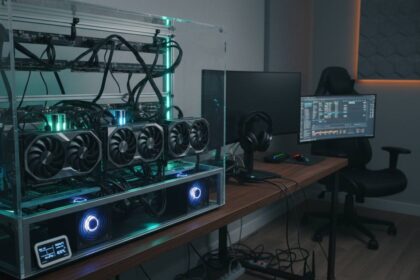

Cryptocurrency mining is the process of validating transactions on a blockchain network and adding them to the public ledger while earning newly created coins as rewards. In simpler terms, miners use powerful computers to solve complex mathematical puzzles; when they succeed, they earn cryptocurrency. This process secures the network and introduces new coins into circulation. This guide walks you through everything you need to know to start mining, from understanding the fundamentals to setting up your first operation and calculating potential profitability.
What Is Cryptocurrency Mining?
Cryptocurrency mining serves two fundamental purposes: securing the blockchain network and minting new digital currency. When someone sends cryptocurrency transactions, these transactions need verification to prevent fraud. Miners group these transactions into blocks and compete to solve a cryptographic puzzle—the first to solve it gets to add the block to the blockchain and receives a reward in newly minted coins.
This mechanism is called Proof of Work (PoW), and it was pioneered by Bitcoin, the first cryptocurrency. The puzzle requires significant computational effort to solve but is easy to verify once solved. This asymmetry is what makes the system secure—altering any historical block would require re-solving all subsequent blocks, which becomes computationally impossible as the chain grows.
The mining reward serves as an economic incentive for participants to dedicate their computing resources to network security. For Bitcoin, the current block reward stands at 3.125 BTC per block as of 2024, following the periodic "halving" events that reduce rewards approximately every four years. Other cryptocurrencies using PoW include Ethereum Classic, Litecoin, Dogecoin, and Monero, each with different reward structures and mining algorithms.
Key Insights
- Bitcoin mining rewards halve approximately every four years, with the next halving expected around 2028
- The Bitcoin network's total hash rate exceeds 600 exahashes per second as of late 2024
- Individual miners rarely succeed alone due to competition from large-scale operations
- Mining difficulty adjusts automatically to maintain consistent block times
How Cryptocurrency Mining Works
The mining process begins when transactions are broadcast to the network. Miners collect pending transactions from the memory pool and organize them into a candidate block. Each block contains a header containing the previous block's hash, a Merkle root representing all transactions in the block, a timestamp, and a nonce—a random number miners repeatedly change to generate different hash outputs.
The target is to produce a hash that falls below a specific threshold set by the network's difficulty adjustment. Since cryptographic hash functions produce seemingly random outputs, miners must essentially guess repeatedly until one meets the criteria. This is why mining is often compared to searching for a specific grain of sand in an infinite desert—the probability of success per attempt is minuscule, but the massive volume of attempts makes eventual success statistically probable.
When a miner finds a valid hash, they broadcast the solution to the network. Other nodes verify the solution by running the same calculation and confirming the block meets all consensus rules. Once verified, the block becomes part of the permanent blockchain, and the successful miner receives their reward. This reward cannot be spent immediately—most cryptocurrencies include a maturation period, typically 100 blocks for Bitcoin, before the coins become spendable.
The difficulty of these puzzles adjusts dynamically. As more miners join the network, blocks are solved faster than intended, causing the protocol to increase difficulty. Conversely, when miners leave, difficulty decreases. This self-regulating mechanism ensures block times remain relatively stable—approximately 10 minutes for Bitcoin.
| Component | Function | Importance |
|---|---|---|
| Block Header | Contains metadata for the puzzle | Essential |
| Previous Hash | Links to prior block | Critical for security |
| Merkle Root | Summarizes all transactions | Ensures integrity |
| Nonce | Variable number for guessing | Miner's tool |
| Target | Difficulty threshold | Determines rarity |
Types of Cryptocurrency Mining
Solo Mining vs. Pool Mining
Solo mining involves working independently, competing against every other miner on the network. While successful blocks yield the full reward, the probability of an individual miner solving a block is extremely low given the current network difficulty. For most beginners, solo mining is impractical—statistically, you might wait years before solving a single block with consumer-grade equipment.
Mining pools aggregate the computational power of many miners, increasing the group's collective chance of solving blocks. When the pool succeeds, rewards are distributed proportionally among participants based on their contributed hash power. This provides steady, smaller payments rather than infrequent large payouts. Most individual miners join pools, with popular options including Foundry, AntPool, and F2Pool.
Cloud Mining
Cloud mining allows you to rent computing power from remote data centers. You pay a contract fee and receive a share of the mining rewards generated by the provider's hardware. This eliminates the need to purchase, configure, and maintain physical equipment, but comes with significant drawbacks. Cloud mining contracts often have fixed terms that may become unprofitable if cryptocurrency prices drop or network difficulty increases. Additionally, many cloud mining companies have been revealed as scams, making due diligence essential.
Hardware Options
ASIC Miners (Application-Specific Integrated Circuits) are purpose-built machines designed exclusively for mining specific algorithms. They offer the highest hash rates and efficiency but represent substantial capital investment. Modern ASICs for Bitcoin, like the Antminer S21, cost several thousand dollars each and consume significant electricity. Their specialized nature means they cannot be repurposed if mining becomes unprofitable.
GPU Mining uses graphics cards originally designed for gaming. While less efficient than ASICs for Bitcoin, GPUs can mine various cryptocurrencies and remain flexible if you want to switch between different coins. NVIDIA and AMD GPUs have been popular choices, though availability and pricing fluctuate dramatically due to demand from both gamers and miners.
CPU Mining involves using a computer's processor, which is the least efficient method. While theoretically possible, CPU mining for major cryptocurrencies generates negligible returns that rarely cover electricity costs. Some privacy-focused coins like RandomX-optimized Monero still support CPU mining as a legitimate option.
| Method | Initial Cost | Efficiency | Flexibility | Best For |
|---|---|---|---|---|
| ASIC Mining | $2,000-$10,000+ | Highest | Very Low | Bitcoin, specific algos |
| GPU Mining | $500-$3,000 | Moderate | High | Altcoins, dual-mining |
| Cloud Mining | $100-$10,000 | Variable | Low | Beginners, hands-off |
Setting Up Your Mining Operation
Hardware Setup
Begin by selecting your mining hardware based on your budget and target cryptocurrency. For Bitcoin, ASIC miners are essentially mandatory due to competitive difficulty. For other coins, research which algorithms your preferred GPU can mine efficiently. Popular GPU-minable coins include Ethereum Classic, Ravencoin, and Ergo.
Once you have hardware, you'll need appropriate power supply units (PSUs) with sufficient wattage—ASICS often require dedicated circuits. Proper cooling is critical; mining hardware generates substantial heat and can fail quickly without adequate ventilation or cooling solutions. Many miners use industrial fans, air conditioning, or even immersion cooling for high-end setups.
Software Configuration
Mining software connects your hardware to the blockchain network or mining pool. Popular options include CGMiner (classic, text-based), NiceHash (user-friendly with auto-conversion to Bitcoin), and HiveOS (advanced management for multiple rigs). The software configuration typically involves entering your pool credentials, wallet address, and hardware settings.
You'll also need a cryptocurrency wallet to receive your mining rewards. Hardware wallets like Ledger or Trezor provide the best security for significant holdings, while software wallets offer convenience for smaller amounts. Never mine directly to exchange wallets—exchanges can freeze accounts, and moving coins out costs fees.
Choosing a Mining Pool
Pool selection involves evaluating several factors: payout frequency, fee structure, pool size, and geographic server location. Larger pools offer more consistent payouts due to increased collective hash power, but rewards are more thinly distributed. Smaller pools may pay larger amounts per block but with longer intervals between payouts.
Pools typically charge 1-4% of rewards as fees. Some pools offer proportional payments (PPS), guaranteeing fixed rewards per share submitted, while others use more complex schemes like Pay-Per-Last-N-Shares (PPLNS) that can yield higher returns over time but include variance. Server location matters because network latency affects share submission—a closer server means fewer stale shares.
Profitability and Costs
Mining profitability depends on three primary factors: hash rate (your computing power), electricity costs, and cryptocurrency market value. Calculate your potential earnings using mining profitability calculators, which account for current difficulty, reward structures, and electricity prices—but remember these are estimates that change constantly.
Electricity is typically the largest ongoing expense. The most efficient ASIC miners consume around 30-50 joules per terahash, but even these can cost hundreds of dollars monthly in electricity depending on your local rates. The average U.S. industrial electricity rate is approximately $0.12 per kilowatt-hour, though residential rates often exceed this. Many profitable miners locate operations in regions with cheap electricity, such as parts of Texas, Washington State, or international locations with hydroelectric power.
| Factor | Impact on Profitability | Typical Range |
|---|---|---|
| Hash Rate | Directly proportional | 100 TH/s - 500+ TH/s |
| Electricity Cost | Inversely proportional | $0.05 - $0.30/kWh |
| Pool Fees | Reduces earnings | 1% - 4% |
| Market Price | Highly variable | Volatile |
| Difficulty | Inversely proportional | Adjusts ~biweekly |
Beyond electricity, factor in hardware depreciation—ASIC miners typically have 3-5 year lifespans before becoming obsolete or failing. Cooling costs, internet service, and potential facility rentals add to operational expenses. Many miners find their equipment becomes unprofitable before the hardware fails, particularly as difficulty increases and cryptocurrency prices fluctuate.
Is Mining Right for You?
Before investing in mining equipment, honestly assess your situation. Mining requires technical comfort with hardware configuration, ongoing maintenance, and financial management of fluctuating revenues and expenses. The initial capital outlay is substantial—quality ASIC miners start around $2,000, and setting up proper electrical and cooling infrastructure adds significantly to costs.
Consider your motivation carefully. If you expect easy profits, cryptocurrency mining will likely disappoint. The economics are challenging, with many variables outside your control. However, if you're passionate about supporting decentralized networks, want to learn about blockchain technology, and have access to cheap electricity, mining can be a rewarding long-term pursuit.
Alternative approaches may better serve your goals. Purchasing cryptocurrency directly involves less complexity and often higher returns than mining, particularly for casual investors. Staking—holding coins in a wallet to support PoS blockchain operations—offers similar economic participation with lower resource requirements. Trading profitably requires expertise but avoids the operational burdens of physical mining operations.
The Future of Cryptocurrency Mining
The mining landscape continues evolving rapidly. Bitcoin mining's environmental concerns have prompted increased renewable energy adoption—the Bitcoin Mining Council reports sustainable energy usage exceeding 50% among major North American miners. Institutional players dominate an increasingly professionalized industry, with publicly traded mining companies operating at scales impossible for individuals.
Regulatory attention is intensifying globally. Some jurisdictions have restricted or banned mining due to energy consumption concerns, while others actively recruit mining operations for economic development. Tax implications vary by location but generally treat mining rewards as taxable income at fair market value upon receipt.
Technological developments may reshape mining. The next generation of ASICs promises improved efficiency, potentially extending the viability of PoW mining. Some communities are experimenting with alternative consensus mechanisms that maintain mining's security benefits while reducing energy consumption. Regardless of specific developments, mining will likely remain a cornerstone of cryptocurrency economics for the foreseeable future.
Frequently Asked Questions
Is cryptocurrency mining still profitable in 2024-2025?
Profitability is possible but challenging. Success depends heavily on electricity costs, hardware efficiency, and cryptocurrency prices. Many individual miners operate at losses or minimal margins. Profitable miners typically have access to electricity below $0.10/kWh and use efficient, modern equipment. Calculate your specific numbers using profitability calculators before investing.
How much does it cost to start mining Bitcoin?
A basic ASIC miner suitable for home use costs approximately $2,000-$4,000. Beyond the hardware, budget for appropriate power infrastructure, cooling solutions, and ongoing electricity costs. Full setups with proper electrical work can exceed $5,000-$10,000. Starting smaller with used equipment carries higher failure risks.
How long does it take to mine one Bitcoin?
With a modern ASIC like the Antminer S21 (200 TH/s), you would need approximately 3-5 years to solve a block solo given current Bitcoin network difficulty. Joining a pool provides proportional rewards—pooled mining might yield 0.0005-0.001 BTC monthly with similar hardware, depending on pool performance and fees.
Can I mine cryptocurrency with a regular laptop?
You can technically mine, but it will not be profitable. CPU mining generates perhaps a few cents monthly while potentially damaging your hardware through heat and wear. Even specialized software cannot overcome the fundamental inefficiency of consumer processors compared to ASICs or GPUs. Some coins claim CPU-friendly mining, but network participants quickly saturate any profitability.
What happens when all cryptocurrency is mined?
Bitcoin's supply is capped at 21 million coins, with the final coins expected around 2140. After all coins are minted, miners will rely on transaction fees as compensation for their work. This transition ensures network security continues even after block rewards end, though fee markets must develop sufficiently to incentivize continued mining.
Is mining legal in the United States?
Yes, cryptocurrency mining is legal in the United States at the federal level. Some states have varying regulations or electricity rate structures that affect viability. Municipalities may have zoning or noise ordinances relevant to mining operations. Always verify local regulations before establishing a mining operation, particularly for larger setups.