

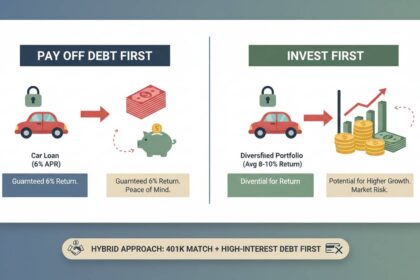

The question of whether to pay off debt or invest first is one of the most common financial dilemmas Americans face today. With credit card rates hovering near historic highs and the stock market offering seemingly endless opportunities, the decision has real consequences for your wealth. The right choice depends on your specific situation—and the math might surprise you.
Understanding the Debt vs. Investment Dilemma
The core tension is straightforward: every dollar you put toward debt is a guaranteed return (the interest rate you're paying), while every dollar invested offers uncertain returns but potential growth over time. This simple framing, however, masks a more complex reality that financial advisors grapple with daily.
According to a 2024 survey by Northwestern Mutual, 37% of Americans carry credit card debt, with an average balance of $6,850. Meanwhile, the S&P 500 has delivered approximately 10% average annual returns over long periods. The question becomes: should you eliminate a guaranteed 19% credit card obligation or capture market returns that may or may not exceed that?
The quick answer: It depends on the interest rate, your emergency fund status, and whether your employer offers matching contributions on retirement accounts.
Key Factors That Determine the Right Move
Before making any decision, you need to evaluate five critical factors. Skip this step, and you're guessing rather than planning.
Interest Rate Comparison
The first calculation is simple: compare your debt interest rate to expected investment returns. Financial professionals often use the concept of a "risk-free return" when advising clients. If your debt interest rate exceeds what you could reasonably earn investing, mathematically speaking, paying off debt wins every time.
The break-even threshold typically falls between 5% and 7%. Credit card rates averaging 19-24% almost always justify prioritizing debt payoff. Mortgage rates around 6-7% create a genuine gray area where either approach could make sense.
Emergency Fund Status
No investment strategy works if you're one financial emergency away from accumulating more debt. Most certified financial planners recommend having three to six months of expenses in an emergency fund before aggressively paying down debt or investing.
If you have zero emergency savings, building that foundation should come first—before both debt payoff and investing. Otherwise, an unexpected car repair or medical bill sends you back into debt, erasing any progress.
Employer Retirement Matches
This factor is non-negotiable according to nearly every financial advisor. If your employer offers a 401(k) match, contributing enough to capture that full match should typically come before extra debt payments.
A 50% employer match is an instant 50% return on your money—far exceeding any debt interest rate except perhaps predatory lending. Leaving that money on the table is essentially turning down free cash.
When Paying Off Debt Should Come First
Certain situations clearly favor aggressive debt elimination. Understanding these scenarios helps you make an informed decision rather than following generic advice that may not fit your life.
High-Interest Consumer Debt
Credit card balances, personal loans with rates above 10%, and store credit cards should generally be prioritized over investing. The math is brutal but undeniable: paying off a 24% credit card is like earning a guaranteed 24% return. No investment can promise that consistently.
Consider this scenario: You have $10,000 in credit card debt at 22% APR and $5,000 you could invest. Even if the market returns 10% annually, you'd need to invest nearly $23,000 to equal the $2,200 annual interest savings from paying off that debt.
Debt Affecting Your Mental Health
Financial stress impacts more than your bank account. A 2023 study published in the Journal of Financial Planning found that high debt levels correlate strongly with decreased life satisfaction and increased anxiety—regardless of net worth.
If debt keeps you up at night, the psychological benefits of eliminating it may outweigh mathematical optimization. Peace of mind has real value that compound interest calculations don't capture.
Variable-Rate Debt
While current rates are high by historical standards, they could decline in the future. If you have debt at variable rates, paying it down reduces your exposure to potential rate increases. This defensive move becomes more attractive as rates climb.
When Investing First Makes More Sense
Conversely, certain conditions suggest investing should take priority. These situations often involve lower-interest debt, employer matches, or specific financial goals that require market participation.
Low-Interest Fixed Debt
Mortgage loans at 3-4%, student loans at 3-5%, or auto loans below 6% may warrant a different approach. These rates are low enough that historically, investing the difference could yield better returns.
The math works like this: If your mortgage is at 4% and you expect 7-8% market returns over time, investing the extra cash potentially nets you 3-4% in positive spread. This "spread investing" requires discipline and time horizon, but the numbers favor investment in these cases.
Tax-Advantaged Retirement Accounts
401(k) contributions, especially with employer matches, and Roth IRA contributions offer benefits that debt elimination cannot match. These accounts provide tax advantages, potential employer matches, and decades of tax-free growth.
Financial planner Katherine L. Smith, CFP, based in Denver, frequently advises clients: "I'm yet to see a client regret maxing out their 401(k) match and Roth IRA while paying minimums on low-interest debt. The tax advantages compound in ways that simple interest calculations miss entirely."
Building Credit for Major Purchases
paradoxically, sometimes you need to take on more debt strategically. Building credit history for future mortgage eligibility might require maintaining some debt utilization. Closing accounts reduces your available credit, potentially hurting your score. In these cases, strategic minimal debt management supports larger financial goals.
The Math Behind Your Decision
Let's run actual numbers to illustrate how this plays out in real scenarios.
Scenario A: Credit Card Debt
| Factor | Value |
|---|---|
| Credit card balance | $8,000 |
| Interest rate | 22% APR |
| Monthly payment (minimum) | $200 |
| Time to payoff (minimum) | 58 months |
| Total interest paid | $3,580 |
With $500 monthly payment: Debt cleared in 19 months, interest paid $1,420. Savings versus minimum: $2,160.
Scenario B: Investment Alternative
| Factor | Value |
|---|---|
| Investment amount | $500/month |
| Expected return | 7% annually |
| Value after 19 months | $9,870 |
| Value after 58 months | $37,850 |
The investment path yields more money if you can maintain the payments. However, the $3,580 in avoided interest from aggressive payoff is guaranteed. The investment returns are not.
This is the crux of the decision: guaranteed returns versus uncertain future value. Most people underestimate the psychological weight of debt elimination and overestimate their investment consistency.
Expert Strategies That Combine Both Approaches
The best approach often isn't binary. Sophisticated financial planning incorporates elements of both debt payoff and investing simultaneously.
The Avalanche Method
List all debts by interest rate, paying minimums on all while attacking the highest-rate debt with extra money. This mathematically saves the most interest over time. For credit cards, this approach works best.
The Snowball Method
Alternatively, pay minimums on all debts while targeting the smallest balance first for psychological wins. Personal finance author and advisor David Ramsey popularized this approach, noting that momentum matters as much as mathematics. The emotional victory of clearing a small debt keeps people motivated.
Hybrid Strategies
Some financial advisors recommend a balanced approach: maintain emergency savings, capture employer matches, then split extra money 50/50 between debt and investing. This provides diversification between guaranteed returns and market growth.
Tom Anderson, CFA and founder of Beacon Wealth Management in Chicago, explains: "I recommend splitting focus for clients with moderate debt between 5-8%. They get guaranteed wins from debt payoff while still participating in market growth. The psychological balance often leads to better long-term outcomes than extreme approaches."
Special Situations Requiring Different Thinking
Certain life stages or circumstances change the standard advice significantly.
Student Loan Considerations
With federal student loans, income-driven repayment plans and potential forgiveness programs exist that private debt doesn't offer. However, interest still accrues during deferment. Evaluate whether your federal loans qualify for forgiveness programs before accelerating payments. The math changes substantially if 10-25 years of payments result in remaining balance forgiveness.
Business Debt
Self-employed individuals or business owners face different calculations. Business debt may be tax-deductible, changing the effective interest rate. Additionally, business growth often depends on reinvestment. A small business loan at 8% enabling 20% revenue growth makes mathematical sense to service while investing in expansion.
Inherited or Windfall Debt
When receiving unexpected money—an inheritance, lottery win, or large bonus—deciding between debt and investment changes. Financial advisors generally recommend paying off high-interest debt regardless, but low-interest debt becomes more negotiable. With windfalls, the guaranteed "return" from debt payoff is less compelling since you're not sacrificing current cash flow.
Frequently Asked Questions
Should I pay off debt before starting to invest?
Yes, with three exceptions: you have an emergency fund established, your employer offers 401(k) matching, and your debt interest rate is below approximately 5%. Otherwise, eliminating high-interest debt provides a guaranteed return that exceeds typical investment returns.
Does the type of debt matter in this decision?
Absolutely. Credit card debt at 20%+ should always be prioritized. Mortgage debt at 4% is vastly different from that credit card balance. Calculate your effective interest rate on each debt type and prioritize accordingly.
How much should I have in emergency savings before choosing investing over debt?
Three to six months of expenses is the standard recommendation. Start with one month if you're aggressively paying high-interest debt, then build to three months once that debt is gone.
What if my employer matches my 401(k) contribution?
Always contribute enough to get the full employer match first. This is an instant 50-100% return, far better than any debt interest rate except the most predatory lending.
Is it ever worth investing while carrying credit card debt?
Rarely, unless the debt is very low-interest (under 5%) and you have excellent emergency savings. In most cases, the guaranteed return from debt elimination exceeds uncertain investment gains.
How do I decide if I'm in the "gray area" with moderate interest debt?
For debt between 5-8%, consider your risk tolerance, time horizon, and tax situation. If you're younger with decades until retirement and can tolerate market volatility, investing may win. If market declines would cause you to sell investments, debt payoff provides more certainty.
Making Your Decision
The pay-off-debt-versus-invest question has no universal answer. Your interest rates, emergency savings, employer benefits, risk tolerance, and psychological relationship with debt all factor in.
For most people: Build a small emergency fund of $1,000-2,000, capture your full 401(k) match, then attack high-interest debt aggressively. Once credit cards are gone, rebuild emergency savings to three to six months, then maximize retirement accounts while paying minimums on low-interest debt.
The bottom line: High-interest debt demands priority. Low-interest debt allows flexibility. The key is understanding which category your specific debt falls into—and acting accordingly rather than following generic advice that may not fit your numbers.
Your next step: Calculate your exact interest rates, check your employer match policy, assess your emergency fund status, then decide. The math will tell you the truth if you're willing to look at it honestly.