

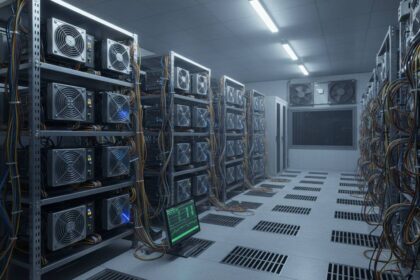

Crypto mining is the process by which new cryptocurrency tokens are created and transactions are verified and added to a blockchain ledger. Miners use powerful computers to solve complex mathematical puzzles that validate transactions, and in exchange, they receive newly minted coins as a reward. This process secures the network and introduces new coins into circulation without requiring a central authority like a bank or government.
Key Insights
- Crypto mining secures blockchain networks through mathematical verification
- Miners compete to solve puzzles, with the winner earning newly created coins
- The process consumes significant energy due to computational demands
- Mining profitability depends on electricity costs, hardware efficiency, and cryptocurrency prices
- Different cryptocurrencies use different consensus mechanisms, affecting how mining works
The mining ecosystem has grown from hobbyists using basic computers into a multi-billion dollar industry dominated by specialized hardware and large-scale operations. Understanding how mining works is essential for anyone interested in cryptocurrencies, whether you plan to mine yourself or simply want to comprehend the fundamentals behind digital currencies like Bitcoin.
How Cryptocurrency Mining Works
At its core, cryptocurrency mining serves two primary purposes: confirming transactions and creating new coins. When someone sends cryptocurrency to another person, that transaction needs verification to prevent fraud. Miners group thousands of transactions into blocks and compete to solve a mathematical puzzle that validates the entire block.
The process begins when a transaction is broadcast to the cryptocurrency network. Transactions wait in a mempool—a waiting area for unconfirmed transactions—until miners pick them up and organize them into a candidate block. The miner then attempts to find a valid hash, which is a fixed-length string of numbers and letters that meets specific criteria established by the network's protocol.
This hash-finding process involves repeatedly changing a small piece of data called a "nonce" and running it through a cryptographic hash function. The miner adjusts the nonce millions or billions of times per second, searching for a hash that falls below a target value set by the network. This target adjusts automatically approximately every two weeks in Bitcoin's case, ensuring that blocks are solved at a consistent rate regardless of how many miners are competing.
When a miner finds a valid hash, they broadcast the block to the network for verification. Other nodes in the network confirm the solution, and if consensus is reached, the block is added to the blockchain permanently. The successful miner receives the block reward, which currently stands at 6.25 Bitcoin for the Bitcoin network, along with any transaction fees included in the block.
This mechanism is called Proof of Work because miners must demonstrate they have expended computational effort to earn the reward. The difficulty and energy intensity are intentional features that secure the network against attacks. To reverse or manipulate transactions, an attacker would need to control more than half of the network's total computational power, making such attacks economically impractical on established networks.
The Technology Behind Mining
The mining process relies on specialized hardware and software working together to perform the intensive calculations required. Understanding the technological components helps explain why mining has evolved into such a specialized industry.
Mining Hardware Evolution
Early Bitcoin mining occurred using standard computer central processing units (CPUs). As more miners joined the network and competition increased, graphics processing units (GPUs) became popular because they could perform the hash calculations much faster. GPU mining allowed individual enthusiasts to participate profitably during Bitcoin's early years.
The next evolution brought application-specific integrated circuits (ASICs)—specialized machines designed exclusively for mining particular algorithms. ASICs vastly outperform general-purpose hardware in both speed and energy efficiency, though they cost thousands of dollars and serve no purpose other than mining. Today, ASICs dominate Bitcoin mining, making CPU and GPU mining for Bitcoin completely unprofitable.
Different cryptocurrencies use different mining algorithms, which affects hardware requirements. Bitcoin uses SHA-256, while other coins like Litecoin use Scrypt, and Monero uses RandomX. Some algorithms remain GPU-friendly, allowing miners to switch between different cryptocurrencies based on profitability.
Hash Rate and Network Difficulty
Hash rate measures the total computational power securing a cryptocurrency network, typically expressed in hashes per second (H/s). Bitcoin's hash rate has grown from mere megahashes per second in its early days to current levels exceeding hundreds of exahashes per second—representing a trillion-fold increase.
Network difficulty adjusts automatically to maintain consistent block times. When more miners join the network, the difficulty increases, requiring more calculations to find a valid hash. Conversely, when miners leave—often due to unprofitable conditions—the difficulty decreases. This dynamic ensures that block times remain predictable regardless of network conditions.
The relationship between hash rate, difficulty, and profitability creates a delicate economic balance. Miners invest in expensive hardware expecting to earn rewards over time, but profitability can shift dramatically based on cryptocurrency prices, electricity costs, and network competition.
Types of Crypto Mining
Several distinct approaches to mining have emerged, each with different requirements, costs, and accessibility levels. Understanding these options helps determine which approach might work best for different situations.
Solo Mining
Solo mining involves working independently to find blocks without joining other miners. While this approach keeps all block rewards for the individual, the statistical probability of solving a block alone is extremely low for most miners. Unless you operate substantial mining power, waiting years to solve a block is common, making solo mining impractical for most individuals.
Mining Pools
Mining pools combine the computational resources of many miners to increase the probability of finding blocks. When the pool successfully mines a block, rewards are distributed among participants proportionally to the hash power each contributed. Pools typically charge small fees for their services, but they provide consistent, smaller payments rather than rare large payouts.
Pool participation has become the standard approach for most individual and small-scale miners. Popular pools include Foundry, AntPool, and ViaBTC, among others. Choosing a pool involves considering fees, payout frequency, reputation, and whether the pool supports the cryptocurrency you intend to mine.
Cloud Mining
Cloud mining allows users to rent mining hardware remotely rather than purchasing and maintaining their own equipment. Users pay a contract fee and receive a portion of the mining rewards, minus electricity and maintenance costs. This approach eliminates the need for technical knowledge, physical space, and noise concerns associated with running mining hardware.
However, cloud mining contracts often favor the provider, and profitability depends heavily on cryptocurrency price movements. Many cloud mining operations have faced criticism for opacity and underdelivering promised returns. Potential participants should thoroughly research providers and understand contract terms before investing.
Proof of Stake Alternative
Ethereum, the second-largest cryptocurrency by market capitalization, transitioned from Proof of Work to Proof of Stake in 2022. Proof of Stake eliminates traditional mining entirely, instead requiring validators to lock up (stake) their coins as collateral to create new blocks. This approach reduces energy consumption by approximately 99.9% compared to Proof of Work.
The shift illustrates an ongoing debate in the cryptocurrency industry about sustainability and scalability. While Proof of Stake dramatically reduces energy use, critics argue it concentrates wealth among large token holders rather than distributing mining opportunities broadly.
Is Crypto Mining Profitable?
Profitability in crypto mining depends on numerous interconnected factors, making it a complex calculation that changes continuously. Understanding these variables helps set realistic expectations.
Key Profitability Factors
Electricity costs typically represent the largest ongoing expense for miners. Mining operations seek locations with abundant, inexpensive power, often near hydroelectric dams, wind farms, or areas with surplus energy. Industrial miners sometimes negotiate rates significantly below residential prices, creating advantages unavailable to individual miners.
Hardware efficiency directly impacts profitability by determining how much electricity converts into hash power. Modern ASIC miners are dramatically more efficient than older models, meaning newer hardware can remain profitable even when older equipment cannot. The lifespan of mining hardware also matters, as equipment gradually becomes obsolete as networks grow more difficult.
Cryptocurrency prices obviously affect mining profitability, as block rewards represent a fixed number of coins regardless of market value. When prices rise, mining becomes more profitable and attracts more participants, increasing difficulty. When prices fall, some miners become unprofitable and exit the network, causing difficulty to adjust downward.
Profitability Calculations
Mining profitability calculators available online estimate potential returns based on hash rate, power consumption, electricity costs, and cryptocurrency prices. However, these calculations cannot account for future price movements, difficulty changes, or hardware failures.
As of the current market environment, profitable Bitcoin mining generally requires access to electricity costing less than approximately $0.05 to $0.10 per kilowatt-hour, depending on hardware efficiency. At higher electricity costs, miners may operate at a loss or need to shut down equipment temporarily during unfavorable periods.
Many miners hold their earned coins rather than selling immediately, betting that appreciation will exceed mining costs. This strategy carries significant risk but has proven profitable during bull markets.
Getting Started with Mining
For those interested in attempting cryptocurrency mining, a systematic approach helps minimize risk and maximize learning opportunities.
Research and Preparation
Before purchasing any equipment, thoroughly research the cryptocurrency you intend to mine, its mining algorithm, and the associated hardware requirements. Understand your electricity costs and whether your residential rate allows for profitable operation. Consider the noise, heat, and space requirements of mining equipment.
Join mining communities and forums to learn from experienced miners. These communities share practical knowledge about hardware optimization, troubleshooting, and profitability strategies that cannot be found in official documentation.
Hardware Acquisition
For beginners interested in mining cryptocurrencies other than Bitcoin, GPU mining remains accessible. Graphics cards from NVIDIA and AMD can mine various coins, and the hardware retains resale value for gaming or other purposes if mining becomes unprofitable.
ASIC miners for Bitcoin require substantial investment—typically ranging from $2,000 to $10,000 or more for current-generation equipment. Purchase from authorized resellers or established secondary markets to avoid scams or counterfeit hardware.
Setup and Configuration
Mining software connects your hardware to the network or mining pool. Popular options include HiveOS, NiceHash, and various pool-specific software. Configuration involves entering wallet addresses where you'll receive rewards, pool connection details, and hardware settings.
Proper cooling extends hardware lifespan and maintains efficiency. Mining generates significant heat, requiring adequate ventilation or active cooling solutions. Monitoring software tracks temperature, hash rate, and shares submitted, alerting you to problems.
Environmental and Economic Impact
Crypto mining has attracted significant attention for its environmental footprint and economic implications. A balanced understanding requires examining both the criticisms and potential benefits.
Energy Consumption Concerns
Bitcoin's energy consumption has drawn comparisons to entire countries, with critics arguing that the electricity used for mining could be deployed for more productive purposes. The network's annual electricity consumption varies based on price and difficulty but has historically fallen between 100-150 terawatt-hours.
Much of this energy comes from renewable sources in some regions, particularly hydroelectric power in areas like China (before restrictions), Norway, and parts of the United States and Canada. However, fossil fuel-powered grids still contribute significantly to global mining operations.
Economic Considerations
Beyond environmental concerns, mining operations bring economic effects to local communities. Large-scale mining facilities create jobs, often in economically distressed areas seeking investment. They also increase demand for electricity, potentially affecting local utility rates and infrastructure.
The economic argument for mining centers on network security and censorship resistance. Proponents argue that the energy expenditure provides tangible value by securing a global, decentralized monetary network independent of government control.
Regulatory uncertainty remains a significant factor, as governments worldwide consider how to tax, restrict, or support mining operations. Changes in policy can dramatically affect mining profitability and geographic distribution.
Frequently Asked Questions
How long does it take to mine one Bitcoin?
The time to mine one Bitcoin depends entirely on your hash rate relative to the total network. With current network difficulty, an average consumer ASIC miner might take decades to mine one Bitcoin solo. However, mining pools provide small, frequent payouts proportional to your contribution, so you effectively earn fractions of Bitcoin continuously rather than waiting for a full coin.
Is crypto mining legal in the United States?
Yes, cryptocurrency mining is legal in the United States at the federal level. However, regulations vary by state, and some local jurisdictions have restrictions or specific licensing requirements. Additionally, miners must consider tax implications, as the IRS treats cryptocurrency mining rewards as taxable income.
How much does mining equipment cost?
Entry-level GPU mining setups can cost $500-$2,000 for graphics cards plus related components. Professional ASIC miners range from $2,000 for older models to over $10,000 for the latest, most efficient equipment. Complete mining operations with multiple ASICs and proper infrastructure can cost tens or hundreds of thousands of dollars.
Can I mine crypto on my laptop?
While technically possible to mine certain cryptocurrencies on a laptop, it is generally not recommended. Laptops lack adequate cooling for sustained mining operations and will likely overheat or suffer reduced lifespan. Additionally, the hash rate is so low compared to specialized hardware that electricity costs will exceed any potential earnings.
What happens when all coins are mined?
For Bitcoin, the maximum supply of 21 million coins will be reached around the year 2140 based on current emission schedules. At that point, miners will no longer receive block rewards for creating new coins. However, they will continue earning transaction fees, which should provide sufficient incentive to maintain network security and validate transactions.
Does mining consume more energy than traditional banking?
This comparison is complex and depends on what aspects of traditional banking are included. Some estimates suggest Bitcoin's energy consumption rivals certain national banking systems when considering data centers, branch operations, ATM networks, and physical currency logistics. However, traditional financial infrastructure serves billions more daily transactions than Bitcoin processes.
Conclusion
Cryptocurrency mining represents a fundamental mechanism enabling decentralized digital currencies to function securely without central authorities. By understanding how mining works—the hardware, economics, and environmental considerations—you can make informed decisions about participation or simply appreciate the technological innovation underlying cryptocurrencies.
For those considering mining, approach it as a business endeavor rather than a get-rich-quick scheme. Calculate realistic profitability considering all costs, particularly electricity. Start small, learn continuously, and be prepared for the volatile nature of both cryptocurrency markets and network difficulty.
The mining landscape continues evolving, withProof of Stake and other consensus mechanisms offering alternatives to traditional mining. Regardless of which approaches dominate future development, understanding mining provides essential foundation for navigating the broader cryptocurrency ecosystem.