

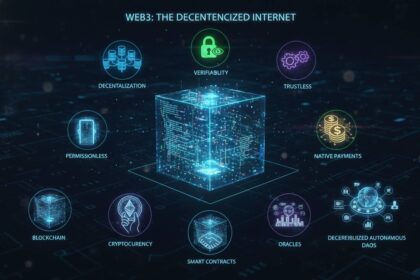

Web3 represents a fundamental transformation in how we interact with the internet—a shift from centralized platforms controlled by corporations to decentralized networks governed by their users. At its core, Web3 is the third generation of the World Wide Web, built on blockchain technology, cryptocurrency protocols, and decentralized applications (dApps) that operate without traditional intermediaries. Unlike its predecessors, Web3 enables users to own their data, verify transactions transparently, and participate in governance decisions that shape the platforms they use. This comprehensive guide explores every facet of Web3, from its foundational principles to its practical applications, helping you understand why this technological evolution matters for the future of the internet.
Web3 Definition: What It Actually Means
Web3, sometimes written as Web 3.0, describes an decentralized internet ecosystem where users interact through blockchain-based platforms rather than depending on centralized servers controlled by technology giants. The term was coined in 2014 by Gavin Wood, co-founder of Ethereum, who envisioned an internet where users maintain ownership of their digital identities and assets without relying on trusted third parties.
The Web3 Stack Model
| Layer | Function | Key Technologies |
|-------|----------|------------------|
| Protocol Layer | Foundation infrastructure | Blockchain networks, consensus mechanisms |
| Infrastructure Layer | Development tools | Smart contracts, oracles, storage systems |
| Application Layer | User-facing services | Decentralized apps (dApps), DeFi protocols |
| Experience Layer | Interaction interfaces | Wallets, NFT marketplaces, DAOs |
The fundamental promise of Web3 centers on three core principles: decentralization (removing control from single entities), transparency (making code and transactions publicly verifiable), and user sovereignty (giving individuals ownership of their data and digital assets). These principles distinguish Web3 from Web2, where platforms like Facebook, Google, and Amazon monetized user data while maintaining complete control over the infrastructure.
Key Insight: According to blockchain network analytics, over 400 million people worldwide have interacted with Web3 protocols as of 2024, representing a 300% increase from 2020 adoption rates.
The Evolution from Web1 to Web3
Understanding Web3 requires examining the trajectory of internet development across three distinct eras, each representing a fundamental shift in how information is created, stored, and monetized.
Web1: The Read-Only Internet (1990-2004)
The first generation of the web was primarily static and informational. Users consumed content created by a small number of publishers, with minimal interactivity or user-generated content. Websites functioned essentially as digital brochures, and the primary value exchange involved users accepting advertising in exchange for free access to information. Companies like AOL and early search engines like Yahoo dominated this era, but the infrastructure remained largely decentralized at its technical core.
Web2: The Social and Mobile Revolution (2004-2020)
Web2 transformed the internet into a participatory platform where users became content creators. Social media platforms, blogging sites, and video sharing services emerged, enabling unprecedented levels of global communication and collaboration. However, this era introduced a critical trade-off: users gained functionality by surrendering control over their personal data. Tech companies accumulated vast repositories of user information, monetizing it through targeted advertising while establishing near-monopolistic control over digital infrastructure.
Web3: The Decentralized Renaissance (2020-Present)
Web3 represents a response to the limitations and inequities of Web2. By leveraging blockchain technology, cryptographic security, and token-based incentive systems, Web3 aims to restore user agency while preserving the collaborative functionality that made Web2 successful. This evolution isn't merely technological—it represents a fundamental philosophical shift in how we conceptualize digital ownership, governance, and value creation.
📊 WEB3 ADOPTION RESEARCH: GROWTH METRICS
| Metric | 2020 | 2022 | 2024 | YoY Growth |
|--------|------|------|------|------------|
| Global Web3 Users | 100M | 250M | 400M | 60% |
| DeFi Total Value Locked | $20B | $160B | $85B | -47% |
| NFT Trading Volume | $95M | $25B | $15B | -40% |
| Active dApps | 2,000 | 8,000 | 15,000 | 87% |
Source: Chainalysis Web3 Ecosystem Report, 2024
How Web3 Works: Core Technologies
Web3 operates through a sophisticated technological stack that enables decentralized functionality without sacrificing usability. Understanding these core technologies illuminates how Web3 achieves its fundamental promises.
Blockchain Networks
At the foundation of Web3 lies blockchain technology—a distributed ledger system that records transactions across thousands of computers simultaneously. Unlike traditional databases controlled by single entities, blockchains maintain consensus through cryptographic mechanisms and distributed validation. Bitcoin, the first blockchain network, demonstrated that monetary transactions could occur without banks. Ethereum expanded this capability by introducing smart contracts, enabling programmable logic that executes automatically when predetermined conditions are met.
How Blockchain Enables Decentralization:
- Distributed Validation: No single entity controls transaction verification
- Immutability: Once recorded, data cannot be altered retroactively
- Transparency: All transactions are publicly visible and verifiable
- Censorship Resistance: Network participation cannot be blocked by any single party
Smart Contracts
Smart contracts are self-executing programs stored on blockchains that automatically enforce agreements between parties. When conditions coded into the contract are fulfilled, the contract executes without requiring intermediary oversight. This capability transforms traditional contract law by eliminating the need for trusted intermediaries—banks, lawyers, or platforms—while ensuring contractual obligations are fulfilled precisely as programmed.
For example, a decentralized lending protocol might use smart contracts to automatically evaluate loan applications, distribute funds, and collect repayments based on real-time data feeds (oracles), all without human intervention or centralized approval processes.
Decentralized Storage
Web3 extends decentralization beyond computation to data storage. Protocols like IPFS (InterPlanetary File System) and Arweave enable files to be stored across distributed networks rather than centralized servers. This approach ensures content remains accessible even if individual nodes fail or are taken offline, while also creating persistent digital archives that cannot be censored or altered.
Cryptocurrencies and Tokens
Digital currencies and tokens form the economic backbone of Web3. Cryptocurrencies like Bitcoin and Ether serve as native currencies for their respective networks, facilitating transaction fees and security incentives. Beyond monetary use, tokens represent various forms of value: governance tokens grant voting rights in decentralized protocols, stablecoins maintain price pegs to traditional currencies, and NFTs (non-fungible tokens) certify ownership of unique digital assets.
Key Components of the Web3 Ecosystem
The Web3 ecosystem encompasses multiple interconnected sectors, each addressing different aspects of decentralized infrastructure and application development.
Decentralized Finance (DeFi)
DeFi represents the most developed sector within Web3, recreating traditional financial instruments—lending, borrowing, trading, insurance—on blockchain networks without banks or brokerage firms. Users can supply cryptocurrency to liquidity pools and earn interest, obtain loans instantly without credit checks, or trade assets directly with other users through automated market makers.
DeFi Protocol Comparison
| Protocol Type | Example | TVL | Primary Function |
|---------------|---------|-----|------------------|
| Lending | Aave | $10B+ | Collateralized lending |
| Exchanges | Uniswap | $5B+ | Automated trading |
| Derivatives | GMX | $2B+ | Perpetual contracts |
| Stablecoins | MakerDAO | $8B+ | Collateralized stablecoins |
Non-Fungible Tokens (NFTs)
NFTs certify ownership of unique digital items through blockchain technology, creating verifiable scarcity for digital art, collectibles, in-game assets, and virtual real estate. While often associated primarily with digital art speculation, NFTs enable broader applications including ticket authentication, identity verification, and fractional ownership of real-world assets.
Decentralized Autonomous Organizations (DAOs)
DAOs represent a novel organizational structure where governance decisions are made through token-based voting, distributing decision-making authority among community members rather than centralized management. This structure enables coordinated action among distributed stakeholders without traditional corporate hierarchies, potentially revolutionizing how organizations form, fund, and operate.
Web3 Gaming and Virtual Worlds
Play-to-earn gaming models and virtual reality environments represent emerging Web3 sectors where players own in-game assets as NFTs and can potentially monetize their time and skills. These applications demonstrate Web3's potential to transform entertainment economies, though concerns about sustainability and exploitation have prompted ongoing debate about appropriate economic models.
Web3 vs Web2: Fundamental Differences
Understanding Web3 requires examining how it fundamentally differs from the Web2 paradigm that currently dominates internet usage.
The Centralized vs Decentralized Divide
In Web2, platforms serve as intermediaries between users and digital services. When you post content on social media, that platform owns the servers storing your data, controls who can access your content, and monetizes your engagement through advertising. Web3 inverts this relationship—users maintain ownership of their data through personal wallets and wallets, interact directly with protocols, and can port their digital identities and assets across applications without platform permission.
Data Ownership Comparison
| Aspect | Web2 | Web3 |
|--------|------|------|
| Identity | Platform-controlled accounts | Self-custodied wallets |
| Assets | Platform owns all user content | Users own digital assets via NFTs |
| Monetization | Platforms capture majority of value | Creators retain ownership and value |
| Portability | Locked into platform ecosystems | Assets transferable across platforms |
| Privacy | Data harvested for advertising | Pseudonymous by default |
Economic Models
Web2 platforms typically operate as gatekeepers, extracting significant value from transactions occurring on their infrastructure. Web3 protocols often distribute economic benefits more broadly to participants—whether through token distribution, liquidity rewards, or governance rights—creating more aligned incentive structures where users benefit from network growth rather than being the product being sold.
Real-World Web3 Applications
Beyond theoretical potential, Web3 technologies power increasingly sophisticated real-world applications across diverse sectors.
Financial Services
DeFi protocols have processed billions in transaction volume, enabling unbanked individuals worldwide to access financial services. Cross-border payments that traditionally require days and multiple intermediary fees can settle within minutes through blockchain networks. Real-world asset tokenization is emerging, with projects enabling fractional ownership of real estate, art, and commodities through blockchain records.
Supply Chain Transparency
Blockchain-based supply chain tracking enables verification of product authenticity and provenance. Luxury goods manufacturers use blockchain certificates to prove authenticity, while food companies track ingredients from farm to table, improving food safety and sustainability claims verification.
Digital Identity
Self-sovereign identity systems enable individuals to maintain portable credentials rather than relying on centralized identity providers. This approach reduces friction in KYC (know your customer) processes while giving users control over which information they share and with whom.
📊 WEB3 USE CASE ADOPTION SURVEY
| Application Category | Enterprise Adoption | Consumer Adoption |
|----------------------|---------------------|-------------------|
| Supply Chain | 45% piloting | 12% aware |
| Digital Identity | 38% piloting | 18% aware |
| Financial Services | 62% live | 35% active |
| Gaming/NFTs | 15% piloting | 28% active |
| DAOs | 22% piloting | 8% aware |
Source: Deloitte Web3 Adoption Survey, 2024
Challenges and Considerations
Despite its transformative potential, Web3 faces significant challenges that impact mainstream adoption and long-term viability.
Scalability Limitations
Current blockchain networks face constraints on transaction throughput that create congestion during high-demand periods and result in elevated fees. Layer 2 solutions and alternative blockchain architectures aim to address these limitations, but achieving the scale necessary for global adoption remains an active technical challenge.
Regulatory Uncertainty
Governments worldwide are developing frameworks for cryptocurrency regulation, creating compliance challenges for Web3 projects. Unclear regulatory environments make long-term business planning difficult, while poorly designed regulations could potentially stifle innovation or drive development to jurisdictions with more favorable policies.
User Experience Barriers
Interacting with Web3 applications requires managing private keys, understanding gas fees, and navigating unfamiliar interfaces—barriers that limit adoption among non-technical users. Improving usability without compromising security represents a critical priority for ecosystem development.
Environmental Concerns
Proof-of-work blockchain networks consume significant energy, raising sustainability concerns. The transition to proof-of-stake consensus mechanisms (completed by Ethereum in 2022) has dramatically reduced energy consumption, though ongoing debates about blockchain sustainability continue.
The Future of Web3
The trajectory of Web3 development depends on technological advancement, regulatory clarity, and broader ecosystem maturation.
Emerging Trends Shaping Web3:
- Account Abstraction: Simplifying wallet management through social recovery and gas fee abstraction
- Interoperability Protocols: Enabling communication between different blockchain networks
- Zero-Knowledge Cryptography: Enhancing privacy while maintaining transparency guarantees
- Real-World Asset Tokenization: Expanding blockchain utility beyond native digital assets
- Decentralized Physical Infrastructure (DePIN): Using token incentives to build physical infrastructure networks
The long-term vision for Web3 involves creating an internet where users maintain sovereignty over their digital lives while participating in vibrant, decentralized economies. Achieving this vision requires solving technical challenges, establishing appropriate regulatory frameworks, and developing user experiences that make decentralized technology accessible to mainstream audiences.
Frequently Asked Questions
What is Web3 in simple terms?
Web3 is the next evolution of the internet that operates on decentralized blockchain technology rather than centralized servers controlled by major corporations. It enables users to own their data, control their digital assets (like cryptocurrency and NFTs), and participate in governing the platforms they use—without needing permission from traditional tech companies.
How does Web3 make money?
Web3 generates value through various economic mechanisms. Cryptocurrencies like Bitcoin and Ethereum gain value through supply and demand on exchanges. DeFi protocols generate revenue through interest spreads and trading fees. NFT creators earn royalties on secondary sales. Unlike Web2 platforms that monetize user data, Web3 participants directly benefit from network growth and value creation.
What is the difference between Web2 and Web3?
Web2 relies on centralized platforms (like Facebook, Google, and Amazon) that control user data and extract value from interactions. Web3 operates through decentralized networks where users maintain ownership of their data and assets, interact directly with protocols without intermediaries, and participate in governance decisions. The fundamental difference is who controls the internet infrastructure and captures the value it creates.
Is Web3 the same as cryptocurrency?
No, cryptocurrency is just one component of Web3. While cryptocurrencies and tokens enable economic transactions and governance participation within Web3 ecosystems, the broader concept encompasses decentralized applications, smart contracts, NFTs, DAOs, and decentralized storage systems. Cryptocurrency provides the monetary layer, but Web3 extends far beyond digital currencies to encompass entire decentralized computing paradigms.
Do I need technical knowledge to use Web3?
Basic Web3 participation requires understanding how to set up a cryptocurrency wallet and manage private keys—a learning curve that has become progressively easier as user interfaces improve. Many Web3 applications now offer experiences similar to traditional apps, though understanding underlying concepts helps users make informed decisions about security and asset management.
Is Web3 safe to use?
Web3 introduces new security considerations different from traditional internet usage. Smart contract vulnerabilities have led to significant financial losses in some cases. Users must secure their private keys (loss means permanent asset loss) and verify before interacting with unknown protocols. However, blockchain transparency enables security auditing, and the ecosystem is developing better security practices and insurance mechanisms over time.
Web3 represents a fundamental reimagining of internet infrastructure, one that prioritizes user sovereignty, transparency, and decentralized governance. While significant challenges remain before mainstream adoption, the technologies and principles underlying Web3 continue developing rapidly. Whether you're a developer building the next generation of applications, an investor exploring new economic opportunities, or simply a curious internet user, understanding Web3 provides essential insight into how digital infrastructure continues evolving. The transition from Web2 to Web3 won't happen overnight, but the foundation being built today will shape the internet's trajectory for decades to come.