

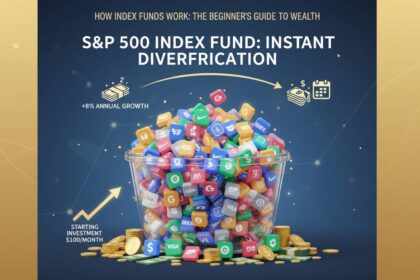

Index funds have revolutionized how millions of Americans build wealth, offering a simple path to diversified investing that consistently outperforms most professionally managed portfolios over time. If you've ever wondered how these investment vehicles function and why financial experts consistently recommend them for long-term wealth creation, this comprehensive guide will walk you through everything you need to know.
At their most basic level, index funds are investment funds designed to track a specific market index—like the S&P 500—rather than trying to beat it. This passive approach means lower costs, broader diversification, and historically superior returns compared to the majority of actively managed funds. Understanding how index funds work could be the single most important financial decision you make, potentially adding tens of thousands of dollars to your nest egg over a investing lifetime.
What Exactly Is an Index Fund?
An index fund is a type of mutual fund or exchange-traded fund (ETF) that builds its portfolio to match the components of a specific financial market index. The most popular example tracks the S&P 500, which includes 500 of the largest U.S. companies weighted by market capitalization. When you invest in an S&P 500 index fund, you effectively own a tiny piece of every company in that index—from Apple and Microsoft to smaller companies you've likely never heard of.
The concept emerged from academic research in the 1970s, pioneered by John Bogle, founder of Vanguard Group. Bogle's revolutionary idea was simple: instead of paying expensive fund managers to try (and usually fail) to beat the market, investors could simply own the entire market at a fraction of the cost. This philosophy challenged the entire actively managed fund industry and eventually spawned a multi-trillion-dollar revolution in how people invest.
Unlike actively managed funds, where portfolio managers actively buy and sell securities trying to outperform specific benchmarks, index funds operate on a "buy and hold" philosophy. They replicate the index they track rather than selecting individual stocks based on research or predictions. This structural difference creates several advantages that we'll explore throughout this guide.
Index funds come in two primary forms: mutual funds and ETFs. Mutual funds are priced once per day at net asset value (NAV), while ETFs trade throughout the day like individual stocks on an exchange. Both serve the same fundamental purpose—giving investors broad market exposure—but offer different trading characteristics and tax efficiencies.
How Index Funds Actually Work
Understanding the mechanics behind index funds requires grasping a few key concepts: market capitalization weighting, full replication versus sampling, and the role of the fund administrator.
When an index fund tracks an index like the S&P 500, it doesn't randomly select stocks. Instead, it owns shares in the same proportions as the index itself. The S&P 500 is weighted by market capitalization, meaning larger companies (measured by their total stock value) have greater representation in the index. Apple, as one of the world's most valuable companies, might represent 7% of the S&P 500, while a smaller company might represent just 0.1%. The index fund mirrors this exact structure.
Most index funds use a strategy called full replication, meaning they own shares in every single company included in their target index. For an index like the S&P 500, this means owning stock in 500 different companies. While this might sound administratively complex, it actually simplifies operations—there's no need for expensive research teams to pick "winning" stocks because you're simply owning everything.
Some funds tracking broader or more obscure indices use sampling methods. Rather than owning every single security (which could mean thousands of stocks for total market funds), they select a representative sample that mimics the index's performance characteristics. This approach works well for indices with many small components and keeps transaction costs manageable.
The fund provider—the company managing the index fund—handles all administrative tasks: tracking the index, rebalancing the portfolio when companies are added or removed from the index, and processing investor transactions. This专业化 (specialization) is what allows index funds to charge such low fees compared to actively managed alternatives.
Types of Index Funds
The index fund universe extends far beyond just the S&P 500, offering investors numerous options to match their specific goals, risk tolerances, and investment timeframes.
Broad Market Index Funds track indices representing the entire U.S. stock market, such as the Wilshire 5000 or CRSP U.S. Total Market Index. These funds own thousands of companies and provide maximum diversification across the entire American economy. They're ideal for investors who want one fund to hold everything.
Large-Cap Index Funds focus on companies with the largest market capitalizations, typically tracking indices like the S&P 500 or Russell 1000. These funds tend to be less volatile than their smaller-cap counterparts while still offering substantial growth potential.
Small-Cap and Mid-Cap Index Funds track indices containing medium and smaller-sized companies. While these funds carry higher volatility, they often deliver superior long-term returns and provide important diversification benefits when combined with large-cap holdings.
International Index Funds extend beyond U.S. borders, tracking indices like the MSCI EAFE (Europe, Australasia, Far East) or emerging market indices. These funds provide geographic diversification and exposure to global economic growth, though they carry additional currency and geopolitical risks.
Bond Index Funds follow indices composed of fixed-income securities rather than stocks. They track U.S. Treasury indices, corporate bond indices, or combinations thereof. These funds are essential for investors seeking income and portfolio stability as they approach retirement.
Sector Index Funds focus on specific industries like technology, healthcare, energy, or financial services. They're useful for investors who want to overweight certain sectors they believe will outperform while maintaining overall market exposure elsewhere.
Why Index Funds Beat Most Active Managers
The evidence supporting index fund outperformance over long periods is overwhelming and represents one of the most well-documented phenomena in finance.
According to the S&P Indices Versus Active Funds (SPIVA) U.S. Report, over rolling 10-year periods, approximately 90% of actively managed large-cap funds have underperformed the S&P 500. This isn't a single year's anomaly—it's a consistent pattern that persists decade after decade. The data becomes even more damning when considering that these figures represent returns before the significantly higher fees charged by active managers.
The math behind this phenomenon is straightforward. The market is a zero-sum game (before costs) and a negative-sum game (after costs). When you factor in management fees, trading costs, and the overhead of running active portfolios, the deck becomes stacked against active managers. They're not just competing against each other—they're competing against every other investor in the market, and the odds of consistently picking winners are minuscule.
Consider this practical example: if the stock market returns an average of 10% annually and an active fund charges 1.5% in annual fees, you need to earn at least 11.5% just to match the market. Studies consistently show that the majority of active managers fail to achieve this threshold year after year.
The historical data supports this analysis. According to Vanguard research, over the 30-year period ending in 2022, index funds outperformed actively managed funds in 87% of the years examined. The few active managers who do succeed in any given year rarely repeat their success, making it nearly impossible to identify them in advance.
This explains why legendary investors like Warren Buffett have repeatedly recommended index funds for the vast majority of Americans. In his 2017 letter to Berkshire Hathaway shareholders, Buffett stated: "Consistently spend money annually from your own pocket encouraging your friends, neighbors, and employees to invest in low-cost index funds."
Key Benefits of Index Fund Investing
The advantages of index fund investing extend far beyond just performance, making these vehicles exceptionally well-suited for building long-term wealth.
Low Costs Mean Higher Returns: The expense ratio—the annual fee expressed as a percentage of your investment—is the single most important factor you can control as an investor. While actively managed funds typically charge 0.5% to 1.5% or more annually, many index funds charge just 0.03% to 0.10%. Over a 30-year investment horizon, this difference can translate to hundreds of thousands of dollars in additional wealth. According to Fidelity Investments, a $100,000 investment earning 7% annually would grow to $761,000 with a 0.10% expense ratio versus just $575,000 with a 1.0% expense ratio—a difference of nearly $186,000.
Instant Diversation: Rather than researching and purchasing individual stocks (which requires significant time and expertise), index funds provide immediate exposure to hundreds or thousands of companies with a single purchase. This diversification dramatically reduces your company-specific risk—if one company in the index goes bankrupt, its impact on your portfolio is negligible.
Tax Efficiency: Index funds typically have lower turnover than actively managed funds because they only buy or sell securities when the underlying index changes. This lower turnover generates fewer taxable events, meaning you'll owe less in capital gains taxes each year. For taxable brokerage accounts, this tax efficiency advantage can be substantial.
Transparency: With an index fund, you always know exactly what you own. The fund publishes its complete holdings daily, unlike actively managed funds which may only disclose their holdings quarterly. This transparency allows you to understand and monitor your exact market exposure at all times.
Simplicity: Building a diversified portfolio of individual stocks requires extensive research, ongoing monitoring, and significant capital. Index funds let you achieve broad diversification with just a few fund purchases, making them ideal for investors who want to spend their time on other pursuits rather than managing their portfolios.
Proven Long-Term Performance: While past performance doesn't guarantee future results, the historical track record of index funds tracking major indices like the S&P 500 demonstrates their effectiveness at building wealth over decades. A $10,000 investment in the S&P 500 in 1980 would have grown to over $1 million by 2023, despite numerous market crashes, recessions, and economic crises along the way.
How to Start Investing in Index Funds
Beginning your index fund investment journey requires just a few straightforward steps, and modern technology has made the process easier than ever.
Step 1: Choose Your Account Type: Decide whether you want to invest in a tax-advantaged retirement account (like a 401(k) or IRA) or a taxable brokerage account. Retirement accounts offer tax benefits but limit when you can access your money without penalties. Taxable accounts offer more flexibility but may generate annual tax bills.
Step 2: Select a Brokerage: Open an account with a reputable brokerage that offers low-cost index funds. Major online brokers like Fidelity, Charles Schwab, Vanguard, and TD Ameritrade all offer extensive index fund selections with no minimum investments on many options. Many also offer commission-free ETF trading if you prefer that structure.
Step 3: Determine Your Asset Allocation: Decide how you want to divide your investments between stocks and bonds based on your age, risk tolerance, and goals. A common rule of thumb suggests holding your age (or age minus 10 or 20) in bonds, with the remainder in stocks. Younger investors can typically afford more stock exposure for greater growth potential.
Step 4: Select Your Index Funds: Choose funds that match your asset allocation strategy. For most beginners, a simple three-fund portfolio works excellently: a U.S. total stock market fund, an international stock fund, and a U.S. bond fund. This combination provides broad diversification across thousands of securities worldwide.
Step 5: Invest Regularly: The most successful investors contribute consistently, regardless of market conditions. Setting up automatic monthly contributions Dollar-Cost Averages your purchases over time, reducing the impact of market volatility and building the habit of regular saving.
Common Mistakes to Avoid
Even though index fund investing is straightforward, beginners often make several avoidable errors that can undermine their long-term success.
Mistake #1: Paying Attention to Short-Term Performance
It's tempting to check your portfolio daily, especially during market volatility. However, index fund investing is a decades-long strategy. Checking your account too frequently can lead to emotional decisions that hurt your returns. Focus on your progress toward long-term goals rather than daily fluctuations.
Mistake #2: Chasing Hot Performance
No one can predict which market segments will outperform in any given year. Trying to rotate between different index funds based on recent performance almost always leads to buying high and selling low. The most reliable approach is maintaining a consistent, diversified allocation through all market conditions.
Mistake #3: Ignoring Expense Ratios
While differences of 0.1% or 0.2% may seem insignificant, they compound dramatically over time. Always check the expense ratio before purchasing any fund, and favor low-cost options. Many excellent index funds charge less than 0.05% annually.
Mistake #4: Overlooking International Exposure
Some investors mistakenly believe U.S. markets offer sufficient diversification. However, roughly 40% of global stock market capitalization exists outside the United States. Ignoring international markets leaves significant diversification benefits on the table and exposes you to unnecessary concentration risk.
Mistake #5: Trying to Time the Market
Waiting for the "right time" to invest usually means never investing at all. The best time to start was yesterday; the second-best time is today. Consistent contributions regardless of market conditions historically outperform attempts to time entry points.
Frequently Asked Questions
What is the minimum amount needed to start investing in index funds?
Most index funds have no minimum investment requirements when purchased through brokerages like Vanguard, Fidelity, or Charles Schwab. You can start with as little as $1 in many cases, making index funds accessible to virtually anyone wanting to begin building wealth.
Are index funds safe during market crashes?
Index funds are subject to market downturns like all equity investments—their value falls when the underlying index declines. However, they're generally considered safer than individual stocks because diversification protects you from any single company's failure. During market recoveries, index funds participate in the rebound just as they do in declines.
How many index funds should I own?
For most investors, three to five index funds provide sufficient diversification. A common approach uses three funds: a U.S. total market fund, an international stock fund, and a bond fund. More complex portfolios aren't necessarily better—in fact, excessive complexity can increase costs and administrative burden without meaningful diversification benefits.
When should I sell my index fund investments?
Ideally, you should sell index funds only when you need the money for specific goals or when your asset allocation has drifted significantly from your target. Unlike individual stocks, there's no reason to sell index funds based on market timing or short-term performance concerns. The buy-and-hold philosophy works because markets historically trend upward over time.
Do index funds pay dividends?
Yes, most stock index funds pay dividends collected from the underlying securities. These dividends are typically distributed to fund shareholders quarterly, though the exact frequency varies by fund. You can choose to reinvest dividends (purchasing more shares) or take them as cash, depending on your income needs.
Can I lose all my money in index funds?
While index funds can lose significant value during market downturns, it's nearly impossible to lose your entire investment unless every company in the index becomes worthless—which would represent a complete collapse of the global economy. Even during the worst market crashes in history, major indices have eventually recovered and reached new highs.
Conclusion
Index funds represent one of the most powerful wealth-building tools available to individual investors. Their combination of low costs, broad diversification, tax efficiency, and proven long-term performance makes them the foundation of a sound investment strategy regardless of your age, income, or financial goals.
The beauty of index fund investing lies in its simplicity. You don't need to be a finance expert, spend hours researching stocks, or worry about daily market movements. By consistently contributing to a diversified portfolio of low-cost index funds, you position yourself to capture the growth of the global economy over decades.
Remember that successful index fund investing requires patience and discipline. Market downturns will happen—they're an unavoidable part of investing. But history demonstrates that markets recover, and investors who stay the course consistently outperform those who try to time their entries and exits.
Start small if you must, but start today. The compound growth working in your favor over 20, 30, or 40 years will surprise you, and the simplicity of the index fund approach means you can spend your time living your life rather than managing your investments. That's the true power of index funds—not just building wealth, but building it without sacrificing your time and peace of mind.