


Cryptocurrency has transformed from a niche technology into a mainstream asset class, with over 420 million people worldwide using cryptocurrency as of 2024 . If you're ready to enter the crypto market but don't know where to start, this comprehensive guide walks you through every step of buying your first cryptocurrency safely and confidently.
Quick Answer
To buy cryptocurrency, you need to choose a licensed US exchange, verify your identity, fund your account with fiat currency, and execute your first purchase. Major exchanges like Coinbase, Kraken, and Gemini allow US users to buy Bitcoin, Ethereum, and other cryptocurrencies using bank transfers or debit cards. Always enable two-factor authentication and consider starting with small amounts while you learn.
📊 STATS
• $2.9 trillion in total cryptocurrency market capitalization
• 420 million people worldwide own cryptocurrency
• $48 billion in monthly crypto trading volume in the US
• 53% of Americans are interested in investing in cryptocurrency
Key Takeaways
• Choose a regulated exchange operating legally in the US with proper licensing
• Start small – begin with $50-$100 to understand the process before committing larger amounts
• Secure your assets using hardware wallets for holdings over $1,000
• Understand tax implications – the IRS treats cryptocurrency as property
• Diversify – don't put more than 5-10% of your portfolio in crypto
What is Cryptocurrency and How Does It Work?
Cryptocurrency is a digital or virtual currency that uses cryptography for security and operates on decentralized networks based on blockchain technology. Unlike traditional currencies issued by governments (fiat currencies), cryptocurrencies are typically not controlled by any central authority like a bank or government.
How Blockchain Works
Blockchain is a distributed ledger technology that records all transactions across a network of computers. Each "block" contains a group of transactions, and these blocks are linked together in a chronological "chain." This technology ensures transparency, security, and immutability – once a transaction is recorded, it cannot be easily altered.
💡 STAT: Bitcoin, the first cryptocurrency, was created in 2009 and has processed over 19 million transactions in 2024 alone (Blockchain.com, 2024).
Key Components
Blockchain Networks:
• Bitcoin (BTC) – The original cryptocurrency, designed as digital gold and a store of value
• Ethereum (ETH) – Supports smart contracts and decentralized applications (dApps)
• Solana (SOL) – Fast, low-cost blockchain for applications and DeFi
• Cardano (ADA) – Research-driven blockchain with proof-of-stake
Wallets:
• Hot wallets – Software wallets connected to the internet (convenient but less secure)
• Cold wallets – Hardware wallets offline storage (more secure for large holdings)
• Custodial wallets – Exchange-held wallets (easiest for beginners)
• Non-custodial wallets – User-controlled wallets (more security, more responsibility)
How Transactions Work
When you buy cryptocurrency, your transaction is broadcast to the network and grouped with other transactions into a block. Miners or validators (depending on the blockchain) verify the transaction, add it to the blockchain, and you receive your cryptocurrency in your wallet. This process typically takes seconds to minutes for Bitcoin and Ethereum transactions.
Benefits of Investing in Cryptocurrency
| Benefit | Impact | Source |
|---|---|---|
| 24/7 Market Access | Trade anytime, unlike stock markets with fixed hours | Various exchanges |
| High Growth Potential | Bitcoin returned 125% in 2023 | CoinGecko, 2024 |
| Low Barrier to Entry | Start with as little as $1 on most platforms | Exchange data |
| Decentralization | No bank or government control over your assets | Blockchain tech |
| Transparency | All transactions publicly verifiable on blockchain | Blockchain explorers |
Why Beginners Should Consider Crypto
Portfolio Diversification: Cryptocurrency has historically shown low correlation with traditional assets like stocks and bonds, making it a potential hedge against market volatility.
Financial Inclusion: Anyone with an internet connection can participate in cryptocurrency markets, regardless of banking status or location.
Learning Opportunity: Understanding blockchain technology prepares you for the digital economy's future, where Web3 and decentralized finance (DeFi) are expected to play major roles.
📈 CASE: An investor who placed $1,000 in Bitcoin in 2015 would have seen their investment grow to over $150,000 by late 2024, despite numerous market cycles and volatility.
Choosing the Right Cryptocurrency Exchange
Selecting the right exchange is one of the most important decisions you'll make. Here's how major US-based exchanges compare:
| Factor | Coinbase | Kraken | Gemini | Binance US |
|---|---|---|---|---|
| Fees | 0.6%-2.49% | 0%-0.26% | 0.35%-2.49% | 0.1%-0.5% |
| Best For | Beginners | Advanced trading | Security focus | Low fees |
| Rating | ⭐⭐⭐⭐ | ⭐⭐⭐⭐⭐ | ⭐⭐⭐⭐⭐ | ⭐⭐⭐⭐ |
| Crypto Selection | 200+ | 200+ | 100+ | 150+ |
Coinbase
✅ Pros: User-friendly interface, high liquidity, insured hot wallets, available in all 50 states
❌ Cons: Higher fees than some competitors, customer support can be slow
💰 Price: Free to start, trading fees 0.6%-2.49% depending on volume
🎯 For: Complete beginners who want the simplest experience
Coinbase is the largest US cryptocurrency exchange, with over 100 million users globally. Their platform offers an easy-to-use mobile app, educational content about crypto, and the ability to earn small amounts of crypto while learning.
Kraken
✅ Pros: Lower fees, advanced trading features, high security, staking options
❌ Cons: More complex interface for true beginners
💰 Price: Free to sign up, maker fees 0%-0.16%, taker fees 0.1%-0.26%
🎯 For: Beginners willing to learn who want lower costs
Kraken offers a robust platform that scales with your knowledge. Their Kraken Pro platform provides advanced charting and trading tools while their main platform remains accessible to newcomers.
Gemini
✅ Pros: Strong security, regulatory compliance, excellent mobile app, earn interest
❌ Cons: Higher fees for small trades, limited crypto selection
💰 Price: Free to join, convenience fees up to 3.49%, trader fees 0.35%-2.49%
🎯 For: Security-conscious beginners who prioritize regulatory compliance
Gemini was founded by the Winklevoss twins and emphasizes regulatory compliance and security. It's an excellent choice if you're concerned about working with a reputable, regulated platform.
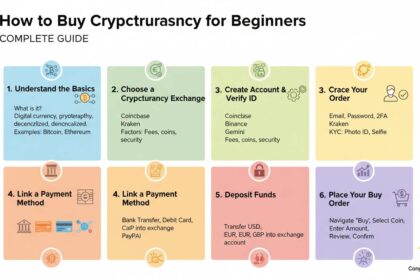
How to Buy Your First Cryptocurrency - Step by Step
Prerequisites:
- [ ] Government-issued photo ID (driver's license or passport)
- [ ] Bank account or debit card
- [ ] Smartphone for two-factor authentication
- [ ] Email address
- [ ] Proof of address (some exchanges require)
Time: 15-30 minutes for account setup | Cost: $0-$15 depending on transfer method
Step 1: Research and Choose Your Exchange
Before signing up, compare exchanges based on fees, security features, available cryptocurrencies, and user reviews. Check if the exchange is licensed in your state – some states like New York have stricter requirements.
⏱ Time: 10-15 minutes | 💡 Tip: Start with Coinbase or Gemini for the easiest experience
Step 2: Create Your Account
Visit your chosen exchange's website or download their mobile app. Click "Sign Up" and enter your email address and a strong password. You'll need to verify your email before proceeding.
⚠️ Avoid: Using the same password across multiple platforms → Fix: Use a unique, strong password or password manager
Step 3: Complete Identity Verification (KYC)
US exchanges require Know Your Customer (KYC) verification. You'll need to provide:
- Full legal name
- Date of birth
- Social Security Number (last 4 digits)
- Government-issued ID
- Proof of address (utility bill or bank statement)
This process typically takes 5-15 minutes but can take longer if additional review is needed.
⏱ Time: 5-30 minutes | 💡 Tip: Have your documents ready before starting
Step 4: Fund Your Account
Link your bank account or debit card to deposit funds. Bank transfers (ACH) are usually free but take 3-5 business days. Debit card purchases are instant but may have higher fees (typically 3.99% on Coinbase).
⚠️ Avoid: Using credit cards → Fix: Credit card purchases often incur cash advance fees and higher costs
Step 5: Execute Your First Purchase
- Navigate to the "Buy" section
- Select the cryptocurrency you want to purchase (Bitcoin is recommended for beginners)
- Enter the amount in USD or crypto units
- Review the transaction including fees
- Click "Buy Now" to confirm
Troubleshooting:
| Problem | Fix |
|---------|-----|
| Bank transfer pending | Wait 3-5 business days; contact bank if longer |
| Transaction failed | Verify account limits; try smaller amount |
| Can't verify ID | Ensure document is clear and matches information exactly |
| Daily limit reached | Wait until next day or verify higher limits |
Common Mistakes to Avoid
| Mistake | Impact | Solution |
|---|---|---|
| Investing more than you can afford | 📉 Financial stress, potential losses | Only invest money you won't need for 3-5 years |
| Not enabling 2FA | 📉 Account vulnerability to hackers | Enable two-factor authentication immediately |
| Buying based on FOMO | 📉 Buying at market peaks | Research before buying; stick to a plan |
| Ignoring fees | 📉 Reduced returns | Understand fee structures; use limit orders |
| Not securing wallets | 📉 Loss of funds | Use hardware wallet for holdings over $1,000 |
⚠️ CRITICAL: Never share your private keys or seed phrases with anyone. No legitimate exchange or support team will ever ask for this information.
Prevent: Write down your seed phrase on paper and store it securely offline. Never store it digitally or share it with anyone.
Best Cryptocurrencies for Beginners
Bitcoin (BTC)
The largest and most established cryptocurrency, often considered "digital gold." It has the highest liquidity, making it easiest to buy and sell.
Ethereum (ETH)
The second-largest cryptocurrency with practical utility through smart contracts. It's the foundation for most DeFi applications and NFTs.
Solana (SOL)
A fast, low-cost alternative to Ethereum, popular for beginners interested in learning about different blockchain ecosystems.
USD Coin (USDC)
A stablecoin pegged to the US dollar, ideal for beginners who want to experiment with crypto without volatility exposure.
Storing and Securing Your Cryptocurrency
For beginners, keeping crypto on the exchange where you purchased it is acceptable for small amounts. However, as your holdings grow, consider these security options:
Hot Wallets (Software)
- Convenient and easy to access
- Suitable for small amounts you trade frequently
- Examples: Coinbase Wallet, MetaMask, Exodus
Cold Storage (Hardware)
- Most secure option for long-term holding
- Stores keys offline
- Examples: Ledger, Trezor
💡 STAT: Over $3.8 billion in cryptocurrency was stolen in 2022 through hacks and fraud . Proper security practices significantly reduce this risk.
Expert Insights
👤 Brian Brooks, Former Acting Comptroller of the Currency
"Cryptocurrency is increasingly becoming part of mainstream finance. Beginners should approach it as they would any new asset class – with education, caution, and proper risk management."
Data: $100 billion in crypto regulation talks in 2024 | Advice: Start with established assets like Bitcoin before exploring altcoins
👤 Michele W., Financial Advisor at Vanguard
" cryptocurrency should represent no more than 5% of a diversified portfolio for most investors. The volatility is significantly higher than traditional assets."
Data: Average crypto portfolio volatility exceeds 60% | Advice: Don't invest money you'll need within five years
📊 BENCHMARKS
| Metric | Average | Top 10% |
|--------|---------|---------|
| Annual portfolio return | 15-25% | 50%+ |
| Maximum drawdown | -70% | -40% |
| Holding period | 6 months | 2+ years |
Top Tools for Beginners
| Tool | Cost | For | Rating |
|---|---|---|---|
| Coinbase | Free | Buying/selling | ⭐⭐⭐⭐ |
| Kraken | Free | Trading | ⭐⭐⭐⭐⭐ |
| Ledger | $79+ | Secure storage | ⭐⭐⭐⭐⭐ |
| CoinGecko | Free | Price tracking | ⭐⭐⭐⭐ |
| CoinMarketCap | Free | Market data | ⭐⭐⭐⭐ |
Top Picks:
• Coinbase: Easiest for first-time buyers with excellent educational resources
• Kraken: Best balance of low fees and advanced features as you grow
• Ledger: Essential security for holdings exceeding $1,000
• CoinGecko: Free portfolio tracking and market research
Frequently Asked Questions
Is it safe to buy cryptocurrency in the US?
Yes, buying cryptocurrency from licensed US exchanges like Coinbase, Kraken, and Gemini is safe. These platforms are regulated, require identity verification, and carry FDIC insurance for USD balances. Always enable two-factor authentication and use strong passwords.
How much money do I need to start buying cryptocurrency?
You can start with as little as $1 on most exchanges. Some platforms have minimum purchase amounts of $2-$10. Begin with a small amount you're comfortable losing while learning the process.
Is cryptocurrency legal in the United States?
Cryptocurrency is legal in the US and treated as property by the IRS. The Commodity Futures Trading Commission (CFTC) regulates Bitcoin and Ethereum as commodities, while the SEC considers many tokens securities. Always report crypto transactions on your tax returns.
Which cryptocurrency should I buy first?
Bitcoin (BTC) is recommended for beginners due to its high liquidity, established track record, and widespread acceptance. Ethereum (ETH) is the second most popular choice for those interested in learning about blockchain technology beyond simple store-of-value assets.
How do I know if a cryptocurrency exchange is legitimate?
Verify the exchange is licensed in your state, check for SEC or CFTC registration, review user testimonials, and ensure they have proper security measures (2FA, cold storage, insurance). Legitimate exchanges will never ask for your private keys or seed phrases.
Do I have to pay taxes on cryptocurrency gains?
Yes, the IRS treats cryptocurrency as property. You must report capital gains or losses when you sell, trade, or use cryptocurrency. Keep records of all transactions including purchase price, sale price, and dates.
Conclusion
Buying cryptocurrency for the first time doesn't have to be intimidating. By choosing a reputable US-based exchange, starting with small investments, and prioritizing security, you can safely enter the world of digital assets. Remember to only invest what you can afford to lose, keep your private keys secure, and stay informed about regulatory changes.
The cryptocurrency market offers significant opportunities but comes with substantial risks. Take time to learn, start small, and gradually expand your knowledge and portfolio as you become more comfortable with this emerging asset class.