

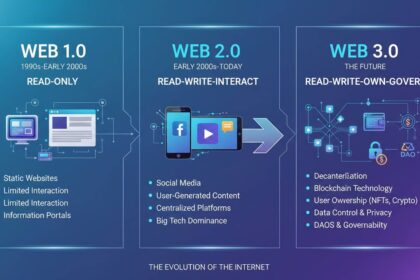

Web3 represents the next evolution of the internet—a decentralized, user-controlled digital ecosystem built on blockchain technology. Unlike the current web (Web2), where giant technology corporations control platforms, data, and revenue, Web3 enables direct peer-to-peer interactions through decentralized protocols. This fundamental shift promises to return ownership of digital assets and identity to users while creating new economic models.
The meaning of Web3 extends beyond simple technological advancement. It encompasses a philosophical movement toward internet democratization, where individuals maintain sovereignty over their personal data, financial transactions, and digital identities. Understanding Web3 and its benefits becomes increasingly relevant as major corporations, financial institutions, and governments explore decentralized solutions.
The Evolution from Web1 to Web3
To comprehend Web3 meaning fully, examining the internet's evolutionary trajectory provides essential context. Each era represents a distinct paradigm in how people create, consume, and monetize digital content.
Web1: The Read-Only Internet (1990-2004)
The first generation of the internet, often called the "read-only web," emerged in the early 1990s. Web1 consisted primarily of static HTML pages with limited interactivity. Users consumed content created by a small number of organizations and developers. Companies like AOL dominated this era through portals that curated access to information. The technology was revolutionary for its time but offered minimal user participation beyond viewing static content.
During this period, approximately 400 million people worldwide accessed the internet, primarily through dial-up connections. Content creation required technical expertise, limiting participation to those with coding knowledge. E-commerce existed but remained rudimentary, with security concerns limiting widespread adoption.
Web2: The Social Web (2004-2020)
Web2 introduced user-generated content and social interactivity, transforming the internet into a participatory platform. The rise of social media platforms like Facebook, YouTube, Twitter, and Instagram enabled billions to create and share content. Mobile smartphone adoption accelerated this transformation, making internet access ubiquitous.
However, Web2 created significant power concentration among technology giants. By 2020, just five companies—Google, Amazon, Facebook (Meta), Apple, and Microsoft—controlled the majority of internet infrastructure, data, and advertising revenue. These corporations monetize user data through targeted advertising, creating what critics call a "surveillance economy." Users surrender personal information in exchange for "free" services, with limited control over how that data gets used or monetized.
The business model fundamentally shifted from selling products to harvesting attention and data. Terms of service changes could restrict user access overnight, while algorithm changes determined what content users saw. This centralization created vulnerabilities—data breaches affected hundreds of millions, and platform bans could destroy livelihoods without recourse.
Web3: The Decentralized Internet (2020-Present)
Web3 emerges as a response to Web2's centralized control. The term gained prominence around 2014 when Ethereum co-founder Gavin Wood described a vision for a decentralized internet layer. The concept matured with the 2020 DeFi summer and subsequent NFT explosion, demonstrating blockchain technology's practical applications beyond cryptocurrency.
The core Web3 meaning centers on decentralization through distributed ledger technology. Instead of servers owned by companies, data resides across peer-to-peer networks where no single entity controls the infrastructure. Smart contracts—self-executing programs stored on blockchains—automate agreements without intermediaries. Users maintain cryptographic proof of ownership over digital assets, including tokens representing art, music, domain names, and financial instruments.
Venture capital investment in Web3 companies reflects growing confidence in this paradigm. According to PitchBook data, blockchain and crypto investments exceeded $30 billion in 2021 alone, with substantial funding continuing into 2022 despite market downturns. Major enterprises including Meta, Microsoft, and Goldman Sachs have launched Web3 initiatives, signaling institutional validation.
Core Technologies Powering Web3
Understanding Web3 benefits requires grasping the technological infrastructure enabling decentralization. Several interconnected technologies create the Web3 ecosystem.
Blockchain Technology
Blockchain serves as Web3's foundational technology—a distributed ledger that records transactions across many computers. Once recorded, data becomes extremely difficult to alter, creating trust without requiring trusted intermediaries. Bitcoin, launched in 2009, demonstrated this technology's viability for financial transactions, while Ethereum expanded the concept to support arbitrary program execution through smart contracts.
The technology solves the "double-spend problem" that previously required banks or payment processors to verify transactions. Blockchains achieve consensus through various mechanisms—Proof of Work requires computational effort to validate transactions, while Proof of Stake validates based on cryptocurrency holdings. These consensus mechanisms ensure network security while maintaining decentralization.
Decentralized Applications (dApps)
Unlike traditional applications running on company servers, dApps operate on peer-to-peer networks. Users connect through cryptocurrency wallets rather than creating accounts tied to email addresses or phone numbers. This architectural difference means no single company can shut down a dApp or control user access.
Popular dApps demonstrate Web3's practical utility. Uniswap, a decentralized exchange, processed over $600 billion in trading volume during 2021 without traditional exchange infrastructure. OpenSea facilitated billions in NFT transactions without central ownership. Aave, a decentralized lending protocol, enabled users to lend and borrow billions in cryptocurrency without banks.
Smart Contracts
Smart contracts are self-executing programs stored on blockchains that automatically enforce agreement terms when conditions are met. These digital agreements eliminate the need for traditional legal enforcement or trusted intermediaries. When a smart contract receives payment, it automatically delivers the contracted product or service.
The implications extend beyond simple transactions. Insurance claims can process automatically when sensor data confirms covered events. Royalty payments to artists can flow automatically whenever their work resells. Supply chain tracking can verify product authenticity at each transfer point. These capabilities promise dramatic efficiency gains across industries.
Cryptography and Digital Identity
Web3 enables self-sovereign identity—users control their digital identifiers without depending on centralized identity providers. Cryptocurrency wallets serve as identity instruments, allowing users to prove ownership of assets and authenticate without sharing personal information. Zero-knowledge proofs enable verification of claims (such as being over 21) without revealing underlying data.
This cryptographic approach to identity addresses fundamental privacy concerns. Users can maintain pseudonymous identities while building reputation through on-chain activity. Credential verification becomes faster and more reliable while reducing identity theft risks.
Key Benefits of Web3
The benefits of Web3 extend across economic, social, and technological dimensions. Understanding these advantages explains why developers, investors, and institutions increasingly embrace decentralized technology.
Financial Inclusion and Access
One of Web3's most significant benefits involves expanding financial access to underserved populations. Traditional banking requires extensive documentation, credit history, and physical infrastructure that exclude approximately 1.4 billion adults globally, according to World Bank data. Cryptocurrency only requires internet connectivity, enabling financial participation regardless of geographic location or documentation status.
Decentralized finance (DeFi) protocols enable services traditionally provided by banks—lending, borrowing, trading, and earning interest—without institutional gatekeepers. Users can earn interest on cryptocurrency holdings, access loans using crypto as collateral, and trade assets without centralized exchange approval. This permissionless accessibility represents a fundamental shift in financial inclusion.
The statistics demonstrate growing adoption. Chainalysis reported that cryptocurrency ownership grew over 300% between 2019 and 2021, with substantial growth in developing nations. In countries experiencing hyperinflation such as Venezuela and Argentina, Bitcoin and stablecoins provide financial stability alternatives.
User Ownership and Control
Web3 returns ownership and control to users across several dimensions. When users purchase NFTs representing digital art, they receive cryptographic proof of ownership that cannot be replicated or forged. This ownership persists regardless of which platforms host the artwork. Unlike traditional digital purchases (e-books, music downloads), NFT acquisitions grant true ownership transferable across platforms.
Platform interoperability addresses another ownership challenge. In Web2, users cannot transfer followers, content, or reputation between platforms. Web3 enables portable identity and reputation through ENS (Ethereum Name Service) domains and other standards. Users own their social graphs rather than surrendering them to platform operators.
The creator economy benefits substantially from these ownership rights. Musicians releasing music as NFTs can retain significantly higher revenue shares than traditional streaming platforms provide. Artists receive automatic royalty payments on secondary sales through smart contract enforcement. This shift addresses decades of criticism regarding exploitative industry practices.
Transparency and Trustlessness
Blockchain's public nature creates unprecedented transparency in systems traditionally shrouded in opacity. Transaction records remain permanently accessible, enabling verification of any claim. Charity donations can be tracked to confirm they reach intended recipients. Supply chain information becomes verifiable rather than relying on corporate assertions.
Trustless verification eliminates the need to trust counterparties or intermediaries. Users need not trust that a decentralized exchange will honor trades—code enforces execution automatically. Financial protocols publish their code for community audit, with on-chain data revealing actual performance versus marketing claims. This radical transparency fundamentally changes how trust operates in digital systems.
The implications extend to governance and coordination. Decentralized autonomous organizations (DAOs) enable collective decision-making with transparent voting records and automated execution. Members can verify that leadership follows community mandates, addressing principal-agent problems inherent in traditional organizations.
Security and Data Protection
Web3's distributed architecture provides security advantages over centralized systems. Data stored across thousands of nodes cannot be deleted through single points of failure. This resilience proved valuable during conflicts where governments attempted to censor information—decentralized platforms continued operating when centralized services faced shutdowns.
Cryptographic security protects user assets without requiring personal data disclosure. Unlike traditional systems where data breaches expose millions of Social Security numbers and credit cards, blockchain transactions involve pseudonymous addresses rather than identifying information. Users maintain greater privacy while transacting.
Security researcher credentials support this advantage. According to security firm Certik, decentralized protocols that undergo professional audits experience significantly fewer exploits than unaudited code. The open-source nature enables community scrutiny, identifying vulnerabilities before malicious actors can exploit them.
Innovation and Creator Economy
Web3 enables new business models and revenue streams impossible in previous internet eras. Fractional ownership allows groups of users to collectively own expensive assets. Royalties flow automatically to creators whenever their work generates value. Token-gated communities create exclusive membership experiences with verifiable proof of ownership.
Gaming exemplifies Web3's innovation potential. Players can genuinely own in-game assets as NFTs, trading or selling them across games that support interoperability standards. Play-to-earn models enable players to earn cryptocurrency through gameplay, creating real economic value. This represents a fundamental shift from the traditional model where players spend money without any residual value.
The creator economy statistics validate this transformation. According to a16z analysis, creator economy platforms grew from $5.7 billion in 2020 to over $13 billion by 2022. Web3-native creators report significantly higher earnings compared to traditional platform alternatives, with some generating millions in NFT sales while retaining 80-90% of revenue versus 10-15% on traditional platforms.
Real-World Web3 Applications
Beyond theoretical benefits, practical Web3 applications demonstrate tangible value across industries.
Decentralized Finance (DeFi)
DeFi applications replicate traditional financial services through smart contracts. Users can supply cryptocurrency to liquidity pools and earn interest, with algorithms determining rates dynamically. Borrowing enables users to access liquidity without selling assets, using crypto holdings as collateral. Derivatives and synthetic assets create new hedging and speculation opportunities.
Total Value Locked (TVL) in DeFi protocols peaked at over $180 billion in late 2021, according to DeFi Llama data. While subsequent market conditions reduced this figure, institutional interest continued growing. Major financial institutions including Fidelity and BlackRock have explored DeFi infrastructure, recognizing its efficiency potential.
Non-Fungible Tokens (NFTs)
NFTs extend blockchain's utility beyond financial instruments to represent unique digital items. Digital art represents the most prominent category—Beeple's artwork sold for $69 million at Christie's, demonstrating fine art market acceptance. Beyond art, NFTs represent domain names, event tickets, membership credentials, and in-game items.
The NFT market processed over $25 billion in trading volume during 2021, according to Bloomberg analysis. Major brands including Nike, Gucci, and Adidas launched NFT collections. The technology enables verifiable scarcity and ownership in digital contexts, creating new possibilities for digital collectibles and entitlement systems.
Decentralized Social Media
Platforms like Lens Protocol and Mirror enable content creation without platform dependency. Users own their content and follower relationships, which remain portable across applications built on the same protocol. Content monetization happens directly through cryptocurrency payments rather than advertising intermediation.
This approach addresses growing concerns about content moderation and deplatforming. Users can join platforms matching their values while retaining their digital identity and audience. Creators cannot lose their following base due to policy changes or platform failures.
Supply Chain and Enterprise Applications
Enterprise blockchain applications address practical business challenges. Supply chain tracking on blockchains enables verification of product origins and authenticity. Pharmaceutical companies use blockchain to track medications through distribution channels, combating counterfeiting. Logistics giants including Maersk and IBM developed TradeLens for shipping documentation.
Enterprise Ethereum and specialized chains like Hyperledger serve business requirements for privacy, scalability, and regulatory compliance. Major consulting firms including Deloitte and Accenture have developed substantial blockchain practices serving enterprise clients.
Challenges and Considerations
Balanced analysis requires acknowledging Web3's significant challenges. Understanding limitations enables realistic assessment of this emerging technology.
Scalability and Environmental Concerns
Current blockchain networks face significant scalability limitations. Bitcoin and Ethereum process approximately 7 and 15 transactions per second respectively, far below Visa's 65,000 TPS capacity. This constraint leads to network congestion during high-demand periods, resulting in slow confirmations and high fees.
Environmental concerns accompany energy-intensive consensus mechanisms. Early criticisms focused on Bitcoin's energy consumption, comparable to some small countries. While newer proof-of-stake systems dramatically reduce energy use—Ethereum's transition reportedly reduced energy consumption by 99.95%—environmental debates continue influencing public perception.
Regulatory Uncertainty
Governments worldwide grapple with how to regulate cryptocurrency and Web3 applications. Unclear or restrictive regulations create business uncertainty, potentially stifling innovation. The collapse of FTX and other platforms increased regulatory scrutiny, with some jurisdictions considering comprehensive bans.
The decentralized nature of Web3 creates enforcement challenges. Unlike traditional companies, decentralized protocols lack identifiable operators subject to jurisdiction. Regulatory frameworks remain fragmented, with different approaches in the US, EU, and Asia creating compliance complexity for global applications.
User Experience Barriers
Cryptocurrency custody remains challenging for mainstream users. Managing private keys introduces technical complexity and security risks—loss of keys means permanent asset loss. Phishing attacks and smart contract exploits have resulted in billions in losses, highlighting user safety challenges.
Current Web3 applications require significant technical knowledge compared to traditional alternatives. Gas fees, transaction confirmations, and wallet management create friction that limits mainstream adoption. While user experience improves continuously, significant barriers remain before mass adoption becomes realistic.
Volatility and Financial Risk
Cryptocurrency markets exhibit extreme volatility, with prices fluctuating dramatically over short periods. This volatility makes cryptocurrency impractical for everyday transactions and creates substantial financial risk for users. The 2022 market correction eliminated approximately $2 trillion in cryptocurrency market capitalization, demonstrating the sector's speculative nature.
The Future of Web3
Despite challenges, Web3 development continues accelerating. Major technology companies are investing in decentralized infrastructure, while traditional financial institutions explore blockchain applications. The long-term trajectory suggests continued integration of Web3 concepts into mainstream technology.
Layer 2 scaling solutions address current blockchain limitations. Technologies like rollups promise to dramatically increase transaction throughput while maintaining security. Interoperability protocols connect different blockchain networks, enabling cross-chain applications.
Enterprise adoption continues growing, with major corporations implementing blockchain solutions for supply chain, finance, and identity management. These implementations often operate in permissioned networks distinct from public blockchains but contribute to broader ecosystem development.
Frequently Asked Questions
What is Web3 in simple terms?
Web3 is the next version of the internet built on blockchain technology. Instead of tech companies controlling platforms and data, users own their digital assets, identity, and information through cryptographic verification. It enables direct peer-to-peer interactions without intermediaries like banks or platform operators.
How is Web3 different from Web2?
Web2 relies on centralized platforms (Google, Facebook, Amazon) that control user data and monetize through advertising. Web3 is decentralized—users control their own data through cryptocurrency wallets, own digital assets as NFTs, and interact through trustless protocols rather than company servers.
What are the main benefits of Web3?
Key benefits include: financial inclusion through permissionless access, user ownership of digital assets and identity, transparency through public blockchain records, enhanced security through distributed systems, and new creator economy opportunities with higher revenue shares.
Is Web3 only about cryptocurrency?
No. While cryptocurrency enables Web3's economic infrastructure, the ecosystem encompasses decentralized identity, NFTs for digital ownership, DeFi for financial services, DAOs for governance, and decentralized social media. Cryptocurrency serves as the economic layer enabling these applications.
What are the main challenges facing Web3?
Current challenges include scalability limitations, regulatory uncertainty, complex user experience, extreme market volatility, and environmental concerns regarding energy consumption. These issues actively receive development attention through Layer 2 solutions, improved UX, and more efficient consensus mechanisms.
Conclusion
Web3 represents a fundamental reimagining of internet infrastructure, shifting control from centralized corporations to distributed networks and individual users. The meaning extends beyond technology to encompass a philosophical movement toward digital sovereignty, transparency, and inclusive economic participation.
The benefits of Web3—financial inclusion, user ownership, trustless transactions, enhanced security, and creator empowerment—address genuine limitations of the current internet paradigm. Practical applications in DeFi, NFTs, and decentralized social platforms demonstrate tangible value creation.
However, realistic assessment acknowledges significant challenges. Scalability constraints, regulatory uncertainty, user experience barriers, and market volatility require continued development before mainstream adoption becomes universal. The technology remains early in its evolution, analogous to the internet's formative years.
For readers considering Web3 participation, understanding both promise and limitations enables informed engagement. Whether as creator, investor, or curious observer, Web3's development merits attention as it shapes the next chapter of digital infrastructure.