

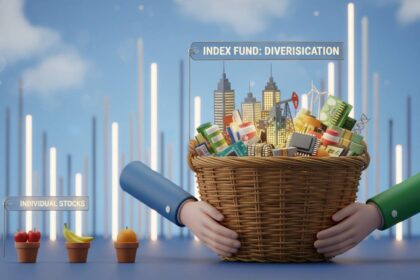

An index fund is a type of investment fund that tracks a specific market index, such as the S&P 500, by holding the same securities in roughly the same proportions as that index. For beginners, index funds offer a simple, low-cost way to invest in the stock market without needing to select individual stocks or time the market.
This guide breaks down everything you need to know about index funds, from how they work to how you can start investing today.
Key Insights
- Index funds provide instant diversification across hundreds or thousands of companies
- They typically have significantly lower fees than actively managed funds
- Research shows most actively managed funds underperform index funds over time
- You can build a diversified portfolio with just a few index funds
Understanding Index Funds: The Basics
An index fund is a pooled investment vehicle that aims to replicate the performance of a specific financial market index. When you invest in an index fund, your money is combined with other investors' money to purchase a broad slice of the market.
The concept originated in the 1970s when Vanguard founder John Bogle introduced the first retail index fund for individual investors. Before this innovation, low-cost index investing was reserved primarily for institutional investors.
What is an Index?
An index is a hypothetical portfolio of securities representing a particular market segment. The S&P 500, for example, includes 500 of the largest U.S. companies and serves as a benchmark for the overall U.S. stock market. Other popular indices include the Nasdaq Composite, Dow Jones Industrial Average, and international indices like the MSCI World.
When you buy shares of an S&P 500 index fund, you own a tiny piece of each company in that index. If Apple comprises 7% of the S&P 500, your fund holds approximately 7% of its assets in Apple shares.
Key Characteristics:
- Passive management approach (no active stock selection)
- Holdings mirror the underlying index
- Prices fluctuate throughout the trading day
- Net Asset Value (NAV) calculated daily
- Available through brokers, retirement accounts, and robo-advisors
How Index Funds Work
Understanding the mechanics behind index funds helps you make informed investment decisions. Here's how the process works:
The Creation Process
Fund managers don't actively pick stocks. Instead, they design the fund to hold securities in proportions matching the target index. When a company is added to the S&P 500, the fund must purchase shares of that company. When a company is removed, the fund sells those shares.
This "buy the index" approach requires minimal trading, which keeps costs low. The fund manager's job is primarily administrative—ensuring the fund's holdings accurately reflect the index, processing investor purchases and redemptions, and maintaining compliance with regulations.
Types of Index Fund Structures
| Structure | Description | Tax Efficiency | Minimum Investment |
|---|---|---|---|
| Mutual Fund | Pooled investment, end-of-day pricing | Lower | $1,000 - $3,000 |
| ETF (Exchange-Traded Fund) | Trades like a stock throughout the day | Higher | $1 - price of share |
| Index Annuity | Insurance product with index exposure | Varies | $1,000+ |
Expense Ratios Explained
The expense ratio represents the annual fee charged by the fund, expressed as a percentage of your investment. For example, a 0.03% expense ratio means you pay $3 annually for every $10,000 invested.
According to the Investment Company Institute, the average actively managed U.S. equity mutual fund charges an expense ratio of approximately 0.71%, while the average index fund charges around 0.06%. This difference can significantly impact your returns over time.
Types of Index Funds
Index funds come in various forms, each tracking different segments of the market. Understanding these categories helps you build an appropriate portfolio.
U.S. Stock Index Funds
These funds track indices representing the U.S. stock market, ranging from large-cap companies to small-cap stocks. The most popular options include:
- Large-Cap Index Funds: Track the S&P 500 or similar indices focusing on the 500 largest U.S. companies
- Total Market Index Funds: Track indices representing the entire U.S. stock market, including thousands of companies
- Small-Cap Index Funds: Focus on smaller companies with higher growth potential but increased volatility
International Index Funds
These funds provide exposure to markets outside the United States. They help diversify geographically and access growth opportunities in emerging economies.
Bond Index Funds
Fixed income index funds track indices representing the bond market. They provide regular income through interest payments and are generally less volatile than stock funds.
Sector Index Funds
These focus on specific industries like technology, healthcare, energy, or financial services. They allow targeted exposure but offer less diversification than broad market funds.
Recommended Beginner Portfolio Allocation
| Category | Example Index Fund | Allocation Suggestion |
|---|---|---|
| U.S. Total Market | Vanguard Total Stock Market (VTI) | 50-70% |
| International | Vanguard Total International (VXUS) | 20-30% |
| Bonds | Vanguard Total Bond Market (BND) | 10-20% |
Benefits of Investing in Index Funds
Index funds offer several advantages that make them particularly suitable for beginner investors.
Instant Diversification
Rather than researching and selecting individual stocks, you gain exposure to hundreds or thousands of companies in a single purchase. If one company performs poorly, its impact on your overall portfolio is minimal. This diversification reduces risk without requiring extensive research.
Lower Costs
The passive management approach means significantly lower fees compared to actively managed funds. Over a 30-year investment horizon, paying 0.70% in annual fees versus 0.05% can cost you tens of thousands of dollars in lost returns.
Consistent Performance
Actively managed funds rarely beat their benchmark indices consistently. According to data from SPIVA (S&P Indices Versus Active), over the 10-year period ending 2023, approximately 90% of large-cap active managers underperformed the S&P 500. Index funds guarantee market-matching performance (minus minimal fees).
Simplicity
Managing an index fund portfolio requires far less time and expertise than picking individual stocks. Once you've established your allocation, periodic rebalancing is the primary maintenance required.
Tax Efficiency
Because index funds have low turnover (they only trade when the underlying index changes), they generate fewer capital gains distributions than actively managed funds. This tax efficiency is particularly valuable in taxable accounts.
Warren Buffett, one of the world's most successful investors, has repeatedly recommended index funds for individual investors. In his 2024 shareholder letter, he noted that index funds "remain the most sensible equity investment for most Americans."
Risks and Considerations
While index funds offer many advantages, understanding their limitations helps you set realistic expectations.
Market Risk
Index funds don't protect against market downturns. When the market falls, your index fund investments fall too. However, historically, markets have recovered from every recession and reached new highs over time.
No Downside Protection
Unlike some actively managed funds, index funds won't try to protect your capital by moving to cash during downturns. You experience the full market decline—and ultimately, the full recovery.
Tracking Error
While minimal, differences between fund returns and index returns can occur due to factors like cash holdings, trading costs, and timing differences. Most index funds track their indices very closely.
Concentration Risk in Certain Indices
Some indices are heavily weighted toward particular sectors or companies. The S&P 500, for instance, has significant concentration in technology companies. If that sector underperforms, your fund will feel the impact.
Inflation Risk
Over very long periods, inflation can erode purchasing power. However, stocks (and stock index funds) historically outpace inflation over decades.
Interest Rate Risk
Bond index funds are particularly sensitive to interest rate changes. When rates rise, bond prices fall, affecting your fund's value.
How to Start Investing in Index Funds
Beginning your index fund investment journey involves several straightforward steps:
Step 1: Choose a Brokerage Account
Select a broker that offers access to index funds with low or no minimum investments. Many online brokers now offer commission-free trading on ETFs and mutual funds.
Popular Brokerages for Index Fund Investors:
- Fidelity Investments
- Charles Schwab
- Vanguard
- TD Ameritrade
- Robinhood
- E*TRADE
Step 2: Determine Your Investment Amount
You can start investing with very little money. Many ETFs allow purchasing single shares, meaning you could begin with $50 or less. Mutual funds sometimes have minimum investment requirements ranging from $1,000 to $3,000.
Step 3: Select Your Index Funds
For most beginners, a simple three-fund portfolio provides excellent diversification:
- U.S. Total Stock Market Fund: Core U.S. equity exposure
- International Stock Fund: Non-U.S. equity exposure
- Bond Fund: Stability and income
Step 4: Make Your Purchase
Once you've funded your account, place orders for your chosen funds. With ETFs, you can buy shares throughout the trading day. With mutual funds, your order executes at the end-of-day NAV price.
Step 5: Automate Your Investments
Setting up automatic monthly contributions helps you invest consistently regardless of market conditions. This dollar-cost averaging approach reduces the stress of timing the market.
Sample Beginner Investment Plan
| Month | U.S. Stock Fund | International Fund | Bond Fund | Total |
|---|---|---|---|---|
| 1 | $200 | $100 | $50 | $350 |
| 2 | $200 | $100 | $50 | $350 |
| 3 | $200 | $100 | $50 | $350 |
Index Funds vs. Other Investment Options
Understanding how index funds compare to alternatives helps you make informed decisions.
Index Funds vs. Individual Stocks
| Factor | Index Funds | Individual Stocks |
|---|---|---|
| Diversification | Instant across hundreds of companies | Requires buying many stocks |
| Time Required | Minimal research needed | Significant research required |
| Risk | Lower (spread across many companies) | Higher (concentration risk) |
| Fees | Low expense ratios | None directly, but trading costs apply |
| Performance | Matches market average | Can beat or underperform significantly |
Index Funds vs. Actively Managed Funds
Research consistently shows that most actively managed funds underperform index funds after fees. A landmark study from DALWA analyzed decades of data and found that actively managed funds in developed markets consistently underperformed their benchmarks net of fees.
The evidence is clear: for most investors, low-cost index funds provide better long-term returns than the average actively managed fund.
Index Funds vs. Robo-Advisors
Robo-advisors typically build portfolios using index funds. The additional service comes with higher fees (usually 0.25% to 0.50% annually). If you're comfortable managing a simple three-fund portfolio, you can achieve similar results without the extra cost.
Common Mistakes to Avoid
New index fund investors should be aware of these potential pitfalls:
Mistake #1: Chasing Performance
Past performance doesn't predict future results. The best-performing index funds today may not be tomorrow's leaders. Instead, focus on broad diversification and low costs.
Mistake #2: Overtrading
Frequently buying and selling index funds defeats the purpose of long-term investing. Each trade potentially incurs costs and may trigger tax consequences. Stay focused on your long-term strategy.
Mistake #3: Ignoring Expense Ratios
Small fee differences compound significantly over time. A fund charging 0.15% will cost you far less over 30 years than one charging 0.75%.
Mistake #4: Neglecting Rebalancing
Over time, your portfolio allocation drifts as some investments grow faster than others. Annual rebalancing helps maintain your target allocation and manages risk.
Mistake #5: Investing Emergency Funds in Stocks
Index funds should be part of long-term investment strategy only. Money you'll need within three to five years belongs in safer, more liquid investments.
Frequently Asked Questions
What is the minimum amount needed to start investing in index funds?
You can start investing in index funds with very little money. Many ETFs (exchange-traded funds) allow you to purchase a single share, meaning you could begin with as little as $50 to $100 depending on the fund's share price. Some mutual funds have minimum investment requirements of $1,000 to $3,000, though this varies by fund. Many brokerages also offer fractional shares, allowing you to invest even smaller amounts.
Are index funds safe during a market crash?
Index funds are not immune to market crashes—they fall along with the broader market since they hold the same securities. However, historically, markets have recovered from every crash and reached new highs over time. Index funds provide diversification that protects you from individual company failures, but they cannot protect against systemic market declines. For protection during downturns, consider holding bonds or cash equivalents alongside your stock index funds.
How do taxes work with index funds?
Index funds are relatively tax-efficient due to low turnover. When you sell shares for a profit, you may owe capital gains tax. For holdings in taxable accounts, you'll receive Form 1099 reporting your taxable distributions. In tax-advantaged accounts like IRAs or 401(k)s, you won't pay taxes on gains while the money remains in the account. Consider holding index funds in tax-advantaged accounts to minimize tax impact.
Can you lose money with index funds?
Yes, you can lose money investing in index funds during periods when the market declines. Index funds don't guarantee returns or protect against losses. However, the stock market has historically trended upward over long periods despite periodic downturns. Investors who hold diversified index funds for decades have historically been rewarded, but there's always some level of risk involved.
How many index funds should a beginner have?
A beginner can build a well-diversified portfolio with just three index funds: a U.S. total stock market fund, an international stock fund, and a bond fund. This three-fund portfolio provides broad diversification across thousands of companies and multiple asset classes. As you become more experienced, you might add sector-specific funds or other asset classes, but three funds is an excellent starting point for most investors.
What's the difference between an index fund and an ETF?
The main difference is how they trade. Index mutual funds execute trades once per day at the end-of-day net asset value (NAV) price. ETFs (exchange-traded funds) trade throughout the day on stock exchanges like individual stocks, with prices fluctuating continuously. Both can be index funds—both track indices—but they have different trading mechanisms. ETFs generally have slightly lower expense ratios and are more tax-efficient, while mutual funds offer automatic investment features and simpler purchasing for retirement accounts.
Conclusion
Index funds represent one of the most accessible and effective ways for beginners to build wealth through the stock market. By offering instant diversification, low costs, and consistent market-matching performance, they eliminate many of the complexities and uncertainties that challenge new investors.
The evidence is compelling: index funds have outperformed the majority of actively managed funds over nearly every time horizon, all while charging a fraction of the fees. For most individual investors, the case for index funds is clear.
Starting your investment journey with index funds doesn't require extensive knowledge of the stock market or significant capital. What it requires is commitment to consistent investing, patience during market fluctuations, and the discipline to maintain a long-term perspective.
Begin with a simple three-fund portfolio, automate your contributions, and resist the urge to react to short-term market movements. Over time, the power of compounding returns and diversification can help you build meaningful wealth.
Remember: you don't need to beat the market to build financial security. Sometimes, simply matching the market through low-cost index funds is the smartest investment strategy of all.