

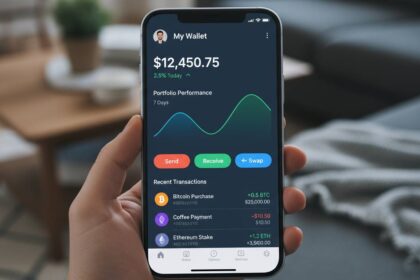

A blockchain wallet is a digital tool that allows users to store, send, and receive cryptocurrency by interacting with a blockchain network. Unlike a traditional wallet that holds physical cash, a blockchain wallet doesn't store coins directly—it stores the private keys needed to access your cryptocurrency holdings on the blockchain. These private keys are essentially the passwords that prove ownership of your digital assets and authorize transactions.
With over 420 million cryptocurrency users worldwide as of 2024 (Crypto.com, 2024), understanding blockchain wallets has become essential for anyone looking to participate in the crypto economy. Whether you're investing in Bitcoin, Ethereum, or exploring decentralized finance (DeFi), choosing the right wallet type determines how much control you have over your assets and how secure they remain.
This guide walks you through everything you need to know about blockchain wallets, from the fundamental technology behind them to practical steps for getting started.
Understanding Blockchain Wallets: The Basics
A blockchain wallet operates on public-key cryptography, a security system that uses two related keys: a public key (similar to an email address) and a private key (similar to a password). The public key can be shared freely with anyone who wants to send you cryptocurrency, while the private key must remain absolutely secret.
Key Insights
- Blockchain wallets store private keys, not actual cryptocurrency
- Every transaction is recorded on the blockchain and cannot be reversed
- Wallets don't require traditional bank accounts or personal information
- Loss of private keys means permanent loss of access to funds
When you install a blockchain wallet application or create an account with a wallet provider, the software generates a pair of cryptographic keys. The wallet then creates a human-readable version of your public key called a wallet address—a long string of alphanumeric characters that functions like a digital mailing address.
For example, a Bitcoin wallet address might look like: 1BvBMSEYstWetqTFn5Au4m4GFg7xJaNVN2
This address can be shared openly. When someone sends Bitcoin to this address, the transaction gets recorded on the Bitcoin blockchain, permanently verifying that the coins have transferred from one wallet to another.
The fundamental innovation separating blockchain wallets from traditional financial tools is decentralization. No bank or government entity controls these wallets or can reverse transactions. This gives users complete ownership but also places full responsibility for security on the individual.
How Blockchain Wallets Work
When you initiate a cryptocurrency transfer, your wallet uses your private key to create a digital signature that authorizes the transaction. This signature proves you own the funds you're trying to send without revealing your private key itself—a clever mathematical guarantee that maintains security even in public view.
The transaction then propagates through the blockchain network. Nodes (computers participating in the blockchain) verify the signature and check that you have sufficient balance. Once validated, the transaction gets grouped with others into a block and added to the blockchain permanently.
This process typically takes anywhere from a few seconds to several minutes, depending on the blockchain's design and network congestion. Bitcoin transactions average around 10 minutes per confirmation, while Ethereum transactions often complete in 15 seconds to a few minutes.
📊 TRANSACTION SPEEDS BY BLOCKCHAIN
| Blockchain | Avg. Transaction Time | Confirmations Required |
|---|---|---|
| Bitcoin | 10 minutes | 3-6 |
| Ethereum | 15 seconds - 5 min | 12-20 |
| Solana | 400-800 milliseconds | 1-2 |
| Polygon | 1-2 seconds | 1 |
Sources: Blockchain.com, 2024; Ethereum Foundation, 2024
Your wallet balance isn't stored in the wallet itself. Instead, the wallet queries the blockchain to find all transactions associated with your address and calculates your current balance. This is why blockchain wallets must connect to the internet (for hot wallets) or sync with blockchain data to display accurate balances.
Most modern wallets support multiple cryptocurrencies. A single wallet application can manage Bitcoin, Ethereum, USDT, and hundreds of other tokens—all from the same interface. This multi-chain support uses different derivation paths to generate separate addresses for each blockchain while maintaining a unified user experience.
Types of Blockchain Wallets: Custodial vs. Non-Custodial
The most important distinction in blockchain wallets is whether they are custodial or non-custodial. This choice fundamentally affects security, control, and responsibility.
Custodial Wallets
Custodial wallets are provided by exchanges and third-party services that hold your private keys on your behalf. When you create an account on Coinbase, Binance, or similar platforms, you're using a custodial wallet. These services store your keys in their systems, similar to how a bank holds your money.
✅ Advantages of Custodial Wallets:
- Password recovery possible if you forget credentials
- User-friendly interfaces ideal for beginners
- Built-in customer support for troubleshooting
- Often include additional features like staking and yield earning
❌ Disadvantages:
- You don't truly own your crypto—if the exchange is hacked or goes bankrupt, you could lose funds
- Withdrawal limits and processing times
- Requires KYC (Know Your Customer) verification
- Centralized point of failure
Non-Custodial Wallets
Non-custodial wallets give you complete control over your private keys. Software like MetaMask, Exodus, or hardware wallets like Ledger and Trezor fall into this category. Your keys never leave your device (or the hardware wallet), meaning you have true ownership of your cryptocurrency.
✅ Advantages of Non-Custodial Wallets:
- Complete ownership—you're the only one who can access your funds
- No middleman risk or exchange failure scenarios
- Enables interaction with decentralized applications (dApps)
- Greater privacy (no KYC required for basic usage)
❌ Disadvantages:
- No password recovery—if you lose your keys, funds are gone forever
- Steeper learning curve for beginners
- Full responsibility for security
- No customer support if you make mistakes
Most financial experts recommend that beginners start with a small amount in a custodial wallet to learn the basics, then gradually transition to non-custodial solutions as they gain confidence and larger holdings.
Hot Wallets vs. Cold Wallets
Beyond the custodial distinction, wallets are also categorized by their internet connectivity.
Hot Wallets
Hot wallets remain connected to the internet, making them convenient for frequent trading and transactions. Mobile apps, browser extensions, and web-based wallets all qualify as hot wallets. Examples include MetaMask, Trust Wallet, and the hot wallet functions on exchanges.
The convenience comes with increased security risk. Any wallet connected to the internet faces potential hacking, phishing, and malware threats. According to Chainalysis (2024), approximately 3.7% of all cryptocurrency transaction volume in 2023 involved hacked or stolen funds—though this percentage has declined as security practices improved.
Cold Wallets
Cold wallets store private keys offline, completely disconnected from the internet. This makes them immune to online hacking attempts. Hardware wallets like Ledger and Trezor are the most popular cold storage solutions, storing keys on physical devices that must be connected to sign transactions.
Paper wallets represent another cold storage method, where private keys are printed on paper and stored securely. While secure, they're less practical for regular use and can be damaged or lost.
📈 SECURITY COMPARISON
| Factor | Hot Wallet | Cold Wallet |
|---|---|---|
| Internet Connection | Always online | Offline until needed |
| Hacking Risk | Higher | Near-zero |
| Convenience | High | Lower |
| Best For | Trading, small amounts | Long-term storage, large amounts |
| Cost | Free to $50 | $50-$300 |
For practical crypto management, many users employ a hybrid approach: keeping smaller amounts in hot wallets for daily transactions while securing the majority of their holdings in cold wallets.
Key Features to Look for in a Blockchain Wallet
When selecting a blockchain wallet, several features determine whether it's suitable for your needs.
Multi-Currency Support
The best wallets support hundreds of cryptocurrencies, enabling you to manage all your holdings from one application. If you plan to hold various coins or tokens, verify that your wallet supports each one before committing.
Backup and Recovery Options
Non-custodial wallets provide a recovery phrase—typically 12 or 24 words—that can restore your wallet if you lose access. This seed phrase must be written down and stored securely. Never store digital copies, as they can be hacked.
Hardware wallets offer additional backup options, with some supporting encrypted microSD card backups or multi-signature recovery setups.
Network Compatibility
Different blockchains use different protocols. Ethereum uses EVM (Ethereum Virtual Machine) compatibility, while Bitcoin uses its own scripting language. If you want to interact with specific DeFi protocols or NFTs, ensure your wallet supports those networks.
MetaMask, for instance, supports Ethereum, Polygon, Arbitrum, Optimism, and dozens of other EVM-compatible networks. Solana-based wallets like Phantom focus exclusively on Solana and its ecosystem.
Transaction Fees Management
Blockchain transactions require fees paid to network validators. Some wallets let you adjust fee levels—paying more for faster confirmations during congestion. Understanding fee structures helps you avoid overpaying during low-traffic periods.
dApp Integration
If you're interested in decentralized finance, NFTs, or Web3 applications, your wallet must connect to these platforms. Browser extension wallets like MetaMask and Rabby excel at dApp connections, while some hardware wallets now include Bluetooth for mobile dApp interaction.
Setting Up Your First Blockchain Wallet
Getting started with a blockchain wallet involves several important steps that set the foundation for secure crypto management.
Step 1: Choose Your Wallet Type
For absolute beginners, starting with a reputable custodial wallet on a major exchange like Coinbase or Kraken provides the gentlest learning curve. These platforms offer built-in customer support, easy fiat on-ramps (converting USD to crypto), and insurance on certain holdings.
After gaining familiarity, consider adding a non-custodial software wallet for interactive with DeFi and dApps.
Step 2: Download from Official Sources
Never search for wallet downloads through search engines—phishing sites frequently appear in results. Always navigate directly to official websites or use official app stores. Verify the URL carefully: fake sites often use similar-looking domains with slight misspellings.
Step 3: Create Strong Security Measures
When setting up non-custodial wallets, you'll receive your seed phrase immediately. Write it down on paper—multiple copies stored in different secure locations are recommended. Never share this phrase with anyone, including wallet support staff. Legitimate companies will never ask for your seed phrase.
Enable all available security features: biometric login (fingerprint or face recognition), two-factor authentication (2FA), and transaction confirmation requirements.
Step 4: Verify Your Setup
Before transferring significant funds, send a small test transaction. Send $5-10 worth of cryptocurrency to your new wallet, then attempt to send it back or to another address. This verifies everything works correctly without risking large amounts.
Step 5: Add Funds
To add cryptocurrency, you can either purchase directly within custodial platforms using bank accounts or credit cards, or transfer from another wallet or exchange. External transfers require obtaining your wallet's deposit address—triple-check this address matches the correct blockchain for the asset you're receiving.
Common Mistakes to Avoid
New cryptocurrency users frequently make several avoidable errors that sometimes result in permanent fund loss.
Sending Crypto to the Wrong Blockchain
One of the most common mistakes is sending tokens to an address on the wrong blockchain. Bitcoin sent to an Ethereum address (or vice versa) typically results in permanent loss. Most wallets display warnings, but always verify you're sending on the correct network.
For example, USDT exists on many blockchains (ERC-20 on Ethereum, TRC-20 on Tron, SPL on Solana). Each version has a different address format and requires different transaction fees.
Losing Access to Recovery Phrases
Without your seed phrase, there's no way to recover a non-custodial wallet. People have lost billions of dollars worth of cryptocurrency by misplacing paper backups or accidentally destroying them. Store recovery phrases in fireproof safes, safety deposit boxes, or other secure physical locations.
Ignoring Transaction Fees
During periods of high blockchain congestion, transaction fees can spike dramatically. A simple transfer that normally costs $1 might cost $30 or more during peak times. Using fee estimation tools and timing transactions during off-peak hours saves money.
Falling for Phishing Scams
Phishing attacks targeting cryptocurrency users are sophisticated and common. Scammers create fake websites, send fraudulent emails, or impersonate support staff on social media. Always verify URLs, never click suspicious links, and remember that legitimate services will never ask for your seed phrase or private keys.
The Future of Blockchain Wallets
Blockchain wallet technology continues evolving rapidly, with several trends shaping the future of how we manage digital assets.
**Account Abstraction **
Ethereum's account abstraction technology, now live on the network, enables smart contract wallets that function more like traditional accounts. These wallets can implement social recovery (trusted contacts who can help restore access), automated spending limits, and multi-signature requirements—all features impossible with traditional private key wallets.
Multi-Party Computation (MPC)
MPC technology splits private keys into multiple fragments distributed across different devices or parties. Transactions require signatures from multiple fragments, combining security with convenience. This approach eliminates single points of failure without requiring users to manage complex hardware devices.
Interoperability Improvements
Cross-chain bridges and multi-chain aggregators are making it easier to manage assets across different blockchains from single interfaces. Soon, users may manage Bitcoin, Ethereum, Solana, and dozens of other chains without switching applications.
Institutional Adoption
Major financial institutions are developing enterprise-grade wallet solutions with institutional oversight, insurance, and compliance features. This infrastructure is bringing cryptocurrency to mainstream finance while maintaining necessary security and regulatory standards.
Frequently Asked Questions
What is the difference between a blockchain wallet and a crypto exchange?
A blockchain wallet is a tool for storing and managing your private keys, giving you direct control over your cryptocurrency. A crypto exchange is a trading platform where you buy, sell, and trade cryptocurrencies. Most exchanges provide built-in wallets (which are custodial), but you can also withdraw funds to your own non-custodial wallet for greater security.
Are blockchain wallets anonymous?
Blockchain wallets provide pseudonymity, not complete anonymity. While you don't need to provide personal information to create a non-custodial wallet, all transactions are publicly visible on the blockchain. Analysis firms can often trace transactions and potentially identify users through exchange KYC data or spending patterns.
Can I have multiple blockchain wallets?
Yes, there's no limit to how many wallets you can create. Many users maintain multiple wallets for different purposes—a hot wallet for trading, a cold wallet for long-term storage, and separate addresses for privacy. This practice is actually recommended for security and organization.
What happens if I lose my blockchain wallet?
If you lose access to a custodial wallet, contact the platform's customer support—they can help recover accounts through traditional identity verification. For non-custodial wallets, your only recovery option is your seed phrase. Without it, your cryptocurrency is permanently inaccessible. This is why securely storing your seed phrase is absolutely critical.
Do blockchain wallets work internationally?
Yes, blockchain wallets work globally without restrictions. Unlike traditional bank accounts that may have geographic limitations, anyone with internet access can create a non-custodial wallet and send/receive cryptocurrency anywhere in the world. The main international consideration is ensuring your local regulations permit cryptocurrency ownership and use.
How much does a blockchain wallet cost?
Most software wallets (hot wallets) are free to download and use, though you'll pay network transaction fees when sending cryptocurrency. Hardware wallets (cold wallets) typically cost between $50 and $300, representing a one-time purchase for enhanced security. Custodial wallets offered by exchanges are generally free to use, though some premium features may involve fees.