

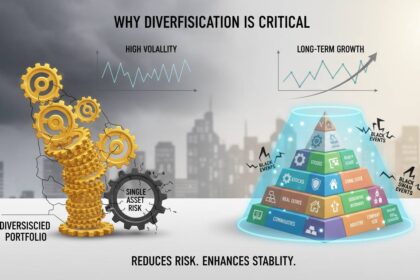

Every year, thousands of investors learn a painful lesson: putting all their eggs in one basket leads to catastrophic losses. Whether it's the tech bubble of 2000, the financial crisis of 2008, or the market volatility of 2020, concentrated portfolios suffer the most severe damage while diversified portfolios weather the storm and emerge stronger. Understanding why diversification matters—and how to implement it effectively—separates successful long-term investors from those who chase quick gains and frequently lose capital.
This guide breaks down the mechanics of portfolio diversification, examines the research backing its effectiveness, and provides actionable strategies you can implement regardless of your experience level or investment amount.
What Diversification Actually Means
Diversification is the practice of spreading investments across various asset classes, sectors, and geographic regions to reduce overall portfolio risk. However, true diversification extends far beyond simply owning multiple stocks. It encompasses several interconnected dimensions that work together to protect and grow your wealth over time.
Asset class diversification involves holding a mix of stocks, bonds, real estate, commodities, and cash equivalents. Each asset class responds differently to economic conditions—when stocks decline, bonds often remain stable or increase in value, providing a counterbalance that smooths overall portfolio performance.
Geographic diversification means investing in companies and markets across multiple countries. The U.S. stock market doesn't always lead global performance, and international exposure protects against domestic economic downturns while capturing growth in emerging markets.
Sector diversification ensures your portfolio isn't overly concentrated in any single industry. Technology, healthcare, finance, energy, and consumer goods sectors each respond uniquely to economic cycles. A portfolio heavy in energy stocks during a renewable energy transition, for example, would significantly underperform a balanced sector allocation.
Market cap diversification involves holding a mix of large-cap, mid-cap, and small-cap companies. Large-cap stocks typically offer stability during downturns, while small-caps often provide higher growth potential during economic expansions.
The common thread across all these dimensions is correlation—the mathematical measure of how closely two investments move in relation to each other. Effective diversification requires combining assets with low or negative correlation, so when one investment declines, others potentially increase or remain stable.
The Mathematics Behind Portfolio Protection
Modern portfolio theory, developed by Nobel Prize-winning economist Harry Markowitz in 1952, demonstrated mathematically what experienced investors had observed intuitively: you can reduce portfolio volatility without necessarily sacrificing expected returns by combining assets with imperfect correlation.
Consider the historical evidence. During the 2008 financial crisis, the S&P 500 declined 37%. However, a diversified portfolio holding 60% stocks and 40% bonds would have experienced only a 22% loss—significantly less damage while maintaining exposure to the eventual market recovery. Bonds, particularly U.S. Treasury bonds, often act as safe havens during market stress, rising in value when stocks fall.
📊 HISTORICAL RISK-RETURN COMPARISON
| Portfolio Allocation | Average Annual Return | Worst Year | Best Year | Volatility (Std Dev) |
|---|---|---|---|---|
| 100% Stocks | 10.2% | -37% | 52% | 17.5% |
| 80% Stocks / 20% Bonds | 9.1% | -27% | 44% | 13.8% |
| 60% Stocks / 40% Bonds | 8.2% | -22% | 38% | 10.4% |
| 40% Stocks / 60% Bonds | 7.1% | -14% | 29% | 7.2% |
| 100% Bonds | 5.4% | -8% | 25% | 4.8% |
Source: Morningstar data, 1926-2023
These numbers reveal an essential truth: diversification doesn't just reduce risk—it often improves risk-adjusted returns. The 60/40 portfolio didn't just lose less than the all-stock portfolio; it delivered returns more consistently, allowing compound growth to work more effectively over time.
The key insight is that volatility drag—the negative effect of large losses on your ability to recover—hurts concentrated portfolios significantly more than diversified ones. A 50% loss requires a 100% gain to break even. A 20% loss requires only 25% gains to recover. Diversification's primary benefit is limiting maximum drawdowns, which accelerates long-term wealth accumulation.
Why Individual Investors Underestimate Diversification
Despite overwhelming evidence supporting diversification, individual investors consistently fail to implement it effectively. Behavioral finance research reveals several psychological factors that work against proper portfolio construction.
Overconfidence bias leads investors to believe they can pick winners and avoid losers. Media coverage of spectacular success stories—the investor who bought Amazon in 1997, the trader who called the 2008 crash—creates an illusion that superior stock-picking ability is common. In reality, studies consistently show that actively managed funds underperform index funds over most time periods, and individual investors perform even worse due to emotional trading.
Familiarity bias causes investors to overweight companies they know personally. An engineer at Boeing might hold primarily aerospace stocks; a nurse might concentrate in healthcare companies. This pattern feels logical—"I understand these businesses"—but creates massive concentration risk. Your employer, your industry, and your geographic region all represent potential sources of correlated loss.
Loss aversion makes the pain of losses feel approximately twice as powerful as the pleasure of equivalent gains. This asymmetry leads investors to seek safety in familiar, concentrated positions rather than accepting the cognitive discomfort of owning assets they don't fully understand.
Research from Dalbar Inc., a financial services research firm, demonstrates the cost of these behavioral biases. While the S&P 500 delivered an average annual return of 10.0% over the 20-year period ending 2022, the average equity fund investor earned only 7.1%—a staggering gap caused primarily by poor timing and overtrading.
Common Diversification Mistakes to Avoid
Understanding what diversification is not proves equally important as understanding what it is. Several common mistakes undermine well-intentioned investors.
❌ MYTH: Owning many stocks within a single sector provides adequate diversification.
✅ REALITY: All stocks in a sector often move together. Owning 50 different tech companies provides minimal protection when technology stocks decline broadly.
❌ MYTH: Diversification guarantees positive returns.
✅ REALITY: Diversification reduces risk and volatility; it doesn't eliminate loss potential. During severe market crashes, nearly all asset classes can decline simultaneously, as occurred in 2022 when both stocks and bonds fell significantly.
❌ MYTH: Once diversified, you never need to rebalance.
✅ REALITY: Market movements cause portfolio drift over time. A portfolio that started as 60/40 might drift to 75/25 after several years of strong stock performance, exposing you to more risk than intended.
❌ MYTH: International diversification is unnecessary for U.S. investors.
✅ REALITY: The U.S. market represents roughly half of global market capitalization. Ignoring international markets misses roughly half of global investment opportunities and increases vulnerability to U.S.-specific economic challenges.
Concentration risk represents the most dangerous mistake. Single-stock ownership—whether through company stock in a 401(k) or a large position in a "sure thing"—creates vulnerability that diversification cannot fix once a crisis hits. The employees of Enron, WorldCom, and Lehman Brothers learned this lesson too late, watching their retirement savings vanish when their employers collapsed.
How to Build a Diversified Portfolio
Implementing effective diversification requires understanding your personal situation, time horizon, and risk tolerance before selecting specific investments.
Step 1: Assess Your Risk Profile
Your ability and willingness to endure portfolio losses determine appropriate allocation. Younger investors with stable income and decades until retirement can tolerate more stock exposure. Near-retirees need more conservative allocations to protect accumulated wealth.
Step 2: Choose Your Asset Allocation
Most investors benefit from a simple three-fund portfolio approach:
- U.S. Total Stock Market Index Fund: Provides broad exposure to U.S. companies of all sizes
- International Stock Index Fund: Offers exposure to developed and emerging markets outside the U.S.
- Bond Index Fund: Delivers stability and income with lower correlation to stocks
A common starting point for younger investors is 80% stocks (60% U.S., 20% international) and 20% bonds, adjusting toward more conservative allocations as retirement approaches.
Step 3: Add Diversification Layers
Beyond the basic three-fund portfolio, additional diversification opportunities include:
- Real Estate Investment Trusts (REITs): Commercial and residential property exposure
- TIPS (Treasury Inflation-Protected Securities): Protection against inflation
- International Bonds: Developed-market government and corporate debt
- Small-Cap Value Tilt: Historical evidence suggests small-cap value stocks offer higher long-term returns
Step 4: Implement and Maintain
Open accounts with low-cost brokerages offering index funds and exchange-traded funds (ETFs). Automate contributions to ensure consistent investing regardless of market conditions. Set calendar reminders to review allocation annually and rebalance when drift exceeds 5% from targets.
The Role of Asset Allocation in Long-Term Success
Research consistently demonstrates that asset allocation explains the majority of portfolio returns over time. A landmark study by Brinson, Hood, and Beebower (1986) found that asset allocation decisions explained over 90% of return variability, with market timing and security selection contributing minimally.
This finding has profound implications. Rather than spending countless hours analyzing individual stocks or trying to time market movements, investors achieve better outcomes by focusing on constructing and maintaining appropriate asset allocations.
The evidence is compelling: Vanguard's research shows that over a 10-year period, funds with more consistent asset allocation consistently outperformed those with volatile, frequently-changed allocations. The simplicity of diversification strategies outperforms complex approaches that attempt to outsmart the market.
Dollar-cost averaging—investing fixed amounts at regular intervals regardless of market conditions—complements diversification by removing emotional decision-making from the investment process. This systematic approach naturally buys more shares when prices are low and fewer when prices are high, averaging out market volatility over time.
Building Wealth Through Disciplined Diversification
The true power of diversification emerges over decades of consistent investing. Compound growth requires sustained participation in markets, and diversification protects your ability to remain invested through market downturns that would otherwise cause panic selling.
Consider two hypothetical investors starting at age 25 with $10,000 annually to invest:
Investor A experiences a 40% loss in year one, loses motivation, and reduces contributions during the downturn. After 40 years of inconsistent investing with an average return of 7%, this investor accumulates approximately $580,000.
Investor B maintains consistent contributions throughups and downs, achieving the same 7% average return through disciplined diversification. This investor accumulates approximately $1.7 million—nearly three times more wealth from identical total contributions.
The difference isn't superior stock-picking or market timing. It's simply staying invested through volatility, which diversification makes psychologically sustainable.
Frequently Asked Questions
Does diversification still work during major market crashes?
Diversification doesn't eliminate losses during crashes, but it significantly reduces them. During the 2008 financial crisis, a 60/40 portfolio lost about 22% versus 37% for stocks alone. During the 2022 market correction, diversification provided less protection because stocks and bonds fell together, but diversified portfolios still outperformed single-asset classes. The key insight is that diversification's main benefit is limiting maximum drawdowns, which accelerates recovery and preserves compounding ability.
How many different investments do I need for proper diversification?
Quality matters more than quantity. Research suggests that owning 20-30 stocks across different sectors provides most of the diversification benefit available from individual stocks. Adding bonds, international exposure, and other asset classes further reduces risk. Beyond 30-40 positions, additional diversification provides diminishing returns while increasing complexity and trading costs.
Should I rebalance my portfolio regularly?
Yes, annual rebalancing is generally recommended to maintain your target allocation. When stocks outperform, they grow to represent a larger percentage of your portfolio than intended, increasing risk. Rebalancing forces you to sell appreciated assets and buy underperforming ones—counterintuitive but effective for long-term returns. Many investors automate rebalancing through their retirement accounts or use target-date funds that handle allocation automatically.
Is diversification important if I'm investing for retirement in 20+ years?
Absolutely. While younger investors can tolerate more volatility, they also have the most to lose from concentration risk. A single major market downturn early in your career can devastate compounding potential if you're heavily concentrated. Maintaining diversification throughout your career protects against black swan events that are impossible to predict. The earlier you establish diversified habits, the more wealth you'll accumulate.
What's the difference between diversification and asset allocation?
Asset allocation is the strategic decision about what percentage of your portfolio goes to each asset class (stocks, bonds, real estate, etc.). Diversification is the implementation tactic—actually owning multiple securities within each asset class to reduce specific risks. You need both: proper allocation provides the foundational risk-return profile, while diversification within each category reduces unsystematic risk.
Can I achieve diversification through target-date funds?
Yes, target-date funds provide built-in diversification and automatic rebalancing. These funds hold thousands of securities across multiple asset classes and gradually shift to more conservative allocations as you approach retirement. They're an excellent choice for investors who want a single, simple solution. Just verify the expense ratio is low (below 0.20%) and that the fund includes adequate international exposure.
The Path Forward
Diversification isn't exciting. It won't generate headlines or make you feel like a financial genius. It's a methodical, patience-focused approach that works quietly in the background while more glamorous strategies crash and burn.
The evidence is unambiguous: diversified portfolios deliver superior risk-adjusted returns over time. They protect against the catastrophic losses that destroy wealth and psychological capital. They allow investors to sleep soundly during market turbulence and maintain the discipline necessary for long-term success.
Start today by assessing your current allocation. If you're heavily concentrated in single stocks, sectors, or asset classes, consider gradually shifting toward broader diversification. Even small steps toward diversification compound into significant wealth protection over time.
Remember: the goal isn't to avoid all losses—that's impossible. The goal is to limit downside risk while maintaining upside participation. That's what diversification delivers, and that's why it remains the foundation of sound investing regardless of market conditions or economic environment.