

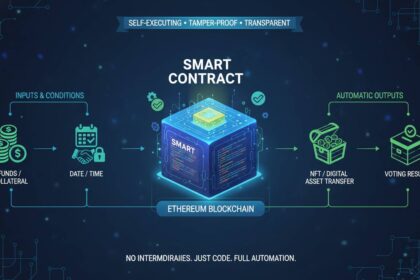

A smart contract on Ethereum is a self-executing program stored on the blockchain that automatically enforces the terms of an agreement when predetermined conditions are met. Think of it as a digital vending machine: insert the correct amount (condition), and the machine automatically delivers your product (execution) without needing a cashier or middleman. These contracts run on the Ethereum Virtual Machine (EVM), a decentralized computing environment that processes transactions without any central authority.
Ethereum, launched in 2015 by Vitalik Buterin, became the first major blockchain platform specifically designed to support smart contracts. Unlike Bitcoin, which primarily handles financial transactions, Ethereum's architecture allows developers to build decentralized applications (dApps) that can automate virtually any type of agreement or process.
The Origins and Evolution of Smart Contracts
The concept of smart contracts predates Ethereum by nearly two decades. Computer scientist Nick Szabo coined the term in 1994, describing self-executing contracts with terms directly written into code. Szabo's original vision included digital assets like cash and derivatives, anticipating many features that blockchain would later make technically feasible.
📊 KEY STATS
- 2015: Ethereum launches as the first major smart contract platform
- 2021: Ethereum processes over 1.5 million transactions daily at peak usage
- 2023: Over 50 million smart contracts have been deployed on Ethereum
- $50+ billion: Total Value Locked (TVL) in Ethereum DeFi protocols as of 2024
Before Ethereum, attempts to implement smart contracts faced a fundamental problem: how to ensure that parties fulfill their obligations without relying on a trusted third party. Traditional digital agreements require courts, escrow services, or intermediaries to enforce compliance. Blockchain technology solved this through decentralization—multiple computers (nodes) validate and record every transaction, making it practically impossible to alter the contract's terms after deployment.
How Ethereum Smart Contracts Actually Work
Understanding smart contracts requires grasping three interconnected concepts: the Ethereum Virtual Machine, gas fees, and the contract deployment process.
The Ethereum Virtual Machine (EVM)
The EVM serves as the computational engine powering Ethereum. It's a Turing-complete software stack, meaning it can execute any algorithm given enough resources. When you interact with a smart contract—whether transferring tokens, voting in a DAO, or purchasing digital art—you're essentially instructing the EVM to run specific code.
Here's a simplified example of what a basic smart contract looks like in code:
// A simple example in Solidity (Ethereum's programming language)
pragma solidity ^0.8.0;

contract SimpleStorage {
    uint256 private value;

    // Store a value
    function setValue(uint256 _value) public {
        value = _value;
    }

    // Retrieve the stored value
    function getValue() public view returns (uint256) {
        return value;
    }
}
This example demonstrates three core principles: state storage (the value variable), function execution (setValue and getValue), and access control (anyone can call these functions).
Gas and Transaction Costs
Every operation on Ethereum requires computational resources, measured in "gas." Gas serves two purposes: it prevents network spam and incentivizes miners (or validators in Ethereum's proof-of-stake system) to process transactions. Complex contracts with many operations cost more gas than simple ones.
| Operation Type | Gas Cost | Example |
|---|---|---|
| Basic transfer | 21,000 gas | Sending ETH to another wallet |
| Simple contract call | 40,000+ gas | Interacting with a token contract |
| Complex DeFi transaction | 100,000+ gas | Swapping tokens on Uniswap |
| NFT mint | 150,000+ gas | Creating a new digital collectible |
Gas prices fluctuate based on network demand. During high-traffic periods, users pay premium fees to have their transactions prioritized.
The Deployment Process
When developers deploy a smart contract, they're essentially publishing code to the blockchain that becomes permanently stored and publicly accessible. The process involves:
- Writing the contract in a programming language like Solidity
- Compiling the code into bytecode the EVM can understand
- Deploying the bytecode as a transaction to the Ethereum network
- Recording the contract address where users can interact with it
Once deployed, the contract operates autonomously. It cannot be stopped, modified, or deleted by any single entity—including its creator. This immutability is both a feature and a limitation, as bugs in the code become permanent.
Real-World Applications and Use Cases
Smart contracts on Ethereum now power a diverse ecosystem of applications spanning finance, gaming, art, and governance.
Decentralized Finance (DeFi)
DeFi represents the largest use case for Ethereum smart contracts. These applications recreate traditional financial instruments—lending, borrowing, trading, insurance—without banks or brokers.
Uniswap, for example, uses smart contracts to automate cryptocurrency trading. The protocol replaces traditional order books with automated liquidity pools. When you swap one token for another, smart contracts calculate the exchange rate based on supply and demand, execute the trade instantly, and distribute trading fees to liquidity providers.
Aave, a lending protocol, allows users to lend cryptocurrencies and earn interest or borrow assets by depositing collateral. Smart contracts automatically calculate interest rates, manage collateral liquidation if values drop, and distribute returns to lenders.
Non-Fungible Tokens (NFTs)
NFTs are unique digital assets verified through Ethereum smart contracts. When you purchase an NFT, the contract records your wallet address as the new owner in an immutable ledger.
The standard ERC-721 contract defines core functions like transferFrom (moving ownership), tokenURI (linking to digital content), and ownerOf (checking current ownership). This standardization enables NFTs to work across different marketplaces and wallets seamlessly.
Decentralized Autonomous Organizations (DAOs)
DAOs represent a new form of organizational governance built on smart contracts. Instead of traditional corporate structures with executives and boards, DAOs use programmable rules to coordinate group decisions.
Members receive governance tokens granting voting rights. Proposals go through smart contracts that automatically execute approved actions—disbursing funds, updating parameters, or making investment decisions—without human intervention.
Advantages and Limitations
Smart contracts offer transformative capabilities, but understanding their constraints is essential for realistic implementation.
Key Advantages
Trustlessness: Parties don't need to trust each other or a central authority. The code executes exactly as written, eliminating the need for intermediaries.
Transparency: All contract code and transaction history are publicly visible on the blockchain. Anyone can audit how the contract operates.
Security: Blockchain's cryptographic architecture makes records extremely difficult to alter. Once confirmed, transactions become permanent.
Speed: Traditional agreements often require days or weeks for processing. Smart contracts execute in seconds or minutes.
Cost reduction: By removing middlemen, smart contracts can significantly reduce transaction costs for many use cases.
Recognized Limitations
Immutability is a double-edged sword: While it ensures no one can change the rules mid-game, it also means deployed contracts cannot be updated—even if developers discover critical bugs. The 2016 DAO hack, where attackers exploited a vulnerability to steal $60 million in Ether, demonstrated this risk dramatically.
Oracle problem: Smart contracts cannot access external data (like stock prices or weather) natively. They rely on "oracles"—third-party services that feed external information into the blockchain. This creates a potential centralization vulnerability, as the oracle becomes a trusted point of failure.
Scalability challenges: Ethereum processes approximately 15-30 transactions per second—far fewer than traditional payment networks like Visa (which handles thousands). This limitation leads to congestion and high fees during peak usage.
Legal uncertainty: Many jurisdictions haven't established clear regulations around smart contracts. Questions about enforceability, liability, and consumer protection remain largely unresolved.
Getting Started with Smart Contracts
If you're interested in exploring or interacting with smart contracts, several paths exist depending on your technical background.
For Non-Technical Users
You don't need coding skills to use smart contract applications. Popular wallets like MetaMask serve as your gateway to the Ethereum ecosystem. After installing a wallet browser extension, you can:
- Use DeFi protocols: Lend, borrow, or trade cryptocurrencies through web interfaces
- Buy and sell NFTs: Purchase digital art and collectibles on marketplaces like OpenSea
- Participate in DAOs: Join communities and vote on governance proposals
- Bridge assets: Transfer tokens between Ethereum and other blockchain networks
Start with small transactions to understand how gas fees work and how wallet confirmations operate.
For Aspiring Developers
If you want to build smart contracts, the learning path involves:
- Solidity fundamentals: Ethereum's primary programming language
- Development environment: Tools like Hardhat or Foundry for testing contracts
- Blockchain basics: Understanding accounts, transactions, and gas mechanics
- Security practices: Learning common vulnerabilities like reentrancy attacks
Online resources from the Ethereum Foundation, freeCodeCamp, and various bootcamps offer structured learning paths for beginners.
The Future of Smart Contracts on Ethereum
Ethereum continues evolving to address current limitations while expanding capabilities.
Ethereum 2.0 and Beyond
The transition to proof-of-stake (completed in September 2022) reduced Ethereum's energy consumption by approximately 99.95%. Future upgrades aim to improve scalability through "sharding"—splitting the network into multiple segments that process transactions in parallel.
Layer 2 solutions already address immediate scaling needs. Rollups bundle hundreds of transactions off-chain, then submit compressed data to Ethereum's main chain. This approach can increase throughput to thousands of transactions per second while maintaining security.
Institutional Adoption
Major financial institutions increasingly explore smart contracts for settlement, derivatives, and asset tokenization. Fidelity, JPMorgan, and various central banks have announced blockchain initiatives leveraging Ethereum's infrastructure.
The European Union's Markets in Crypto-Assets (MiCA) regulation, fully implemented in 2024, provides clearer legal frameworks for smart contract applications in traditional finance.
Frequently Asked Questions
What programming language are Ethereum smart contracts written in?
Solidity is the most widely used language for Ethereum smart contracts. It's similar to JavaScript and was specifically designed for blockchain development. Vyper, another option, offers increased security through simpler syntax and stricter rules.
Can smart contracts be changed after deployment?
By default, smart contracts are immutable—once deployed, their code cannot be modified. This ensures no one can alter the rules retroactively. However, developers can design upgradeable contracts using proxy patterns, which allow certain parameters or logic to be updated while maintaining the original contract address.
Do I need cryptocurrency to interact with smart contracts?
Yes, you need ETH (Ethereum's native cryptocurrency) to pay for gas fees when executing transactions. Some applications may cover these costs, but most interactions require users to hold ETH in their wallet. You'll also need the specific tokens the contract accepts (like USDC, DAI, or NFTs).
Are smart contracts legally binding?
The legal status of smart contracts varies by jurisdiction and depends heavily on the specific use case. Traditional courts generally haven't addressed smart contract enforceability comprehensively. Some jurisdictions may recognize smart contract code as evidence of agreement, while others consider them unenforceable digital constructs. For significant agreements, consult legal professionals familiar with blockchain technology.
How do I know a smart contract is safe to use?
Research the contract's audit history (security firms like Trail of Bits, OpenZeppelin, and Certik audit major protocols), check whether the development team is publicly identified, review community feedback, and start with small test transactions. No contract is completely risk-free, but due diligence significantly reduces exposure to scams or coding vulnerabilities.
What's the difference between Ethereum and Bitcoin for smart contracts?
Bitcoin's scripting language is intentionally limited for security reasons—it primarily handles simple payment conditions. Ethereum was built from the ground up as a programmable platform capable of executing complex logic and storing arbitrary data. This fundamental design difference makes Ethereum the dominant platform for smart contract applications.
Conclusion
Smart contracts represent a fundamental shift in how agreements and transactions can be automated and enforced. On Ethereum, these self-executing programs enable everything from decentralized finance applications to digital art ownership, all without traditional intermediaries.
The technology isn't perfect—scalability constraints, immutability risks, and regulatory uncertainty present ongoing challenges. Yet the ecosystem continues maturing rapidly, with Layer 2 solutions already handling significant transaction volume and major institutional players exploring blockchain-based infrastructure.
Whether you're simply using DeFi protocols or planning to develop your own applications, understanding how smart contracts work provides essential foundation for navigating this evolving landscape. Start with small interactions, maintain security awareness, and recognize that this technology remains in its early stages—with significant developments still ahead.