

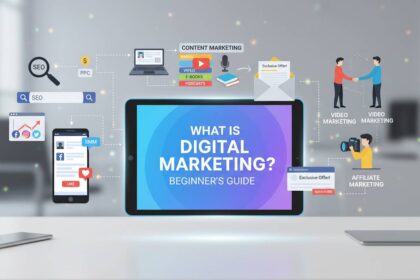

Digital marketing encompasses all marketing efforts that use electronic devices or the internet to connect with potential customers. Businesses leverage digital channels such as search engines, social media, email, websites, and mobile apps to reach their target audiences, build brand awareness, generate leads, and drive sales. Unlike traditional marketing, digital marketing provides unprecedented ability to track, measure, and optimize campaigns in real-time, making it essential for businesses of all sizes in today's connected world.
📊 STATS
• 97% of Americans use the internet daily
• 93% of online experiences begin with a search engine
• Businesses that use marketing automation see a 14.5% increase in sales productivity
• Digital ad spending in the US reached $276 billion in 2024 (eMarketer, 2024)
Key Takeaways
• Omnichannel presence: Successful digital marketing requires visibility across multiple platforms where your audience spends time
• Data-driven decisions: Analytics allow precise targeting and ROI measurement impossible with traditional methods
• Cost-effectiveness: Digital marketing costs 60-70% less than traditional marketing while generating more leads
• Global reach: The internet eliminates geographic boundaries, allowing small businesses to compete globally
• Real-time optimization: Campaigns can be adjusted instantly based on performance data
• Customer engagement: Direct two-way communication builds lasting relationships and brand loyalty
The evolution from traditional to digital marketing represents the most significant shift in how businesses connect with consumers. Companies that master digital marketing strategies gain competitive advantages through better audience targeting, improved customer insights, and scalable growth opportunities. Whether you're a small business owner, marketing professional, or entrepreneur, understanding digital marketing fundamentals is no longer optional—it's essential for sustainable business success.
Understanding Digital Marketing Fundamentals
Digital marketing refers to the strategic use of digital channels, platforms, and technologies to promote products, services, or brands to potential customers. Unlike conventional marketing approaches that rely on print, television, or radio advertisements, digital marketing operates in the online space where consumers increasingly spend their time and money.
The core philosophy behind digital marketing centers on reaching the right audience, at the right time, with the right message. This precision targeting distinguishes digital marketing from mass marketing techniques that cast wide nets hoping to catch interested prospects. Through sophisticated data collection and analysis, businesses can now understand customer behaviors, preferences, and purchase patterns with remarkable accuracy, enabling highly personalized marketing approaches that resonate on an individual level.
Core Components
Essential Elements:
• Search Engine Optimization (SEO): Optimizing website content to rank higher in organic search results
• Content Marketing: Creating valuable, relevant content to attract and engage target audiences
• Social Media Marketing: Using platforms like Facebook, Instagram, LinkedIn, and TikTok to build brand presence
• Email Marketing: Direct communication with prospects and customers through targeted email campaigns
• Pay-Per-Click Advertising (PPC): Paid advertisements on search engines and social platforms
• Affiliate Marketing: Partnering with affiliates to promote products in exchange for commissions
• Analytics and Data Analysis: Measuring performance and informing strategy decisions
💡 FACT: Companies that prioritize blogging generate 67% more leads than those without blogging strategies
How Digital Marketing Works
Digital marketing operates on the principle of meeting consumers where they already spend significant time—online. The process begins with identifying your target audience and understanding their online behavior, including which platforms they use, what content they consume, and how they make purchasing decisions. Armed with this intelligence, marketers craft strategies designed to capture attention, build trust, and guide prospects through the customer journey from initial awareness to final conversion.
The customer journey in digital marketing typically follows distinct stages: awareness (when potential customers discover your brand), consideration (when they evaluate your offerings), conversion (when they make a purchase), and retention (when they become repeat customers). Each stage requires different marketing tactics and messaging approaches. Search engine marketing captures users actively seeking solutions, social media builds brand awareness and community, email nurtures leads through the sales funnel, and retargeting advertisements remind previous visitors to complete their purchases.
Benefits of Digital Marketing for Business Growth
Digital marketing offers transformative advantages that traditional marketing cannot match. The ability to track every interaction, measure every conversion, and optimize every campaign in real-time fundamentally changes how businesses approach marketing investments. This data-driven approach eliminates much of the guesswork that characterized marketing decisions in the past, replacing intuition with evidence-based strategies that deliver measurable results.
| Benefit | Impact | Source |
|---|---|---|
| Targeted Reach | 2-3x higher conversion rates | HubSpot, 2023 |
| Cost Efficiency | 60-70% lower cost per lead | DMA, 2023 |
| Brand Awareness | 3x more brand mentions | Social Media Today, 2024 |
| Customer Engagement | 2x more customer interactions | Salesforce, 2023 |
| Global Scalability | Reach 4.9 billion internet users | DataReportal, 2024 |
Key Advantages
Top Benefits:
• Precise audience targeting: Reach specific demographics, interests, and behaviors with accuracy impossible in traditional media
• Measurable ROI: Track exact returns on every marketing dollar spent through detailed analytics
• Scalable strategies: Start small and expand campaigns based on performance and budget
• 24/7 marketing: Your business remains visible and accessible around the clock, even outside business hours
• Personalization at scale: Deliver tailored messages to thousands of individuals simultaneously
• Competitive advantage: Smaller businesses can now compete effectively with larger enterprises
📈 CASE: Glossier, a beauty brand, built a $1.8 billion company primarily through digital marketing and social media engagement, bypassing traditional retail distribution
The democratization of marketing tools and platforms means that startups and small businesses now access enterprise-level marketing capabilities without enterprise-level budgets. This shift has fundamentally changed competitive dynamics across industries, rewarding creativity and strategy over sheer advertising spend. Businesses that embrace digital marketing effectively can achieve visibility and customer acquisition rates that would have been impossible just a decade ago.
Major Types of Digital Marketing Channels
Digital marketing encompasses multiple distinct channels, each serving unique purposes and reaching audiences in different ways. Understanding these channels and how they work together creates the foundation for developing comprehensive digital marketing strategies.
Search Engine Optimization (SEO)
SEO involves optimizing websites and content to rank higher in organic (non-paid) search engine results. When users search for products, services, or information related to your business, appearing on the first page of results significantly increases visibility and click-through rates. SEO encompasses technical optimization (site speed, mobile-friendliness, secure connections), on-page optimization (keywords, meta tags, content quality), and off-page factors (backlinks, social signals, brand mentions).
Content Marketing
Content marketing focuses on creating and distributing valuable, relevant content to attract and retain a clearly defined audience. This approach positions your brand as a trusted authority in your industry while providing genuine value to potential customers. Content formats include blog posts, articles, videos, podcasts, infographics, ebooks, whitepapers, and case studies. The goal is not direct selling but building trust and authority that ultimately drives profitable customer actions.
Social Media Marketing
Social media platforms have become essential marketing channels where businesses build communities, engage directly with customers, and distribute content. Each platform serves different purposes and attracts distinct audiences—LinkedIn for B2B professionals, Instagram and TikTok for visual content and younger demographics, Facebook for broad community building, and Twitter for real-time engagement and customer service. Successful social media marketing requires consistent posting, genuine engagement, and authentic brand voice.
Email Marketing
Email marketing remains one of the most effective digital marketing channels, delivering an average return of $36 for every $1 spent . Email campaigns include newsletters, promotional offers, transactional messages, automated drip sequences, and personalized communications. The key to email marketing success lies in building quality lists, segmenting audiences, crafting compelling subject lines, and delivering value that justifies continued subscriber engagement.
Pay-Per-Click Advertising (PPC)
PPC advertising allows businesses to place advertisements on search engines, social media platforms, and websites, paying only when users click on their ads. Google Ads is the dominant search advertising platform, while Facebook Ads, LinkedIn Ads, and Amazon Ads offer powerful targeting capabilities across different contexts. PPC provides immediate visibility, precise targeting, and controllable budgets, making it accessible for businesses of all sizes.
How to Create a Digital Marketing Strategy
Building an effective digital marketing strategy requires systematic planning and execution. The following framework provides a structured approach to developing your digital marketing efforts.
Prerequisites:
- [ ] Clearly defined business goals and objectives
- [ ] Understanding of target audience demographics and behaviors
- [ ] Defined budget for digital marketing activities
- [ ] Basic website optimized for conversions
- [ ] Content creation capabilities or resources
Time: 2-4 weeks for initial strategy | Ongoing: Continuous optimization
Steps
1. Define Your Goals and KPIs
Start by establishing what you want to achieve through digital marketing. Goals might include increasing website traffic by 50%, generating 100 new leads monthly, improving brand awareness, or boosting online sales by 30%. Each goal should be Specific, Measurable, Achievable, Relevant, and Time-bound (SMART). Once goals are established, identify key performance indicators (KPIs) that will track progress toward those goals.
⏱ 1-2 days | 💡 Tip: Start with 3-5 primary goals to maintain focus
2. Identify Your Target Audience
Develop detailed buyer personas representing your ideal customers. Include demographic information (age, location, income, occupation), psychographic details (interests, values, pain points), and behavioral data (online habits, preferred platforms, purchasing patterns). Understanding exactly who you're trying to reach shapes every subsequent marketing decision.
⚠️ Avoid: Creating vague, generic audience definitions → Fix: Use actual customer data and market research to build detailed personas
3. Choose Your Channels
Select digital marketing channels based on where your target audience spends their time and where your business can most effectively compete. Not every channel makes sense for every business—a B2B software company should prioritize LinkedIn and search engine marketing, while a consumer fashion brand might focus on Instagram and influencer partnerships. Start with 2-3 primary channels and expand as you achieve results.
4. Create Compelling Content
Develop a content strategy that addresses your audience's needs at each stage of their journey. This includes educational content for awareness-stage prospects, comparison guides for consideration-stage leads, and testimonials or case studies for conversion-stage customers. Content should provide genuine value while subtly guiding readers toward desired actions.
5. Implement and Launch
Put your strategy into action by launching campaigns across selected channels. Ensure tracking mechanisms are in place to measure performance from day one. This includes setting up Google Analytics, configuring conversion tracking pixels, establishing social media analytics, and creating dashboards to monitor KPIs in real-time.
6. Measure and Optimize
Review performance regularly—at minimum weekly for active campaigns and monthly for overall strategy assessment. Analyze which tactics are generating results and which need adjustment. Digital marketing success comes from continuous testing, learning, and refinement. A/B test headlines, images, calls-to-action, and targeting parameters to improve performance over time.
Troubleshooting:
| Problem | Fix |
|---------|-----|
| Low website traffic | Improve SEO, increase content production, check technical issues |
| High bounce rate | Enhance page load speed, improve content relevance, strengthen CTAs |
| Poor conversion rates | Optimize landing pages, clarify value proposition, reduce form fields |
| Low email engagement | Improve subject lines, segment lists, personalize content |
Common Digital Marketing Mistakes to Avoid
Many businesses undermine their digital marketing efforts through avoidable errors that limit results and waste budget. Understanding these pitfalls helps you sidestep costly mistakes and achieve better outcomes.
| Mistake | Impact | Solution |
|---|---|---|
| Ignoring mobile users | 60%+ of web traffic lost | Ensure mobile-responsive design |
| Lack of clear CTA | Conversions decrease 80% | Add prominent, specific calls-to-action |
| Inconsistent posting | Audience disengagement | Maintain regular posting schedule |
| Ignoring analytics | Missed optimization opportunities | Review data weekly and adjust strategies |
| Buying followers | Wasted budget, damaged credibility | Focus on organic growth and genuine engagement |
⚠️ CRITICAL: Attempting to be present on every platform simultaneously dilutes resources and reduces effectiveness across all channels. Most small businesses achieve better results by mastering 2-3 channels rather than spreading thin across many.
Prevent: Start focused, prove success in one area, then expand systematically
Essential Digital Marketing Tools
Successful digital marketing requires the right tools to plan, execute, analyze, and optimize campaigns. Here's a curated selection of essential tools for businesses at various stages.
| Tool | Cost | For | Rating |
|---|---|---|---|
| Google Analytics 4 | Free | Website analytics and tracking | ⭐⭐⭐⭐⭐ |
| HubSpot | Free-$1,200/mo | All-in-one marketing platform | ⭐⭐⭐⭐⭐ |
| SEMrush | $120-$450/mo | SEO and competitive research | ⭐⭐⭐⭐⭐ |
| Mailchimp | Free-$1,135/mo | Email marketing automation | ⭐⭐⭐⭐ |
| Hootsuite | $99-$739/mo | Social media management | ⭐⭐⭐⭐ |
| Canva | Free-$13/mo | Visual content creation | ⭐⭐⭐⭐⭐ |
Top Picks:
• Google Analytics 4: Essential for understanding website traffic, user behavior, and conversion tracking—no digital marketing stack is complete without it
• HubSpot: Comprehensive platform offering CRM, email marketing, landing pages, and analytics in one integrated system
• SEMrush: Industry-leading tool for keyword research, competitor analysis, and SEO optimization recommendations
Expert Insights on Digital Marketing Success
👤 Neil Patel, Digital Marketing Expert and Co-Founder of NP Digital
"The biggest mistake most businesses make with digital marketing is treating it as a set of isolated tactics rather than an integrated system. Every channel should work together—your blog content should support your SEO, which feeds your social media, which drives email list growth, which nurtures leads toward conversion. The whole is genuinely greater than the sum of its parts."
👤 Ann Handley, Chief Content Officer at MarketingProfs
"Content marketing isn't about volume—it's about value. Brands that succeed focus on creating genuinely useful content that solves real problems for real people. When you help your audience first, the business results follow naturally."
📊 BENCHMARKS
| Metric | Average | Top 10% |
|--------|---------|---------|
| Email open rate | 21.5% | 32% |
| Click-through rate | 2.6% | 5.3% |
| Landing page conversion | 2.35% | 5.31% |
| SEO organic traffic growth | 15%/year | 50%+/year |
Conclusion
Digital marketing has evolved from an optional addition to traditional marketing into an essential component of business success. The ability to reach targeted audiences, measure results precisely, and optimize strategies in real-time provides advantages that simply don't exist in conventional marketing approaches. For businesses seeking growth in today's digital-first economy, mastering digital marketing isn't just beneficial—it's imperative.
The journey to digital marketing success begins with understanding your audience, defining clear goals, and selecting the channels where you can most effectively compete. Start focused, commit to creating genuine value through your content and communications, and commit to continuous learning and optimization. The businesses that thrive in the digital landscape are those that treat marketing as an ongoing experiment—testing, measuring, learning, and refining their approach based on real data rather than assumptions.
Frequently Asked Questions
What is digital marketing in simple terms?
Digital marketing is using online platforms like search engines, social media, email, and websites to promote products or services to potential customers. It allows businesses to reach their target audience where they spend time online, track campaign performance, and adjust strategies based on measurable results.
How long does it take to see results from digital marketing?
Results vary by channel and strategy. PPC campaigns can generate immediate traffic within hours of launching. SEO typically takes 3-6 months to show significant results. Content marketing and social media marketing generally require 6-12 months of consistent effort before substantial results materialize. Email marketing often shows results within the first few campaigns.
Do small businesses need digital marketing?
Absolutely. Digital marketing levels the playing field, allowing small businesses to compete with larger companies without massive advertising budgets. Local SEO, targeted social media marketing, and email campaigns provide affordable ways for small businesses to reach and convert local customers.
Which digital marketing channel is most effective?
The most effective channel depends on your business type, target audience, and goals. For most businesses, a combination of SEO, content marketing, and email marketing provides the strongest foundation. B2B companies often find LinkedIn most effective, while B2C businesses may see better results from Instagram, TikTok, or Facebook.
How much should a small business spend on digital marketing?
Small businesses should typically allocate 7-12% of their revenue to marketing, with digital marketing making up an increasing portion of that budget. Many experts recommend starting with a smaller test budget (even $500-$1,000 monthly) to learn what works before scaling successful campaigns.
Can I do digital marketing myself, or do I need to hire experts?
Small business owners can handle basic digital marketing themselves using user-friendly tools and available resources. However, as campaigns grow more complex or budgets increase, working with specialists or agencies often provides better returns through expertise, efficiency, and advanced capabilities.