

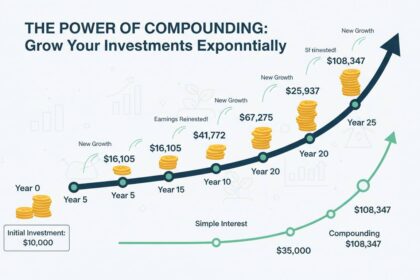

Compound interest has been called the eighth wonder of the world by many financial experts, and for good reason. It represents one of the most powerful forces in building long-term wealth, yet many investors fail to fully understand how it works or how to harness its potential effectively. Whether you are just starting your investment journey or looking to optimize your existing portfolio, understanding compounding is essential to achieving financial independence. This comprehensive guide explores the mechanics of compounding, its significance in investment strategy, and practical ways to maximize its benefits for your financial future.
Understanding the Fundamentals of Compounding in Investing
Compounding in investing refers to the process where the returns generated on your initial investment—both principal and accumulated earnings—generate their own returns over time. Unlike simple interest, where you earn returns only on the original principal amount, compound interest allows your money to grow exponentially as each period's earnings become part of the base upon which future earnings are calculated. This recursive growth pattern distinguishes compounding from linear growth and creates the mathematical foundation for long-term wealth accumulation.
The concept seems straightforward, but its implications are profound. When you invest money, you earn returns on that capital. Those returns, when reinvested, begin earning returns themselves. Over decades, this snowball effect can transform modest initial investments into substantial portfolios. The key elements that drive compounding include the rate of return, the frequency of compounding periods, and critically, the time horizon during which your money remains invested. Understanding these variables allows investors to make informed decisions about where to place their capital and how long to let it grow.
Historical data demonstrates the remarkable power of compounding over extended periods. A $10,000 investment growing at 7% annually would double approximately every 10 years, meaning that same initial investment would grow to over $76,000 after 30 years. This mathematical reality explains why financial advisors consistently emphasize starting early and maintaining consistent contributions throughout one's career. The mathematics of compounding reward patience and discipline above all other factors.
How Compounding Actually Works in Practice
To visualize how compounding operates, consider a practical example involving a hypothetical investor. Suppose you invest $5,000 in a diversified index fund that historically returns 8% annually. In the first year, your investment grows by $400, bringing your total to $5,400. In the second year, you earn 8% on $5,400 rather than just the original $5,000, resulting in $432 in gains. By year three, your earnings increase again to $466.56. Each year, the percentage return applies to an increasingly larger base, creating accelerating growth that becomes more pronounced over time.
The real power of compounding emerges when you add regular contributions to this equation. Continuing the example above, imagine you add $200 monthly to your $5,000 initial investment. Over 20 years at an 8% annual return, you would contribute $53,000 from your own pocket, yet your portfolio would grow to approximately $147,000. The excess $94,000 represents money earned through compounding—a return on your returns that would not exist without the reinvestment strategy. This distinction between money you put in and money your money earned highlights why wealthy individuals and financial institutions prioritize long-term investing horizons.
The frequency of compounding periods also influences outcomes significantly. Most modern investment accounts compound on a daily or monthly basis rather than annually. While the difference may seem negligible in the short term, it becomes substantial over decades. An investment compounding daily will ultimately yield more than one compounding annually at the same stated interest rate, due to the more frequent application of returns to the growing base. Understanding this nuance helps investors evaluate different investment products and choose those offering more frequent compounding schedules.
The Mathematics Behind Compound Growth
The mathematical formula for compound interest is A = P(1 + r/n)^(nt), where A represents the final amount, P is the principal investment, r is the annual interest rate expressed as a decimal, n is the number of times interest compounds per year, and t is the number of years the money remains invested. This formula reveals how each variable affects outcomes and helps investors project future portfolio values under different scenarios. While you need not perform these calculations manually, understanding the relationships between variables empowers better financial decision-making.
The Rule of 72 provides a useful shortcut for estimating how long it takes an investment to double at a given rate of return. Simply divide 72 by your annual return rate to determine the approximate number of years required for doubling. At 6% annual returns, your money would double in approximately 12 years. At 8%, it would double in about 9 years. This rule demonstrates why even modest differences in annual returns create dramatically different long-term outcomes. Over a 30-year investment horizon, the difference between 6% and 8% returns could mean the difference between a $500,000 portfolio and one exceeding $1 million.
The exponential nature of compound growth means that most of your portfolio's value accumulates in the later years of your investment timeline. In the early years, your returns may seem modest compared to your contributions. However, by year 15 or 20, your investment returns often exceed your annual contributions, creating a self-sustaining growth engine. This pattern explains why financial planners stress the importance of not touching retirement accounts until later in life—the penalty for early withdrawal eliminates years of compounding that can never be recovered.
Simple Interest Versus Compound Interest: Understanding the Difference
Simple interest calculates returns only on the principal amount, while compound interest calculates returns on the principal plus all previously accumulated interest. This fundamental distinction creates dramatically different outcomes over time. Consider a $10,000 investment at 5% interest over 20 years. Under simple interest, you would earn exactly $500 per year, totaling $10,000 in interest plus your original $10,000, ending with $20,000. Under compound interest calculated annually, your final balance would reach approximately $26,533—a difference of over $6,500 that came purely from allowing your earnings to generate their own returns.
Most savings accounts, certificates of deposit, and bonds use some form of compound interest, though the rates tend to be lower than what equities historically deliver. The key distinction for investors lies in choosing vehicles that offer both competitive rates and the tax advantages that allow compounding to occur in tax-deferred or tax-advantaged accounts. When you pay taxes on gains annually in a standard brokerage account, you reduce the amount that can compound, creating what financial experts call the "tax drag" that slows wealth accumulation. Retirement accounts like 401(k)s and IRAs eliminate this drag, allowing the full force of compounding to work on behalf of your financial goals.
Understanding this difference also helps explain why debt can be so destructive when it compounds against you. Credit card debt typically compounds daily at extremely high interest rates, meaning balances can grow alarmingly fast if minimum payments are made. The same mathematical force that builds wealth through investing can work in reverse when you carry high-interest debt, making debt repayment a priority for anyone seeking financial security.
Compounding Opportunities in Different Investment Vehicles
Index funds and exchange-traded funds represent excellent vehicles for compounding because they offer broad market exposure with historically low fees. When you invest in an S&P 500 index fund, you gain exposure to 500 of America's largest companies, all of which contribute to your compounding journey. The key advantage lies in the minimal expenses that eat away at returns in actively managed funds. Over 30 or 40 years, the difference between a 0.03% expense ratio and a 0.75% expense ratio can amount to hundreds of thousands of dollars in lost growth potential.
Dividend-paying stocks offer another compelling compounding opportunity through a mechanism called dividend reinvestment. Many brokerage firms and mutual funds offer automatic dividend reinvestment programs that use dividend payments to purchase additional shares. Each new share then generates its own dividends, creating a compounding cycle within your stock portfolio. Companies like Johnson & Johnson, Procter & Gamble, and other Dividend Aristocrats have increased their dividends for more than 25 consecutive years, providing investors with growing income streams that compound over decades.
Real estate investments can also harness compounding through appreciation, rental income reinvestment, and mortgage paydown. When rental income exceeds expenses, the surplus can be reinvested in additional properties or improvements that increase value. Meanwhile, each mortgage payment reduces your loan balance, effectively forcing savings that compound as you build equity faster in later years. Real estate investment trusts (REITs) offer a way to access real estate compounding benefits without the responsibilities of direct property ownership.
Strategies to Maximize Your Compounding Returns
Starting early remains the single most powerful strategy for maximizing compounding returns, simply because time is the multiplier that makes compound interest so potent. An investor who begins contributing $300 monthly at age 25 would accumulate approximately $610,000 by age 65 assuming 7% annual returns. The same monthly contribution starting at age 35 would yield only approximately $285,000 by age 65—a difference of $325,000 that resulted purely from those extra 10 years of compounding. This dramatic difference illustrates why financial advisors always emphasize starting as early as possible, even with small amounts.
Consistency in contributions proves equally important as starting early. Dollar-cost averaging—investing a fixed amount at regular intervals regardless of market conditions—takes advantage of market volatility by purchasing more shares when prices are low and fewer when prices are high. This systematic approach removes emotional decision-making from investing and ensures that your money remains invested during market downturns when compounding actually works hardest on your behalf. The key is maintaining contributions through market ups and downs, resisting the urge to stop investing during periods of uncertainty.
Minimizing fees and taxes protects your compounding base from unnecessary erosion. Every dollar paid in management fees or capital gains taxes is a dollar that cannot compound on your behalf. Index funds and low-cost ETFs typically charge annual expenses under 0.10%, compared to 0.75% or more for actively managed funds. Tax-advantaged accounts like 401(k)s, Traditional IRAs, and Roth IRAs shield your returns from annual taxation, allowing the full power of compounding to work unimpeded. For investments held in taxable accounts, considering municipal bonds or tax-managed funds can reduce the tax burden on your returns.
Common Mistakes That Undermine Compounding
One of the most damaging mistakes investors make is attempting to time the market rather than staying consistently invested. Missing just a few of the market's best days can dramatically reduce your overall returns. Research shows that the bulk of market gains occur on a relatively small number of trading days, and attempting to avoid downturns almost invariably results in missing the subsequent recoveries. The compounding formula assumes continuous reinvestment, and cashing out during market volatility breaks the cycle precisely when it would be working hardest.
Impatience and unrealistic expectations also undermine compounding success. Many investors abandon sound investment strategies within a few years because returns fail to meet expectations, not understanding that the most significant compounding occurs in later years. The urge to chase hot-performing assets or switch strategies based on short-term results prevents the patient approach necessary for compounding to work. Building genuine wealth through compounding requires accepting that meaningful results take decades, not months.
Failing to rebalance portfolios periodically can also reduce compounding effectiveness. As your investments grow at different rates, your original asset allocation can drift significantly, potentially increasing your risk exposure beyond what you intended. Annual rebalancing—selling overweighted positions and buying underweighted ones—maintains your desired risk level while often creating a slight return boost by systematically buying low and selling high. This disciplined approach supports the long-term compounding strategy by keeping your investments aligned with your goals and risk tolerance.
The Psychological Journey of Long-Term Compounding
Understanding the psychological challenges of compounding helps investors maintain discipline during difficult periods. The early years of investing often feel unrewarding because the absolute dollar amounts seem small compared to your contributions. During this phase, it is easy to question whether the strategy is working or whether you should pursue more aggressive approaches. Recognizing that this feelings is normal and that the most dramatic results occur in later years helps investors stay the course through periods of doubt.
Market downturns test investor resolve and provide opportunities for those who understand compounding. When markets fall, the same percentage declines apply to a smaller base, meaning your money buys more shares at lower prices. This is precisely what successful compounders want—they view market corrections as discount opportunities rather than reasons for panic. The investors who accumulate the greatest wealth through compounding are those who continued contributing during the 2008 financial crisis, the 2020 pandemic selloff, and other periods of uncertainty.
Creating systems and automation removes willpower from the equation entirely. Setting up automatic contributions to your investment accounts ensures that money moves from your paycheck to your portfolio without any conscious decision-making required. When investing becomes automatic, you remove the opportunities for procrastination or fear-based decisions that undermine long-term results. This hands-off approach aligns perfectly with compounding's patient nature and allows the mathematical power of compound interest to work without interference.
Conclusion: Making Compounding Work for Your Financial Future
Compound interest represents perhaps the most reliable path to long-term wealth accumulation available to individual investors. By reinvesting returns rather than spending them, allowing time to work, and maintaining consistent contributions, anyone can harness this powerful mathematical force. The key lies in starting early, staying consistent, minimizing costs, and maintaining patience through market volatility. While compounding may seem slow in its early stages, the exponential growth in later years creates transformative results that make the wait worthwhile.
The journey to financial independence through compounding requires discipline and commitment, but the mathematics are unequivocal. Whether you are investing through index funds, dividend stocks, real estate, or a combination of vehicles, the principle remains the same: your returns generate their own returns, creating a self-reinforcing cycle of wealth building. By understanding these mechanics and applying them consistently over decades, you position yourself to achieve financial goals that might otherwise seem impossible.
Frequently Asked Questions
What is compounding in investing in simple terms?
Compounding in investing is when you earn returns on your initial investment plus returns on the earnings you've already accumulated. Rather than earning interest only on your original principal, you earn interest on the entire balance, causing your money to grow exponentially over time.
How long does it take for compounding to work effectively?
Compounding requires time to generate meaningful results. Most financial experts agree that you need at least 10-15 years to see the exponential effects of compounding. The power of compounding becomes most dramatic after 20-30 years of consistent investing.
What is the difference between compound interest and simple interest?
Simple interest is calculated only on the original principal amount, while compound interest is calculated on the principal plus all previously accumulated interest. This makes compound interest significantly more powerful for long-term wealth building.
How much money do I need to start compounding?
You can start compounding with any amount, even small contributions. Many brokerages allow you to begin investing with $50 or less through fractional shares or low-minimum index funds. The key is starting early and contributing consistently rather than waiting for a large sum.
What investments offer the best compounding returns?
Historically, stocks and stock index funds have offered the highest compounding returns over long periods. Dividend reinvestment programs, growth stocks, and broad market index funds are popular choices. Real estate and bonds also compound but typically at lower rates.
Does compounding work in a recession?
Yes, compounding continues to work during recessions, though portfolio values may decrease temporarily. In fact, downturns can benefit long-term investors by allowing you to purchase more shares at lower prices. The key is maintaining your contributions and not panic-selling during market declines.