


In the world of finance, few concepts hold as much transformative power as compounding. Often described as the "eighth wonder of the world" by financial experts, compounding represents one of the most fundamental mechanisms for building wealth over time. Understanding what compounding is and how it works can mean the difference between struggling financially and achieving long-term financial security. This comprehensive guide explores the intricacies of compounding in finance, examining its mechanics, applications, and implications for investors across all experience levels.
Understanding the Definition of Compounding
Compounding in finance refers to the process whereby the returns generated by an investment are reinvested to generate their own returns over time. Unlike simple interest, where returns are calculated solely on the original principal amount, compound returns are calculated on the principal plus all accumulated interest, dividends, or capital gains from previous periods. This creates a snowball effect where money essentially makes more money, accelerating wealth creation exponentially rather than linearly.
The core principle underlying compounding is deceptively simple: when you earn returns on your returns, growth accelerates. A $10,000 investment growing at 7% annually would reach approximately $19,672 after ten years through compounding, compared to just $17,000 with simple interest. While the difference may seem modest in early years, it becomes dramatically pronounced over longer time horizons, making compounding an extraordinarily powerful tool for long-term wealth accumulation.
Financial institutions, investment firms, and individual investors all rely on compounding to achieve various financial objectives, from retirement savings to estate planning. The concept applies equally to savings accounts, certificates of deposit, bonds, stocks, and mutual funds, making it universally relevant across virtually all investment categories.
How Compound Interest Works: The Mechanics
The mechanics of compound interest form the mathematical backbone of compounding in finance. When an initial sum of money earns interest, that interest is added to the principal balance. In the next compounding period, interest is calculated on the new, larger balance, which includes both the original principal and previously earned interest. This process repeats throughout the investment's lifespan, creating accelerating growth.
Consider a practical example: suppose you deposit $5,000 into a savings account offering 5% annual interest, compounded annually. After the first year, your balance would grow to $5,250 ($5,000 + 5% of $5,000). In year two, interest would be calculated on $5,250 rather than the original $5,000, yielding $262.50 in interest and bringing your total to $5,512.50. By year ten, your original $5,000 would have grown to approximately $8,144, without adding any additional funds.
The frequency of compounding significantly impacts final returns. Interest can be compounded annually, semi-annually, quarterly, monthly, or even daily. More frequent compounding periods generally yield higher returns, though the difference becomes less pronounced with lower interest rates. Many modern savings accounts and investment products compound interest monthly or daily, maximizing the compounding effect for account holders.
The Compound Interest Formula Explained
Understanding the mathematical formula behind compound interest enables investors to calculate potential returns and make informed decisions about their financial strategies. The standard compound interest formula is:
A = P(1 + r/n)^(nt)
Where:
- A represents the future value of the investment
- P is the principal (initial investment amount)
- r denotes the annual interest rate (in decimal form)
- n indicates the number of times interest compounds per year
- t represents the number of years the money remains invested
This formula demonstrates how each variable influences investment growth. Increasing the principal, securing a higher interest rate, compounding more frequently, or extending the investment duration all contribute to greater final returns. The exponential nature of the formula explains why starting to invest early—even with modest amounts—can yield substantial wealth over decades.
For those preferring simpler calculations, the "Rule of 72" offers a quick approximation: divide 72 by the annual interest rate to estimate how many years required to double an investment. At 6% annual returns, for instance, money would approximately double in 12 years. This mental shortcut proves invaluable for quick financial planning and goal-setting.
Simple Interest Versus Compound Interest
Distinguishing between simple and compound interest clarifies why compounding represents such a powerful wealth-building mechanism. Simple interest calculates returns using only the original principal amount, treating interest earned as separate from the investment base. Compound interest, conversely, incorporates previously earned interest into the principal, creating a growing base for future calculations.
The contrast becomes stark over extended periods. Using the previous example of $5,000 at 5% annual interest over 20 years, simple interest would yield $5,000 in total interest ($250 per year × 20 years), resulting in a final balance of $10,000. Compound interest, however, would grow the investment to approximately $13,266—a difference of $3,266, or nearly 65% more than simple interest would provide.
Financial products typically specify whether they employ simple or compound interest. Most savings vehicles, bonds, and investment accounts utilize compound interest, making them more advantageous for long-term wealth building. Some loans, however, use simple interest, which benefits borrowers by keeping interest calculations based on the original loan amount rather than accumulated interest.
The Time Value of Money and Compounding
The time value of money represents a foundational concept closely linked to compounding in finance. This principle holds that money available today is worth more than the same amount in the future due to its potential earning capacity. Compounding exemplifies this principle by demonstrating how present money grows into larger sums over time through reinvested returns.
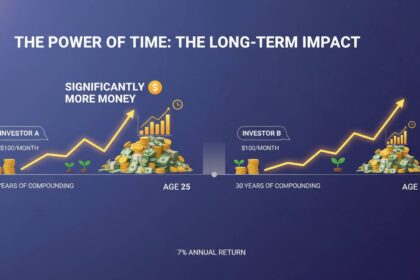
Time plays a crucial role in maximizing compounding's benefits. The earlier one begins investing, the more time compound returns have to work their magic. This explains why financial advisors consistently emphasize starting retirement savings early—even small contributions made in one's twenties can potentially outpace much larger contributions begun in middle age due to the extended compounding period.
Albert Einstein allegedly called compounding the most powerful force in the universe, though the exact attribution remains debated. Regardless of the source, the sentiment accurately captures compounding's transformative potential. A young investor who begins putting away $300 monthly at age 25 could accumulate over $600,000 by age 65, assuming 7% average annual returns—far more than someone who waits until age 35 to begin investing the same $300 monthly, who would accumulate approximately $275,000 by age 65.
Compounding in Different Investment Vehicles
Various investment vehicles harness compounding through different mechanisms, each with distinct characteristics and risk profiles. Understanding how compounding operates across asset classes helps investors construct diversified portfolios aligned with their financial goals and risk tolerances.
Savings Accounts and Certificates of Deposit: Traditional bank products offer relatively modest but guaranteed returns through compound interest. While yields vary with prevailing interest rates, these accounts provide security and accessibility, making them suitable for emergency funds and short-term savings goals.
Bonds: Fixed-income securities pay periodic interest (coupon payments) that can be reinvested to purchase additional bonds or other investments. Government bonds and corporate bonds both enable compounding when interest payments are reinvested rather than spent.
Dividend-Paying Stocks: Companies that distribute dividends to shareholders create compounding opportunities when investors use dividend payments to purchase additional shares. Many dividend reinvestment plans (DRIPs) automate this process, systematically converting dividend income into additional ownership stakes.
Mutual Funds and Exchange-Traded Funds (ETFs): These pooled investment vehicles typically reinvest dividends, interest, and capital gains distributions back into the fund, compounding returns automatically. This automatic reinvestment simplifies the compounding process for investors seeking diversified exposure.
Retirement Accounts: Tax-advantaged vehicles like 401(k) plans and Individual Retirement Accounts (IRAs) compound returns on a tax-deferred (traditional) or tax-free (Roth) basis, enhancing the compounding effect by reducing or eliminating annual tax drag on investment returns.
The Power of Consistent Contributions
While compound returns generate impressive growth, consistent contributions amplify their effect dramatically. Dollar-cost averaging—systematically investing fixed amounts at regular intervals—leverages both compounding and market timing advantages. Regular contributions build wealth through compound returns while simultaneously reducing the impact of market volatility by purchasing more shares when prices are low and fewer when prices are high.
The combination of regular contributions and long holding periods creates the most favorable conditions for wealth accumulation. Investor behavior studies consistently show that those who maintain consistent contribution patterns throughout market fluctuations significantly outperform those who attempt timing the market or stop contributing during downturns.
Financial planners frequently recommend treating retirement contributions as non-negotiable expenses, similar to rent or mortgage payments. Automating contributions through payroll deductions or automatic bank transfers removes the temptation to skip contributions during financially tight periods, ensuring consistent wealth-building over time.
Risks and Considerations
Despite compounding's remarkable potential, investors must understand several important considerations. Compounding assumes positive returns, but investments can also lose value. Market downturns, economic recessions, and individual security failures can interrupt compounding cycles, potentially requiring extended recovery periods before growth resumes.
Inflation poses another significant consideration. While compounding nominally increases account balances, inflation erodes purchasing power over time. An investment returning 3% annually when inflation runs at 2% effectively delivers only 1% real return. Investors must target returns exceeding inflation to achieve genuine wealth preservation and growth.
Fees and expenses also impact compounding's effectiveness. Management fees, expense ratios, trading commissions, and advisor charges reduce net returns, potentially significantly affecting long-term growth. For example, a 1% annual fee that persists over 30 years can reduce a portfolio's final value by approximately 25% compared to a fee-free alternative. Understanding and minimizing costs enhances compounding's benefits.
Taxation further affects compounding, particularly in taxable accounts. While tax-advantaged retirement accounts shelter investments from annual taxation, taxable brokerage accounts subject dividends, interest, and capital gains to annual taxation, reducing the compounding effect. Strategic asset location—placing tax-efficient investments in taxable accounts and tax-inefficient investments in tax-advantaged accounts—optimizes after-tax compounding.
The Psychological Aspect of Compounding
Human psychology often works against effective compounding strategies. Immediacy bias—the preference for immediate rewards over larger future rewards—makes delayed gratification challenging. Watching investments grow slowly in early years, while seeing little difference from initial contributions, tests investor patience and resolve.
Market volatility compounds this challenge. Significant market downturns can wipe out years of compounding gains, tempting investors to abandon their strategies at precisely the wrong moment. Historical evidence demonstrates that markets recover and continue growing over time, but short-term losses feel emotionally devastating, leading many to sell at lows and miss subsequent recoveries.
Successful compounding requires emotional discipline and long-term perspective. Understanding that early compounding years produce seemingly modest results, while later years deliver disproportionate growth, helps investors maintain commitment during challenging periods. Visualization techniques—projecting current savings into future wealth—reinforce the value of persistence.
Conclusion
Compounding represents one of finance's most powerful wealth-building mechanisms, transforming modest initial investments into substantial portfolios through the snowball effect of reinvested returns. Understanding how compounding works, the mathematics behind it, and its application across various investment vehicles empowers individuals to make informed financial decisions that align with their long-term objectives.
The keys to successful compounding involve starting early, maintaining consistent contributions, minimizing costs and taxes, and maintaining emotional discipline through market fluctuations. While no guarantee of profits and always subject to market risks, compounding offers the most reliable path to long-term wealth accumulation available to individual investors.
Whether saving for retirement, building an emergency fund, or pursuing other financial goals, harnessing compounding's power through tax-advantaged accounts, diversified investments, and consistent contribution patterns can help transform financial aspirations into achievable realities. The time to begin compounding is always now—tomorrow's wealth depends on today's decisions.
Frequently Asked Questions
What is compounding in finance in simple terms?
Compounding in finance is when you earn returns on your investment, and then those returns generate their own returns over time. It's like a snowball rolling downhill that keeps growing larger as it rolls. The key feature is that interest or earnings are calculated not just on your original money, but on all the earnings that have been added to your balance.
How does compound interest differ from simple interest?
Simple interest is calculated only on the original principal amount, while compound interest is calculated on the principal plus all accumulated interest from previous periods. For example, with $1,000 at 5% simple interest, you'd earn $50 annually regardless of your balance. With compound interest, second-year interest would be calculated on $1,050, then $1,102.50 the third year, and so on.
How often should interest compound for maximum benefit?
More frequent compounding periods generally yield higher returns. Daily compounding provides the highest returns, followed by monthly, quarterly, semi-annually, and annually. However, the difference becomes less significant with lower interest rates. Most savings accounts and investments compound monthly or daily.
How long does it take for compounding to significantly grow money?
The power of compounding becomes most pronounced over periods of 10 years or more. Using the Rule of 72, you can estimate that money will approximately double every 7 years at a 10% annual return, or every 10 years at a 7% return. Starting early—even with small amounts—allows compounding more time to work.
Does compounding work with losses as well as gains?
Yes, compounding works in both directions. Just as positive returns compound to accelerate growth, losses also compound and can significantly damage portfolios. This is why avoiding significant losses is crucial for long-term wealth building. A 50% loss requires a 100% gain just to recover to the original amount.
What is the best way to take advantage of compounding?
The most effective strategies for benefiting from compounding include starting to invest as early as possible, making consistent regular contributions, holding investments for long periods rather than trading frequently, minimizing fees and expenses, and using tax-advantaged accounts like 401(k)s and IRAs to shield returns from annual taxation.