

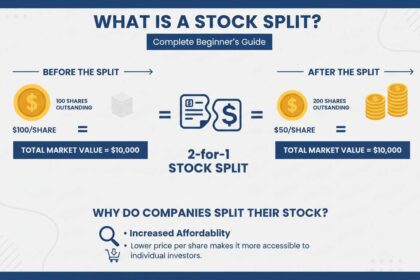

A stock split is a corporate action that increases the number of a company's outstanding shares by dividing each existing share into multiple shares. While the total market value of the company remains unchanged, the price per share adjusts proportionally, making the stock more accessible to a broader range of investors. Understanding what is a stock split and how it works is essential for anyone looking to build wealth through stock market investments.
In a standard stock split, shareholders receive additional shares based on a predetermined ratio. For example, in a 2-for-1 split, an investor holding 100 shares worth $50 each would receive 100 new shares, each valued at $25. The investor's total investment value remains exactly the same—$5,000—though they now own twice as many shares. This mathematical adjustment is purely cosmetic from a portfolio valuation perspective but can have significant implications for trading dynamics and investor sentiment.
Stock splits have become increasingly common among high-growth technology companies and well-established corporations seeking to optimize their share price. Major companies like Apple, Tesla, Amazon, and NVIDIA have all executed notable stock splits in recent years, generating substantial media attention and investor interest. These corporate decisions reflect strategic considerations beyond simple share price management, touching on liquidity, market perception, and shareholder base composition.
Understanding the Mechanics of Stock Splits
The mechanics of a stock split involve a straightforward mathematical calculation that divides the existing share price and multiplies the share count by a split ratio. The most common ratios are 2-for-1, 3-for-1, or 4-for-1, though companies may choose any ratio that serves their strategic objectives. A reverse stock split works in the opposite direction, reducing the number of shares while increasing the price proportionally.
When a company announces a stock split, it establishes a record date and a payment date. Shareholders on the record date receive the additional shares on the payment date, with the split taking effect at the market open following the payment date. brokerage firms automatically handle the adjustment, meaning shareholders do not need to take any action to receive their new shares. The process is seamless from the investor's perspective, though the split creates important changes in how the stock trades.
The total market capitalization of the company remains constant before and after the split. Market capitalization is calculated by multiplying the share price by the total number of outstanding shares, and since one factor increases while the other decreases proportionally, the product stays the same. This fundamental principle distinguishes a stock split from other corporate actions that genuinely dilute or concentrate shareholder value, such as issuing new shares to raise capital.
Why Companies Choose to Split Their Stock
Companies pursue stock splits for several strategic reasons, with share price management remaining the primary motivation. When a company's stock price climbs too high, it can become less attractive to retail investors who prefer to buy shares in whole quantities. Many brokerage platforms encourage fractional share purchases, but psychological pricing thresholds still influence investor behavior. A stock trading at $500 per share appears less accessible than one trading at $125, even if the underlying value is identical.
Amazon's 20-for-1 stock split in June 2022 illustrated this principle perfectly. Before the split, Amazon shares traded above $2,400, creating a substantial barrier for many individual investors. Following the split, the share price dropped to approximately $125, making the stock far more approachable for average investors. The split coincided with Amazon's efforts to join the Dow Jones Industrial Average, where component stocks typically trade at more moderate price levels.
Beyond accessibility, companies pursue stock splits to improve trading liquidity. Lower share prices typically result in higher trading volumes as more participants can afford to trade the stock. Increased liquidity narrows the bid-ask spread, reducing transaction costs for buyers and sellers alike. This enhanced market efficiency benefits both the company and its shareholders, as institutional investors often prefer stocks with robust trading volumes.
Stock splits also serve as marketing tools that generate positive media coverage and investor attention. When a respected company announces a split, news outlets and financial analysts extensively cover the announcement, raising awareness among potential investors. This visibility can attract new shareholders and reinforce loyalty among existing ones, creating a virtuous cycle of engagement and investment.
Impact on Shareholders and Investment Value
For existing shareholders, a stock split is a neutral event that neither creates nor destroys value. The number of shares owned increases, the price per share decreases, and the total investment value remains constant. However, shareholders should understand several important implications that extend beyond simple mathematics.
Tax treatment of stock splits depends on whether the split is considered a taxable event. In the United States, the Internal Revenue Service generally views stock splits as non-taxable events because they do not involve a change in the shareholder's proportional ownership or economic interest. The cost basis of existing shares adjusts accordingly, and no capital gains or losses are recognized at the time of the split. However, shareholders should maintain accurate records of their adjusted cost basis to ensure proper reporting when shares are eventually sold.
Dividend calculations undergo adjustment following a stock split. If a company pays a fixed dividend per share, the dollar amount shareholders receive changes in proportion to the split. In a 2-for-1 split, a quarterly dividend of $1 per share would become $0.50 per share. The total dividend payment to each shareholder remains consistent with their pre-split investment, though the per-share amount reflects the increased share count.
Options and derivatives contracts also adjust to account for stock splits. Options contracts typically specify the number of shares each contract represents, and splits automatically adjust strike prices and contract sizes to maintain economic equivalence. This adjustment ensures that options traders neither benefit nor suffer from corporate actions that alter the share structure.
Forward Splits Versus Reverse Stock Splits
Forward stock splits, the more common variety, increase the number of outstanding shares while decreasing the price proportionally. These splits are denoted by a ratio such as 2-for-1 or 3-for-1, indicating how many new shares each existing shareholder receives. Forward splits typically signal management confidence in the company's future prospects, as high share prices generally result from successful business performance.
Reverse stock splits accomplish the opposite goal, reducing share counts while increasing prices. A 1-for-10 reverse split transforms 1,000 shares valued at $1 each into 100 shares valued at $10 each. Companies typically execute reverse splits to meet minimum share price requirements for stock exchange listing or to appear more substantial to institutional investors. While reverse splits carry a negative connotation, they can serve legitimate corporate purposes when appropriately motivated.
The stock market reaction to reverse splits tends to be more negative than the reaction to forward splits. Investors often view reverse splits as admission that the company's share price has fallen significantly, and some may interpret the action as a desperate attempt to artificially inflate stock prices. However, companies facing legitimate regulatory or listing challenges may have no viable alternative to a reverse split.
Historical Examples and Notable Stock Splits
Apple's stock split history provides a compelling case study in how splits can shape investor returns. Apple executed a 7-for-1 split in 2014, reducing its share price from approximately $700 to around $100. At the time, this move made Apple shares accessible to millions of new investors who could not afford the higher price point. The split preceded Apple's remarkable growth trajectory, with the company's market capitalization expanding substantially in the years following the split.
Tesla conducted a 5-for-1 stock split in August 2020, followed by a 3-for-1 split in August 2022. These splits reflected Tesla's ascending stock price and management's desire to maintain an accessible share price for retail investors. The 2020 split occurred just before Tesla's inclusion in the S&P 500, creating significant demand from index funds that required substantial share quantities.
NVIDIA's 4-for-1 split in July 2021 and subsequent 10-for-1 split in June 2024 demonstrate how companies with rapidly appreciating stock prices repeatedly turn to splits to manage their share price. These actions have helped maintain NVIDIA's position as one of the most widely-held stocks among both retail and institutional investors.
The Strategic Value of Understanding Stock Splits
Knowledge of what is a stock split empowers investors to make informed decisions when these corporate actions occur in their portfolios. Rather than viewing splits as exciting events that create value, sophisticated investors recognize them as neutral transactions that may carry strategic implications for trading and investment planning.
Investors should evaluate stock splits within the broader context of company fundamentals and market conditions. A stock split does not change the underlying business value, and excessive focus on share price accessibility may lead investors to overlook important considerations such as valuation, competitive positioning, and growth prospects. The decision to buy or sell should depend on comprehensive analysis rather than the psychological appeal of a lower share price.
For long-term investors, stock splits require no portfolio adjustments and carry no immediate tax consequences. The automatic adjustment process ensures that proportional ownership remains intact, and future gains or losses will be calculated based on the adjusted cost basis. Understanding this mechanism prevents confusion and ensures that investors respond appropriately when their favorite companies announce splits.
Frequently Asked Questions
Does a stock split mean I make more money?
No, a stock split does not increase the total value of your investment. While you receive more shares, the price per share decreases proportionally. Your overall portfolio value remains exactly the same immediately following the split.
Why do companies split their stocks when they could just keep the price high?
Companies split their stocks primarily to improve accessibility for retail investors and enhance trading liquidity. Lower share prices attract more buyers, increase trading volume, and can generate positive media coverage. Some companies also pursue splits to meet exchange listing requirements or join major indices.
Are stock splits good or bad for investors?
Stock splits are generally considered neutral events from an investment perspective. They neither create nor destroy value for existing shareholders. However, they can provide practical benefits such as improved liquidity and greater accessibility for investors with limited capital.
What happens to my dividends after a stock split?
If the company pays a fixed dividend per share, the dollar amount adjusts proportionally with the split. In a 2-for-1 split, a $2 quarterly dividend becomes $1. However, since you now own twice as many shares, your total dividend payment remains the same.
Can I lose money from a stock split?
You cannot lose money directly from a stock split itself, as the mathematical adjustment preserves your total investment value. However, stock splits do not protect against market movements, and the underlying stock may gain or lose value following the split based on company performance and market conditions.
Do all companies split their stocks?
No, many successful companies choose not to split their stocks. Berkshire Hathaway, for example, has never split its Class A shares, which trade at hundreds of thousands of dollars. Some companies believe that higher share prices naturally filter for serious investors, though this approach has become less common in recent decades.