

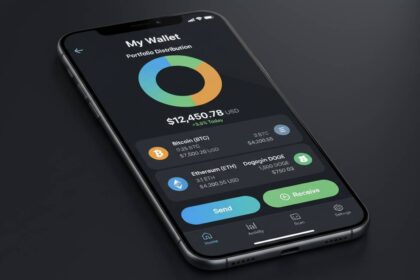

A crypto wallet is a digital tool that allows you to store, send, and receive cryptocurrencies like Bitcoin, Ethereum, and thousands of other digital assets. Unlike a traditional wallet that holds physical cash and cards, a crypto wallet doesn't actually store your coins—it stores the cryptographic keys that prove ownership of your cryptocurrency on the blockchain. These keys come in pairs: a public key (similar to a bank account number) that others can use to send you funds, and a private key (like a password) that authorizes transactions from your wallet.
Key Insights
- Crypto wallets store cryptographic keys, not actual cryptocurrency
- Over 420 million people globally use cryptocurrency wallets as of 2024
- The private key is the most critical security element—anyone with access to it controls your funds
- Lost private keys mean permanent loss of assets; there is no password reset option
- The crypto wallet market is projected to reach $48.9 billion by 2030
Understanding Crypto Wallets: The Basics
To grasp how crypto wallets function, you must first understand that cryptocurrencies exist entirely on their respective blockchains—a distributed digital ledger that records all transactions. When someone "sends" you Bitcoin, they're actually signing a transaction on the Bitcoin blockchain that transfers ownership of a specific amount from their address to yours. Your wallet doesn't hold the Bitcoin; it holds the credentials that prove you control the address where those Bitcoin now reside.
The distinction between storing currency and storing keys is fundamental. Imagine a safety deposit box at a bank: the box itself (your wallet) is just a container, while the valuable contents inside (your crypto) exist in the bank's vault (the blockchain). The key to your safety deposit box—your private key—is what matters. Without it, you cannot access what belongs to you.
Crypto wallets come in various forms, each with different security levels and use cases. Some are simple smartphone apps, others are dedicated physical devices, and some exist as paper documents or even spoken phrases. The common thread is that all wallets, regardless of form, manage the same cryptographic keys.
Key Components of a Crypto Wallet
| Component | Function | Analogy |
|---|---|---|
| Public Key | Receive cryptocurrency | Bank account number |
| Private Key | Authorize transactions | Debit card PIN |
| Seed Phrase | Recovery option | Master password |
| Address | Shortened public key | Email address |
The public address is a shortened, readable version of your public key—essentially what you share with others to receive funds. Most wallets generate a new address for each transaction, enhancing privacy while keeping all funds accessible through the same underlying keys.
How Crypto Wallets Work: Public and Private Keys
Cryptocurrency security relies on asymmetric cryptography, a mathematical system that uses two linked but distinct keys. This technology, developed in the 1970s, forms the backbone of modern digital security and enables cryptocurrency to function without central authorities like banks.
When you create a crypto wallet, the software generates a random number that becomes your private key. This number is then run through a mathematical algorithm to derive your public key, and a shortened version of that becomes your wallet address. The remarkable property of this system is that while it's easy to calculate the public key from the private key, doing the reverse is computationally infeasible—even with supercomputers, taking longer than the age of the universe.
The Transaction Process
When you send cryptocurrency, your wallet uses your private key to create a digital signature that proves you authorize the transaction. This signature is unique to each transaction and cannot be forged. The transaction is then broadcast to the blockchain network, where miners or validators verify the signature and record the transfer.
Consider this process step by step:
- Initiating a transaction: You enter the recipient's address and the amount you wish to send
- Signing: Your wallet uses your private key to create a unique digital signature
- Broadcasting: The signed transaction is sent to the blockchain network
- Verification: Network participants verify the signature is valid
- Confirmation: The transaction is added to the blockchain, completing the transfer
The private key is irreplaceable. According to Chainalysis, approximately 20% of all Bitcoin—worth billions of dollars—has been lost permanently due to forgotten keys, died wallet owners without passing on recovery information, and hardware failures. There is no customer service number to call, no identity verification process, no way to reset a forgotten private key.
Seed Phrases: Your Ultimate Backup
Most modern wallets generate a seed phrase—typically 12 or 24 words—during setup. This phrase is a human-readable representation of your private key that you can write down and store separately. If your wallet is lost, stolen, or breaks, you can recover your funds by entering the seed phrase into a new wallet.
Critical seed phrase rules:
- Never store digitally (no photos, no cloud storage, no screenshots)
- Write multiple copies and store in secure, separate locations
- Never share your seed phrase with anyone, including wallet "support" teams
- Consider using metal backup plates for fire and water resistance
Types of Crypto Wallets: Hot vs Cold
The fundamental division in crypto wallets is between hot wallets and cold wallets. This distinction revolves around whether the wallet connects to the internet, directly impacting convenience and security.
Hot Wallets
Hot wallets remain connected to the internet, typically through mobile apps, desktop software, or web browser extensions. This constant connectivity enables quick and easy transactions but creates potential attack surfaces that hackers can exploit.
Hot wallet types include:
- Mobile wallets: Apps on smartphones (Trust Wallet, Coinbase Wallet)
- Desktop wallets: Software installed on computers (Electrum, Exodus)
- Web wallets: Browser-based services (Coinbase, Kraken)
- Exchange wallets: Default wallets provided by cryptocurrency exchanges
The convenience factor makes hot wallets ideal for frequent traders and everyday purchases. According to a 2023 survey by Security.org, 67% of cryptocurrency owners primarily use hot wallets for their日常交易. However, the FBI's Internet Crime Report notes that over $3.3 billion was lost to cryptocurrency-related fraud in 2022 alone, with many attacks targeting hot wallet users.
Cold Wallets
Cold wallets keep private keys offline, disconnected from the internet entirely. This isolation makes them virtually immune to remote hacking attempts, though they require more effort to use for transactions.
Cold wallet types include:
- Hardware wallets: Dedicated physical devices (Ledger, Trezor, Ellipal)
- Paper wallets: Physical documents with printed keys and addresses
- Air-gapped computers: Isolated devices never connected to networks
Hardware wallets have become the standard for cold storage. Ledger, one of the leading manufacturers, has sold over 6 million devices as of 2024. These devices cost typically between $50-$300 but provide significantly greater security than any hot wallet option.
Software Wallets vs Hardware Wallets: A Comparison
Choosing between software and hardware wallets involves weighing security, convenience, and cost. Here's a detailed comparison to help you decide:
| Factor | Software Wallets | Hardware Wallets |
|---|---|---|
| Cost | Free to $50 | $50-$300 |
| Security | Moderate to High | Highest |
| Convenience | Excellent | Moderate |
| Internet Connection | Required | Optional |
| Best For | Small amounts, frequent trading | Large holdings, long-term storage |
| Portability | Very high (phone/computer) | High (USB-sized devices) |
| Recovery | Seed phrase | Seed phrase |
Software Wallet Advantages
Software wallets excel in user experience and accessibility. They're typically free, easy to set up, and allow transactions within seconds. For beginners holding modest amounts or actively trading, software wallets provide the best balance of security and convenience.
Multi-chain support has become a significant advantage of modern software wallets. Users can manage hundreds of different cryptocurrencies from a single application, checking balances and executing trades across multiple blockchains without maintaining separate wallets.
Hardware Wallet Advantages
The primary advantage of hardware wallets is their isolated key storage. Private keys never leave the device, even when connected to a compromised computer. To authorize a transaction, you physically press buttons on the device, ensuring that malware on your computer cannot access your keys.
For serious cryptocurrency holders—those with significant assets—hardware wallets are considered essential. The investment of $100-$200 is negligible compared to the protection it provides against the most common attack vectors.
How to Choose the Right Crypto Wallet
Selecting a crypto wallet requires honest assessment of your needs, technical comfort level, and the amount you're storing. The "best" wallet depends entirely on your specific situation.
Assess Your Needs First
Ask yourself these questions before choosing:
- How much cryptocurrency do you plan to hold? Under $1,000, a reputable hot wallet suffices. Over $10,000, strongly consider hardware storage.
- How often will you transact? Daily trading favors hot wallets; monthly or yearly transactions suit cold storage.
- How many different cryptocurrencies do you want? Some wallets support only Bitcoin; others support thousands.
- What's your technical comfort level? Hardware wallets have steeper learning curves.
- Do you need to access funds from multiple devices? Some wallets sync across devices; others don't.
Reputation Matters Tremendously
The cryptocurrency space contains numerous scams, and wallet selection is where vigilance is most critical. Only download wallets from official sources—never from links in emails or social media posts. Research the wallet's history, check for security audits, and verify the developer team when possible.
Red flags to watch for:
- Promises of guaranteed returns
- Requests for your seed phrase
- Poor security track record
- No clear developer identity
- Limited community adoption
According to CryptoSlate, over $2 billion in cryptocurrency was stolen in 2023 through various attacks, many targeting users of lesser-known or compromised wallet applications.
Security Best Practices for Crypto Wallets
Security in cryptocurrency requires a fundamentally different mindset than traditional finance. There's no insurance, no fraud protection, no way to reverse transactions. The responsibility falls entirely on you.
Essential Security Measures
Use hardware wallets for significant holdings. Anything over a few thousand dollars should probably be in cold storage. The peace of mind is worth the investment.
Enable all available security features. This includes two-factor authentication, biometric locks, and transaction confirmation requirements. Layer your defenses—don't rely on a single security measure.
Diversify your storage. Don't keep all your cryptocurrency in one wallet. Split holdings across multiple wallets, potentially using different wallet providers, to reduce single points of failure.
Verify every transaction carefully. Before confirming any transfer, double-check the recipient address. Cryptocurrency transactions are irreversible—sending to the wrong address means permanent loss.
Common Attack Vectors
| Attack Type | Description | Protection |
|---|---|---|
| Phishing | Fake websites/emails stealing credentials | Verify URLs, never click links |
| Malware | Keyloggers and clipboard hijackers | Use hardware wallets, verify addresses |
| SIM Swapping | Hijacking phone number for 2FA | Use hardware 2FA, unique phone |
| Social Engineering | Manipulating users to reveal secrets | Never share seed phrase |
Frequently Asked Questions
What happens if I lose my crypto wallet?
If you lose your wallet but have your seed phrase, you can restore your funds by importing that seed phrase into any compatible wallet. Without the seed phrase, your cryptocurrency is permanently lost. The blockchain doesn't have a "forgot password" function.
Can a crypto wallet be hacked?
Yes, particularly hot wallets connected to the internet. Hardware wallets are significantly more resistant to hacking because private keys never leave the device. No wallet is 100% hack-proof, but hardware wallets provide the strongest protection available.
Are crypto wallets anonymous?
Crypto wallets are pseudonymous, not anonymous. While you don't need to provide identification to create a wallet, all transactions are publicly visible on the blockchain. Analysis firms and law enforcement can often trace transactions to identify users, especially when wallets connect to exchanges requiring identity verification.
Should I keep my crypto on an exchange or in a personal wallet?
For small trading amounts, exchange wallets offer convenience. For any significant holdings, personal wallets—especially hardware wallets—are strongly recommended. Exchanges can be hacked, go bankrupt, or freeze accounts; self-custody gives you full control.
How much does a crypto wallet cost?
Software wallets are typically free. Hardware wallets range from $50-$300 depending on features and brand. The one-time investment for a hardware wallet is worthwhile for anyone holding more than a few hundred dollars in cryptocurrency.
Conclusion
Understanding crypto wallets is fundamental to safely navigating the cryptocurrency landscape. These tools don't store your money—they store the keys that control your money on the blockchain. This distinction matters enormously for security.
For beginners, start with a reputable software wallet for learning and small transactions. As your holdings grow, transition to hardware wallets for cold storage of significant amounts. Always maintain backups of your seed phrase in secure, separate locations—and never, under any circumstances, share your private keys or seed phrase with anyone.
The cryptocurrency ecosystem continues evolving rapidly, with new wallet technologies emerging regularly. What remains constant is the core principle: you are your own bank. That freedom carries immense responsibility. Treat your private keys with the care they deserve, and your cryptocurrency will remain secure.