

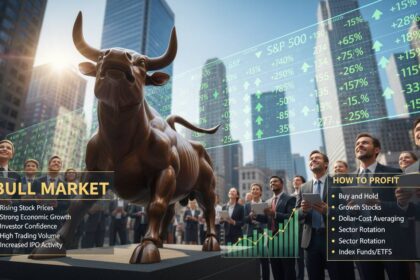

A bull market represents a sustained period of rising asset prices and optimistic investor sentiment across financial markets. In the United States, bull markets have historically delivered significant wealth creation, with the S&P 500 generating average annual returns of approximately 10% over the past century during extended bullish periods. Understanding bull market dynamics is essential for investors seeking to capitalize on upward price trends while managing inherent risks.
Key Insights
- A bull market is defined as a period when stock prices rise 20% or more from recent lows
- The average bull market in the S&P 500 lasts approximately 2.7 years
- Bull markets typically coincide with strong economic growth, low unemployment, and rising corporate profits
- Investors can profit through buy-and-hold strategies, momentum investing, and sector rotation
- Bull markets eventually end—understanding warning signs helps protect portfolios
What Is a Bull Market: Definition and Core Concepts
A bull market is formally defined as a financial market condition characterized by rising asset prices and positive investor sentiment. The commonly accepted technical threshold requires prices to rise 20% or more from a recent trough before officially qualifying as a bull market. This 20% threshold, established by market technicians decades ago, serves as a reliable separator between genuine trend changes and normal market volatility.
The term "bull market" derives from the way a bull attacks—moving its horns upward—which metaphorically represents rising prices. This terminology emerged in the early 18th century London's Jonathan's Coffee House, where investors first used animal metaphors to describe market movements. The opposing term, "bear market," refers to a bear swiping its paws downward, symbolizing falling prices.
Bull markets require three fundamental conditions to sustain:
First, sustained buying pressure must outweigh selling pressure over an extended period. This isn't measured in days or weeks but typically requires months or years of consistent net inflows into equities.
Second, increasing investor confidence drives capital into risk assets. Consumer confidence indices, sentiment surveys like the AAII (American Association of Individual Investors) polling, and institutional fund flows all serve as barometers of this psychological shift.
Third, favorable economic fundamentals provide the underlying support for rising valuations. These include gross domestic product (GDP) growth, corporate earnings expansion, manageable inflation, and accommodative monetary policy from the Federal Reserve.
Not every market advance qualifies as a bull market. Short-term rallies lasting weeks or months, followed by renewed declines, represent bear market rallies or corrections rather than structural bull markets. The distinction matters because investment strategies appropriate for bull markets differ substantially from those suitable for volatile or declining markets.
Key Characteristics and Signs of a Bull Market
Experienced investors recognize several hallmark indicators that distinguish authentic bull markets from temporary price spikes. Understanding these signs helps market participants position portfolios appropriately and avoid whipsaw trades.
Price Movement Patterns
Bull markets exhibit distinctive price action characteristics. Trend lines slope upward with higher highs and higher lows—the classic technical definition of an uptrend. Pullbacks during bull markets typically prove shallow, rarely exceeding 10-15% before buyers reemerge. Volume patterns often show increasing participation during advances and declining volume during minor corrections, confirming healthy demand.
Economic Indicators
Strong bull markets rarely occur in economic vacuums. The Conference Board's Leading Economic Index (LEI) typically shows expansion during bull markets. Initial unemployment claims remain low and stable. Housing starts and building permits indicate construction sector strength. Manufacturing indices like the ISM (Institute for Supply Management) PMI register above 50, signaling expansion.
Market Breadth
A healthy bull market demonstrates broad participation across sectors and market capitalizations. The advance-decline line, measuring the number of stocks rising versus falling, should trend upward alongside major indices. When market gains narrow to just a handful of mega-cap stocks, technical analysts view this as a potential warning sign of an aging bull market.
Sentiment Indicators
Investor sentiment during bull markets shifts toward optimism. The CNN Business Fear & Greed Index consistently registers "greed" or "extreme greed" readings. Retail investor participation increases, as evidenced by trading volume at brokerages and flows into equity mutual funds and exchange-traded funds (ETFs). Initial public offering (IPO) activity accelerates as companies seek to capitalize on favorable valuations.
Valuation Metrics
Bull markets inevitably push valuations higher. Price-to-earnings (P/E) ratios expand beyond historical averages. Price-to-sales ratios and enterprise value to EBITDA multiples similarly stretch upward. While elevated valuations don't immediately end bull markets—prices can remain "expensive" for extended periods—they do reduce future expected returns and increase vulnerability to negative surprises.
Bull Market vs Bear Market: A Comparative Analysis
Understanding the distinction between bull and bear markets is fundamental to investment success. These market regimes require different strategies, risk management approaches, and psychological frameworks.
| Characteristic | Bull Market | Bear Market |
|---|---|---|
| Price Trend | Rising 20%+ from lows | Falling 20%+ from highs |
| Average Duration | 2.7 years (S&P 500) | 1.3 years (S&P 500) |
| Average Decline | +166% cumulative | -37% cumulative |
| Economic Context | Expansion, growth | Recession, contraction |
| Unemployment | Low and falling | Rising |
| Interest Rates | Stable or declining | Rising or peak |
| Corporate Profits | Growing | Declining |
| Investor Sentiment | Optimistic | Pessimistic |
The historical asymmetry between bull and bear market returns explains why long-term investors generally favor equity exposure. Even including devastating bear markets like 1929, 2000, and 2008, the S&P 500 has delivered positive real returns over multi-decade horizons. This positive drift stems from economic growth, productivity improvements, and corporate profit expansion—all fundamental drivers that bull markets capture and amplify.
Bear markets, while painful in real-time, serve essential economic functions. They correct valuations, redistribute capital from inefficient to efficient uses, and restore risk premiums that enable future gains. The most successful investors don't fight bear markets but rather position defensively when warning signs emerge while maintaining long-term conviction during temporary drawdowns.
Historical Bull Markets: Data and Case Studies
Examining historical bull markets provides context for understanding current market conditions and potential future scenarios.
The Post-World War II Bull Market (1949-1956)
Following the severe bear market of 1946-1949, the S&P 500 embarked on an extraordinary recovery, advancing approximately 267% over seven years. This bull market coincided with the post-war economic boom, suburban expansion, the rise of consumer electronics, and unprecedented corporate profitability. The 1949-1956 period demonstrates how economic tailwinds translate into sustained equity appreciation.
The Dot-Com Bull Market (1990-2000)
The technology-driven bull market of the 1990s represents both the power and perils of momentum investing. The S&P 500 gained 417% from October 1990 to March 2000, driven largely by the internet revolution. However, this bull market ended dramatically, with the NASDAQ falling 78% from peak to trough. The lesson: even powerful structural trends can produce unsustainable valuations that eventually correct violently.
The Post-Financial Crisis Bull Market (2009-2020)
The longest bull market in U.S. history lasted approximately 11 years, delivering 409% cumulative returns from March 2009 to February 2020. This remarkable advance occurred despite tepid economic growth, near-zero interest rates, and periodic concerns about valuations. Federal Reserve accommodation, corporate profit growth, and multiple expansion all contributed to gains. COVID-19 finally ended this bull market with a rapid 34% decline in just 33 days—yet markets recovered within months, launching a new bull market.
The Current Bull Market (2020-Present)
Following the COVID-19 crash, markets surged to new highs, powered by unprecedented fiscal stimulus, zero-interest rate policy, and economic reopening. By late 2021, this bull market had already surpassed 100% gains. While 2022 brought significant volatility and a brief bear market, 2023-2024 has seen renewed strength, with artificial intelligence enthusiasm driving technology sector leadership.
How to Identify a Bull Market: Technical and Fundamental Analysis
Identifying bull markets in real-time requires combining technical indicators with fundamental analysis. No single metric provides certainty, but a confluence of signals strengthens confidence in market regime identification.
Technical Indicators
Moving Averages: The 200-day moving average serves as a critical trend filter. Prices consistently above this level suggest an established uptrend, while sustained breaks below warrant caution. During bull markets, prices typically trade well above the 200-day moving average with brief violations during corrections.
Relative Strength Index (RSI): This momentum oscillator measures price change speed. Readings above 70 indicate overbought conditions, while readings below 30 suggest oversold. During bull markets, overbought readings can persist for extended periods as prices grind higher despite extreme RSI readings.
MACD (Moving Average Convergence Divergence): The MACD histogram shows the difference between the 12-day and 26-day exponential moving averages. Positive histogram readings during bull markets confirm upward momentum. Bullish crossovers (the MACD line crossing above the signal line) often precede significant advances.
Fundamental Indicators
Corporate Earnings Growth: S&P 500 earnings per share growth serves as the primary fundamental driver of long-term returns. Bull markets typically feature double-digit earnings growth as economic expansion boosts revenues and operating leverage improves margins.
Federal Reserve Policy: Accommodative monetary policy—low interest rates, quantitative easing, forward guidance indicating rates will remain low—historically supports bull markets. Conversely, Fed tightening cycles often precede market tops.
GDP Growth: Real GDP expansion of 2-4% annually provides sufficient economic growth to support rising corporate profits without triggering inflation concerns that prompt Fed tightening.
Leading Economic Index: This composite of 10 economic indicators tends to turn positive before economic expansions accelerate. LEI strength correlates with bull market sustainability.
How to Profit in a Bull Market: Strategies and Approaches
Successful bull market investing requires strategies that capitalize on upward price trends while managing risk. Different approaches suit different risk tolerances and time horizons.
Buy and Hold Strategy
The simplest approach involves purchasing quality equities and holding through market volatility. This strategy has historically outperformed more active trading approaches. During the 1980-2020 period, the S&P 500 returned approximately 10.4% annually despite numerous corrections and two major bear markets. Key requirements include long time horizons (10+ years), diversified portfolios, and emotional discipline to maintain positions during temporary declines.
Momentum Investing
Momentum strategies buy assets showing recent strong performance while avoiding or shorting underperformers. Academic research, including the influential 1993 paper by Jegadeesh and Titman, demonstrates momentum premium across global markets. Practical implementation involves screens for stocks with 6-12 month price appreciation, rebalancing monthly or quarterly to maintain exposure to continuing trends.
Sector Rotation
Different sectors outperform at different market cycle stages. During early bull markets, cyclical sectors like technology, consumer discretionary, and industrials typically lead. As bull markets mature, defensive sectors like consumer staples, utilities, and healthcare often outperform. Sector ETFs like the Technology Select Sector SPDR (XLK) and Consumer Discretionary Select Sector SPDR (XLY) enable tactical allocation shifts.
Dollar-Cost Averaging
Investors nervous about market timing can employ dollar-cost averaging—investing fixed dollar amounts at regular intervals regardless of price. This approach reduces the psychological stress of lump-sum investing while ensuring participation in market advances. Historical analysis shows lump-sum investing generally outperforms, but dollar-cost averaging provides psychological benefits for risk-averse investors.
Growth vs. Value Tilt
Bull markets typically favor growth stocks as investors reward companies demonstrating rapid earnings expansion. The Russell 1000 Growth index outperformed value significantly during the 1990s and 2020-2021 bull markets. However, growth underperforms during value-friendly periods. Maintaining balanced growth/value exposure or tilting toward growth during bull markets captures momentum while preserving diversification.
Risks and Common Mistakes During Bull Markets
Even during favorable market conditions, investors make costly errors. Understanding common pitfalls helps avoid psychological traps that destroy returns.
Chasing Performance
Buying assets after they've already appreciated significantly exposes investors to mean reversion risk. The Morningstar research showing that last year's top-performing funds frequently become next year's underperformers reflects this reality. Disciplined rebalancing maintains target allocations regardless of recent performance.
Overconfidence and Margin
Bull markets breed confidence, often leading investors to employ margin (borrowed money) to amplify returns. While leverage works in rising markets, even modest corrections can trigger margin calls and forced liquidations at the worst possible times. The 1929 crash, 2000 dot-com bust, and 2008 financial crisis all saw leveraged investors wiped out while those using only own capital survived.
Ignoring Valuation
Bull markets can remain "irrational" far longer than rational investors expect. However, starting valuations strongly predict future returns. Investors buying at extreme valuations accept lower expected returns regardless of subsequent bull market duration. The Shiller P/E (cyclically-adjusted price-to-earnings ratio) provides a useful valuation benchmark—readings above 30 historically signal below-average subsequent returns.
Neglecting Diversification
Concentrating portfolios in hot sectors or individual stocks exposes investors to idiosyncratic risk. The "FANG" stocks (Facebook/Meta, Amazon, Netflix, Google/Alphabet) dominated 2010s returns but suffered significant drawdowns in 2022. Diversification across sectors, asset classes, and geographies reduces unsystematic risk without sacrificing much expected return.
Timing the Top
Perhaps the most costly mistake involves exiting stocks too early during bull markets. Missing just the 10 best trading days between 1980 and 2020 would have reduced annual returns from 10.4% to approximately 6.1%—a substantial opportunity cost. While protecting gains makes psychological sense, market timing rarely works consistently.
Frequently Asked Questions
How long does a typical bull market last?
The average bull market in the S&P 500 since 1929 has lasted approximately 2.7 years, with the longest lasting over 11 years (2009-2020) and the shortest lasting just months. Duration varies significantly based on economic conditions, Fed policy, and valuation levels at market lows.
What percentage gain defines a bull market?
The commonly accepted technical definition requires a 20% or greater rise from a market bottom. This threshold helps distinguish genuine trend changes from normal volatility. Markets can technically advance 15-19% and still experience bear markets, illustrating the somewhat arbitrary nature of the definition.
Can you make money in a bear market?
Yes, through inverse ETFs (like SH or SPXY), short selling, put options, or rotating to defensive sectors like utilities and consumer staples. However, bear market strategies require active management, typically underperform buy-and-hold over long horizons, and carry significant risk if market timing proves incorrect.
What kills a bull market?
Bull markets typically end due to economic recession, Fed tightening, valuation extremes, or external shocks (wars, pandemics, crises). The most common trigger is the Federal Reserve raising interest rates to combat inflation, which increases borrowing costs, slows economic growth, and compresses equity valuations.
Should I invest differently during a bull market?
Bull markets favor growth and cyclical sectors over value and defensive stocks. Momentum strategies tend to outperform during bullish periods. However, maintaining diversification remains prudent—bull markets can reverse quickly, and concentration in hot sectors leads to severe drawdowns when trends change.
How do I know when a bull market ends?
Warning signs include falling below the 200-day moving average, negative divergence between prices and indicators, declining market breadth, peaking leading economic indicators, and Fed policy tightening. No single signal perfectly predicts tops, but a confluence of negative indicators warrants risk reduction.
Conclusion
Bull markets represent favorable conditions for equity investors, characterized by rising prices, optimistic sentiment, and strong economic fundamentals. Understanding the definition, identifying the signs, and employing appropriate strategies helps investors capitalize on these opportunities while managing inherent risks.
The historical evidence demonstrates that bull markets, while occasionally ending dramatically, have consistently delivered substantial returns over time. By maintaining diversified portfolios, avoiding common psychological pitfalls, and staying focused on long-term fundamentals, investors can participate in bull market gains while building lasting wealth.
Successful investing requires neither predicting market tops nor timing bottoms perfectly. Instead, it demands disciplined execution of sound principles: diversification, regular rebalancing, low-cost index funds or quality individual stocks, and emotional resilience during inevitable volatility. These principles serve investors well regardless of whether markets rise continuously or gyrate unpredictably.
Remember that bull markets eventually give way to bear markets, and vice versa. The key to long-term success lies not in forecasting these regime changes but in maintaining balanced, well-researched portfolios that perform acceptably across various market conditions.