

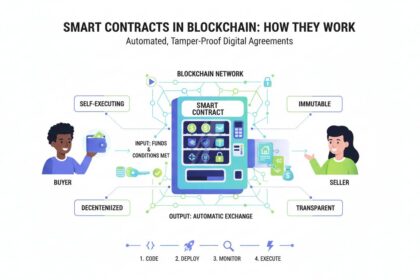

Smart contracts are one of the most transformative applications of blockchain technology, yet many people find them confusing. At their core, smart contracts are self-executing programs stored on a blockchain that automatically enforce the terms of an agreement when predetermined conditions are met. Think of them as digital agreements that eliminate the need for middlemen like lawyers, banks, or notaries—they simply do what they're programmed to do, when they're programmed to do it, without any possibility of manipulation or interference.
This guide will walk you through everything you need to understand about smart contracts, from their origins to their real-world applications, so you can grasp how they're reshaping industries from finance to supply chain management.
What Exactly Is a Smart Contract?
A smart contract is a piece of code deployed on a blockchain network that automatically executes specific actions when certain conditions are fulfilled. The term was coined by computer scientist Nick Szabo in 1994, though the technology didn't become practical until blockchain platforms like Ethereum emerged years later.
Unlike traditional contracts that require human interpretation and enforcement, smart contracts are "if-then" statements written in code. For example: "IF the buyer deposits payment into the contract, THEN the digital asset will be automatically transferred to the buyer." This happens instantly, without any intermediary processing the transaction.
Here's what makes them powerful:
- Automation: Once conditions are met, the contract executes automatically
- Transparency: Everyone on the network can see the contract code and its current state
- Immutability: Once deployed, the code cannot be changed—preventing tampering
- Trustlessness: Parties don't need to trust each other; they trust the code
- Cost reduction: Eliminating middlemen reduces fees significantly
How Do Smart Contracts Work?
Understanding how smart contracts work requires a basic understanding of blockchain technology. A blockchain is a distributed ledger—essentially a database replicated across thousands of computers worldwide. When a smart contract is deployed, its code is stored on this ledger and becomes part of the blockchain.
The process works in several stages:
1. Agreement Creation
Two or more parties agree on the terms of their arrangement. These terms are translated into code by developers, defining exactly what conditions must be met and what actions will occur when they are.
2. Deployment
The smart contract is deployed to the blockchain network. This involves paying a transaction fee (often called "gas" on Ethereum) and waiting for the network to confirm the deployment.
3. Trigger Conditions
The contract sits idle on the blockchain, constantly monitoring for the predetermined conditions. These conditions are typically blockchain events, such as a payment being received or a specific timestamp arriving.
4. Automatic Execution
When all conditions are met, the smart contract automatically executes the agreed-upon actions. This might involve transferring cryptocurrency, issuing a digital asset, updating records, or triggering other smart contracts.
5. Completion and Recording
Every step of the process is recorded on the blockchain, creating an immutable audit trail. This record cannot be altered or deleted, providing complete transparency.
For instance, imagine you're renting an apartment through a smart contract. You might send your security deposit to the contract address. The contract could be programmed to automatically release the deposit back to you (minus any agreed-upon deductions) 24 hours after your lease ends, assuming no disputes were flagged. No property manager needed.
A Brief History of Smart Contracts
The concept of smart contracts predates blockchain technology itself. Nick Szabo, a cryptographer and legal scholar, introduced the idea in 1994, envisioning self-executing contracts that could enforce terms without requiring trust in human intermediaries. Szabo famously used the example of a vending machine: insert the correct amount of money, and the machine automatically dispenses the selected item—no cashier required.
However, the technology to make this vision reality didn't exist at the time. Blockchain technology, first introduced with Bitcoin in 2009, provided the necessary infrastructure. But it was Ethereum, launched in 2015 by Vitalik Buterin and his team, that made smart contracts practical by creating a platform specifically designed to support them.
Ethereum introduced a Turing-complete programming language, meaning developers could write virtually any type of program or application on the platform. This opened the floodgates for innovation, enabling the development of decentralized applications (dApps), decentralized finance (DeFi) protocols, and non-fungible tokens (NFTs).
Since then, numerous blockchain platforms have emerged offering smart contract capabilities, including Solana, Cardano, Polygon, and Avalanche. Each offers different approaches to scalability, security, and functionality.
Key Features That Make Smart Contracts Powerful
Smart contracts derive their power from several key characteristics that distinguish them from traditional agreements:
Immutability
Once a smart contract is deployed to the blockchain, its code cannot be modified. This eliminates the risk of someone going back and changing the terms after the fact. However, this also means bugs in the code cannot be fixed—so thorough auditing is essential before deployment.
Transparency
All smart contract code on a public blockchain is visible to anyone. This transparency builds trust because parties can verify exactly what the contract will and won't do. There's no fine print to hide behind.
Speed and Efficiency
Traditional contract enforcement can take days, weeks, or even months, especially when international borders and multiple intermediaries are involved. Smart contracts execute in seconds or minutes once conditions are met.
Security
Blockchain networks use advanced cryptography to secure transactions. Smart contracts inherit this security, making them extremely difficult to hack or manipulate—provided the code itself is sound.
Cost Savings
By eliminating intermediaries like lawyers, brokers, and banks, smart contracts significantly reduce transaction costs. A 2021 report from Santander Bank estimated that smart contracts could save the financial industry up to $12 billion annually in infrastructure costs.
Precision
Smart contracts execute exactly as programmed, with zero room for human error or interpretation disputes. The code does precisely what it was written to do.
Real-World Use Cases and Applications
Smart contracts are being implemented across numerous industries, solving real problems and creating new possibilities:
Finance and Lending
DeFi platforms use smart contracts to enable lending without traditional banks. Users can lend their cryptocurrency to pools and earn interest, or borrow against their holdings—all governed by smart contracts that automatically calculate interest, liquidate undercollateralized positions, and distribute funds.
Supply Chain Management
Companies like IBM and Walmart are using smart contracts to track products through supply chains. A smart contract can automatically record when a product changes hands, verify authenticity through IoT sensors, and trigger payments when goods arrive at their destination.
Real Estate
Smart contracts can streamline property transactions by automating title transfers, escrow arrangements, and payment processing. This can reduce closing times from weeks to days while cutting significant legal fees.
Insurance
Insurance claims processing is notoriously slow and prone to disputes. Smart contracts can automatically verify claim conditions (such as weather data confirming a storm) and process payments instantly—eliminating months of back-and-forth.
NFTs and Digital Ownership
Non-fungible tokens (NFTs) are built using smart contracts that establish and transfer ownership of digital assets. These contracts can also ensure creators receive royalties every time their work is resold.
Voting Systems
Smart contracts can create tamper-proof voting systems where votes are automatically counted and verified, potentially eliminating fraud while maintaining voter privacy.
Advantages and Benefits of Smart Contracts
The benefits of smart contracts extend far beyond simple automation:
Trust Elimination
You don't need to trust the other party to honor their word—the code enforces the agreement objectively. This is particularly valuable in transactions between strangers who have no reason to trust each other.
Accuracy
Human error in contract execution is eliminated. The contract does exactly what it was programmed to do, every single time.
Backup and Recovery
Because blockchain data is distributed across thousands of nodes, smart contracts and their transaction history cannot be lost, destroyed, or corrupted.
Global Accessibility
Smart contracts work across borders without requiring local legal expertise or compliance with multiple jurisdictions. They operate identically regardless of where parties are located.
Programmable Money
Smart contracts enable new financial instruments and business models that weren't previously possible. Programmable money responds to real-world events automatically, enabling dynamic, automated financial arrangements.
Limitations and Challenges
Despite their potential, smart contracts face significant challenges that users should understand:
Code Vulnerabilities
Smart contract bugs can be catastrophic. The infamous DAO hack in 2016 exploited a vulnerability in code, resulting in $60 million in Ethereum being stolen. While this led to important lessons about security auditing, vulnerabilities remain a serious concern.
Oracle Problem
Smart contracts can only access data within the blockchain. To respond to real-world events (like weather, stock prices, or shipping status), they need "oracles"—external data feeds. These oracles introduce centralization risk because the smart contract is only as trustworthy as its data source.
Legal Recognition
Most legal systems haven't yet fully integrated smart contracts. Questions about enforceability, liability, and jurisdiction remain largely unanswered. A smart contract might execute perfectly according to code but lack legal standing in a court of law.
Immutability Risks
While immutability builds trust, it also means bugs cannot be fixed after deployment. If a vulnerability is discovered later, the only solution may be to deploy a completely new contract—requiring all users to migrate.
Scalability Issues
Public blockchains can only process so many transactions per second. During high-demand periods, networks can become congested, leading to slow processing and high fees.
User Experience
Interacting with smart contracts typically requires technical knowledge—managing cryptocurrency wallets, understanding gas fees, and navigating decentralized applications. This remains a barrier to mainstream adoption.
The Future of Smart Contracts
The smart contract ecosystem continues to evolve rapidly. Several developments are shaping its future:
Layer 2 Solutions
Networks like Optimism, Arbitrum, and zkSync are building on top of Ethereum to enable faster and cheaper transactions while maintaining security. These "rollups" process transactions off the main blockchain and settle them in batches.
Cross-Chain Compatibility
Projects like Polkadot and Cosmos are working to enable smart contracts to communicate across different blockchain networks, potentially unlocking unprecedented interoperability.
AI Integration
The combination of artificial intelligence and smart contracts could enable even more sophisticated automated systems—self-managing financial portfolios, autonomous business operations, and dynamic legal agreements that adapt to changing conditions.
Enterprise Adoption
Major corporations continue to explore and implement smart contract solutions. Companies like Microsoft, Amazon, and Oracle offer blockchain services that include smart contract functionality for business applications.
Regulatory Clarity
Governments worldwide are working to establish regulatory frameworks for smart contracts and blockchain technology. This clarity will likely accelerate institutional adoption.
Frequently Asked Questions
Q: Can smart contracts be changed after they're deployed?
No, smart contracts on most blockchain networks are immutable once deployed. This means the code cannot be modified, added to, or deleted. This is intentional—it ensures the contract behaves exactly as written without possibility of tampering. However, some networks offer "upgradeable" smart contracts using proxy patterns, where a new contract can replace an old one—but this must be designed into the system from the beginning.
Q: Do I need to know how to code to use smart contracts?
No, you don't need coding knowledge to use smart contracts. You can interact with decentralized applications that use smart contracts behind the scenes. However, if you want to create smart contracts, you do need programming skills—typically in languages like Solidity (for Ethereum) or Rust (for Solana). Many no-code platforms are emerging to let non-developers create simple smart contracts.
Q: Are smart contracts legally binding?
This depends on your jurisdiction. While smart contracts can automatically execute their terms, most legal systems haven't yet established clear rules about their enforceability. Some countries recognize them as valid agreements, while others are still determining how to handle disputes involving code-based contracts. It's advisable to consult legal professionals for important agreements, especially those involving significant value.
Q: What happens if a smart contract doesn't execute correctly?
If a smart contract doesn't execute as expected, the outcome depends on whether the issue is due to the code itself or external factors. Bugs in the contract code typically result in losses that cannot be recovered (unless the blockchain community decides to intervene through a "hard fork," which has happened in extreme cases). If the code is correct but the oracle provides wrong data, the contract will still execute based on that incorrect data—highlighting the importance of reliable oracle systems.
Q: How much does it cost to deploy a smart contract?
The cost varies significantly depending on the blockchain network, the complexity of the contract, and network congestion. On Ethereum, deploying a simple smart contract might cost anywhere from $50 to several hundred dollars in "gas fees." Complex contracts with more code can cost thousands. During periods of high network activity, fees can spike dramatically. Alternative blockchains often offer much lower deployment costs.
Q: Are smart contracts the same as cryptocurrency?
No, they're different but related. Cryptocurrency is a digital form of money or value that operates on a blockchain. Smart contracts are programs that run on blockchains. While some cryptocurrencies are themselves implemented as smart contracts, the technology is distinct—smart contracts can manage, transfer, or interact with cryptocurrency, but they represent a much broader capability than simple digital money.
Conclusion
Smart contracts represent a fundamental shift in how agreements are made and enforced in the digital age. By automating trust and eliminating intermediaries, they have the potential to make transactions faster, cheaper, and more reliable across virtually every industry.
While challenges remain—particularly around security, scalability, and legal recognition—the technology is maturing rapidly. Whether you're interested in decentralized finance, supply chain transparency, or new models of digital ownership, understanding smart contracts is essential for navigating the evolving digital landscape.
The key takeaway is this: smart contracts aren't just a technical innovation; they're a new way of establishing trust in the digital world. As the technology continues to develop and overcome its current limitations, we'll likely see even more innovative applications emerge—potentially transforming how business is conducted globally.