

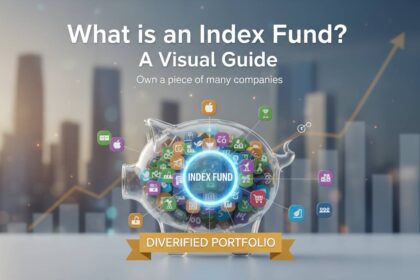

Index funds have become one of the most popular investment vehicles for Americans building wealth for retirement, education, or other financial goals. With over $13 trillion invested in index funds as of 2024, these passive investment vehicles have fundamentally changed how individuals approach the stock market. But the question remains: should you invest in index funds? The answer depends on your financial situation, goals, and understanding of how these instruments work.
This comprehensive guide breaks down everything you need to know about index funds, from their core mechanics to practical strategies for getting started. Whether you're a complete beginner or someone looking to optimize an existing portfolio, you'll find actionable insights backed by research and expert perspectives.
What Are Index Funds and How Do They Work?
An index fund is a type of mutual fund or exchange-traded fund (ETF) designed to track a specific market index, such as the S&P 500, Nasdaq Composite, or Total Stock Market index. Instead of a fund manager actively selecting individual stocks, the fund simply holds the same securities in the same proportions as the chosen index it tracks.
When you invest in an S&P 500 index fund, you're essentially buying a tiny slice of the 500 largest publicly traded U.S. companies. If Apple, Microsoft, and Amazon make up a certain percentage of the S&P 500, your fund holds those same companies in those same proportions. When these companies perform well, your investment grows. When they struggle, your investment declines.
Key Insight: Index funds operate on the principle of passive management, meaning they require far less human intervention than actively managed funds. This structural difference is the primary reason index funds consistently charge lower fees than their actively managed counterparts.
The mechanics are straightforward: the fund issuer creates a portfolio that mirrors the index, and as the index composition changes (quarterly rebalancing), the fund adjusts its holdings accordingly. Investors buy shares of the fund, and their returns directly correspond to the index's performance minus a small expense ratio.
The Case for Index Funds: Key Advantages
The advantages of index funds extend far beyond low costs. Research consistently demonstrates that index funds deliver compelling results for long-term investors.
Lower Costs Mean Higher Returns
The most significant advantage of index funds is their low expense ratio. Actively managed mutual funds typically charge 0.5% to 1.5% or more annually, while index funds often charge just 0.03% to 0.25%. Over decades, this difference compounds dramatically. According to Vanguard's research, fees are the only reliable predictor of future fund performance—what you don't pay in fees stays in your portfolio.
Diversification Instantly
Rather than researching and buying individual stocks, index funds provide instant diversification across hundreds or thousands of companies. This diversification reduces your exposure to any single company's performance. If one company in the S&P 500 collapses, it represents just 0.2% of the index—a manageable loss compared to a concentrated stock position.
Consistent Market Performance
Research from SPIVA (S&P Indices Versus Active) consistently shows that over extended periods, most actively managed funds underperform their benchmark indices. For the 20-year period ending December 2023, 94% of large-cap active managers failed to beat the S&P 500. Index funds guarantee you market returns minus minimal fees, while active management offers no such assurance.
Tax Efficiency
Index funds typically generate fewer capital gains distributions than actively managed funds because they buy and sell securities less frequently. This tax efficiency can significantly impact your after-tax returns, particularly in taxable brokerage accounts.
| Advantage | Impact | Source |
|---|---|---|
| Lower fees | Saves 0.5-1.5% annually | Vanguard, 2024 |
| Instant diversification | 500+ companies in one purchase | SEC |
| Outperformance | 94% of active funds underperform (20yr) | SPIVA, 2023 |
| Tax efficiency | Fewer capital gains distributions | IRS |
Index Funds vs. Actively Managed Funds: A Comparison
Understanding the difference between index funds and actively managed funds is essential for making informed investment decisions.
Actively managed funds employ professional portfolio managers who research companies, analyze market trends, and make buy/sell decisions attempting to "beat the market." This active approach typically results in higher fees, more trading (leading to higher taxes), and inconsistent results.
Index funds take the opposite approach: they don't try to beat the market; they match it. This passive strategy relies on the empirical finding that markets are largely efficient—meaning consistently identifying mispriced securities is extraordinarily difficult.
| Factor | Index Funds | Actively Managed Funds |
|---|---|---|
| Average expense ratio | 0.06% | 0.82% |
| Goal | Match market returns | Beat market returns |
| Management style | Passive | Active |
| Tax efficiency | High | Lower |
| Predictability | Consistent | Variable |
Financial journalist and author John Bogle, founder of Vanguard, famously argued that for most investors, the math simply doesn't work in favor of active management. After paying higher fees and experiencing underperformance, the average active manager delivers net returns below the index they attempt to beat.
That said, actively managed funds may make sense in certain niche areas—small-cap international stocks, for example—where market inefficiency is greater and skilled managers may genuinely add value.
Types of Index Funds Every Investor Should Know
Not all index funds are created equal. Understanding the different types helps you build an appropriate portfolio.
Total Stock Market Index Funds
These funds track the entire U.S. stock market, including large-cap, mid-cap, and small-cap stocks. They offer the broadest market exposure and are excellent core holdings for most investors. Examples include the Vanguard Total Stock Market ETF (VTI) and Fidelity Total Market Index Fund (FSKAX).
S&P 500 Index Funds
The S&P 500 includes 500 of the largest U.S. companies, representing approximately 80% of U.S. market capitalization. These funds are ideal for investors seeking exposure to America's biggest and most established companies. The SPDR S&P 500 ETF Trust (SPY) and Vanguard S&P 500 ETF (VOO) are among the most popular.
Total International Index Funds
For global diversification, international index funds track markets outside the United States. Some funds focus on developed markets (Europe, Japan, etc.), while others include emerging markets. Vanguard Total International Stock ETF (VXUS) provides exposure to thousands of companies in developed and emerging countries.
Bond Index Funds
Index funds aren't limited to stocks. Bond index funds track indices of U.S. Treasury bonds, corporate bonds, or municipal bonds. They provide income and portfolio stability, particularly important as you approach retirement.
Target-Date Funds
These "all-in-one" funds automatically adjust their stock/bond allocation over time based on your expected retirement date. A 2060 target-date fund starts heavily weighted toward stocks and gradually shifts toward bonds as you approach retirement. They're excellent for hands-off investors.
How to Start Investing in Index Funds
Starting with index funds requires several straightforward steps, but thoughtful execution matters.
Step 1: Assess Your Financial Foundation
Before investing, ensure you've established an emergency fund (3-6 months of expenses), paid off high-interest debt, and understand your investment timeline. Index funds work best for long-term goals—ideally five years or more. Shorter time horizons call for more conservative investments.
Step 2: Choose Your Account Type
For retirement, maximize tax-advantaged accounts first:
- 401(k): If your employer offers a 401(k) match, prioritize contributing enough to capture the full match—essentially free money.
- IRA or Roth IRA: Traditional and Roth IRAs offer tax advantages and typically provide more investment options than 401(k)s.
- Taxable brokerage: After maximizing tax-advantaged accounts, a regular brokerage account allows additional investing with more flexibility.
Step 3: Select Your Index Funds
For a simple, effective portfolio, consider a three-fund approach:
- U.S. total stock market index fund (60-70% of stocks)
- International stock index fund (20-30% of stocks)
- U.S. bond index fund (10-20%, adjusting based on age and risk tolerance)
Many brokerages offer commission-free index funds, making it easy to build a diversified portfolio with minimal costs.
Step 4: Invest Regularly
Dollar-cost averaging—investing a fixed amount at regular intervals—removes emotional decision-making from investing. Whether the market is up or down, you continue investing, buying more shares when prices are low and fewer when prices are high.
Step 5: Stay the Course
Market volatility is inevitable. During downturns, the temptation to sell is powerful, but history shows markets recover and grow over time. Maintaining your investment strategy during difficult periods is crucial for long-term success.
Common Mistakes to Avoid When Investing in Index Funds
Even with index funds' simplicity, investors frequently make avoidable errors that undermine their results.
Mistake #1: Chasing Performance
The best-performing index funds change yearly. Instead of chasing last year's winners, focus on low costs, broad diversification, and consistent contributions. The fund that outperforms today may underperform tomorrow—what matters is staying invested.
Mistake #2: Ignoring Expense Ratios
While the difference between 0.04% and 0.25% seems minor, it creates substantial long-term impact. On a $100,000 investment over 30 years with 7% annual returns, a 0.25% fee costs approximately $60,000 more than a 0.04% fee. Always check the expense ratio before investing.
Mistake #3: Over-allocating to Bonds Too Early
Young investors sometimes become overly conservative, shifting too much to bonds too soon. While bonds provide stability, their growth potential is limited. The traditional rule of "100 minus your age in bonds" increasingly suggests that young investors might consider even more aggressive allocations.
Mistake #4: Neglecting International Exposure
Some investors exclusively buy U.S. index funds, missing the diversification benefits of international markets. International stocks occasionally outperform U.S. markets and provide valuable diversification during periods when U.S. markets struggle.
Mistake #5: Trying to Time the Market
Waiting for the "right time" to invest often means never investing. The market's best days frequently follow its worst days. Consistent, patient investing outperforms market timing over nearly every time horizon.
Frequently Asked Questions
Are index funds safe during a market crash?
Index funds are not immune to market crashes—they decline alongside the broader market. However, they tend to recover faster than individual stocks because diversification spreads risk across many companies. During the COVID-19 crash of March 2020, the S&P 500 recovered to new highs within months. The key is maintaining your investment through downturns rather than panic-selling.
How much money do I need to start investing in index funds?
Many brokerages allow you to start with as little as $1 through fractional shares or minimum investment requirements that have dropped significantly in recent years. Some index funds have minimum initial investments of $1,000-$3,000, while ETFs can often be purchased for the price of a single share plus any trading commissions.
Can I lose all my money in index funds?
While theoretically possible in an extreme scenario (like complete economic collapse), losing everything in a diversified index fund is extraordinarily unlikely. Index funds track the broader economy, and historically, the U.S. economy has grown over time. The S&P 500 has delivered positive returns over every 20-year period in history.
How do index funds differ from ETFs?
Index funds and ETFs both track indices, but they trade differently. Index mutual funds are priced once per day at net asset value, while ETFs trade like stocks throughout the day at fluctuating prices. For buy-and-hold investors, the difference is largely academic—both offer excellent low-cost exposure to indices.
Should I invest in index funds through my 401(k) or IRA?
Generally, prioritize tax-advantaged accounts (401ks and IRAs) before taxable accounts due to their tax benefits. Within these accounts, index funds are often excellent choices due to their low costs and tax efficiency. Check whether your employer's 401(k) offers low-cost index fund options.
How many index funds should I own?
For most investors, three to five index funds provide sufficient diversification. A common approach includes one U.S. stock fund, one international stock fund, and one bond fund. Adding more funds provides diminishing returns while increasing complexity. Target-date funds offer even more simplicity by combining everything in a single fund.
Conclusion
Index funds represent one of the most effective wealth-building tools available to individual investors. Their low costs, broad diversification, tax efficiency, and historical outperformance against most actively managed alternatives make them an excellent foundation for most portfolios.
The decision to invest in index funds ultimately comes down to understanding your goals, timeline, and risk tolerance. For long-term investors seeking market returns without the complexity of stock-picking, index funds provide an elegant solution. They let you own a slice of the entire economy, participate in its growth, and avoid the costly mistakes of trying to time the market or pick winning stocks.
Start by assessing your financial foundation, choose appropriate accounts, select low-cost diversified index funds, and commit to consistent contributions regardless of market conditions. Over decades, this disciplined approach has built wealth for millions of Americans—and it can do the same for you.