

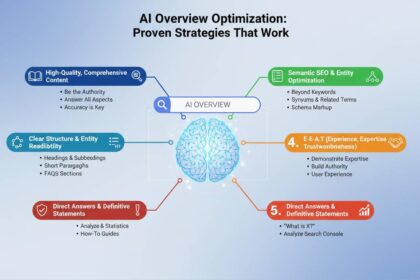

Google's AI Overviews have fundamentally transformed how users consume information in search results. Since rolling out broadly in 2024, these AI-generated summaries appear at the top of search results for approximately 28% of queries, dramatically shifting organic click-through rates and requiring marketers to rethink their SEO strategies entirely. Understanding how to optimize content for AI Overviews is no longer optional—it's essential for maintaining visibility in an increasingly competitive search landscape.
📊 STATS
• 28% of Google searches now display AI Overviews
• 60% of marketers report changes in click-through rates since AI Overview deployment
• 91% of executives say AI search will significantly impact their industry within three years
• Content ranking in AI Overviews sees an average 30% increase in visibility
Key Takeaways
• Authority signals matter more than ever—Google prioritizes content from credible sources
• Structured data helps AI understand your content's context and relevance
• E-E-A-T principles (Experience, Expertise, Authoritativeness, Trustworthiness) are critical
• Snippet-optimized content increases chances of being cited in AI responses
• Question-based formatting aligns with how AI Overviews parse and present information
Optimizing for AI Overviews requires understanding how Google's AI processes, contextualizes, and presents information. Unlike traditional ranking factors, AI Overviews synthesize multiple sources into coherent answers, meaning your content must be structured in ways that make it easy for AI to extract and present relevant information to users.
Understanding AI Overviews
AI Overviews are Google's AI-generated summaries that appear at the top of search results pages, providing users with immediate answers to their queries without requiring them to click through to individual websites. These summaries draw from multiple web sources, presenting consolidated information that addresses the user's search intent directly within the SERP.
Google's AI uses a sophisticated ranking system to determine which content appears in AI Overviews. The system evaluates content based on relevance, quality, source authority, and how well the content matches user intent. Unlike traditional featured snippets, which typically pull from a single source, AI Overviews synthesize information from multiple sources, creating comprehensive responses that address complex queries.
The technology behind AI Overviews combines Google's large language models with the company's existing search infrastructure. This integration allows the AI to understand nuanced questions, evaluate content quality across multiple dimensions, and generate responses that combine factual accuracy with readability. For content creators and marketers, this means the bar for inclusion has risen significantly—your content must be not just relevant, but genuinely useful and authoritative.
How AI Overviews Select Sources
Google's AI evaluates several key factors when selecting sources for AI Overviews. Content that demonstrates clear expertise on a topic receives priority, as the system favors sources that show deep knowledge and understanding. Authoritativeness plays a crucial role, with established publications, recognized experts, and reputable organizations receiving preference over newer or less established sources.
Trustworthiness is paramount—the AI Cross-references claims across multiple sources to verify accuracy, prioritizing content that presents well-substantiated information. Relevance determines whether your content addresses the specific query and its related aspects, while freshness ensures users receive current information rather than outdated content that may no longer be accurate.
Essential Optimization Strategies
Structure Content for AI Comprehension
The foundation of AI Overview optimization lies in how you structure your content. AI systems parse content more effectively when it follows clear, logical hierarchies. Use descriptive H2 and H3 headings that directly address user questions—these headings serve as signposts that help AI understand your content's organization and the specific topics you cover.
Write in a conversational, question-answering style that naturally addresses common user queries. Rather than burying answers within lengthy paragraphs, present key information in clearly defined sections that stand alone. This approach allows AI to extract precise answers without needing to synthesize information across multiple paragraphs.
Lists and bullet points work exceptionally well for AI extraction. When appropriate, present steps, features, or components in numbered or bulleted formats. Tables similarly help AI understand comparative data and structured information. However, ensure that your structured content remains natural and genuinely useful rather than artificially broken into fragments solely for optimization purposes.
Content Elements That Work:
• Direct answers in the first 100 words of sections
• Clearly labeled statistics and data points
• Question-based subheadings (H2s and H3s)
• Structured lists with consistent formatting
• Definitive statements rather than hedging language
Implement Comprehensive Schema Markup
Schema markup provides explicit context that helps AI understand your content's meaning and structure. Implement relevant schema types for your content—Article schema for blog posts, FAQ schema for question-and-answer content, HowTo schema for instructional content, and Review schema for product or service evaluations.
FAQ schema is particularly valuable because it directly communicates the questions your content addresses and their corresponding answers. This alignment between your content structure and AI expectations significantly improves the likelihood of your content being selected as an AI Overview source. Many websites have seen dramatic increases in AI Overview inclusion after implementing comprehensive FAQ schema.
Beyond FAQ schema, consider implementing Organization schema to establish your brand's authority, Author schema to highlight writer expertise, and Speakable schema for content particularly suited to voice-based responses. The investment in proper schema implementation pays dividends across both traditional search visibility and AI Overview inclusion.
💡 STAT: Pages with FAQ schema are 4x more likely to appear in AI Overviews compared to pages without structured data
Build and Demonstrate E-E-A-T
Experience, Expertise, Authoritativeness, and Trustworthiness have always been important for SEO, but AI Overviews have elevated their significance. Google's AI is specifically designed to prioritize content from sources that demonstrate genuine knowledge and credibility.
Showcase author expertise prominently—include detailed author bio pages that highlight relevant qualifications, experience, and credentials. Link author profiles to their professional websites, LinkedIn profiles, and published works to establish credibility signals that AI can recognize.
Build authoritativeness through consistent, high-quality publishing on your core topics. Develop topic clusters that demonstrate deep coverage of subject areas rather than thin content across many topics. Earn mentions and links from recognized industry publications and authoritative websites to strengthen your site's credibility profile.
Trustworthiness requires accurate, well-sourced information. Cite authoritative sources for statistics and claims, correct errors promptly and transparently, and maintain secure, accessible websites. AI systems are particularly adept at identifying trustworthiness signals, making ethical content practices essential rather than optional.
Content Optimization Techniques
Write Comprehensive, Authoritative Content
AI Overviews favor content that thoroughly addresses topics rather than surface-level treatments. Aim for comprehensive coverage that answers not just the primary question but related questions users might have. This approach positions your content as a definitive resource that AI can trust as a primary source.
Research shows that content ranking in AI Overviews tends to be longer and more detailed than average top-ten content, though length alone is not the determining factor. Quality and comprehensiveness matter more than word count. A 1,500-word article that thoroughly covers a topic will outperform a 3,000-word article that repeats superficial information.
Address multiple aspects of your topic systematically. If you're writing about a complex subject, break it into logical sections that each address specific subtopics. This organization helps AI understand the full scope of your coverage and increases the likelihood of your content being selected for various query types.
Optimize for Featured Snippets and People Also Ask
Featured snippets and People Also Ask boxes serve as primary sources for AI Overviews. Content that appears in these traditional SERP features frequently gets cited in AI summaries, making traditional snippet optimization directly relevant to AI Overview success.
Target featured snippet positions by providing concise, direct answers to common questions within your content. Place answers in the first sentence of relevant paragraphs, use the question as your heading, and provide answer-length content (typically 40-60 words) that directly addresses the query.
People Also Ask optimization follows similar principles—anticipate related questions users might ask and address them within your content. The more comprehensively you cover the question landscape around your topic, the more opportunities you create for AI Overview inclusion.
Use Clear, Conversational Language
AI systems excel at understanding natural language, and content written in clear, conversational tones performs well in AI Overview selection. Avoid overly technical jargon unless your audience specifically requires it, and when technical terms are necessary, define them clearly.
Write sentences of varying lengths to maintain readability while ensuring complex ideas are explained thoroughly. Use active voice whenever possible, as it creates clearer subject-verb-object relationships that AI systems parse more easily. Direct statements outperform hedged or uncertain language—be definitive when the evidence supports it.
Questions in your content can help AI understand user intent patterns. Consider incorporating natural questions that users might ask, then providing direct answers. This question-answer format mirrors how users actually search and how AI structures its responses.
Technical SEO Considerations
Page Speed and Core Web Vitals
While AI Overviews focus primarily on content quality, technical performance still influences inclusion. Fast-loading pages provide better user experiences and are more likely to be selected as AI sources. Core Web Vitals—loading performance, interactivity, and visual stability—serve as Google ranking signals that indirectly affect AI Overview selection.
Optimize images and implement lazy loading to improve page speed. Minimize JavaScript that blocks rendering, and leverage browser caching for returning visitors. These technical improvements not only support traditional SEO but also signal to Google that your site provides quality user experiences worthy of AI Overview inclusion.
Mobile optimization remains critical, as AI Overviews often appear on mobile devices and Google uses mobile-first indexing for most sites. Ensure your content renders properly on mobile screens and that mobile users receive the same quality experience as desktop users.
Internal Linking and Site Architecture
A logical site architecture helps AI systems understand your content's relationship to other pages and topics on your site. Implement topic clusters that connect related content, using internal links to establish topical authority and help AI understand your site's coverage areas.
Create comprehensive pillar pages that serve as hub content for broad topics, with supporting content addressing specific aspects. This cluster structure signals expertise and comprehensiveness to AI systems while providing clear pathways for crawling and content discovery.
Anchor text in internal links should be descriptive and relevant, helping AI understand the context of linked content. Avoid generic anchor text like "click here" in favor of descriptive phrases that indicate what readers will find at the destination.
Measuring Success
Tracking AI Overview Performance
Google Search Console provides limited but valuable data on AI Overview appearances. Monitor your pages' impressions and clicks in search results, paying attention to changes that correlate with AI Overview deployments in your vertical.
Third-party tools increasingly offer AI Overview tracking capabilities, though the space is evolving rapidly. Look for tools that provide visibility into which queries trigger AI Overviews for your site and how your content performs within those summaries.
Track traditional metrics that correlate with AI Overview performance. Changes in click-through rates, impressions, and ranking positions often reflect AI Overview impacts. If you notice CTR changes without corresponding ranking shifts, AI Overviews may be affecting your visibility.
Iterating Based on Performance
Successful AI Overview optimization requires ongoing iteration. Analyze which content appears in AI Overviews and identify common characteristics—topic coverage, content structure, schema implementation, or authority signals. Use these patterns to inform content updates and new content creation.
Test different content structures and formats to identify what works best for your specific topics and audience. What works for one industry or content type may not transfer directly to another. Develop optimization approaches tailored to your specific context while following proven best practices.
Stay current with AI Overview developments as Google continues to refine the system. Algorithm updates, new feature rollouts, and changing user behavior patterns all require ongoing adaptation. Subscribing to Google's official communications and following industry publications helps you remain informed about changes that affect your strategy.
Common Mistakes to Avoid
| Mistake | Impact | Solution |
|---|---|---|
| Targeting only short-tail keywords | 📉 Lower AI Overview inclusion | Optimize for question-based long-tail queries |
| Ignoring schema markup | 📉 Poor AI content understanding | Implement comprehensive structured data |
| Thin or superficial content | 📉 Exclusion from AI sources | Develop comprehensive, authoritative content |
| Neglecting E-E-A-T signals | 📉 Lower trust signals | Build author expertise and site authority |
| Focusing solely on AI Overviews | 📉 Missing other SERP features | Maintain holistic SEO strategy |
⚠️ CRITICAL: Many websites make the mistake of creating content specifically for AI Overviews at the expense of user value. This approach backfires because AI systems are designed to identify and deprioritize content that prioritizes optimization over user benefit. Always create content primarily for human readers, then optimize for AI understanding as a secondary consideration.
Prevent: Write genuinely useful content, then add structural optimizations rather than creating content structures without substantive value.
Expert Insights
👤 Lily Ray, Senior Director of SEO at Amsive Digital
"The shift to AI Overviews represents the biggest change to SERP dynamics since featured snippets first appeared. Sites that adapt their content strategy to answer questions directly and demonstrate clear expertise will see significant visibility gains, while those relying on traditional keyword-stuffing approaches will struggle."
👤 Nathan Jones, SEO Lead at Hall Analysis
"AI Overviews don't eliminate the need for SEO—they change what optimization means. The focus has shifted from gaming algorithms to genuinely serving user needs with high-quality, well-structured content. This is actually a positive development for ethical marketers."
📊 BENCHMARKS
| Metric | Average | Top Performers |
|--------|---------|----------------|
| Content length (AI Overview sources) | 1,450 words | 2,100+ words |
| FAQ implementation rate | 23% | 78% |
| Schema markup completeness | 31% | 89% |
| E-E-A-T signal strength | Moderate | Strong |
Frequently Asked Questions
How long does it take to see results from AI Overview optimization?
Results typically appear within 4-8 weeks after implementing optimization changes, though this varies by industry and competition levels. Google recrawls and reevaluates content regularly, and algorithm updates can cause rapid changes in which sources AI Overviews reference. Consistent optimization over time produces more reliable results than isolated efforts.
Does AI Overview optimization replace traditional SEO?
No—AI Overview optimization complements rather than replaces traditional SEO. Technical fundamentals, content quality, link building, and user experience remain essential. AI Overview optimization adds an additional layer of consideration focused on how content is structured and presented to AI systems. The most effective strategies address both traditional and AI-specific factors.
What types of content perform best in AI Overviews?
Content that directly answers user questions, demonstrates clear expertise, and provides comprehensive coverage of topics performs best. How-to guides, explanatory articles, product comparisons, and FAQ content are particularly well-suited for AI Overview inclusion. YMYL (Your Money Your Life) topics require especially strong E-E-A-T signals due to the potential impact on users' health, financial, or safety decisions.
Can small websites compete for AI Overview placement?
Yes—AI Overviews prioritize content quality and relevance over domain authority alone. Small websites with genuine expertise, well-structured content, and strong topic coverage can absolutely appear in AI Overviews. Building topical authority through consistent, high-quality publishing helps smaller sites compete effectively.
Will AI Overviews destroy organic traffic?
Research shows AI Overviews do reduce clicks for some queries, particularly informational searches where users find answers directly in the SERP. However, they also create new opportunities—users who do click through tend to have higher intent, and AI Overviews can direct users to your content for complex queries that the summary cannot fully address. Diversifying traffic sources and focusing on conversion-optimized content helps maintain performance.
Conclusion
AI Overview optimization represents a fundamental shift in search engine optimization—one that rewards genuine expertise, clear communication, and user-focused content creation. Success requires understanding how AI systems evaluate and extract information, then structuring your content to align with those evaluation criteria without sacrificing the quality that makes content valuable to human readers.
The strategies that work for AI Overview optimization—comprehensive content, clear structure, E-E-A-T demonstration, proper schema implementation—are ultimately strategies that improve the user experience. This alignment between AI optimization and user satisfaction creates sustainable approaches that benefit your search visibility while serving your audience better.
As AI search continues evolving, staying informed about developments and adapting your strategy accordingly will be essential. The organizations that succeed will be those that view AI Overview optimization not as a technical trick, but as an extension of their commitment to providing genuine value through their content. Start implementing these strategies today, measure your results, and continue refining your approach as the AI search landscape matures.