

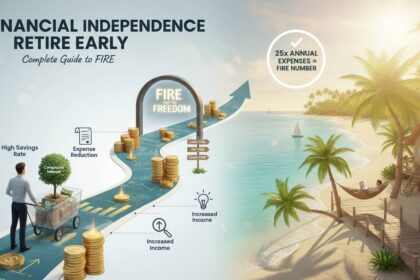

Financial Independence Retire Early (FIRE) is a movement dedicated to extreme savings and investment that enables individuals to retire decades earlier than traditional retirement age. The core philosophy involves maximizing savings rate—often saving 50-75% of income—while investing in low-cost index funds to build a portfolio that generates enough passive income to cover living expenses indefinitely. Once you reach your FIRE number, typically calculated as 25 times your annual expenses (based on the 4% safe withdrawal rate), you have the option to stop working full-time and pursue financial independence.
This comprehensive guide explores the strategies, variations, and practical steps to help you determine whether FIRE is right for you and how to begin your journey toward financial independence.
Understanding the FIRE Movement
The FIRE movement has grown from a niche internet community into a significant financial phenomenon. Its roots trace back to the 1992 publication of Your Money or Your Life by Vicki Robin and Joe Dominguez, which introduced the concept of financial independence through mindful consumption. The movement gained momentum in the 2010s through blogs like Mr. Money Mustache, The Mad Fientist, and ChooseFI, which collectively reached millions of readers seeking alternatives to the traditional career-and-retirement timeline.
The fundamental principle behind FIRE is deceptively simple: save aggressively, invest wisely, and achieve freedom from mandatory work sooner than conventional wisdom suggests. However, the implementation requires discipline, strategic planning, and a willingness to question societal norms around consumption and success.
The Mathematics of FIRE
FIRE calculations rely on the 4% rule, derived from the Trinity Study conducted at Trinity University in 1998. This research found that a diversified portfolio with a 4% annual withdrawal rate has a 95% probability of lasting for at least 30 years. By multiplying your annual expenses by 25, you arrive at your FIRE number—the portfolio size needed to sustain indefinite withdrawals.
For example, if your annual expenses total $40,000, your FIRE number would be $1,000,000. If you spend $80,000 annually, you would need $2,000,000. The calculation assumes you'll withdraw 4% of your portfolio in the first year, then adjust that amount for inflation in subsequent years.
Different FIRE Variations
FIRE is not a one-size-fits-all approach. The movement has evolved to include several distinct variations that accommodate different lifestyle preferences, income levels, and risk tolerances.
Fat FIRE
Fat FIRE targets a more luxurious retirement lifestyle, typically requiring $2-5 million or more in investments. Practitioners of Fat FIRE maintain higher annual spending in retirement—often $100,000 or more—allowing for extensive travel, premium housing, and lifestyle amenities. This variation suits high-income earners who are unwilling to significantly reduce their standard of living in pursuit of early retirement.
Lean FIRE
Lean FIRE focuses on achieving financial independence with a minimal annual budget, typically $25,000-$40,000. This approach requires living below one's means both during the accumulation phase and in retirement. Lean FIRE practitioners often embrace minimalism, DIY skills, and community resources to maintain low costs. While more achievable on modest incomes, Lean FIRE offers less margin for unexpected expenses or lifestyle changes.
Coast FIRE
Coast FIRE represents a middle-ground strategy where you stop contributing to retirement savings but allow your existing portfolio to grow through compound interest. If you've accumulated enough savings that, without additional contributions, it will grow to your FIRE number by traditional retirement age (typically 65), you can "coast" with less demanding work or reduced hours. This variation provides flexibility for those who want to reduce work intensity without fully retiring early.
Barista FIRE
Barista FIRE derives its name from the common example of working part-time at a coffee shop to cover basic expenses while your portfolio handles the rest. This approach typically involves earning $15,000-$30,000 annually from part-time work while your investments cover remaining costs. Barista FIRE reduces the required portfolio size and provides social engagement, healthcare benefits (through an employer), and purpose through meaningful part-time work.
| FIRE Type | Typical Annual Spending | Required Portfolio | Key Characteristics |
|---|---|---|---|
| Lean FIRE | $25,000-$40,000 | $625,000-$1,000,000 | Minimalist lifestyle required |
| Barista FIRE | $40,000-$60,000 | $1,000,000-$1,500,000 | Part-time work expected |
| Standard FIRE | $60,000-$100,000 | $1,500,000-$2,500,000 | Comfortable middle-class lifestyle |
| Fat FIRE | $100,000+ | $2,500,000+ | Luxury lifestyle with extensive options |
How to Calculate Your FIRE Number
Calculating your FIRE number requires honest assessment of your current spending and realistic projections for retirement expenses.
Step 1: Track Your Current Spending
Document all expenses for at least three months to establish an accurate baseline. Include housing costs, utilities, transportation, food, insurance, healthcare, entertainment, and miscellaneous items. Many FIRE practitioners use budgeting apps like YNAB (You Need A Budget) or spreadsheets to categorize and analyze spending patterns.
Step 2: Determine Retirement Expenses
Your retirement spending will likely differ from your current spending. Factor in potential changes: mortgage payoff eliminates housing costs, while healthcare expenses typically increase with age. Retirement also introduces new categories like travel, hobbies, and potentially supporting family members.
Step 3: Add Healthcare Costs
For Americans, healthcare represents one of the largest retirement expenses, particularly before Medicare eligibility at age 65. FIRE practitioners often budget $500-$1,000 monthly per person for health insurance and out-of-pocket costs through the Affordable Care Act marketplace. This figure varies significantly based on age, location, and plan selection.
Step 4: Apply the 25x Multiplier
Once you've calculated annual retirement expenses, multiply by 25 to determine your FIRE number. Using the 4% withdrawal rate provides a margin of safety, though some practitioners use more conservative rates (3-3.5%) to account for longer retirement horizons or market volatility.
Strategies to Achieve FIRE
Achieving FIRE requires a multi-faceted approach combining income maximization, expense reduction, and strategic investing.
Maximize Your Income
Income maximization typically provides the fastest path to FIRE. Strategies include pursuing promotions, negotiating salaries, developing high-demand skills, and in some cases, changing employers to command higher compensation. Side businesses and freelance work offer additional income streams while building assets that can eventually replace employment income.
Jake Thompson, a Certified Financial Planner at Facet Wealth, notes: "The most effective FIRE strategies focus first on income growth. Someone earning $150,000 with a 50% savings rate reaches FIRE faster than someone earning $60,000 saving 70% of income, despite the higher savings percentage."
Reduce Expenses Aggressively
Expense reduction accelerates the savings rate and lowers the FIRE number simultaneously. The most impactful categories include housing (typically 25-35% of spending), transportation, and food. Strategies range from house hacking (renting out portions of your home) to downsizing vehicles, cooking at home, and eliminating subscription services.
Optimize Your Investment Strategy
FIRE practitioners overwhelmingly favor low-cost index funds over actively managed investments. The rationale is straightforward: research consistently shows that most actively managed funds underperform index funds over time, and high fees compound to significantly reduce portfolio growth. Vanguard, Fidelity, and Schwab offer diversified index funds with expense ratios below 0.10%.
A typical FIRE portfolio might allocate 80-90% to stocks (domestic and international) and 10-20% to bonds, with the stock percentage decreasing as retirement approaches.
Common FIRE Mistakes to Avoid
The FIRE journey involves potential pitfalls that can derail even well-intentioned practitioners.
Mistake 1: Underestimating Healthcare Costs
Healthcare represents the largest variable expense in early retirement, particularly in the United States. Many FIRE aspirants drastically underestimate premiums, deductibles, and out-of-pocket costs, creating financial stress when unexpected medical needs arise. Budget conservatively and maintain emergency funds specifically designated for healthcare expenses.
Mistake 2: Ignoring Sequence of Returns Risk
The Trinity Study's 4% rule assumes a 30-year retirement horizon. However, early retirees may need their portfolios to last 40-60 years. A market downturn early in retirement can deplete portfolios faster than expected—a risk called sequence of returns. Maintaining a one-to-two year cash buffer and using a more conservative withdrawal rate (3-3.5%) helps mitigate this risk.
Mistake 3: Neglecting Mental Health and Purpose
FIRE can create unexpected challenges, including loss of identity, social isolation, and difficulty finding purpose without work structure. Dr. Elizabeth Lombardo, a psychologist specializing in financial wellbeing, warns: "Financial independence is necessary for freedom, but it's not sufficient for fulfillment. Early retirees must actively cultivate relationships, hobbies, and sense purpose to maintain psychological wellbeing."
Expert Perspectives on FIRE Viability
Financial professionals offer varied perspectives on FIRE's feasibility and sustainability.
The Case for FIRE
Mr. Money Mustache (Pete Adeney), one of the movement's most prominent voices, retired at age 30 after accumulating approximately $600,000 through aggressive savings and index fund investing. His blog demonstrates that FIRE is achievable on moderate incomes with discipline and unconventional choices.
"The math of compound interest is ruthlessly efficient," Adeney writes. "The key is simply spending less than you earn and investing the difference in low-cost index funds. It works every time."
The Cautionary View
Traditional financial advisors often express concerns about FIRE's assumptions. Wade Pfau, a professor at The American College and researcher on retirement income, recommends caution: "The 4% rule provides reasonable security for a 30-year retirement, but early retirement extending 40+ years requires more conservative planning. A 3-3.5% withdrawal rate and flexible spending in down years improve success probabilities."
Finding Balance
The optimal FIRE strategy incorporates elements from both perspectives: aggressive saving during working years, conservative withdrawal rates in early retirement, and flexibility to adjust spending during market downturns.
Getting Started: Your First Steps
Beginning your FIRE journey requires taking concrete actions, regardless of your current financial situation.
Step 1: Calculate Your Current Net Worth
Add all assets (savings, investments, retirement accounts, property, vehicles) and subtract all liabilities (mortgages, loans, credit card debt). This baseline establishes your starting point and helps identify priorities.
Step 2: Create a Detailed Budget
Track every dollar spent for one month using either software or manual tracking. Categorize expenses and identify areas for potential reduction. Target categories with the highest spending first—housing and transportation typically offer the greatest savings opportunities.
Step 3: Establish an Emergency Fund
Before aggressively investing, accumulate three to six months of expenses in an accessible high-yield savings account. This fund prevents the need to sell investments during market downturns to cover unexpected expenses.
Step 4: Maximize Tax-Advantaged Accounts
Contribute to 401(k) accounts to at least capture employer matching contributions. Then max out Health Savings Accounts (HSAs) if available—these offer triple tax advantages. Finally, contribute to Roth IRAs or traditional IRAs based on your income and tax situation.
Step 5: Develop Additional Income Streams
Consider developing skills or businesses that can generate supplementary income. Options include freelance work, online businesses, rental properties, or monetizing hobbies. Additional income accelerates the path to FIRE while providing potential post-retirement engagement.
Frequently Asked Questions
Q: What is a realistic timeline to achieve FIRE?
The timeline depends on your savings rate relative to income. With a 50% savings rate, most people can achieve FIRE in approximately 15-17 years. A 70% savings rate compresses this to 8-10 years, while a 25% savings rate requires over 25 years. The key variables are your current income, expenses, and investment returns.
Q: Is FIRE only for high earners?
No, FIRE is achievable across income levels, though the path differs. High earners can save more absolute dollars, while lower earners typically must achieve Lean FIRE through aggressive expense reduction. Many FIRE practitioners earn median incomes but achieve FIRE through disciplined spending and lifestyle choices rather than high salaries.
Q: What happens if I change my mind about early retirement?
FIRE provides optionality rather than a mandatory retirement date. Once you achieve financial independence, you can choose to continue working, reduce hours, switch careers, or pursue passion projects. The FIRE number represents the point at which work becomes optional, not mandatory.
Q: How does FIRE handle inflation over a long retirement?
The 4% rule incorporates inflation adjustments—your withdrawal amount increases annually by the inflation rate. However, long retirements (40+ years) present greater inflation uncertainty.FIRE practitioners often maintain flexibility to reduce spending during high-inflation periods and may allocate a portion of portfolios to inflation-protected securities like Treasury Inflation-Protected Securities (TIPS).
Q: Can I achieve FIRE with children?
Yes, many families achieve FIRE with children, though it requires careful planning. Additional considerations include college savings (which can be funded separately from FIRE portfolios), healthcare costs for dependents, and potentially higher housing expenses. The FIRE number increases proportionally with family expenses, but many families successfully reach FIRE through coordinated planning and prioritization.
Q: What are the tax implications of early retirement?
Early retirees must carefully manage withdrawals from tax-advantaged accounts to minimize tax liability. Strategies include Roth conversion ladders, strategically timing traditional 401(k) and IRA withdrawals, and managing the timing of Social Security (if claiming early). State tax treatment also varies significantly, leading some FIRE practitioners to relocate to tax-friendly states.
Conclusion
Financial Independence Retire Early represents a viable path to freedom from mandatory employment for those willing to embrace disciplined saving, strategic investing, and intentional living. The movement offers not merely early retirement but the optionality to design a life aligned with personal values and priorities.
Whether you pursue Fat FIRE with its luxury options or Lean FIRE through minimalist living, the core principles remain consistent: save aggressively, invest wisely, and maintain flexibility. Your FIRE number awaits calculation, and your journey begins with the first budget, the first investment, and the first decision to prioritize future freedom over present consumption.
Start today. Track your spending, maximize your income, and invest the difference. Your financial independence is achievable—the only question is how badly you want it and what you're willing to sacrifice to get there.