

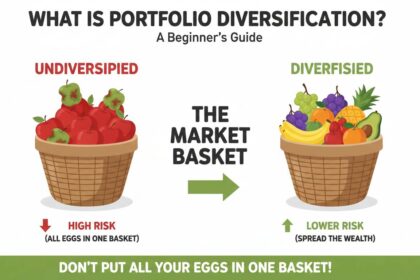

Portfolio diversification is a risk management strategy that involves spreading investments across various asset classes, sectors, and geographic regions to minimize the impact of any single investment's poor performance on your overall portfolio. Rather than putting all your money into one stock, bond, or investment type, diversification means allocating your capital across multiple investments that tend to perform differently under various market conditions.
The core principle behind diversification is simple: different investments react differently to economic events. When one asset class declines, another may rise or remain stable, helping to buffer your portfolio against significant losses. This approach doesn't guarantee profits or protect against all losses, but it represents one of the most widely accepted principles of prudent investing.
Key Insights
- Diversification reduces portfolio volatility without necessarily sacrificing returns
- The correlation between assets is more important than the number of different investments
- Over-diversification can dilute returns without providing additional risk benefits
- Regular rebalancing maintains your target asset allocation
- Modern portfolio theory provides the mathematical foundation for diversification strategies
The History and Evolution of Diversification
Modern portfolio theory (MPT), developed by Nobel Prize-winning economist Harry Markowitz in 1952, provides the academic foundation for diversification. Before Markowitz's work, investors typically focused on analyzing individual securities rather than considering how those securities interacted within a portfolio. Markowitz demonstrated mathematically that an investor could reduce portfolio risk simply by holding securities that were not perfectly correlated—without necessarily reducing expected returns.
Prior to the mid-20th century, diversification was largely an intuitive practice. Wealthy individuals and institutions distributed investments across different asset classes and geographies, but without the rigorous quantitative framework that exists today. The advent of index funds in the 1970s made diversification accessible to everyday investors, allowing them to achieve broad market exposure with minimal costs.
Why Diversification Matters: The Core Benefits
Risk Reduction Through Non-Correlated Assets
The primary benefit of diversification is risk reduction. When you hold a single stock and that company experiences difficulties, your entire investment portfolio suffers. However, if you hold 50 different stocks across multiple industries, poor performance from one or even several companies has a proportionally smaller impact on your total portfolio value.
📊 RESEARCH FINDINGS
| Finding | Data | Source |
|---|---|---|
| portfolios with 1 stock | 71.9% annual volatility | SEC/Markowitz |
| portfolios with 10 stocks | 37.3% annual volatility | SEC/Markowitz |
| portfolios with 20 stocks | 28.2% annual volatility | SEC/Markowitz |
| portfolios with 500 stocks | 19.2% annual volatility | SEC/Markowitz |
The data shows that adding more stocks to a portfolio dramatically reduces volatility, but the marginal benefit decreases significantly after reaching around 20-30 stocks. This phenomenon is known as the "law of diminishing returns" in diversification.
Smoother Investment Returns
Diversification helps create more consistent portfolio performance over time. A portfolio heavily concentrated in one sector might generate exceptional returns during that sector's boom period but suffer devastating losses during its downturn. A diversified portfolio typically experiences more moderate swings, which can help investors stay committed to their long-term strategy during market turbulence.
Protection Against Inflation and Currency Risks
Holding assets across different geographic regions and currencies provides protection against inflation variations and currency fluctuations. If the U.S. dollar weakens against other currencies, international investments can provide a hedge. Similarly, real assets like real estate and commodities often maintain value during periods of high inflation.
Enhanced Risk-Adjusted Returns
Perhaps most importantly, diversification can actually improve risk-adjusted returns—the return you receive per unit of risk taken. By combining assets that have a negative or low correlation, investors can construct portfolios that offer higher expected returns for a given level of risk compared to holding a single asset class.
Types of Diversification
Asset Class Diversification
The most fundamental level of diversification involves spreading investments across different asset classes:
| Asset Class | Characteristics | Typical Role in Portfolio |
|---|---|---|
| U.S. Stocks | High growth potential, higher volatility | Growth engine |
| International Stocks | Geographic diversification, currency exposure | Growth + hedge |
| Bonds | Income generation, capital preservation | Stability |
| Real Estate (REITs) | Inflation protection, income | Diversification |
| Commodities | Inflation hedge, low correlation | Protection |
| Cash equivalents | Liquidity, stability | Emergency fund |
Geographic Diversification
Investing across different countries and regions provides exposure to varying economic conditions, political environments, and market cycles. International investing can capture growth opportunities in emerging markets while providing stability through developed market investments.
Sector and Industry Diversification
Within the stock portion of your portfolio, spreading investments across different sectors—such as technology, healthcare, financial services, consumer goods, and energy—protects against sector-specific downturns. For example, during economic recessions, defensive sectors like healthcare and utilities often outperform cyclical sectors like technology and consumer discretionary.
Company Size Diversification
Market capitalization diversification involves holding stocks of different-sized companies:
- Large-cap: Companies with market values typically above $10 billion
- Mid-cap: Companies with market values between $2-10 billion
- Small-cap: Companies with market values below $2 billion
Each category offers different risk-return profiles, with small-caps generally offering higher growth potential but greater volatility.
How to Diversify Your Portfolio: Practical Strategies
Step 1: Assess Your Risk Tolerance and Investment Horizon
Before building a diversified portfolio, you must understand your personal financial situation, risk tolerance, and when you'll need the money. Younger investors with longer time horizons can typically afford to take more risk, while those nearing retirement may prioritize capital preservation.
Key considerations:
- Current age and expected retirement age
- Income stability and other income sources
- Existing savings and emergency fund status
- Financial goals and their timelines
Step 2: Determine Your Target Asset Allocation
Your asset allocation—the percentage of your portfolio in each asset class—should align with your risk tolerance and goals. A common guideline suggests subtracting your age from 100 or 110 to determine the percentage you might allocate to stocks:
| Age | Aggressive (110-Age) | Moderate (100-Age) | Conservative (90-Age) |
|---|---|---|---|
| 25 | 85% stocks | 75% stocks | 65% stocks |
| 35 | 75% stocks | 65% stocks | 55% stocks |
| 45 | 65% stocks | 55% stocks | 45% stocks |
| 55 | 55% stocks | 45% stocks | 35% stocks |
| 65 | 45% stocks | 35% stocks | 25% stocks |
These are general guidelines; your specific allocation should reflect your individual circumstances.
Step 3: Select Investment Vehicles
Once you've determined your target allocation, choose specific investments to fill each category:
For stock exposure:
- Index funds (S&P 500, total market funds)
- International stock funds
- Sector-specific funds (if desired)
- Individual stocks (for experienced investors)
For bond exposure:
- U.S. government bonds
- Corporate bonds
- Municipal bonds
- International bonds
For alternative investments:
- Real estate investment trusts (REITs)
- Commodity funds
- TIPS (Treasury Inflation-Protected Securities)
Step 4: Implement and Maintain Through Rebalancing
Over time, your portfolio's allocation will drift as different asset classes grow at different rates. Rebalancing involves periodically buying or selling assets to return your portfolio to your target allocation.
When to rebalance:
- On a predetermined schedule (annually, semi-annually)
- When allocations drift beyond a certain threshold (typically 5%)
- When your life circumstances change significantly
Common Diversification Mistakes to Avoid
Mistake #1: Concentration in Similar Investments
Many investors believe they are diversified but actually hold concentrated positions in similar investments. For example, holding multiple tech stocks, several retail companies, and multiple financial services firms isn't true diversification if all these companies respond similarly to economic conditions.
Solution: Ensure your investments span different sectors, industries, and asset classes with low correlation.
Mistake #2: Over-Diversification
Conversely, holding too many investments can dilute returns without providing additional risk benefits. Research from Yale professor Roger Ibbotson suggests that portfolios become adequately diversified with around 20-30 stocks, and additional holdings provide minimal benefit.
Mistake #3: Ignoring Correlation
Simply holding many different investments doesn't guarantee diversification if those investments move together. During market crashes, correlations between asset classes often increase, reducing the protective benefit of diversification precisely when it's needed most.
Mistake #4: Neglecting to Rebalancing
Without periodic rebalancing, portfolios drift toward whatever asset class has performed best, inadvertently increasing risk over time. This often leads to buying high and selling low—the opposite of sound investment practice.
Understanding Correlation in Diversification
The correlation coefficient measures how two assets move relative to each other, ranging from -1 (perfect negative correlation) to +1 (perfect positive correlation), with 0 indicating no relationship.
Key correlation concepts:
- Assets with negative or low correlation provide the best diversification benefits
- Historical correlations may change during market stress
- Some asset classes that appear different may actually have higher correlation than expected
📈 TYPICAL CORRELATION MATRIX
| Asset | US Stocks | Int'l Stocks | Bonds | REITs | Commodities |
|---|---|---|---|---|---|
| US Stocks | 1.0 | 0.8 | -0.1 | 0.6 | 0.3 |
| Int'l Stocks | 0.8 | 1.0 | 0.0 | 0.5 | 0.4 |
| Bonds | -0.1 | 0.0 | 1.0 | 0.1 | -0.2 |
| REITs | 0.6 | 0.5 | 0.1 | 1.0 | 0.3 |
| Commodities | 0.3 | 0.4 | -0.2 | 0.3 | 1.0 |
This matrix illustrates why bonds often serve as portfolio stabilizers—they tend to have low or negative correlation with stocks.
Modern Approaches to Diversification
Factor-Based Investing
Beyond traditional asset class diversification, modern portfolio theory has evolved to include factor-based investing. Factors such as value, momentum, size, and quality can provide additional diversification benefits and potentially enhance returns.
Risk Parity Strategies
Risk parity aims to equalize the risk contribution of each asset class to the portfolio, rather than equalizing the dollar allocation. This approach often results in portfolios with significant bond allocations because stocks are more volatile.
Dynamic Asset Allocation
Some strategies actively adjust portfolio allocations based on market conditions, economic indicators, or valuation metrics. While more complex, these approaches seek to enhance returns while managing risk.
Conclusion
Portfolio diversification remains one of the most powerful tools available to investors seeking to manage risk while pursuing returns. The principle—don't put all your eggs in one basket—has stood the test of time and continues to form the foundation of sound investment practice.
Successful diversification requires more than simply holding many investments. It demands thoughtful consideration of asset correlations, regular portfolio maintenance through rebalancing, and alignment between your investments and your personal financial goals. Whether you're a beginning investor building your first portfolio or an experienced saver refining your strategy, understanding and implementing proper diversification principles can help you navigate market volatility and work toward your long-term financial objectives.
Remember that diversification is a means to an end—achieving your financial goals—not an end in itself. The best diversification strategy is one you can maintain through market ups and downs, allowing you to stay invested for the long term.
Frequently Asked Questions
Does diversification guarantee profits?
No, diversification does not guarantee profits or protect against all losses. While it reduces the impact of any single investment's poor performance, market conditions can cause multiple asset classes to decline simultaneously, as happened during the 2008 financial crisis when stocks and bonds both fell significantly.
How many different investments do I need for proper diversification?
Research suggests that most investors can achieve meaningful diversification with 20-30 stocks across different sectors. Adding more investments beyond this point provides diminishing returns. For most investors, a simple portfolio of 3-5 low-cost index funds can provide excellent diversification.
Should I include international investments in my portfolio?
Yes, most financial experts recommend including international investments as part of a diversified portfolio. International diversification provides exposure to growth opportunities outside the U.S. and helps hedge against currency risk. A common allocation is 70-80% U.S. stocks and 20-30% international stocks, though your specific allocation should reflect your goals and risk tolerance.
How often should I rebalance my portfolio?
The optimal rebalancing frequency depends on your preference and tax situation. Annual rebalancing is common and effective for most investors. Some prefer semi-annual or quarterly rebalancing, while others rebalance only when allocations drift beyond a predetermined threshold (typically 5% or more from target).
Can I over-diversify my portfolio?
Yes, over-diversification can dilute returns without providing meaningful additional risk reduction. Holding hundreds of positions across many asset classes can result in your portfolio closely tracking the overall market while potentially incurring higher fees. Focus on achieving broad diversification across major asset classes rather than maximizing the number of holdings.
What role do bonds play in a diversified portfolio?
Bonds typically serve as the stability component in diversified portfolios. They generally have lower correlation with stocks, providing protection during stock market downturns. Bonds also generate income and help preserve capital. The appropriate bond allocation depends on your age, risk tolerance, and investment timeline.