


The internet is undergoing its most significant transformation since the launch of social media. Web3—the decentralized, blockchain-powered evolution of the world wide web—promises to fundamentally reshape how we interact with digital platforms, own our data, and conduct transactions online. While still in its early stages, Web3 has attracted over $30 billion in investment and continues to reshape conversations in technology, finance, and digital rights. Understanding this shift is no longer optional for anyone interested in the future of the internet.
This comprehensive guide explores what Web3 actually means, how it differs from previous internet eras, the technologies powering it, its benefits and challenges, and what the transition might look like in the coming years.
Understanding Web3: Definition and Core Concepts
Web3 represents the third major era of internet development, built on the principles of decentralization, blockchain technology, and user ownership. At its core, Web3 aims to return control of the internet to its users rather than concentrating power in the hands of large technology corporations.
The term "Web3" was coined by Ethereum co-founder Gavin Wood in 2014, though the concept didn't gain widespread attention until 2021. Unlike previous versions of the internet, Web3 operates without central intermediaries. Instead of trusting banks, social media companies, or technology giants to manage our digital lives, users interact through decentralized protocols that automatically execute transactions and verify ownership.
Three foundational pillars define Web3:
Decentralization means that no single entity controls the network. Instead, transactions and data are verified by distributed nodes across the globe, creating a system that cannot be shut down or controlled by any one party.
Blockchain technology serves as the underlying infrastructure, providing a transparent, immutable ledger that records all transactions without requiring a trusted middleman.
User ownership gives individuals direct control over their digital assets, identity, and data. Instead of creating accounts on platforms that can ban or delete your presence, you hold cryptographic keys that prove ownership of your assets and identity.
The Evolution: From Web1 to Web3
To understand where the internet is heading, it helps to understand where it has been. The internet's development follows a clear progression, with each era bringing new capabilities and new challenges.
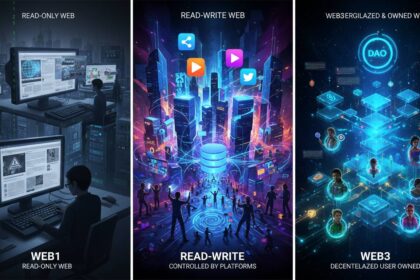
Web1 (1990-2005) was the read-only internet. Early websites were static pages with minimal interactivity. Users consumed content created primarily by organizations and a small number of content creators. The major limitation of Web1 was that ordinary users could not easily create and publish content. Platforms like AOL and early Yahoo dominated this era, offering curated portals to internet content.
Web2 (2005-present) introduced the read-write internet. Social media platforms, blogging sites, and user-generated content platforms transformed the internet into an interactive experience. Facebook, YouTube, Twitter, and countless other platforms enabled anyone to create and share content globally. However, this came at a significant cost: users became the product. These platforms captured vast amounts of personal data and monetized it through advertising, creating surveillance capitalism.
Web2 created unprecedented convenience but also massive data breaches, algorithmic manipulation, and unprecedented concentration of power among a handful of technology giants. These companies control not just our data but increasingly our ability to communicate, organize, and conduct business online.
Web3 aims to be the read-write-own internet. It preserves the interactive capabilities of Web2 while adding true ownership rights. In Web3, users can own their data, monetize their content directly, and participate in governance decisions without needing permission from corporate gatekeepers.
Key Technologies Powering Web3
Web3 isn't a single technology but rather an ecosystem of complementary technologies that work together to create a decentralized internet. Understanding these technologies helps clarify how Web3 operates.
Blockchain Networks
Blockchain serves as the foundational infrastructure for Web3. Public blockchains like Ethereum, Solana, and Polygon provide the decentralized ledgers where transactions are recorded and verified. Ethereum remains the dominant platform, hosting the majority of decentralized applications and holding the largest developer community.
These blockchains operate through consensus mechanisms—ways for distributed nodes to agree on the state of the network. Proof-of-work, used by Bitcoin, requires significant energy consumption. Proof-of-stake, now used by Ethereum and others, requires validators to lock up cryptocurrency as collateral, dramatically reducing energy consumption while maintaining security.
Smart Contracts
Smart contracts are self-executing programs stored on the blockchain that automatically enforce agreements between parties. When predetermined conditions are met, the contract executes without requiring intermediaries. This technology enables trustless transactions—parties can interact without trusting each other because the code guarantees execution.
For example, a smart contract could automatically release payment to a freelancer once their client approves completed work, eliminating disputes over payment. Or a rental agreement could automatically release a security deposit back to a tenant once they vacate the property and the landlord confirms no damage.
Decentralized Applications (dApps)
dApps are applications built on blockchain networks rather than traditional servers. Unlike conventional apps where a single company controls the software and data, dApps connect users directly to the blockchain, removing the middleman.
Popular dApps span numerous categories: decentralized finance (DeFi) platforms like Uniswap for trading cryptocurrency without banks; NFT marketplaces like OpenSea for buying and selling digital collectibles; gaming platforms like Axie Infinity where players truly own their in-game assets; and social platforms like Lens Protocol where users own their social graph.
Tokens and Cryptocurrencies
Tokens serve multiple functions in Web3 ecosystems. Utility tokens provide access to services or governance rights. Governance tokens give holders voting power in decentralized organizations. Non-fungible tokens (NFTs) represent unique digital ownership of assets ranging from art to virtual real estate.
This token-based economy enables new business models impossible in Web2. Creators can launch tokens that give supporters ownership in their work. Communities can fund development through token sales while maintaining governance control. Users can earn tokens through contributions rather than working for a single employer.
Benefits and Advantages of Web3
The shift to Web3 offers several significant advantages over the current internet model, addressing many problems that have emerged in the Web2 era.
True Data Ownership
Perhaps the most fundamental benefit is user ownership of data. In Web3, you control your identity through cryptographic keys rather than usernames and passwords managed by companies. Your data exists in your personal wallet rather than on corporate servers that can be hacked, sold, or used without your consent.
This ownership extends to digital assets. When you purchase an NFT, the blockchain definitively records your ownership in a way that cannot be contested or reversed without your keys. Unlike buying digital goods in traditional platforms where you merely receive a license that can be revoked, Web3 ownership is truly yours.
Financial Inclusion
Web3 opens financial services to anyone with an internet connection, regardless of geographic location or banking status. DeFi protocols allow users to lend, borrow, trade, and earn interest on assets without requiring traditional financial institutions. This accessibility particularly benefits the approximately 1.4 billion adults globally who lack access to traditional banking.
The permissionless nature of blockchain means anyone can build financial products or participate in the economy. You don't need approval from a bank to receive a payment or qualify for a loan based on collateral rather than credit history.
Censorship Resistance
Because Web3 operates across distributed networks without central control, it provides strong resistance to censorship. When content exists on a decentralized network, no single entity can remove it. This protection matters for activists, journalists, and anyone living under regimes that restrict free expression.
During periods of political unrest, when traditional social media platforms sometimes suspend accounts or limit content, decentralized platforms continue operating. This resilience represents a fundamental shift in who controls the public square.
Transparent and Trustless Transactions
Every transaction on a public blockchain is visible and verifiable. This transparency reduces fraud and corruption in systems where intermediaries previously operated with limited oversight. Smart contracts execute exactly as programmed, eliminating the need to trust that counterparties will honor agreements.
The trustless nature of Web3—meaning you don't need to trust the other party—enables interactions between strangers who would never transact in the traditional world. You can trade with anyone globally without worrying about their reputation or the reliability of intermediaries.
Challenges and Criticisms Facing Web3
Despite its promise, Web3 faces significant technical, social, and regulatory challenges that could shape its development and adoption.
Scalability and Environmental Concerns
Early blockchain networks, particularly those using proof-of-work consensus, face serious scalability limitations. Transaction speeds often cannot match traditional payment processors. Ethereum processes approximately 15-30 transactions per second compared to Visa's thousands. While layer-2 solutions and network upgrades are addressing these limitations, they represent ongoing technical challenges.
Energy consumption remains contentious, though the shift to proof-of-stake has dramatically reduced Ethereum's energy usage by approximately 99.95%. Still, critics question whether blockchain technology's environmental impact can be justified, particularly for applications that could function through less energy-intensive means.
User Experience Barriers
The current Web3 experience presents significant barriers to mainstream adoption. Managing cryptographic keys, understanding gas fees, navigating complex wallet setups, and protecting against scams require technical knowledge that average users lack. If Web3 requires a computer science degree to use safely, it will remain a niche technology.
Phishing attacks, rug pulls (where developers abandon projects after collecting investment), and hacks have cost users billions of dollars. The lack of consumer protections familiar from traditional finance—chargebacks, fraud protection, insurance—means users must exercise extreme caution.
Regulatory Uncertainty
Governments worldwide are still determining how to regulate Web3 technologies. Questions around securities law, taxation, consumer protection, and money transmission create significant uncertainty for developers and businesses. Sudden regulatory actions can devastate token prices and force projects to restrict access to certain markets.
The decentralized nature of Web3 also poses challenges for enforcement. When no central entity exists, regulators struggle to determine who is responsible for compliance. This tension between decentralization and accountability remains largely unresolved.
Centralization Concerns
Despite Web3's decentralization ethos, significant centralization has emerged. A small number of large entities control substantial portions of network resources. The top ten Ethereum wallet addresses hold significant portions of total tokens. Several companies dominate infrastructure provision, creating potential single points of failure that contradict Web3's foundational principles.
The Current State of Web3 Adoption
Adoption metrics reveal Web3's current position in its development trajectory. The global blockchain market, which underlies Web3, continues expanding across enterprise and consumer applications.
DeFi protocols now hold over $50 billion in total value locked, though this figure has fluctuated significantly with market conditions. Major financial institutions including Visa, Mastercard, and numerous banks have begun exploring blockchain technology and cryptocurrency integration.
Major technology companies have launched Web3 initiatives. Meta (formerly Facebook) has invested in digital collectibles and blockchain integration. Google offers blockchain node infrastructure. Microsoft has invested in blockchain startups and integrated Web3 tools into its cloud services.
Traditional brands have also entered the space through NFT releases and metaverse investments, though many have retreated as initial enthusiasm faded. This pattern of experimentation followed by recalibration characterizes Web3's current adolescence.
The Future of Web3: Trends and Predictions
Several trends will likely shape Web3's evolution over the coming years, though unpredictable developments could alter this trajectory.
Interoperability—the ability for different blockchain networks to communicate and share information—will likely improve dramatically. Currently, users often must operate across isolated networks. Cross-chain bridges and interoperability protocols are making it easier to move assets and data between blockchains.
Privacy enhancements will address one of Web3's significant limitations. While blockchain transactions are transparent, users increasingly want selective disclosure—proving something about themselves without revealing unnecessary information. Zero-knowledge proofs and other privacy technologies are advancing rapidly.
Mainstream integration will likely accelerate as infrastructure improves and user experience becomes more accessible. The distinction between "Web3" and "traditional" internet may blur as decentralized features become standard components of online services rather than separate ecosystems.
Identity systems will mature significantly. Self-sovereign identity—where users control their own identity credentials rather than relying on centralized identity providers—could fundamentally change how we prove who we are online, reducing the password fatigue and data breaches that plague current systems.
How to Participate in Web3
For those interested in exploring Web3, several steps can help navigate this emerging space safely.
Education comes first. Before investing money or sharing personal information, understand fundamental concepts: how wallets work, what gas fees are, how to identify scams. Numerous free educational resources exist, from documentation on official project websites to community-created guides.
Start with small amounts. If you decide to explore DeFi or purchase cryptocurrency, begin with money you can afford to lose entirely. The space remains highly volatile and risky.
Use reputable platforms. Stick to well-established exchanges and wallets with proven security track records. New projects offering extraordinary returns often turn out to be scams.
Protect your keys. Your private keys control your assets. Never share them. Store them securely. If you lose them, your assets are irretrievable.
Stay skeptical. The space attracts hype and fraud. Question extraordinary claims. Research projects independently. Remember that past performance guarantees nothing about future results.
Conclusion
Web3 represents a fundamental reimagining of how the internet operates, moving from centralized platforms controlled by corporations toward decentralized networks owned by users. The potential benefits—true data ownership, financial inclusion, censorship resistance, and transparent transactions—address many problems that have emerged in the Web2 era.
However, Web3 remains early in its development. Significant challenges around scalability, user experience, regulation, and centralization need resolution before mainstream adoption becomes likely. The path forward will involve technological advancement, regulatory clarification, and continued experimentation.
Whether Web3 fulfills its transformative promise or remains a niche technology used primarily by crypto enthusiasts depends on solving these challenges. What seems certain is that the underlying principles—decentralization, user ownership, and trustless interaction—will influence internet development for years to come, regardless of how the Web3 label evolves.
Frequently Asked Questions
What is the main difference between Web2 and Web3?
The fundamental difference lies in who controls the internet. In Web2, large technology companies control user data, content distribution, and the rules of interaction. In Web3, users own their data and digital assets through cryptographic keys, with no central intermediary controlling their participation.
Is Web3 the same as cryptocurrency?
No, though cryptocurrency is a component of Web3. Cryptocurrency enables the token-based economy and financial transactions within Web3 ecosystems. However, Web3 encompasses broader concepts including decentralized governance, self-sovereign identity, and trustless applications beyond just currency.
Can Web3 work without blockchain technology?
Most Web3 implementations use blockchain, but some alternatives like Directed Acyclic Graphs (DAGs) and other distributed ledger technologies attempt to achieve similar decentralization goals. Blockchain remains the dominant and most proven infrastructure for Web3 applications.
Is Web3 safe to use?
Web3 carries significant risks including volatility, scams, and lack of consumer protections. While the technology itself is innovative, the ecosystem has attracted considerable fraud. Users should educate themselves thoroughly, start with small amounts, and only use reputable platforms.
When will Web3 become mainstream?
Predicting exact timing is impossible, but significant adoption will likely require several years. Mainstream adoption depends on solving current usability challenges, establishing regulatory clarity, and building infrastructure that feels as simple as current internet applications.
Do I need technical knowledge to use Web3?
Currently, yes. Using Web3 safely requires understanding wallets, private keys, gas fees, and blockchain fundamentals. As the ecosystem matures, user experience improvements may make Web3 more accessible to non-technical users, similar to how smartphones made the internet accessible to everyone.