


The internet is undergoing its biggest transformation since the launch of social media. If you've heard the term "Web3" floating around but felt lost in a sea of technical jargon, you're not alone. Search interest in "what is Web3" has exploded over 1,000% since 2020, yet most explanations leave beginners more confused than when they started. This guide cuts through the noise and explains Web3 in plain English—no blockchain expertise required.
Key Insights
- Web3 represents a fundamental shift from platform-controlled internet to user-owned digital infrastructure
- The global Web3 market is projected to reach $81.5 billion by 2030
- Major tech companies including Meta, Google, and Microsoft have invested over $10 billion in Web3-related initiatives since 2022
- Understanding Web3 basics now could position you ahead of the curve as these technologies mature
What Exactly Is Web3?
In the simplest terms, Web3 refers to the next generation of the internet where users own their own data, digital assets, and online identities—rather than giving that control to giant tech companies.
Think of it this way: Web1 was like reading a digital newspaper (read-only). Web2 transformed the internet into a two-way street where you could create and share content—but platforms like Facebook, Google, and YouTube owned your posts, your followers, and the money you made. Web3 flips this model. It uses blockchain technology to create an internet where you own what you create, earn what you generate, and control your digital identity without middlemen taking a cut.
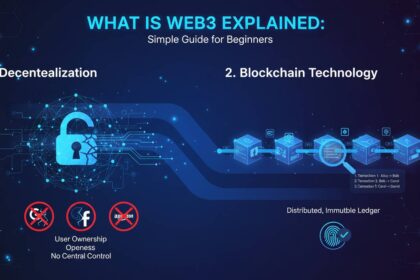
The core philosophy centers on three principles: decentralization (no single company controls the network), ownership (you own your assets and data), and transparency (the code that runs applications is open for anyone to inspect and verify).
This represents a fundamental restructuring of how the internet works at its foundation—not just a new layer on top of what already exists, but a new infrastructure entirely.
The Evolution: Web1 vs Web2 vs Web3
To understand where Web3 is heading, you need to understand where the internet has been.
Web1 (1989-2005) was the era of static websites. Remember those basic HTML pages with blue underlined links? Users could read information but had limited ability to interact or create content. Companies like AOL and early Yahoo dominated this space. The internet was primarily a digital library—an improvement over physical encyclopedias but still fundamentally one-directional.
Web2 (2005-present) brought interactivity and the social web. Suddenly, anyone could create content, start a business, and reach global audiences. Facebook, YouTube, Twitter, and Amazon transformed how we communicate, shop, and entertain ourselves. But there's a catch: to participate, you had to surrender control. These platforms owned your data, controlled what you could and couldn't do, and monetized your participation without sharing the profits. If Facebook decided to delete your page, your entire business disappeared overnight.
Web3 (2020-future) aims to solve these problems using blockchain technology. Instead of one company controlling a platform, Web3 applications run on decentralized networks—thousands of computers around the world that work together. No single company can delete your account, change the rules unexpectedly, or take a cut of everything you earn. The technology is still maturing, but the fundamental promise is compelling: an internet that works for users rather than platforms.
How Web3 Works: The Key Technologies Explained
Understanding Web3 requires grasping a few core technologies that make it possible. While the technical details can get complex, the basic concepts are accessible.
Blockchain Technology
A blockchain is essentially a digital ledger—a shared database that thousands of computers maintain simultaneously. When someone makes a transaction (like sending cryptocurrency or buying a digital artwork), it's recorded across this entire network. Because the information exists on so many computers simultaneously, it's nearly impossible to hack or alter retroactively.
This eliminates the need for trusted intermediaries like banks, notaries, or platform administrators. Instead of trusting one company to be honest, you trust mathematical code and the collective verification of a decentralized network.
Cryptocurrencies and Tokens
Cryptocurrencies serve as the native currencies of Web3 ecosystems. Bitcoin, Ethereum, and thousands of other digital currencies enable peer-to-peer transactions without banks taking fees or delays.
Beyond simple currencies, Web3 introduces tokens—digital assets that can represent anything from membership credentials to ownership shares in a game. These tokens can be bought, sold, and traded just like stocks or art, but they operate on open networks rather than through Wall Street.
Smart Contracts
Smart contracts are self-executing programs that automatically enforce agreements when conditions are met. Traditional contracts require lawyers and courts to enforce them. Smart contracts enforce themselves through code.
For example, imagine a rental agreement where your deposit automatically refunds to your account after you move out and the landlord confirms the property is undamaged—no property manager required. This removes the need to trust that the other party will hold up their end of the bargain.
Decentralized Applications (dApps)
Just as YouTube is a "web application" built on Web2 infrastructure, dApps are applications built on Web3 infrastructure. They're called "decentralized" because they run on blockchain networks rather than company servers.
Popular dApps include OpenSea (a marketplace for digital art), Uniswap (a cryptocurrency exchange), and StepN (a fitness app where you earn cryptocurrency by walking or running). These applications look and feel like regular apps but operate on fundamentally different infrastructure.
Key Benefits and Advantages of Web3
The promise of Web3 extends beyond technical novelty. It offers tangible benefits that could reshape how we interact online.
True Digital Ownership
When you buy a song on iTunes, you don't actually own it—Apple can remove it from your library whenever they want, and it can disappear if the service shuts down. When you buy a cryptocurrency or a digital artwork (an NFT), the ownership record exists on a blockchain. This ownership can't be revoked by any company, doesn't require permission to transfer, and persists regardless of what happens to any individual platform.
This represents a paradigm shift in digital property rights. For the first time, you can truly own digital assets in the same way you own physical ones.
Financial Inclusion
Traditional banking requires extensive documentation, credit history, and physical presence. Web3 financial services work anywhere there's an internet connection. According to the World Bank, approximately 1.4 billion adults globally lack access to traditional banking, but could potentially access Web3 financial services through just a smartphone.
Unbanked populations in developing nations could theoretically access lending, savings, and payment systems without needing a traditional bank account. This democratization of finance represents one of Web3's most transformative potentials.
Transparent and Trustless Transactions
In Web2, you trust companies to handle your data honestly and protect it from breaches. In Web3, trust is embedded in code. Because blockchain transactions are public and verifiable, anyone can confirm that agreements are being honored without needing to trust a central authority.
This eliminates many sources of fraud and corruption while reducing costs associated with verification, compliance, and dispute resolution.
Creator Economy 2.0
Content creators currently surrender significant earnings to platforms. YouTube takes 45% of advertising revenue. Twitch takes 50% of subscriptions. NFT marketplaces like OpenSea take 2.5% of each sale—significantly less than traditional platforms. More importantly, creators maintain ownership of their work and can sell it across platforms without permission.
Emerging models like "play-to-earn" games also allow gamers to earn real value from time invested in gaming—an estimated $3 billion flowed to gamers through blockchain games in 2022 alone.
Common Misconceptions About Web3
Despite growing attention, Web3 remains widely misunderstood. Let's address some of the most persistent myths.
"Web3 is just about cryptocurrency" — While cryptocurrency enables Web3's economic layer, the vision extends far beyond money. Identity systems, voting mechanisms, governance structures, and social networks can all operate on decentralized principles without necessarily involving currency.
"Web3 will replace the regular internet" — This isn't an either/or situation. Web3 technologies will likely integrate into existing internet services rather than replacing everything. Expect gradual adoption across industries rather than a dramatic overnight switch.
"Everything on blockchain is permanent and can't be deleted" — This is partially true for transaction records, but application-layer content can be designed with various deletion capabilities. Privacy-focused blockchains are actively developing solutions that balance transparency with data protection.
"Web3 is only for criminals and speculators" — Early cryptocurrency adoption certainly attracted speculative activity, but major institutions have since entered the space. PayPal allows cryptocurrency transactions. Starbucks offers NFT-based loyalty programs. Fidelity offers cryptocurrency retirement accounts. The demographic is expanding rapidly beyond early adopters.
Practical Applications and Real-World Use Cases
Beyond theoretical benefits, Web3 technologies are already solving real problems across industries.
Finance (DeFi)
Decentralized finance (DeFi) applications offer banking services without traditional banks. You can lend your cryptocurrency and earn interest, borrow against your assets without credit checks, or trade currencies without going through exchanges. Total value locked in DeFi protocols reached $160 billion at its peak, demonstrating substantial real-world adoption.
Gaming and Virtual Worlds
Play-to-earn games like Axie Infinity and STEPN allow players to earn cryptocurrency through gameplay. Virtual real estate in platforms like The Sandbox and Decentraland has sold for millions of dollars. While the gaming market has seen significant volatility, major publishers including Sega, Square Enix, and Ubisoft have announced Web3 initiatives.
Digital Identity
Your digital identity currently fragments across dozens of platforms, each with separate passwords and profiles. Web3 solutions like Ethereum Name Service (ENS) allow you to maintain a single, portable identity that works across all applications. This could eliminate the need to create new accounts for every service while giving you control over what information you share.
Supply Chain and Verification
Walmart uses blockchain to track food origins, reducing the time to trace contaminated products from 7 days to 2.2 seconds. Luxury brands including LVMH and Prada have implemented blockchain verification to combat counterfeit goods. These practical applications demonstrate Web3's value beyond cryptocurrency speculation.
Governance and Voting
Several organizations, including the Ethereum Foundation and various DAOs (Decentralized Autonomous Organizations), use blockchain-based voting systems that are transparent, verifiable, and resistant to manipulation. This could eventually extend to governmental elections, though significant implementation challenges remain.
Getting Started with Web3: A Beginner's Roadmap
If you're curious about participating in Web3, here's how to begin safely.
Start with education before investing money. Understand the fundamental concepts: how wallets work, what gas fees are, and why blockchain matters. Resources like Ethereum.org and CoinDesk's educational section offer free, reputable information.
Set up a wallet to interact with Web3 applications. MetaMask is the most popular browser and mobile wallet, with over 30 million monthly active users. This serves as your digital identity and bank account in the Web3 space.
Start small with minimal financial commitment. Many dApps offer free tiers or test networks where you can experiment without real money. Only invest what you can afford to lose—cryptocurrency prices remain highly volatile.
Be skeptical of opportunities that seem too good to be true. The space has its share of scams, Ponzi schemes, and poorly designed projects. Research thoroughly, verify claims independently, and never share your seed phrase (the password to your wallet) with anyone.
Stay updated through reputable sources. The space evolves rapidly, and today's best practices may change. Follow established outlets, join communities of learners, and approach new opportunities with appropriate caution.
The Challenges and Criticisms of Web3
Transparency requires acknowledging that Web3 faces significant hurdles before reaching mainstream adoption.
Scalability remains a major technical challenge. Popular blockchains like Ethereum can process only 15-30 transactions per second, compared to Visa's 24,000. While solutions like "Layer 2" networks are developing, current infrastructure struggles with mass adoption.
Energy consumption, particularly for proof-of-work blockchains like Bitcoin, has drawn environmental criticism. Ethereum completed a major upgrade ("The Merge") in September 2022 that reduced its energy consumption by approximately 99.95%, but broader environmental concerns persist.
Regulatory uncertainty creates risk for participants. Governments worldwide are still deciding how to tax, regulate, and restrict cryptocurrency and Web3 applications. Sudden regulatory changes could significantly impact the space.
User experience remains challenging. While Web3 has become more accessible, using dApps still requires more technical knowledge than traditional web applications. The "simple" experience that drives mass adoption hasn't fully arrived yet.
Frequently Asked Questions
Is Web3 the same as cryptocurrency?
No—cryptocurrency is just one component of Web3. Web3 is a broader vision for a decentralized internet that includes digital ownership, self-sovereign identity, and decentralized applications. Cryptocurrency serves as the economic layer that enables transactions and incentives within this ecosystem, but Web3 encompasses far more than money.
How is Web3 different from Web2?
The fundamental difference is ownership and control. In Web2, platforms own user data and can modify or delete content at will. In Web3, users own their data and digital assets through blockchain technology, and applications run on decentralized networks rather than company servers. This shifts power from platforms to users, though the technology is still maturing.
Do I need technical skills to use Web3?
Not necessarily, but some basic understanding helps. Using a cryptocurrency wallet and buying digital assets is increasingly user-friendly, with major platforms simplifying the experience. However, understanding best practices for security (protecting your seed phrase, avoiding scams) requires some learning. The user experience continues improving, making Web3 more accessible to non-technical users.
Is Web3 safe to invest in?
Web3 investments carry significant risk, including volatility, scams, and regulatory changes. Only invest money you can afford to lose entirely. Research thoroughly, start with small amounts, and consider consulting financial advisors. The technology shows long-term promise, but short-term speculation has led many investors to substantial losses.
Will Web3 replace the internet as we know it?
Most experts expect Web3 to integrate with existing internet infrastructure rather than replace it entirely. We'll likely see gradual adoption where specific applications and services adopt decentralized features while the broader internet continues functioning. Major technology companies are already incorporating Web3 elements into their existing platforms.
What are the main benefits of Web3 for everyday users?
For everyday users, Web3 offers true digital ownership (you control your assets, not platforms), potential financial inclusion (access to financial services without traditional banking requirements), creator-friendly economics (keep more of what you earn), and improved privacy (share only what you choose to share). However, these benefits depend on the technology maturing and achieving mainstream adoption.
Conclusion
Web3 represents a fundamental rethinking of how the internet operates—from infrastructure to economics to governance. The core promise is compelling: an internet where users own their data, control their digital identities, and keep more of the value they create.
We're still early in this transformation. The challenges are real—scalability issues, regulatory uncertainty, usability gaps, and environmental concerns all require solutions. Major technology companies are investing billions, institutions are entering the space, and practical applications are already demonstrating value beyond speculation.
Whether Web3 fulfills its transformative potential or becomes another overhyped technology cycle remains to be seen. What seems clear is that the basic concepts—decentralization, ownership, and user control—are influencing how technology companies think about internet infrastructure. Understanding these fundamentals positions you to evaluate developments as they unfold, regardless of where the technology ultimately lands.
The internet has always evolved. From static pages to social platforms to whatever comes next, each era brings new possibilities and new challenges. Web3 is simply the latest chapter in that ongoing story—and understanding it starts with grasping these foundational concepts.