

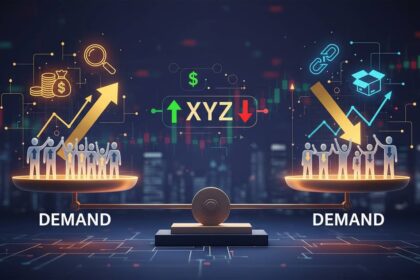

Stock prices change because of the fundamental economic principle of supply and demand. When more investors want to buy a particular stock than sell it, the price rises. Conversely, when more investors want to sell than buy, the price falls. This constant tug-of-war between buyers and sellers plays out every trading day, creating the price movements that define the stock market.
Understanding why stock prices fluctuate is essential for any investor. Whether you're building a retirement portfolio or trading actively, knowing the forces that move prices helps you make more informed decisions and avoid costly mistakes driven by emotion or misunderstanding.
The Core Mechanism: Supply and Demand in Action
At its most basic level, a stock represents ownership in a company. When you buy shares, you become a partial owner entitled to a portion of the company's profits and assets. The price you pay for those shares reflects what other market participants believe that ownership is worth at any given moment.
Key Insights
- Over 15 billion shares trade daily on U.S. exchanges
- The average stock experiences price changes every 14 milliseconds
- Individual investors account for roughly 20% of equity trading volume, down from 48% in 2001
- The bid-ask spread averages 0.1% for large-cap stocks but can exceed 1% for illiquid small-caps
The stock market operates as a continuous auction. Every transaction involves a buyer who believes the price will rise and a seller who believes otherwise or needs liquidity. This disagreement is what creates movement. Even when a company's fundamentals remain unchanged, prices can shift based on changes in investor sentiment, portfolio rebalancing requirements, or shifts in the broader market.
Consider this: Apple Inc. might release excellent quarterly earnings, yet its stock price could still decline if investors were expecting even better results or if broader market conditions turn negative. The relationship between stock prices and company performance isn't always straightforward, which is why understanding the multiple factors at play matters.
Company-Specific Factors Driving Price Changes
Individual companies influence their stock prices through earnings performance, corporate announcements, and operational developments. These factors directly affect what investors believe the company is worth.
Earnings and Financial Performance
Quarterly earnings reports represent the most significant catalyst for individual stock movements. When a company reports results that exceed analyst expectations, the stock typically rises. When results fall short, the stock usually declines.
| Earnings Outcome | Typical Price Impact | Historical Context |
|---|---|---|
| Beat expectations by >10% | +3-7% average | Tech stocks often see larger moves |
| Meet expectations | +0-2% (if not priced in) | Often sees modest gains |
| Miss expectations | -3-10% average | Misses can trigger extended selloffs |
| Significant guidance cut | -10-25% possible | Particularly damaging for growth stocks |
A company's revenue growth rate, profit margins, and cash flow generation all factor into how investors value the business. Amazon's stock surged over 1,000% between 2010 and 2020 as investors rewarded its consistent revenue growth and expanding profit margins, even when the company prioritized reinvestment over near-term profitability.
Corporate Actions and Announcements
Major corporate announcements create significant price volatility:
- Mergers and acquisitions: Target company stocks typically jump 20-40% when acquisition offers arrive, while acquirer stocks often decline slightly due to premium paid
- Product launches: Successful product releases can drive substantial gains—Tesla's Cybertruck launch generated significant volatility
- Management changes: New leadership can inspire confidence or concern depending on track record
- Legal developments: Regulatory fines or favorable court rulings dramatically affect certain sectors
- Dividend changes: Both increases and decreases can move stock prices as investors reassess the company's financial health and priorities
Industry and Competitive Dynamics
Companies don't operate in isolation. When competitors release innovative products, it pressures established players. When industry-wide trends shift—toward renewable energy, for example—companies positioned poorly face headwinds while those positioned well benefit.
Netflix's competition with Disney+ and other streaming services illustrates this dynamic. As the competitive landscape intensified, Netflix's subscriber growth rates slowed, and its stock price reflected changing expectations about long-term market dominance.
Market-Wide Factors Affecting All Stocks
Beyond company-specific news, broader economic and market factors influence how all stocks move. These forces affect investor risk appetite and determine the general environment in which stocks trade.
Interest Rates and Federal Reserve Policy
The Federal Reserve's monetary policy profoundly impacts stock valuations. When the Fed raises interest rates, bonds become more attractive relative to stocks because higher rates mean higher fixed income returns. This competitive dynamic typically pressures stock prices, particularly for growth companies whose valuations rely heavily on future earnings.
| Interest Rate Environment | Historical S&P 500 Performance | Key Dynamics |
|---|---|---|
| Rate cutting cycle (2008-2020) | Significant bull markets | Lower rates = higher valuations |
| Rate hiking cycle (2022) | -19% in 2022 | P/E contractions |
| Neutral/stable rates | Average annual returns ~10% | Fundamentals drive returns |
The Fed's quantitative easing programs following the 2008 financial crisis and 2020 pandemic artificially suppressed interest rates and contributed to sustained bull markets. When the Fed began aggressive rate hikes in 2022 to combat inflation, stock valuations contracted significantly.
Economic Indicators and Macroeconomic Conditions
The overall health of the economy determines corporate earnings growth potential. Key indicators include:
- GDP growth: Strong economic expansion typically lifts corporate profits and stock prices
- Unemployment rates: Low unemployment signals economic strength but can also signal overheating
- Inflation: Moderate inflation is generally positive for stocks, but high inflation triggers rate hikes and uncertainty
- Consumer confidence: When consumers feel confident, they spend, benefiting retail and consumer discretionary companies
The 2008 financial crisis demonstrates how economic collapse devastates stock markets. The S&P 500 fell 57% from peak to trough, and even quality companies saw their stock prices plummet as investors fled to safety.
Geopolitical Events
Wars, political instability, trade disputes, and international crises create uncertainty that markets hate. The Russian invasion of Ukraine in 2022 triggered significant market volatility as investors assessed energy supplies, economic sanctions, and broader geopolitical implications. Markets typically respond negatively to unexpected geopolitical events, though the long-term impacts vary significantly.
The Psychology of Markets: Sentiment and Behavior
Perhaps no factor is more influential—or more frequently underestimated—than investor psychology. Markets are ultimately driven by human emotion, which can create both irrational exuberance and unwarranted fear.
Market Sentiment and Momentum
Stock prices often move in trends because of self-reinforcing feedback loops. When prices rise, investors experience gains, feel confident, and buy more—pushing prices higher still. This momentum can continue far beyond what fundamentals would justify, as demonstrated during the dot-com bubble when companies with no profits and minimal revenue achieved market capitalizations in the billions.
Conversely, fear spreads just as quickly. During market crashes, selling begets more selling as investors panic and liquidate positions regardless of underlying value. The 2020 COVID crash saw the S&P 500 plummet 34% in just 33 days before the fastest recovery in market history—but that rapid decline was driven entirely by fear and liquidity needs rather than changed fundamentals.
Behavioral Biases Affecting Prices
Several well-documented cognitive biases systematically influence investor behavior and stock prices:
- Loss aversion: Investors feel losses more acutely than equivalent gains, causing them to sell winners too early and hold losers too long
- Confirmation bias: Investors seek information supporting existing beliefs, creating echo chambers that can inflate bubbles or deepen selloffs
- Anchoring: Investors fixate on specific price points (like purchase price or 52-week highs) rather than assessing absolute value
- Herding behavior: Following the crowd is evolutionarily ingrained but financially dangerous, as evidenced by numerous market manias
Research from Dalbar Associates consistently shows individual investors underperform the broader market, largely due to behavioral timing mistakes—buying after markets rise and selling after declines.
How Trading Mechanisms Influence Price Discovery
Understanding how markets operate internally helps explain why prices move the way they do during the trading day.
Order Flow and Market Microstructure
Modern markets operate through electronic exchanges matching buy and sell orders. The interaction between market orders, limit orders, and various trading strategies creates continuous price discovery.
- Market orders execute immediately at the best available price, guaranteeing execution but not price
- Limit orders specify the maximum price to pay (or minimum to accept), providing price certainty but execution risk
- Stop-loss orders become market orders when prices reach specified levels, potentially accelerating declines
High-frequency trading firms now account for approximately 50% of U.S. equity trading volume. These firms use sophisticated algorithms to identify and exploit tiny price discrepancies, contributing to market efficiency but also creating flash crashes when algorithms react to erroneous data.
The Role of Market Makers
Market makers—typically large financial institutions—provide liquidity by always being willing to buy and sell particular stocks. They profit from the bid-ask spread, the difference between the price they pay for shares and the price they sell them for.
For highly traded stocks like Apple or Microsoft, the bid-ask spread might be just a penny. For thinly traded small-cap stocks, spreads can be several percentage points, making it expensive to trade and creating more volatile price movements.
After-Hours Trading and Premarket Sessions
Significant news often breaks outside regular market hours (9:30 AM - 4:00 PM ET). Extended trading sessions allow investors to react to earnings reports, economic data, and other announcements before the official market opens.
These sessions typically have lower volume and wider spreads, meaning prices can move dramatically based on relatively few trades. A company's after-hours movement often predicts the next day's trading direction, though gaps can reverse once regular trading begins.
Institutional Investors and Their Impact
While individual investors make up a significant portion of the market, institutional investors—pension funds, mutual funds, hedge funds, and sovereign wealth funds—control far more capital and therefore have outsized influence on stock prices.
Portfolio Rebalancing and Index Investing
The rise of index investing has created predictable flows that affect stock prices. When money flows into index funds tracking the S&P 500, those funds must buy shares in proportion to index weights. This creates automatic demand for the largest companies, as they receive the most significant buying pressure from inflows.
Similarly, quarterly portfolio rebalancing by institutional investors creates predictable selling in outperforming assets and buying in underperformers. This mechanical rebalancing contributes to the "reversion to the mean" patterns researchers consistently observe.
Active Management and Information Advantage
Hedge funds and active mutual fund managers conduct extensive research to identify mispriced stocks. When they identify what they believe is undervaluation, they buy heavily—potentially moving prices significantly given the size of their positions. Their collective trading represents substantial order flow that affects prices throughout the trading day.
What This Means for Your Investment Strategy
Understanding why stock prices change empowers you to be a better investor. Here are the practical implications:
Focus on time horizon. Short-term price movements reflect sentiment and noise. Long-term movements reflect business fundamentals. Understanding which timeframe you're operating in prevents inappropriate reactions to normal market volatility.
Diversify across factors. Since individual stocks move based on company-specific, sector-specific, and market-wide factors, diversification reduces the impact of any single factor on your portfolio.
Separate signal from noise. Not every price movement has fundamental meaning. Markets exhibit random short-term movements that revert quickly. Developing the discipline to ignore noise while responding to meaningful information is crucial for long-term success.
Understand your edge. If you're competing against institutional investors with superior research capabilities, attempting to outtrade them on short-term movements is likely futile. Long-term investing or factor-based strategies offer more accessible edges.
Frequently Asked Questions
Why do stock prices change every second?
Stock prices change continuously because markets operate as ongoing auctions with participants constantly placing new orders. Every new buy or sell order potentially changes the equilibrium price. High-frequency trading algorithms and continuous order flow mean prices update within milliseconds of new information or changed sentiment.
Do stock prices reflect company value?
In the long run, stock prices generally reflect company value because mispriced stocks attract arbitrageurs who correct the discrepancy. However, in the short run, prices frequently deviate from fundamental value due to sentiment, momentum, and information delays. Research suggests price discovery occurs over months to years, not days.
Why do stocks sometimes jump or drop unexpectedly?
Unexpected movements typically result from news that changes investor expectations about future cash flows or risk. This includes earnings surprises, macroeconomic data releases, Federal Reserve announcements, geopolitical events, or surprising corporate developments. Sometimes unexpected moves result from technical factors like margin calls or forced selling rather than fundamental news.
Can stock prices go to zero?
Yes, stock prices can fall to zero if a company goes bankrupt and its equity becomes worthless. Shareholders typically receive nothing after bondholders and other creditors are paid. This is why understanding individual company risk matters, though diversified index investing largely eliminates single-company bankruptcy risk.
Why do stocks go up more than down over time?
Historically, stocks trend upward because the economy grows over time, corporate earnings generally increase, and inflation erodes the value of currency. Companies that successfully reinvest profits at high rates of return generate compounding growth that benefits shareholders. While drawdowns occur regularly, the long-term upward bias reflects genuine wealth creation by productive companies.
How much do emotions affect stock prices?
Emotions significantly affect stock prices, creating both bubbles and crashes that deviate substantially from fundamentals. Behavioral finance research demonstrates that investor sentiment explains a meaningful portion of short-term price movements. The key insight is that while you cannot eliminate market emotions, understanding them helps you avoid being controlled by them.