

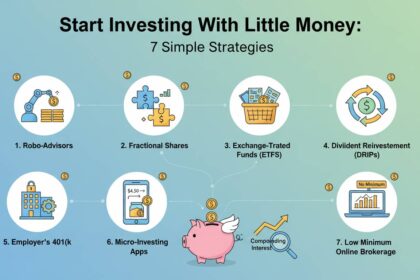

The misconception that you need thousands of dollars to begin investing keeps millions of Americans from building wealth. According to a 2023 Federal Reserve report, nearly 40% of adults in the United States would struggle to cover a $400 emergency, yet the same survey showed that those who start investing—even with small amounts—consistently outperform those who wait. The truth is that you can begin your investment journey with as little as $5, $10, or $50 per month. What matters most is starting.
Key Insights
- The average mutual fund requires minimum initial investments ranging from $500 to $3,000, but fractional shares and micro-investing apps eliminate this barrier entirely.
- Research from Vanguard indicates that investors who contribute consistently—even in small amounts—capture more market volatility through dollar-cost averaging.
- Brokerage accounts with no minimum deposits now represent over 60% of new retail investor accounts opened in the past three years.
This guide walks you through seven proven strategies to start investing with limited funds, the platforms that make it possible, and the pitfalls to avoid. Whether you're saving for retirement, building an emergency fund, or growing wealth for a major purchase, these approaches provide actionable pathways regardless of your current financial situation.
Why Starting Small Works in Your Favor
Before examining specific strategies, understanding why beginning with small amounts actually provides advantages can shift your mindset from hesitation to action. The financial industry has historically marketed investing as something requiring significant capital, but this framing ignores several mathematical and psychological benefits that work in your favor when you start small.
Dollar-cost averaging represents the primary mathematical advantage. When you invest fixed amounts at regular intervals—regardless of whether the market is rising or falling—you automatically buy more shares when prices are low and fewer shares when prices are high. Over time, this smooths out market volatility and often results in better average purchase prices than timing the market. A 2022 analysis by Morningstar found that investors who maintained consistent contribution schedules outperformed lump-sum investors during volatile periods in 7 out of 10 simulated 10-year periods.
The psychological benefits matter equally. Starting with manageable amounts builds financial discipline without creating unsustainable pressure on your monthly budget. You develop the habit of investing—perhaps the most critical skill in wealth building—before committing larger sums. Many affluent investors began their journeys with $25 or $50 monthly contributions that eventually grew into significant portfolios through compound growth.
Additionally, starting small allows you to learn from mistakes without catastrophic consequences. Investment decisions during your first years teach valuable lessons about risk tolerance, asset allocation, and emotional responses to market fluctuations. These experiences prepare you to handle larger portfolios responsibly.
The 7 Simple Strategies for Starting With Little Money
Strategy 1: Use Fractional Shares to Buy Portions of Expensive Stocks
Fractional shares allow you to purchase a percentage of a single share rather than requiring a full share. This innovation fundamentally changed accessibility in the stock market. Companies like Amazon, Alphabet (Google), and Nvidia trade at hundreds or thousands of dollars per share—putting them out of reach for most new investors. Fractional shares remove this barrier.
How it works: If Amazon trades at $180 and you have $18, you can purchase 0.1 (10%) of a share. You own the same percentage of the company as any other shareholder and receive proportional dividends if the company pays them.
Most major brokerages now offer fractional shares, including Fidelity, Charles Schwab, Robinhood, and Webull. The minimum investment often starts at $1 or even $0.01, depending on the platform.
This strategy works particularly well for investors who want to own specific companies they believe in rather than index funds. It democratizes ownership of premium companies while allowing gradual portfolio construction.
Strategy 2: Automate Small Regular Contributions
The most powerful strategy for building wealth over time requires no special financial knowledge—simply setting up automatic contributions. This approach removes decision fatigue, enforces consistency, and leverages dollar-cost averaging without requiring active management.
Implementation: Link your bank account to a brokerage and set up recurring purchases of $10, $25, $50, or whatever amount fits your budget. Schedule these transfers to occur shortly after payday when the money is available.
The key is choosing an amount so small you won't miss it but large enough to accumulate meaningfully over time. Many successful investors started with $20 weekly or $100 monthly contributions that felt negligible initially but grew to represent significant sums within five to ten years.
Most retirement accounts through employers make automation easy via direct deposit percentage allocations. For individual brokerage accounts, nearly every platform offers scheduled recurring investment features.
Strategy 3: Leverage Robo-Advisors for Automated Portfolio Management
Robo-advisors provide algorithm-driven investment management at a fraction of the cost of traditional financial advisors. These platforms create diversified portfolios based on your risk tolerance, time horizon, and financial goals, then automatically rebalance as markets shift.
Leading platforms include:
| Platform | Minimum Investment | Management Fee | Best For |
|---|---|---|---|
| Betterment | $0 | 0.25%-0.35% | Beginners seeking guidance |
| Wealthfront | $1 | 0.25% | Tax-loss harvesting benefits |
| M1 Finance | $100 | 0% | Free automated investing |
| SoFi Invest | $1 | 0% | No-fee automated portfolios |
Robo-advisors eliminate the intimidation factor for new investors. You answer questions about your goals and risk tolerance, and the algorithm handles asset allocation, rebalancing, and tax optimization. The low or zero minimum investments make these accessible to anyone.
For investors starting with $100 or less, robo-advisors provide professional portfolio management that would otherwise require thousands in assets to access through traditional advisors.
Strategy 4: Invest in Low-Cost Index Funds and ETFs
Index funds and exchange-traded funds (ETFs) allow you to own thousands of companies with a single purchase. Rather than picking individual stocks—requiring research, time, and risk concentration—you can own the entire market or broad segments with minimal cost.
Popular index fund options:
- S&P 500 index funds track the 500 largest U.S. companies and have historically returned approximately 10% annually over long periods
- Total market funds include small and mid-cap companies beyond the S&P 500, providing broader diversification
- Target-date funds automatically adjust asset allocation as you approach retirement, becoming more conservative over time
Expense ratios—the annual fee charged by funds—directly impact your returns. A fund charging 0.03% annually will significantly outperform one charging 0.75% over decades due to compound growth. Vanguard, Fidelity, and Schwab all offer index funds with expense ratios below 0.10%, and many ETFs trade with zero commission.
The minimum investment for most index funds has dropped dramatically. Many ETFs can be purchased for the price of a single share plus any fractional share capability, while mutual funds often allow initial investments as low as $1 or $100.
Strategy 5: Take Advantage of Employer Retirement Matches
If your employer offers a 401(k) match, this represents an immediate 100% return on your contribution—before considering any investment returns. Leaving this benefit unclaimed essentially refusing free money.
Understanding 401(k) matches: Employers typically match a percentage of your salary (commonly 3-6%) or match dollar-for-dollar up to a certain percentage. If you earn $50,000 annually and your employer matches 3% of your salary, contributing $1,500 yearly triggers an additional $1,500 from your employer.
Strategy: At minimum, contribute enough to your employer's retirement plan to capture the full match. This provides instant 100% returns that dwarf any investment performance you might achieve on your own.
Many employers now offer Roth 401(k) options, allowing after-tax contributions that grow tax-free. If you expect to be in a higher tax bracket in retirement, Roth options often provide better long-term value.
Note that 401(k) accounts have contribution limits ($23,000 for 2024 if under 50), but you can start with much smaller amounts and increase contributions as your income grows.
Strategy 6: Use Micro-Investment Apps
Micro-investment apps specialize in helping users invest spare change or small recurring amounts. These platforms round up purchases to the nearest dollar and invest the difference, making investing nearly effortless.
Popular micro-investing platforms:
- Acorns rounds up purchases and invests in diversified portfolios starting at $5 monthly
- Stash allows investing in fractional shares of individual companies and ETFs with as little as $1
- Chime offers automatic savings features that transfer rounded amounts to investment accounts
These apps lower psychological barriers by treating investing as effortless. The amounts seem negligible individually—perhaps $3.50 per week—but accumulate to hundreds or thousands annually without conscious savings effort.
While micro-investing apps serve as excellent starting points, most experts recommend transitioning to lower-fee platforms as your portfolio grows. The small percentage fees charged by some micro-investing services become more significant as your balance increases.
Strategy 7: Start with Index Fund Target-Date Funds
Target-date funds provide a complete investment solution in a single purchase. You simply select the fund matching your expected retirement year, and the fund manages asset allocation automatically—shifting from stocks to bonds as you approach retirement.
How they work: A 2050 target-date fund initially invests heavily in stocks (aggressive allocation) because you have decades to recover from market downturns. By 2040, it begins shifting toward bonds (conservative allocation), protecting capital as retirement approaches.
This approach eliminates complex decision-making. You don't need to choose between stocks and bonds, domestic and international, or decide when to rebalance. The fund handles everything based on your expected timeline.
Minimum investments for target-date funds are often $1 or $100 at major brokerages. The automatic rebalancing and diversification make these ideal for investors who want a set-it-and-forget-it approach.
Fidelity, Vanguard, and T. Rowe Price all offer highly-rated target-date funds with low expense ratios (typically 0.10% or less).
Common Mistakes to Avoid When Starting Small
Understanding what not to do proves as important as knowing which strategies to use. Several common errors can derail your investing journey before it gains momentum.
| Mistake | Impact | Solution |
|---|---|---|
| Waiting for "right time" | Missed compound growth | Start immediately with available funds |
| Focusing on short-term losses | Panic selling during downturns | Maintain long-term perspective |
| Ignoring fees | Reduced returns over time | Choose low-cost index funds and ETFs |
| Over-diversifying initially | 分散注意力, confusion | Start simple, expand later |
| Neglecting emergency fund | Forced selling during crises | Build 3-6 months expenses before investing heavily |
The most damaging mistake is waiting. Market timing rarely works consistently, and attempting to "wait for a better entry point" typically results in never starting. The best time to begin investing was years ago; the second-best time is today.
Another frequent error involves paying excessive attention to short-term market movements. News cycles emphasize daily fluctuations, but successful investing requires ignoring this noise. Daily portfolio check-ins correlate with poorer investment decisions, according to research from Caliper, which found that investors who checked portfolios frequently underperformed those who checked less often.
Finally, many new investors underestimate the impact of fees. A 1% annual fee might seem insignificant but reduces your final portfolio value by 20-30% over 30 years compared to a 0.10% fee. Always prioritize low-cost options, especially when starting with limited funds.
Essential Tools and Platforms
Choosing the right platform significantly impacts your ability to start investing with small amounts and keep more of your returns.
For commission-free ETFs and fractional shares:
- Fidelity – No minimums, excellent research, fractional shares available
- Charles Schwab – No minimums, strong customer service, extensive ETF selection
- Robinhood – Fractional shares, intuitive interface, but limited research tools
For automated robo-advisor services:
- Betterment – Goal-based investing, tax optimization, low minimums
- Wealthfront – Sophisticated tax strategies, pathfinder advice tool
- M1 Finance – Free platform with customizable portfolios
For employer retirement accounts:
- Most employer 401(k) platforms now offer low-cost index fund options
- Look for institutional-class shares with expense ratios below 0.20%
The best platform ultimately depends on your specific needs—some prioritize simplicity, others offer research capabilities, and some provide automated management. Most new investors benefit from starting with a major brokerage like Fidelity or Schwab due to their combination of low costs, no minimums, and extensive educational resources.
Frequently Asked Questions
How much money do I actually need to start investing?
You can start investing with as little as $1 or even $0 in many cases. Fractional shares, micro-investing apps, and brokerages with no minimum deposits have eliminated the traditional barriers to entry. Even $10 per month creates meaningful wealth over time through compound growth.
Is investing with small amounts worth it?
Absolutely. The power of compound growth means that even modest amounts grow significantly over decades. Someone investing $50 monthly from age 25 to 65 at 7% average returns will accumulate approximately $175,000—far exceeding the $24,000 they contributed. Starting small beats not starting at all.
What's the safest way to invest little money?
For the safest approach, prioritize diversified index funds or ETFs that track broad market indexes like the S&P 500. These provide instant diversification across hundreds or thousands of companies, reducing risk compared to individual stock selection. Target-date funds add automatic rebalancing for additional safety as you approach your goals.
Should I pay off debt first or start investing?
This depends on the interest rate of your debt. Generally, high-interest debt (credit cards, personal loans) should be prioritized since guaranteed returns from paying off 20%+ interest debt exceed most investment returns. For lower-interest debt (student loans below 5%, mortgages), starting to invest while paying debt incrementally often makes sense.
Can I lose all my money investing small amounts?
All investing carries risk, but diversified index funds minimize the risk of total loss. While individual stocks can go to zero, an index fund containing 500 or 3,000 companies would require all American companies to fail simultaneously—a scenario more catastrophic than any investment loss. Your principal is never guaranteed in investing, but diversification significantly reduces catastrophic loss risk.
How long does it take to see returns from investing?
Investment returns fluctuate daily, but meaningful growth typically requires three to five years minimum. Historical market returns suggest that one-year periods may show losses, five-year periods usually show gains, and ten-year periods almost always show positive returns. Investing requires patience and a long-term perspective.
Building Your Financial Future Begins Now
Starting to invest with limited funds requires less money, less knowledge, and less complexity than ever before. The seven strategies outlined—fractional shares, automated contributions, robo-advisors, low-cost index funds, employer matching, micro-investing apps, and target-date funds—provide multiple entry points regardless of your financial situation or experience level.
The most critical action is simply beginning. Every day you wait represents lost compound growth and diminished financial security. Whether you start with $5 through a micro-investing app or $100 in a 401(k), you develop habits, gain experience, and build momentum toward long-term wealth.
Remember that all successful investors started somewhere, and most began with amounts far smaller than you might imagine. The journey of building wealth spans decades, and every contribution—no matter how small—represents progress toward financial independence and the freedom that accompanies it. Your future self will thank you for starting today rather than waiting for a hypothetical perfect moment that never arrives.