

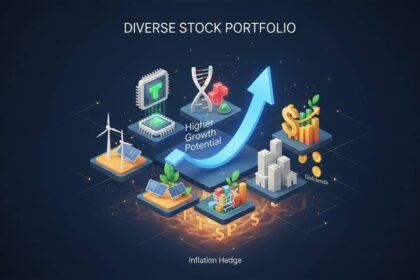

The age-old question of stocks versus bonds has困惑ed investors for generations. While stocks have delivered approximately 10% average annual returns over the past century, bonds have historically provided steadier—though lower—yields with significantly less volatility. The reality is that neither investment is universally "better." Your optimal choice depends entirely on your timeline, risk tolerance, financial goals, and current market conditions.
This comprehensive guide breaks down the stocks vs. bonds debate using historical data, risk metrics, and expert insights to help you make informed decisions aligned with your financial situation.
Understanding Stocks and Bonds: The Fundamental Differences
Stocks represent ownership shares in a company. When you purchase stock, you become a partial owner and gain the right to share in the company's profits through dividends and capital appreciation. Stock prices fluctuate based on company performance, market sentiment, economic conditions, and numerous other factors.
Bonds are debt instruments. When you buy a bond, you're lending money to a government, municipality, or corporation in exchange for regular interest payments (coupon) and the return of principal at maturity. Bonds essentially represent IOUs with defined repayment terms.
| Characteristic | Stocks | Bonds |
|---|---|---|
| Nature | Ownership stake | Debt obligation |
| Income | Dividends (variable) | Fixed interest payments |
| Price Volatility | High | Low to moderate |
| Potential Return | Higher (long-term) | Lower (predictable) |
| Risk | Higher | Lower (generally) |
| Inflation Protection | Moderate to high | Limited |
The key distinction lies in the risk-return tradeoff. Stocks offer higher potential returns but come with greater uncertainty. Bonds provide more predictable income streams with lower risk of capital loss—though they aren't risk-free, as we'll explore later.
Historical Performance: What the Data Shows
Understanding long-term historical returns provides crucial context for the stocks vs. bonds decision.
📊 KEY PERFORMANCE DATA
- S&P 500 Average Annual Return: 10.2% (1928-2023) (Yale Nobel laureate Robert Shiller data)
- 10-Year U.S. Treasury Average Return: 4.8% (1928-2023)
- Bonds (Investment Grade Corporate): 6.2% average annual return (1928-2023)
- Worst Stock Market Year: -43.3% (1931) during the Great Depression
- Worst Bond Year: -8.8% (1994) during rate hike cycles
- Recovery Time from Major Stock Decline: Average 4.2 years (1929-2023)
The historical equity risk premium—the additional return stocks provide over risk-free bonds—averages approximately 5-6% annually. This premium compensates investors for accepting greater short-term volatility.
"Over long periods, stocks have been remarkably successful investments, but this success has come with substantial short-term volatility and the risk of significant losses."
— Burton Malkiel, Professor of Economics at Princeton University and author of "A Random Walk Down Wall Street"
The Vanguard Total Stock Market Index Fund (VTSAX) has returned 10.5% annually since inception in 1992, while the Vanguard Total Bond Market Index Fund (VBTLX) has returned 5.3% annually over the same period—nearly double the difference that separates these two asset classes historically.
Risk and Return: The Core Tradeoff
Understanding risk requires looking beyond simple return comparisons to examine volatility, maximum drawdowns, and the psychological toll of market fluctuations.
Volatility Metrics
| Measure | Stocks (S&P 500) | Bonds (Aggregate) |
|---|---|---|
| Standard Deviation | 15-20% | 4-6% |
| Sharpe Ratio (historical) | 0.4-0.5 | 0.3-0.4 |
| Maximum Drawdown | -50% to -60% | -15% to -20% |
Standard deviation measures how much returns vary from the average. Higher standard deviation means more dramatic swings—meaningful for investors who might need to sell during downturns.
The Inflation Factor
Bonds face a unique challenge: inflation erosion. During the 1970s and early 1980s, when inflation routinely exceeded bond yields, bondholders lost purchasing power despite receiving steady interest payments.
- Real return = Nominal return - Inflation rate
- Inflation (2021-2024): 4.7%, 8.0%, 4.1%, 2.9% (BLS data)
- Current 10-year Treasury yield: ~4.3% (2024)
- Real yield after inflation: Approximately 1-2%
John Bogle, founder of Vanguard and investing legend, emphasized that "the stock market is a giant distraction from the business of investing." His research consistently showed that low-cost index funds outperform most actively managed portfolios over time—a critical insight when considering the stocks vs. bonds decision.
When Stocks Make More Sense
Certain investor profiles and market conditions favor stock allocation.
Ideal Candidates for Stock-Heavy Portfolios
- Long time horizons: 10+ years until goal
- High risk tolerance: Can withstand 30-50% portfolio drops
- Growth goals: Maximizing wealth over income
- Inflation protection needs: Protecting purchasing power
- Regular income from other sources: Salary, pension, rental income
The Growth Argument
Warren Buffett, widely considered the most successful investor of the 20th century, has consistently advised long-term stock investments. His holding company Berkshire Hathaway maintains a predominantly equity-heavy portfolio, and he has instructed executors to invest his estate in index funds after his death.
"Consistently buy an S&P 500 low-cost index fund," Buffett wrote in his 2013 letter to shareholders. "Keep buying it regularly through good times and bad, including through the Great Recession and the various dot-bubble collapses."
Case Study: An investor who placed $10,000 in the S&P 500 in 1980 would have approximately $1.2 million by 2023, despite multiple crashes including the 1987 Black Monday, 2000 dot-com bust, 2008 financial crisis, and 2020 pandemic plunge. The same investment in 10-year Treasury notes would have grown to approximately $175,000—roughly one-seventh the stock market result.
When Bonds Make More Sense
Bonds serve critical portfolio functions that stocks cannot replicate.
Ideal Candidates for Bond-Heavy Portfolios
- Near-term goals: 3-7 years until retirement or major purchase
- Capital preservation: Protecting principal value
- Income needs: Regular, predictable cash flow
- Lower risk tolerance: Discomfort with market volatility
- Diversification: Reducing portfolio correlation
The Income Argument
Bond yields have become increasingly attractive in the post-2022 rate hike environment. The yield on 10-year Treasury notes reached 5%—the highest since 2007—making bonds competitive with stock dividend yields while offering significantly less volatility.
BlackRock data indicates that a 60/40 portfolio (60% stocks, 40% bonds) has historically experienced 25-30% less volatility than an all-stock portfolio, with only marginally lower long-term returns.
- Current aggregate bond yield: 4.8-5.2%
- S&P 500 dividend yield: 1.3-1.5%
- Bond income advantage: ~3-4% higher annual income
The Psychological Benefit
Nobel laureate Daniel Kahneman's research on behavioral finance demonstrates that investors who experience large losses often make irrational decisions—selling at bottoms and missing subsequent recoveries. Bonds reduce this behavioral risk.
"The most important quality for an investor is temperament, not intellect," noted Warren Buffett. Bonds provide temperamental stability during turbulent markets.
Building a Portfolio: The Integration Approach
Modern portfolio theory suggests the optimal strategy integrates both asset classes based on individual circumstances.
Age-Based Allocation Models
| Approach | Stock % | Bond % | Rationale |
|---|---|---|---|
| Traditional | 100 - Age | Age | Reduce risk as you age |
| Modern | 110 - Age | Age - 10 | Higher equity allocations |
| Aggressive (young) | 90-100% | 0-10% | Maximize compounding |
| Conservative (near retirement) | 40-50% | 50-60% | Preserve capital |
The 60/40 Portfolio: Historical Performance
The classic 60% stocks/40% bonds allocation has delivered approximately 8.9% average annual returns since 1928, with significantly lower volatility than stocks alone.
Key Finding: The 60/40 portfolio's worst year (-22%) was dramatically less severe than stocks alone (-43%) during the worst market years.
Implementation Strategies
1. Target-Date Funds: Automatically adjust stock/bond ratios over time. Popular providers include Vanguard, Fidelity, and BlackRock.
2. Risk-Based Funds: Maintain constant risk levels regardless of age. Examples include Vanguard's LifeStrategy funds.
3. Custom Allocation: Manually adjust based on personal circumstances, market conditions, and rebalancing needs.
The Role of Individual Circumstances
Your optimal stocks vs. bonds allocation depends on factors beyond simple age or risk tolerance.
Questions to Ask Yourself
- When will you need this money? (Timeline determines risk capacity)
- How did you react during 2008 or 2020 market drops? (Past behavior predicts future reactions)
- What other income sources do you have? (Social Security, pension, salary affects risk needs)
- What are your financial goals? (Wealth accumulation vs. income generation)
- Do you need regular distributions? (Income needs favor bonds)
Market Timing Considerations
No one consistently predicts market movements. However, current yield environments influence decision-making:
- High bond yields (current environment): Bonds offer competitive returns with lower risk, potentially warranting higher bond allocations
- Low bond yields (historical): Stocks become relatively more attractive for long-term investors
"Time in the market beats timing the market." — Popular investment maxim supported by numerous academic studies
Frequently Asked Questions
Should a 30-year-old invest entirely in stocks?
While younger investors can typically afford more stock exposure due to long time horizons, a 100% stock allocation isn't necessary. Adding 10-20% bonds can reduce volatility without significantly sacrificing long-term returns. A common guideline suggests 90% stocks/10% bonds for young investors.
Are bonds completely safe?
No. Bonds carry several risks: Interest rate risk (rates rise, bond prices fall), credit risk (issuer defaults), inflation risk (fixed payments lose purchasing power), and liquidity risk (difficulty selling at fair value). Treasury bonds carry virtually no credit risk but still face inflation and interest rate risk.
How do I decide between individual bonds and bond funds?
Individual bonds offer predictable income and principal return at maturity. Bond funds provide diversification and professional management but have variable returns and no guaranteed principal. For most investors, low-cost bond index funds like BND (Vanguard Total Bond Market) or AGG (iShares Core US Aggregate Bond) are appropriate.
What's the minimum investment needed to start?
Both stocks and bonds can be accessed through mutual funds or ETFs with minimal initial investments—often $1 or less through fractional share programs. Individual bonds typically require $1,000 minimum denominations, though bond funds allow smaller positions.
Should I ever go 100% bonds?
A 100% bond allocation is rarely appropriate for younger investors due to inflation risk and limited growth potential. However, retirees or those with very short time horizons (under 3-5 years) may appropriately hold predominantly bonds or bond equivalents like money market funds.
How often should I rebalance my portfolio?
Annual rebalancing is typically sufficient and tax-efficient. Rebalancing forces "buy low, sell high" discipline by trimming overweighted asset classes and adding to underweighted ones. Major life events (marriage, divorce, retirement, inheritance) may warrant portfolio reviews regardless of timing.
Conclusion: There Is No Universal Answer
The stocks vs. bonds question has no single correct answer—only correct answers for specific individuals at specific times.
The evidence suggests:
- For long-term wealth accumulation: Stocks historically outperform and provide inflation protection
- For capital preservation and income: Bonds offer stability and predictable returns
- For most investors: A diversified approach combining both asset classes optimizes the risk-return tradeoff
The most successful investors focus not on choosing one asset class over the other, but on maintaining appropriate diversification, minimizing costs, and staying committed to their long-term strategy during market fluctuations.
As modern portfolio theory pioneer Harry Markowitz famously noted, "Diversification is the only free lunch in investing." Whether that diversification leans toward stocks, bonds, or a balanced approach depends on your unique financial circumstances, goals, and risk tolerance—the fundamental factors that should guide every investment decision you make.