

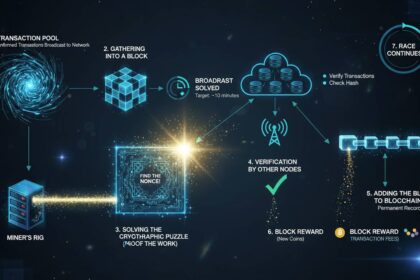

Cryptocurrency mining is the foundational process that secures blockchain networks and introduces new coins into circulation. Without mining, cryptocurrencies like Bitcoin would lack the decentralized trust mechanism that makes them functional. Understanding this process reveals how digital money actually works beneath the surface of apps and exchanges.
At its core, cryptocurrency mining is a computational competition where specialized computers solve complex mathematical puzzles to validate transactions and add them to the blockchain ledger. The miners who successfully solve these puzzles receive newly minted cryptocurrency as compensation for their efforts and computational resources. This elegant system eliminates the need for traditional banks or payment processors while maintaining perfect transaction records.
The process serves three critical functions simultaneously: confirming that cryptocurrency transactions are legitimate, preventing the same digital coins from being spent twice, and creating new coins in a predetermined, predictable manner. Every Bitcoin in existence has entered circulation through mining, making it both the creation mechanism and the security foundation of the entire cryptocurrency economy.
How Cryptocurrency Mining Works Technically
The mining process begins when someone initiates a cryptocurrency transaction. Before that transaction becomes permanent, it must be verified and recorded on the blockchain. Here's how that verification happens in practice.
First, transactions are grouped into a candidate block containing hundreds or thousands of individual transactions. This block contains a cryptographic hash of the previous block, creating the "chain" that makes blockchain so secure. The mining software then attempts to find a unique number, called a "nonce," that when combined with the block's data produces a hash meeting specific criteria established by the network's protocol.
This is where the real computational work occurs. Miners repeatedly change the nonce value and run the hashing function, searching for the rare combination that produces a valid hash. On networks like Bitcoin, the target is incredibly difficult to achieve—approximately one in every 25 trillion attempts succeeds. This difficulty adjusts automatically based on total network computing power to ensure blocks are added at consistent intervals, roughly every ten minutes for Bitcoin.
Once a miner finds a valid hash, they broadcast their solution to the network. Other nodes verify the solution quickly, and if correct, the new block gets added to the blockchain. The successful miner receives the block reward—currently 3.125 Bitcoin as of the 2024 halving—plus all transaction fees included in the block. This reward incentivizes miners to dedicate expensive hardware and electricity to securing the network.
Proof of Work Versus Proof of Stake
Understanding proof of work is essential because it explains why mining requires such enormous computational resources. Proof of work is the original consensus mechanism pioneered by Bitcoin, designed to make network participation costly and thereby prevent bad actors from manipulating the blockchain.
In a proof of work system, the probability of winning the block reward corresponds directly to computational power contributed to the network. An individual miner with hardware representing 1% of total network hash rate will, statistically, win 1% of blocks over time. This creates an economic model where honest participation is more profitable than attempted fraud, as controlling 51% of network hash power would cost billions of dollars in specialized hardware and electricity.
Proof of stake, in contrast, requires validators to lock up existing cryptocurrency as collateral rather than solving mathematical puzzles. Ethereum transitioned to proof of stake in 2022, reducing energy consumption by approximately 99.95%. However, proof of work networks continue operating with significant hash rates, as proponents argue it offers superior security guarantees through genuine physical resource expenditure.
The choice between these mechanisms represents one of the most significant debates in cryptocurrency architecture. Critics of proof of work point to energy consumption and environmental concerns, while supporters emphasize the mathematical finality and proven security track record of systems like Bitcoin.
Mining Hardware: From CPUs to ASICs
The evolution of mining hardware tells a fascinating story of technological arms races and increasing specialization. Early Bitcoin mining in 2009 and 2010 could be performed using standard computer processors (CPUs). The network was so small that any capable laptop could successfully mine blocks and earn meaningful rewards.
As cryptocurrency prices rose and more people began mining, the competition intensified. Graphics processing units (GPUs) emerged as superior alternatives to CPUs, offering roughly 50 times the hashing performance for certain algorithms. This democratized mining temporarily—enthusiasts could build affordable mining rigs using consumer graphics cards, and many early adopters accumulated significant cryptocurrency holdings this way.
The development of application-specific integrated circuits (ASICs) fundamentally changed mining economics. These purpose-built chips are designed exclusively for hashing specific algorithms, offering performance levels thousands of times higher than CPUs or GPUs. A modern Bitcoin ASIC miner can perform 300 terahashes per second—meaning three hundred trillion hash attempts every second.
However, ASICs sacrifice all versatility for their specialized task. They cannot be repurposed for any other computing task, and they rapidly become obsolete as manufacturers release newer generations. The capital-intensive nature of ASIC mining has created significant centralization, with large industrial operations dominating Bitcoin's hash rate. Companies like Marathon Digital Holdings and Riot Platforms operate massive facilities containing tens of thousands of ASICs.
GPU mining remains viable for coins using algorithms designed to resist ASIC development. Ethereum Classic, Ravencoin, and several privacy-focused cryptocurrencies still support GPU mining, allowing enthusiasts to participate without investing in expensive specialized hardware.
Mining Pools and Collective Mining
Individual mining profitability has decreased dramatically as network difficulty increased. A solo miner with even powerful hardware would statistically wait years to find a block, making consistent returns nearly impossible. Mining pools emerged as the solution, allowing individual miners to combine their computational resources and share block rewards proportionally.
When participating in a pool, miners contribute their hash rate toward solving blocks collectively. When the pool successfully mines a block, the reward gets distributed among all participants based on their contributed hash power. This creates steady, predictable income rather than lottery-like occasional large payments.
Major mining pools include Foundry USA, AntPool, and ViaBTC, collectively controlling significant portions of Bitcoin's hash rate. Pool operators typically charge fees ranging from 1% to 3% of earnings. Some pools operate transparently with public statistics, while others have faced criticism for opacity or suspected hidden hashrate manipulation.
The emergence of mining pools created new centralization concerns. While any individual can theoretically become a Bitcoin miner, the practical reality is that most hash rate funnels through a relatively small number of large pools. This concentrates power and creates potential attack vectors if pool operators act maliciously or face regulatory action.
The Economics of Cryptocurrency Mining
Successful mining operations must carefully balance revenue against substantial operational costs. The primary expenses include hardware acquisition, electricity consumption, cooling systems, facility space, and maintenance personnel. Profitability calculations require tracking both the fluctuating cryptocurrency prices and the always-increasing network difficulty.
Electricity costs typically represent the largest ongoing expense. A single ASIC miner might consume 3,000 watts continuously, running up electricity bills quickly. Industrial mining facilities negotiate preferential power rates, often locating in regions with abundant hydroelectric, nuclear, or natural gas energy. Some operations seek locations with extreme climates to leverage natural cooling, reducing air conditioning expenses.
The halving events built into Bitcoin's code automatically reduce block rewards by 50% approximately every four years. The most recent halving occurred in April 2024, reducing rewards from 6.25 to 3.125 Bitcoin per block. This programmatic scarcity creates upward price pressure over time but simultaneously squeezes miner profit margins. Operations that cannot maintain profitability after halving become unviable, contributing to periodic industry consolidation.
Market volatility creates additional challenges. Mining profitability fluctuates significantly with cryptocurrency prices, sometimes turning profitable operations into money-losing enterprises within days. Sophisticated miners use financial instruments like futures contracts or hash rate futures to hedge against adverse price movements.
Environmental Considerations and Energy Debate
The environmental impact of cryptocurrency mining generates substantial controversy and legitimate concern. According to the Cambridge Centre for Alternative Finance, Bitcoin mining consumes approximately 150 terawatt-hours of electricity annually—comparable to the entire country of Argentina. This consumption has drawn criticism from environmental organizations and prompted regulatory scrutiny in several jurisdictions.
However, the energy debate contains important nuances. Mining operations increasingly locate in regions with excess renewable energy capacity, particularly hydroelectric resources in areas like Sichuan, China (prior to restrictions), and Quebec, Canada. Some operators actively seek stranded energy resources—remote power generation that cannot efficiently connect to traditional grids—transforming wasted energy into valuable computing.
The geographic distribution of mining hash rate has shifted dramatically following China's 2021 crackdown on cryptocurrency operations. The United States now hosts the largest concentration of Bitcoin mining, followed by Kazakhstan and Russia. This geographic diversification has reduced concerns about single-country dominance while introducing new political risks.
Critics argue that precious computing resources are devoted to solving meaningless mathematical puzzles rather than productive purposes. Supporters counter that mining provides essential infrastructure for a potentially transformative financial system and that energy consumption should be evaluated relative to the value it secures—not compared to zero.
Several cryptocurrency projects have emerged with explicit environmental missions. Chia, for instance, uses a "proof of space and time" mechanism that utilizes storage capacity rather than computational power, dramatically reducing energy requirements. However, these alternatives have not achieved the market dominance or security track record of proof of work systems.
Different Mining Approaches Across Cryptocurrencies
While Bitcoin dominates public attention, hundreds of cryptocurrencies employ various mining mechanisms. Understanding these differences reveals the breadth of approaches to achieving decentralized consensus.
Ethereum Classic continues using proof of work, maintaining compatibility with GPU miners after Ethereum's transition to proof of stake. This decision preserved the existing mining community but also created opportunities for individuals who found ASIC mining inaccessible.
Monero uses a proof of work algorithm specifically designed to resist ASIC development, called RandomX. This algorithm is optimized for general-purpose CPUs, making mining more accessible to everyday computer users. The network intentionally updates its protocol to block any ASIC attempts, maintaining GPU and CPU mining viability.
Dogecoin and Litecoin both use Scrypt, an algorithm originally designed to be memory-hard and resist ASICs. However, dedicated Scrypt ASICs eventually emerged, centralizing these networks' mining around specialized hardware owners.
Some cryptocurrencies experiment with hybrid approaches. Decred combines proof of work mining with proof of stake voting, allowing holders to participate in governance without expensive hardware. This hybrid model attempts to balance security with reduced environmental impact.
The rise of proof of stake has fundamentally altered the mining landscape. Ethereum's transition eliminated GPU mining on the second-largest cryptocurrency by market cap, causing significant disruption in the GPU mining community. Many former Ethereum miners migrated to alternative coins or exited mining entirely.
Frequently Asked Questions
Is cryptocurrency mining still profitable in 2024?
Profitability depends heavily on electricity costs, available hardware, and cryptocurrency prices. Industrial operations with cheap power can remain profitable at current reward levels, while small-scale miners with residential electricity rates typically struggle to break even. Mining profitability calculators help estimate potential returns based on specific hardware and energy costs.
How much does mining hardware cost?
Entry-level GPU mining rigs can cost $1,000-$3,000, while professional ASIC miners range from $2,000 for older models to $10,000+ for cutting-edge machines. Industrial facilities involve millions of dollars in hardware acquisitions. The rapid obsolescence of mining equipment creates ongoing capital expenditure requirements.
Can I mine Bitcoin on my home computer?
No. Home computers cannot compete against industrial ASIC operations. CPU and GPU mining for Bitcoin produces no meaningful results—the electricity costs exceed any potential earnings. Home computers can only mine certain alternative cryptocurrencies with ASIC-resistant algorithms.
What happens when all cryptocurrency is mined?
Bitcoin has a capped supply of 21 million coins, with the last coins projected to be mined around 2140. After all coins enter circulation, miners will rely entirely on transaction fees for revenue. This transition ensures network security continues indefinitely while creating deflationary economic conditions.
Is cryptocurrency mining legal?
Cryptocurrency mining is legal in most countries, including the United States. However, some jurisdictions have banned or restricted mining activities due to energy concerns or financial regulations. China imposed comprehensive restrictions in 2021, driving significant mining operations to other countries. Potential miners should verify local regulations before investing in equipment.
How long does it take to mine one Bitcoin?
With modern ASIC hardware, mining one Bitcoin depends entirely on your share of total network hash rate. A single powerful ASIC miner might produce 0.0001 BTC per day. In practical terms, joining a mining pool provides more consistent returns than attempting solo mining, where block discovery could take years.
Understanding cryptocurrency mining reveals the intricate systems securing digital financial networks. From specialized hardware solving complex mathematical problems to global pools distributing rewards across thousands of participants, mining represents both an engineering achievement and an ongoing economic experiment. Whether viewed as essential infrastructure or environmental concern, mining fundamentally shapes how cryptocurrencies function and evolve.