

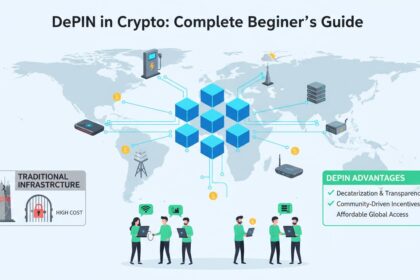

DePIN represents one of the most promising use cases for blockchain technology, bridging the gap between digital tokens and real-world physical infrastructure. If you've wondered how cryptocurrency can actually build tangible infrastructure—from wireless networks to mapping systems—this guide covers everything you need to know about Decentralized Physical Infrastructure Networks.
📊 STATS
• The DePIN sector reached $3.5 billion in total value locked by late 2024
• Helium, the largest DePIN project, covers 3,000+ cities globally with its decentralized wireless network
• The DePIN market is projected to grow to $35 billion by 2028
• Over 500,000 hotspot operators participate in DePIN networks worldwide
Key Takeaways
• DePIN stands for Decentralized Physical Infrastructure Networks—blockchain-powered systems that build real-world infrastructure
• These networks tokenize physical assets like wireless antennas, storage devices, and sensors, allowing anyone to participate
• Users earn crypto rewards by contributing hardware (antennas, storage, computing power) to the network
• DePIN aims to disrupt traditional infrastructure monopolies by creating decentralized alternatives
• Major DePIN sectors include wireless (Helium), storage (Filecoin), computing (Render), and mapping (Hivemapper)
Understanding DePIN: Definition and Core Concepts
Decentralized Physical Infrastructure Networks (DePIN) represent a fundamental shift in how physical infrastructure gets built, operated, and owned. Rather than relying on centralized corporations to deploy and maintain infrastructure like cell towers, storage servers, or mapping sensors, DePIN enables communities to collectively own and operate these resources.
At its core, a DePIN combines blockchain technology with physical infrastructure deployment. Participants—often called "hosters" or "operators"—install specialized hardware in their homes or businesses. This hardware connects to the DePIN's network and provides real-world services: wireless coverage, file storage, GPU computing power, or geographic mapping data. In return, contributors receive cryptocurrency tokens.
The blockchain serves multiple critical functions in this model. It provides a transparent, immutable record of who contributed what resources to the network. Smart contracts automatically distribute token rewards based on verified contributions. The token itself creates economic incentives that align individual participant goals with network growth—operators earn more when their hardware provides valuable services.
How DePIN Differs from Traditional Infrastructure
Traditional infrastructure deployment follows a familiar pattern: a large corporation raises capital, purchases equipment, contracts installers, and maintains everything through regional offices. This model works but creates several inefficiencies. Capital requirements exclude smaller players. Geographic monopolies limit competition. Customer service suffers from lack of choice. Innovation slows when incumbent players face no pressure to improve.
DePIN flips this model entirely. Instead of one company owning everything, thousands or millions of individuals each own small pieces of the infrastructure. No central authority controls the network. Anyone with appropriate hardware can join. Competition happens at the edge—users can choose which network serves their needs.
This architectural difference produces several important characteristics. First, deployment accelerates because anyone can contribute rather than waiting for corporate budget approval. Second, resilience improves since no single point of failure exists. Third, costs often decrease because community operators have lower overhead than traditional corporations.
Key Components of a DePIN
Every DePIN shares several fundamental building blocks that enable decentralized operation:
Physical Layer: The actual hardware devices that provide services. For Helium, this means LongFi hotspots that transmit wireless signals. For Filecoin, it's storage servers. For Render, it's GPUs capable of graphics rendering. These devices must meet technical specifications and often require straightforward setup procedures.
Network Layer: The software connecting individual devices into a cohesive network. This includes peer-to-peer communication protocols, service verification systems, and data routing mechanisms. The network layer ensures devices can discover each other, coordinate, and deliver services to end users.
Token Economy: The cryptocurrency system that powers economic incentives. Tokens typically serve multiple functions: rewarding contributors, enabling service payments, and governing network decisions. Token economics must balance inflation (rewarding growth) with scarcity (maintaining value).
Verification Mechanism: The system that proves contributions are legitimate. Some DePINs use proof-of-work style computational challenges. Others rely on peer verification where nearby operators confirm service quality. Still others employ oracle systems that cross-reference network data with external sources.
💡 STAT: DePIN projects have collectively distributed over $2 billion in token rewards to infrastructure providers since 2021
How DePIN Networks Actually Work
Understanding DePIN requires seeing how the pieces fit together in practice. Let's walk through a typical transaction flow using Helium as our primary example, then compare with other major categories.
When you set up a Helium hotspot, the device begins listening for nearby wireless traffic. It measures signal strength, checks data transfer rates, and records coverage patterns. This data gets submitted to the Helium blockchain, where a consensus mechanism verifies the hotspot is actually providing coverage rather than claiming false rewards.
The proof-of-coverage system uses a clever mechanism: nearby hotspots verify each other. If your hotspot claims to cover an area where no other hotspots exist, the system treats that claim skeptically. This creates economic disincentives for fake hardware claims while remaining computationally efficient.
Once verified, your hotspot earns HNT tokens proportionally to the coverage and data transfer it provides. The more devices you run, the more you earn—but diminishing returns apply to prevent monopolization. Smart contracts automatically distribute these rewards weekly.
For users who want wireless service, the system works differently. Device makers integrate Helium's LongFi technology into phones, trackers, and sensors. These devices automatically connect to the nearest Helium hotspot when in range. The device maker pays for this coverage using Data Credits—a stable, burn-and-mirror token mechanism that separates network usage costs from token speculation.
The Role of Tokens in DePIN
Tokens serve as the economic backbone of DePIN networks, but their specific functions vary by project:
Utility Tokens: Enable access to network services. Filecoin users pay FIL to store files. Render users pay RNDR for GPU time. These tokens have functional demand beyond speculation.
Staking and Security: Many DePINs require tokens for security deposits. Operators stake tokens as collateral against malicious behavior. If they violate network rules, they lose their stake. This creates accountability without requiring corporate oversight.
Governance Rights: Token holders typically receive voting power over network decisions. This might include parameter changes, fund allocation, or protocol upgrades. Governance aims to give community meaningful control while preventing capture by large holders.
Incentive Alignment: Perhaps most importantly, tokens align incentives across the network. When token value rises, early contributors benefit—encouraging long-term thinking. When the network succeeds, everyone's hardware becomes more valuable. This creates positive feedback loops that traditional infrastructure cannot replicate.
Major DePIN Categories and Leading Projects
The DePIN ecosystem spans multiple infrastructure categories, each with distinct technical requirements and market opportunities. Understanding these categories helps identify which projects interest you most.
Wireless Networks
Helium pioneered the wireless DePIN category, deploying the largest decentralized wireless network globally. Their LongFi protocol enables low-power devices to transmit data over long ranges using the 915 MHz band (in the US). The network supports millions of IoT devices tracking everything from pet locators to shipping containers.
PeerMe takes a different approach, building decentralized mobile phone infrastructure. Rather than focusing on IoT devices, PeerMe enables direct peer-to-peer mobile calling and texting through a blockchain-coordinated network.
| Feature | Helium | PeerMe |
|---|---|---|
| Primary Use | IoT devices | Mobile phones |
| Spectrum | Sub-GHz LoRaWAN | Licensed/unlicensed |
| Token | HNT | P2P |
| Coverage | 3,000+ cities | Emerging |
| Devices | 500,000+ | Beta |
Storage Networks
Filecoin operates as the largest decentralized storage network, with over 4 exabytes of storage capacity committed to the system. Users pay FIL tokens to store files across thousands of storage providers globally. The system uses proof-of-replication to verify providers actually store the data they claim.
Arweave takes a different approach with permanent storage. Once data uploads to Arweave, it cannot be deleted or modified—creating an immutable archive. This suits applications requiring tamper-proof records, including scientific data, legal documents, and artistic works.
Compute Networks
Render and io.net represent the GPU compute category, providing distributed computing power for graphics rendering, AI inference, and general parallel computation. Artists use Render to render 3D animations on distributed GPUs rather than expensive local hardware. Researchers use io.net for machine learning workloads requiring significant compute.
Mapping and Sensors
Hivemapper builds decentralized mapping by equipping drivers with dashcams that capture street-level imagery. Contributors earn HONEY tokens for driving covered routes and providing mapping data. The resulting maps compete with Google Maps and Waze, offering potential advantages in freshness and granularity.
IOTEX focuses on IoT device coordination, creating a blockchain specifically designed for connected devices. Their approach emphasizes interoperability and low-latency communication between sensors, actuators, and control systems.
📈 CASE: Helium network grew from zero to 500,000+ hotspots in under four years, achieving coverage equivalent to traditional cellular IoT networks at a fraction of the capital cost
Benefits and Advantages of DePIN
DePIN offers compelling advantages over traditional infrastructure models, though understanding these benefits requires examining specific value propositions for different stakeholder groups.
For Infrastructure Providers
Running DePIN hardware provides several advantages over traditional approaches to earning from infrastructure:
Low Barrier to Entry: Traditional infrastructure requires massive capital—cell towers cost millions. DePIN lets individuals participate with hardware investments as low as $200-500 for basic setups. This democratizes infrastructure ownership.
Earn While Contributing: Rather than purchasing equipment hoping for returns, DePIN operators earn immediately upon successful deployment. Cash flow starts quickly rather than requiring years to recoup investments.
Community Support: DePIN communities provide peer-to-peer support, shared troubleshooting guides, and collective knowledge bases. New operators benefit from experienced community members without requiring corporate help desks.
Passive Income Potential: Once configured, most DePIN hardware requires minimal ongoing attention. Operators earn rewards automatically while providing ongoing infrastructure services.
For End Users
Users who consume DePIN services experience several advantages:
Lower Costs: Decentralized networks often provide services more cheaply than centralized alternatives. Without corporate overhead, profit margins, or geographic monopolies, competitive pressure drives prices down.
Enhanced Privacy: Some DePINs offer improved privacy characteristics compared to centralized services. Peer-to-peer architectures can reduce data collection by intermediaries.
Network Resilience: Distributed infrastructure continues functioning even when individual nodes fail. This reliability matters for critical applications where downtime has serious consequences.
Community Governance: Users often have voice in network decisions through governance tokens. This contrasts sharply with traditional services where users have no recourse except switching competitors or accepting poor terms.
Broader Economic Impacts
At scale, DePIN could produce significant economic changes:
Infrastructure Democratization: Communities could build their own networks rather than depending on corporate decisions about where to deploy coverage. This matters especially in underserved areas where traditional providers lack business cases.
New Economic Models: DePIN creates novel ways to monetize underutilized assets—residential bandwidth, spare storage, GPU idle time. This "idle capacity economy" extracts value from resources that would otherwise go to waste.
Reduced Monopoly Power: As decentralized alternatives mature, incumbent infrastructure providers face real competitive pressure. History suggests this generally benefits consumers through improved service and lower prices.
Getting Started with DePIN
If DePIN interests you, several paths forward require different commitment levels. Here's how to begin at whatever intensity suits your situation.
Prerequisites
Before diving in, ensure you understand the requirements:
- Technical Comfort: Basic networking knowledge helps significantly. You'll configure WiFi settings, understand port forwarding, and troubleshoot connectivity issues.
- Capital Availability: Hardware costs range from under $100 (basic sensors) to several thousand dollars (high-performance compute nodes). Plan for electricity costs as ongoing expenses.
- Time Commitment: Initial setup takes 1-3 hours depending on project complexity. Ongoing maintenance requires occasional attention but generally remains minimal.
- Risk Tolerance: Cryptocurrency investments carry volatility risk. Hardware may become obsolete. Regulatory changes could affect token values. Only invest what you can afford to lose.
Steps to Become a DePIN Operator
1. Research Projects Thoroughly
Don't rush in. Read whitepapers, join community forums, and understand token economics. Some projects have high token inflation that dilutes rewards. Others face uncertain regulatory futures.
2. Calculate ROI Realistically
Online calculators estimate potential earnings, but treat these as optimistic scenarios. Consider your electricity costs, internet reliability, and local competition. Earnings often fall below early adopter projections.
3. Acquire Appropriate Hardware
Purchase hardware directly from project-recommended vendors or verified resellers. Avoid used equipment of uncertain provenance. Some projects require specific hardware configurations.
4. Optimize Placement
Location significantly impacts earnings. Wireless DePINs benefit from elevated positions with clear radio paths. Storage nodes need stable power and internet. Research optimal placement for your specific project.
5. Configure and Monitor
Follow official setup guides precisely. After deployment, monitor performance during the first weeks. Address issues promptly while rewards remain testable.
Time and Cost Estimates
| Project Category | Initial Cost | Monthly Electricity | Setup Time |
|---|---|---|---|
| Wireless Hotspot | $200-600 | $5-15 | 1-2 hours |
| Storage Provider | $500-2000 | $10-30 | 2-4 hours |
| GPU Node | $1500-5000 | $30-100 | 3-5 hours |
| Sensor/Dashcam | $100-300 | $2-5 | 30 min |
⚠️ WARNING: Earnings claims found in project marketing often reflect early conditions that have since changed. Always do your own calculations based on current network dynamics.
Risks and Challenges
DePIN isn't without significant risks. Understanding these challenges helps you make informed decisions.
Technical Risks
Hardware Obsolescence: Projects evolve, and older hardware sometimes becomes incompatible with newer network versions. Equipment that earned rewards last year might not work next year. Factor this obsolescence risk into your investment calculations.
Network Competition: Multiple DePINs sometimes compete for similar use cases. A winning network might not be obvious in advance, and betting on the wrong project could mean your hardware becomes worthless.
Verification Gaming: While DePIN systems design against false claims, clever participants sometimes find ways to game verification. This can reduce legitimate operators' earnings while increasing network inefficiency.
Market Risks
Token Volatility: DePIN tokens can swing dramatically in value. Earnings in tokens might be worth significantly less (or more) when converted to fiat currency. This volatility makes ROI calculations difficult.
Regulatory Uncertainty: Crypto regulation remains unsettled globally. Some jurisdictions might restrict DePIN operations or token usage. Future regulatory actions could significantly impact viability.
Adoption Dependency: DePINs need both infrastructure providers AND service users. Networks with lots of hardware but few users provide poor earnings. Networks with many users but insufficient hardware can't serve demand. Both sides need maturity for healthy operation.
Economic Risks
Unsustainable Tokenomics: Some DePIN projects use token inflation to attract operators, creating Ponzi-like dynamics where later participants subsidize earlier ones. Eventually, these models often collapse.
Competition from Incumbents: Traditional companies aren't standing still. If major cellular carriers or cloud providers dramatically lower prices or improve service, decentralized alternatives might struggle to compete.
⚠️ CRITICAL: Never invest more than you can afford to lose. DePIN involves emerging technology with limited track record. Hardware might not earn what you expect. Tokens might lose significant value. Diversify across projects and maintain fallback plans.
Frequently Asked Questions
What does DePIN stand for?
DePIN stands for Decentralized Physical Infrastructure Networks. These are blockchain-based systems that enable communities to collectively build and operate physical infrastructure like wireless networks, storage systems, and computing resources.
Is DePIN profitable for individual operators?
Profitability varies significantly by project, location, and timing. Some operators earn modest returns covering electricity costs plus some profit. Others find their hardware never recoups its purchase price. Current market conditions suggest most basic setups take 12-24 months to become profitable, assuming stable token prices.
What are the biggest DePIN projects?
The largest DePINs by market cap and adoption include Helium (wireless), Filecoin (storage), Render (GPU compute), Hivemapper (mapping), and IOTEX (IoT). Each category has multiple competing projects with different technical approaches and token economics.
Do I need technical expertise to run DePIN hardware?
Basic technical comfort helps significantly. You'll need to configure network settings, troubleshoot connectivity issues, and monitor equipment. Most projects provide detailed guides, and communities offer support for beginners. However, completely non-technical users often struggle with troubleshooting when issues arise.
Is DePIN legal in the United States?
DePIN operates in legal gray areas rather than explicit prohibition. Token issuance might qualify as securities under current interpretations. Wireless transmission requires FCC compliance regardless of underlying technology. Consult legal counsel for specific situations. Regulatory clarity remains limited, representing ongoing risk.
What's the difference between DePIN and traditional crypto projects?
Traditional crypto projects like Bitcoin or Ethereum provide purely digital services. DePIN specifically focuses on building real-world physical infrastructure—wireless coverage, storage capacity, computing power—through blockchain coordination. This makes DePIN more closely tied to tangible assets and real utility.
Conclusion
DePIN represents a compelling intersection of blockchain technology and tangible infrastructure deployment. These networks demonstrate that cryptocurrency can do more than simply transfer value—it can coordinate communities to build physical systems that serve real needs.
The sector has grown substantially, with billions of dollars in value now secured by decentralized infrastructure providers. Major categories including wireless, storage, compute, and sensing have established projects with meaningful adoption. Early participants have earned significant token rewards, though future returns remain uncertain.
For those interested in participating, the path forward requires careful research, realistic expectations, and appropriate risk management. DePIN isn't a guaranteed money-maker—it's an emerging technology with genuine promise AND significant uncertainty. Approach opportunities with eyes open, understanding both the potential upsides and substantial risks.
The broader implication extends beyond personal profit potential. If DePIN achieves its vision at scale, infrastructure ownership could fundamentally democratize. Communities could build their own networks. Individuals could earn from underutilized resources. Competition could challenge entrenched monopolies. Whether this optimistic scenario materializes depends on technical execution, regulatory treatment, and sustained community engagement.
The next few years will likely determine whether DePIN remains a niche experiment or transforms into a meaningful alternative to traditional infrastructure. For now, the space offers interested participants ways to contribute to that outcome while potentially earning rewards for their contributions.