

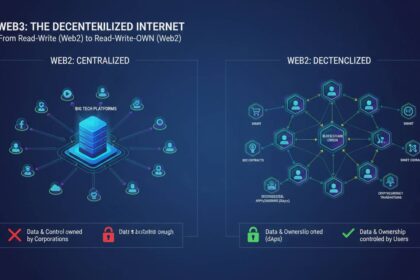

Web3 represents the next evolution of the internet—a shift from centralized platforms controlled by corporations to decentralized networks owned and governed by their users. If you're wondering what all the fuss is about, this guide breaks down Web3 in plain English, explaining how it works, why it matters, and what it means for your digital life.
📊 STATS
• The global blockchain market is projected to reach $1.9 trillion by 2030
• Over 400 million people globally use Web3 applications
• Decentralized finance (DeFi) platforms hold over $200 billion in total value locked
• Major brands including Starbucks, Nike, and Adidas have launched Web3 initiatives since 2022
Key Takeaways
• Web3 is the decentralized internet built on blockchain technology
• Core difference from Web2: users own their data and digital assets instead of corporations
• Key technologies include blockchain, cryptocurrencies, NFTs, and DAOs
• Adoption is growing but mainstream usage remains in early stages
• Investment required: education, compatible wallets, and understanding of security practices
Unlike Web2, where companies like Google, Meta, and Amazon control your data and monetize it, Web3 puts you in the driver's seat. Think of it as the internet returning to its roots—open, collaborative, and user-owned—while adding new capabilities that weren't possible before.
Understanding Web3: Definition and Core Concepts
Web3, also called the decentralized web, refers to an internet ecosystem built on blockchain technology. At its core, Web3 aims to remove intermediaries—banks, tech giants, and other central authorities—from digital interactions. Instead of asking permission from a company to create an account, publish content, or transfer money, Web3 allows you to do these things directly using decentralized protocols.
What Makes Web3 Different?
Decentralization is the fundamental principle. In Web2, when you post a photo on Instagram or write a blog post on WordPress, those platforms own your content. They can delete it, restrict access, or change the rules whenever they want. In Web3, your content lives on a distributed network of computers (nodes) that no single entity controls. You hold the keys—literally, in the form of cryptographic keys—that prove ownership of your digital assets.
Blockchain technology serves as the foundation. A blockchain is a distributed ledger that records transactions across many computers. Once something is recorded, it's extremely difficult to alter. This creates trust without requiring a central authority. Every transaction is transparent and verifiable by anyone.
Token economics drive Web3 ecosystems. Instead of being a "product" that companies give you for free in exchange for your data, Web3 often rewards participation with tokens. These digital assets can represent ownership, voting rights, or access to services. Some tokens have monetary value and can be traded on exchanges.
The Three Eras of the Internet
To understand Web3, it helps to see how the internet has evolved:
| Era | Years | Key Features | Examples |
|---|---|---|---|
| Web1 | 1990-2005 | Read-only, static websites | Early Yahoo, AOL |
| Web2 | 2005-2020 | Social media, user-generated content, cloud services | Facebook, YouTube, Google |
| Web3 | 2020-present | Decentralization, blockchain, user ownership | Ethereum, Uniswap, OpenSea |
Web1 was like a digital library—mostly one-way information delivery. Web2 transformed the internet into a social platform where users created content but didn't own it. Web3 aims to give users true ownership of their digital identities and assets.
Key Technologies Powering Web3
Blockchain Networks
Blockchain is the underlying technology that makes Web3 possible. Several blockchains power different aspects of the Web3 ecosystem:
Ethereum remains the leading platform for Web3 development. It introduced smart contracts—self-executing programs that automatically enforce agreements between parties. Ethereum hosts most decentralized applications (dApps), NFT marketplaces, and DeFi protocols.
Solana offers faster transaction speeds and lower fees than Ethereum, making it popular for gaming and high-frequency trading applications.
Polygon provides scaling solutions for Ethereum, helping reduce congestion and transaction costs while maintaining security.
Cryptocurrencies and Tokens
Web3 relies heavily on cryptocurrencies as the native medium of exchange:
• Coins (like ETH, SOL, MATIC) serve as the primary currency on their respective blockchains
• Tokens represent assets or utilities built on existing blockchains. ERC-20 tokens on Ethereum are the most common standard
• Stablecoins (like USDC, USDT) are cryptocurrencies pegged to fiat currencies, reducing volatility
Smart Contracts
Smart contracts are programs stored on a blockchain that execute automatically when predetermined conditions are met. They eliminate the need for intermediaries in countless scenarios:
Imagine you want to rent your apartment to a stranger. In the traditional system, you'd use Airbnb, which takes a cut and holds your funds. In a Web3 rental system, a smart contract could hold the tenant's payment, automatically release it to you once a smart lock confirms entry, and return it if the lock isn't activated. No middleman required.
DAOs (Decentralized Autonomous Organizations)
DAOs represent a new way to organize collective decision-making. Instead of a CEO or board making choices, DAO token holders vote on proposals. The organization's rules are encoded in smart contracts, making operations transparent and resistant to manipulation.
Benefits of Web3
Web3 offers several compelling advantages over the current internet model:
| Benefit | Impact | Real-World Example |
|---|---|---|
| User Ownership | 100% control over digital assets | You own your NFT, not the platform where you bought it |
| Financial Inclusion | Anyone with internet can access financial services | Unbanked populations using mobile wallets |
| Transparency | All transactions publicly verifiable | Open-source code anyone can audit |
| Censorship Resistance | No single entity can block access | Content survives even if servers go down |
| Reduced Fees | Eliminates middlemen taking cuts | Peer-to-peer trading without exchange fees |
Ownership Economy
The most transformative aspect of Web3 is the ownership economy. In Web2, when you buy digital goods—think in-game purchases or digital art—you don't actually own them. The platform can revoke access at any time. In Web3, when you buy an NFT representing digital art, ownership is recorded on the blockchain. It's provably yours, and no company can take it away.
This extends to identity, too. Instead of creating accounts on dozens of platforms (each collecting your data), Web3 enables self-sovereign identity. You maintain a decentralized identifier that you can use across applications without revealing more information than necessary.
New Economic Models
Web3 enables innovative economic models impossible in Web2:
Creator economy 2.0 allows artists and creators to earn directly from their work. When you buy music as an NFT, for example, the artist receives a percentage of every subsequent sale—forever. This solves the problem of artists seeing no revenue from secondary market sales.
Play-to-earn gaming rewards players for time invested in games. Unlike traditional gaming where the company captures all value, players own their in-game assets and can sell them for real money.
Fractional ownership lets multiple people own portions of expensive assets. A group of fans could collectively own a piece of music royalties or real estate, receiving proportional收益.
Common Web3 Misconceptions
Many people hold incorrect assumptions about Web3. Let's address the biggest ones:
| Misconception | Reality |
|---|---|
| "Web3 is just for crypto speculation" | While crypto is a component, Web3 spans gaming, identity, social media, supply chain, and enterprise applications |
| "Web3 is anonymous" | Transactions are pseudonymous—traceable but not tied to real identities without additional info |
| "Web3 will replace Web2" | The transition will be gradual; Web2 platforms will likely adopt Web3 elements rather than vanish |
| "You need to be technical to use Web3" | User experience is improving rapidly; many dApps now feel as smooth as traditional apps |
Addressing Security Concerns
Web3 has legitimate security challenges that users must understand:
🔴 Scams and fraud are rampant. Rug pulls (developers abandoning projects after collecting investment), phishing attacks, and Ponzi schemes target Web3 users daily.
🔴 Irreversible transactions mean mistakes are permanent. If you send funds to the wrong address, there's no customer service to call.
🔴 Smart contract bugs have resulted in hundreds of millions in losses. Code audits reduce risk but don't eliminate it.
Best practices include: using hardware wallets for significant holdings, never sharing seed phrases, verifying contract addresses before transactions, and starting with small amounts when trying new platforms.
How to Get Started with Web3
Ready to explore Web3? Here's a practical roadmap:
Prerequisites:
- [ ] Smartphone or computer with internet access
- [ ] Email address (for exchanges and notifications)
- [ ] Government ID (for compliant exchanges requiring verification)
- [ ] Willingness to learn and start small
Time: 1-2 hours initial setup | Cost: $0-100 to start
Steps
1. Choose a Wallet
Your Web3 journey begins with a crypto wallet—the tool that holds your keys and connects you to dApps. Start with user-friendly options:
- MetaMask (browser extension + mobile): The most popular Ethereum wallet
- Phantom (mobile + browser): Best for Solana ecosystem
- Coinbase Wallet: Good for beginners already using Coinbase
⏱ 10 minutes | 💡 Tip: Write your seed phrase on paper and store it securely. Never store it digitally.
2. Acquire Cryptocurrency
You'll need crypto to interact with Web3 apps. Options include:
- Centralized exchanges: Coinbase, Kraken, Binance (US)
- Peer-to-peer platforms: LocalBitcoins, Paxful
- Decentralized exchanges: Uniswap, Raydium (swap tokens directly)
⚠️ Avoid: Sending crypto to the wrong network → Fix: Always double-check the network matches (e.g., don't send ERC-20 tokens to a Solana address)
3. Explore dApps
Start with established, user-friendly applications:
- OpenSea or Blur: Browse and buy NFTs
- Uniswap or SushiSwap: Trade tokens without intermediaries
- Aave or Compound: Earn interest on crypto holdings
4. Start Small
Never invest more than you can afford to lose. Web3 is experimental. Begin with small transactions to understand how gas fees work, how transactions appear on block explorers, and how to cancel stuck transactions.
Troubleshooting
| Problem | Fix |
|---|---|
| Transaction stuck | Increase gas fee or wait for network congestion to clear |
| Wallet not connecting | Clear browser cache, check network settings, try different browser |
| Token didn't arrive | Verify transaction on block explorer; check if you used correct network |
| Lost seed phrase | If lost permanently, wallet cannot be recovered—never share seed phrase |
The Future of Web3
Web3 is still in its infancy, but momentum is building. Major technology companies, financial institutions, and governments are exploring blockchain applications.
Enterprise adoption is accelerating. Over 80% of Fortune 500 companies are exploring blockchain technology, according to a 2024 Deloitte survey. Enterprise blockchains like Hyperledger and R3 are being used for supply chain tracking, digital identity, and settlement systems.
Regulatory clarity is coming. The EU's MiCA (Markets in Crypto-Assets) regulation provides a comprehensive framework. The US is still developing its approach, but clear rules will help legitimate projects thrive while protecting consumers.
Scalability challenges are being addressed. Layer 2 solutions, sharding, and new consensus mechanisms are solving the throughput limitations that currently make some blockchains slow and expensive during peak usage.
Interoperability is improving. Bridges between blockchains, cross-chain protocols, and aggregate platforms are making it easier to move assets and data across different networks.
The question isn't whether Web3 will matter—it's how quickly it will reshape digital life and who will benefit most from the transition.
Frequently Asked Questions
What is Web3 in simple terms?
Web3 is the next version of the internet where users own their data and digital assets instead of big tech companies. It uses blockchain technology to enable direct interactions without intermediaries—from owning your online identity to trading assets without banks.
How is Web3 different from Web2?
Web2 platforms (Facebook, Google, Amazon) own user data and monetize it through advertising. Web3 gives users ownership through cryptographic keys and decentralized networks. In Web2, you rent access to services; in Web3, you own your assets.
Do I need cryptocurrency to use Web3?
Yes, most Web3 applications require cryptocurrency for transactions, whether that's buying NFTs, trading on DeFi platforms, or paying network fees. However, some platforms are building abstraction layers that may eventually hide crypto complexity from users.
Is Web3 safe to use?
Web3 has security risks including scams, smart contract bugs, and irreversible transactions. However, using reputable platforms, hardware wallets for large holdings, and following basic security practices significantly reduces risk. Never invest more than you can afford to lose.
Will Web3 replace the internet we use now?
Web3 is more likely to integrate with and complement Web2 rather than replace it entirely. Many expect a hybrid future where traditional platforms adopt Web3 elements like user ownership and区块链technology while maintaining usability.
Conclusion
Web3 represents a fundamental shift in how we interact online—from being the product to being the owner. Built on blockchain technology, it promises user sovereignty, transparent transactions, and new economic models that reward participation.
The technology is still maturing, with legitimate challenges around usability, security, and regulation. But the core vision—returning ownership of digital life to individuals—has powerful appeal. Whether you're an investor, creator, developer, or simply a curious internet user, understanding Web3 positions you to navigate the evolving digital landscape.
The best approach? Start exploring cautiously. Set up a wallet, buy a small amount of crypto, and try a few transactions. The best way to understand Web3 is to experience it firsthand—just remember to prioritize security and never invest more than you can afford to lose.