

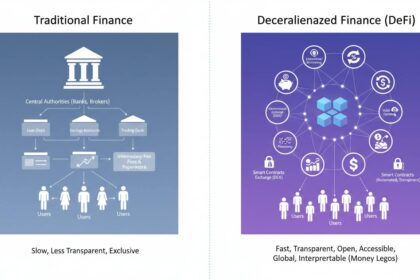

Decentralized Finance, commonly known as DeFi, is transforming how people think about money, banking, and financial services. In simple terms, DeFi refers to financial applications built on blockchain technology that operate without traditional intermediaries like banks, brokers, or insurance companies. These decentralized protocols allow anyone with an internet connection to access financial services directly, from earning interest on savings to trading cryptocurrencies or borrowing funds. The DeFi ecosystem has grown exponentially, with over $80 billion in total value locked as of 2024, representing a fundamental shift in how value transfers occur globally.
📊 STATS
• $80B+ in total value locked in DeFi protocols
• 4,500+ DeFi projects launched globally
• 3.5M+ unique DeFi wallet addresses
• $180B in cumulative DeFi trading volume
Key Takeaways
• No Middlemen: DeFi removes banks and brokers from financial transactions
• Blockchain-Based: Transactions are recorded on public, immutable ledgers
• Global Access: Anyone with internet can use DeFi services
• Transparency: All transactions and smart contracts are publicly verifiable
• Programmable Money: Automated financial agreements called smart contracts handle everything
What is DeFi? Understanding the Basics
DeFi, short for Decentralized Finance, represents a movement to recreate traditional financial instruments using decentralized networks—primarily Ethereum and other blockchain platforms. Instead of relying on centralized institutions like banks to facilitate transactions, DeFi uses smart contracts: self-executing programs that automatically enforce agreements when predetermined conditions are met. This eliminates the need for trust in a third party and allows financial services to operate 24/7 without interruption.
The core innovation behind DeFi is the ability to create programmable money. When you deposit funds in a traditional bank, you trust the institution to manage and lend your money while paying you a small interest rate. In DeFi, your funds go into a liquidity pool—a smart contract that anyone can borrow from or contribute to. Interest rates are determined algorithmically based on supply and demand, not by a bank's executive team. This creates a more transparent, accessible, and efficient financial system that operates without gatekeepers.
Traditional finance (TradFi) relies on intermediaries who verify identities, process transactions, and enforce rules. These institutions serve as trusted parties between buyers and sellers, but they also charge fees, limit access based on geography or credit history, and can reject transactions for various reasons. DeFi removes these gatekeepers by using cryptographic verification and code-based enforcement, enabling peer-to-peer financial transactions that are faster, cheaper, and more inclusive.
Core DeFi Concepts
Smart Contracts:
These are self-executing programs stored on a blockchain that automatically carry out specific actions when conditions are met. For example, a lending smart contract might automatically release funds to a borrower once they provide sufficient collateral. Once deployed, smart contracts cannot be changed, making them tamper-proof and reliable.
Liquidity Pools:
Instead of matching individual buyers and sellers, DeFi uses pools of cryptocurrency that users contribute to. These pools provide liquidity for trading, lending, and other financial activities. Users who contribute to pools earn a share of the fees generated by the protocol.
Yield Farming:
This strategy involves moving cryptocurrencies across different DeFi protocols to maximize returns. Users stake their tokens in various liquidity pools or farming programs to earn interest, often receiving additional tokens as rewards.
Total Value Locked (TVL):
TVL represents the total amount of cryptocurrency deposited in DeFi protocols. It's the primary metric for measuring the size and health of the DeFi ecosystem.
💡 STAT: DeFi lending rates often exceed 5-10% annually for stablecoins, compared to less than 0.5% for traditional savings accounts
How DeFi Works: The Technology Behind It
DeFi operates on blockchain networks, with Ethereum being the most popular platform for DeFi applications. Blockchains are distributed ledgers that record transactions across thousands of computers, making them nearly impossible to alter retroactively. This transparency and security form the foundation of trustless financial systems.
When you interact with a DeFi protocol, you connect your cryptocurrency wallet—software that stores your digital assets and allows you to sign transactions. This wallet serves as your identity, eliminating the need for traditional Know Your Customer (KYC) processes that require personal identification documents. Your wallet address is a string of letters and numbers that represents you on the blockchain, enabling pseudonymous participation in financial activities.
Transactions in DeFi are processed through smart contracts. Consider a simple example: Alice wants to borrow 1,000 USDC (a stablecoin pegged to the US dollar) using her Ethereum as collateral. She would interact with a lending protocol's smart contract by specifying the amount she wants to borrow and the collateral she's providing. The smart contract automatically checks if her collateral meets the required ratio—typically 150-200% of the loan value. If it does, the contract instantly transfers the USDC to her wallet. If the value of her collateral drops below the threshold, the smart contract automatically liquidates her holdings to repay the lender.
Gas fees are another essential component of DeFi. These are small payments users make to network validators who process and confirm transactions. On Ethereum, gas fees vary based on network congestion—during high-traffic periods, fees can spike significantly. Layer 2 solutions and alternative blockchains like Solana, Avalanche, and Polygon have emerged to address these scalability issues with lower transaction costs.
Key Benefits of Decentralized Finance
DeFi offers several compelling advantages over traditional financial systems that have attracted millions of users worldwide.
Financial Inclusion:
Approximately 1.4 billion adults globally lack access to traditional banking services . DeFi only requires an internet connection and a smartphone, enabling anyone to save, borrow, trade, and invest without approval from financial institutions.
Higher Returns:
DeFi eliminates many middlemen, allowing users to capture more value. Lending stablecoins on DeFi platforms can yield 5-15% annually, while liquidity providers earn trading fees that would otherwise go to centralized exchanges.
Transparency and Auditability:
All DeFi transactions occur on public blockchains where anyone can verify activity. Smart contract code is typically open-source, allowing developers to audit protocols for security vulnerabilities and users to understand exactly how their funds are being managed.
24/7 Accessibility:
Traditional markets close on weekends and holidays. DeFi markets never sleep—users can trade, borrow, or lend at any time, from anywhere in the world.
| Benefit | DeFi | Traditional Finance |
|---|---|---|
| Access Hours | 24/7/365 | Business hours only |
| Account Minimum | None | Often $100+ |
| Interest Rates | 5-15% (savings) | 0.01-2% (savings) |
| Settlement Speed | Minutes | 1-5 business days |
| Identity Required | No (wallet only) | Yes (ID, SSN) |
Real-World Impact
📈 CASE: A small business owner in Argentina used DeFi lending to access $10,000 in USDC using their crypto holdings as collateral. Traditional banks had rejected their loan applications due to hyperinflation concerns. The DeFi transaction completed in 8 minutes with no credit check.
Popular DeFi Use Cases
DeFi has expanded beyond simple lending into a sophisticated ecosystem of financial services.
Decentralized Exchanges (DEXs):
Platforms like Uniswap and Curve allow users to trade cryptocurrencies directly from their wallets without depositing funds on a centralized exchange. Instead of matching orders, DEXs use automated market makers (AMMs) that price assets algorithmically based on supply and demand in liquidity pools.
** lending Platforms:**
Protocols like Aave and Compound enable users to lend out their cryptocurrencies and earn interest. Borrowers can obtain loans by overcollateralizing their holdings—meaning they must put up more value than they borrow to protect lenders from losses.
Stablecoins:
These are cryptocurrencies designed to maintain a stable value, typically pegged to the US dollar. USDC, DAI, and USDT allow DeFi users to avoid the volatility common in crypto markets while still accessing decentralized financial services.
Yield Aggregators:
Tools like Yearn Finance and Convex automatically move user funds across different DeFi protocols to optimize returns. These services simplify yield farming by handling the complex decision-making and gas optimization.
Insurance:
DeFi insurance protocols like Nexus Mutual provide coverage against smart contract failures and other technical risks, creating a safety net for participants in the ecosystem.
Risks and Considerations
While DeFi offers significant benefits, it's essential to understand the risks involved before participating.
Smart Contract Vulnerabilities:
DeFi protocols are software that can contain bugs or security flaws. Hackers have exploited vulnerabilities to steal billions from DeFi protocols—over $3.8 billion was lost to DeFi hacks in 2022 alone (Chainalysis). Always research protocol audits and security track records before depositing funds.
Impermanent Loss:
When providing liquidity to AMMs, you may experience impermanent loss—a situation where the value of your deposited assets changes compared to simply holding them. This can result in lower returns than expected, even if you're earning trading fees.
Regulatory Uncertainty:
Governments worldwide are still determining how to regulate DeFi. Changes in legislation could impact how you use DeFi services or tax your gains.
Complexity and User Error:
DeFi requires technical knowledge. Mistakes like sending funds to wrong addresses or interacting with malicious contracts can result in permanent losses with no recourse.
| Risk | Impact | Mitigation |
|---|---|---|
| Smart Contract Hack | Total fund loss | Use audited protocols, limit exposure |
| Impermanent Loss | Reduced returns | Understand before providing liquidity |
| Market Volatility | Liquidation | Maintain conservative collateral ratios |
| Scams | Fund theft | Verify contract addresses, research projects |
⚠️ CRITICAL: Never invest more than you can afford to lose in DeFi. The space is highly experimental, and even experienced users suffer losses. Start with small amounts while learning.
Getting Started with DeFi
If you're interested in exploring DeFi, follow these steps to begin safely.
Prerequisites:
- [ ] A cryptocurrency wallet (MetaMask, Rainbow, or Trust Wallet)
- [ ] Cryptocurrency purchased from a reputable exchange (Coinbase, Kraken)
- [ ] Small amount of Ethereum or the network's native token for gas fees
Steps
1. Set Up Your Wallet
Download MetaMask or another reputable wallet browser extension. Write down your seed phrase—12 or 24 words that can recover your wallet. Store this securely offline. Never share your seed phrase with anyone.
2. Transfer Funds
Purchase Ethereum or your preferred chain's native token from a centralized exchange, then withdraw to your wallet address. Start with a small amount you can afford to lose while learning.
3. Explore DeFi Safely
Begin with established protocols like Aave (lending), Uniswap (trading), or Curve (stablecoin swaps). Use aggregator sites like DeFi Llama or DappRadar to research protocols. Always verify you're on the correct website—phishing sites are common.
4. Start Small
Don't rush to yield farm or chase high returns. Begin by simply sending a small test transaction to understand how gas fees work and how transactions appear in your wallet.
Troubleshooting:
| Problem | Fix |
|---------|-----|
| Transaction stuck | Increase gas fee or wait for network congestion to clear |
| Wrong network | Switch network in wallet settings |
| Insufficient gas | Transfer more native token for fees |
| Approval pending | Check pending transactions in wallet |
The Future of DeFi
DeFi continues to evolve rapidly as developers address current limitations. Layer 2 solutions are reducing transaction costs and increasing speed, making DeFi more accessible. Institutional interest is growing, with major financial firms exploring blockchain-based financial products. Cross-chain interoperability is improving, allowing assets to move seamlessly between different blockchain networks.
The integration of real-world assets into DeFi—tokenizing real estate, stocks, and commodities—could bring trillions of dollars into the ecosystem. Regulatory frameworks are developing, which could provide more consumer protections while potentially limiting some DeFi innovations.
Conclusion
DeFi represents a fundamental transformation in how financial services function globally. By removing intermediaries and replacing them with transparent, programmable smart contracts, decentralized finance offers greater accessibility, higher returns, and unprecedented financial freedom. However, the space carries significant risks including smart contract vulnerabilities, market volatility, and regulatory uncertainty. Beginners should start slowly, conduct thorough research, and never invest more than they can afford to lose. As the technology matures and regulatory frameworks develop, DeFi has the potential to create a more inclusive and efficient financial system for everyone.
Frequently Asked Questions
What is DeFi in simple terms?
DeFi (Decentralized Finance) is financial services built on blockchain technology that operate without traditional intermediaries like banks. It allows anyone with an internet connection to lend, borrow, trade, and earn interest on cryptocurrencies directly through smart contracts.
Is DeFi safe to use?
DeFi carries significant risks including potential smart contract hacks, loss of funds due to user error, and extreme market volatility. Always research protocols thoroughly, start with small amounts, and only invest what you can afford to lose.
How do I start with DeFi?
To start, you need a cryptocurrency wallet like MetaMask, some cryptocurrency (usually Ethereum for gas fees), and knowledge of basic DeFi protocols. Begin by exploring established platforms like Aave for lending or Uniswap for trading with small amounts.
Do I need to verify my identity to use DeFi?
No, one of DeFi's main advantages is that it doesn't require traditional identity verification. You only need a cryptocurrency wallet, which operates pseudonymously without providing personal identification documents.
What's the difference between CeFi and DeFi?
CeFi (Centralized Finance) refers to traditional financial services managed by companies like banks and exchanges. DeFi operates through decentralized protocols without intermediaries. CeFi offers more regulatory protection but requires identity verification and has limited hours, while DeFi is accessible 24/7 but puts more responsibility on users.