

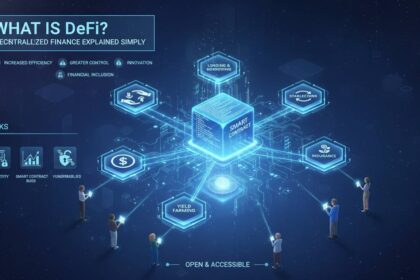

Decentralized Finance, commonly known as DeFi, represents a revolutionary shift in how financial services operate. Unlike traditional banking systems that rely on intermediaries like banks, brokers, and payment processors, DeFi uses blockchain technology to enable peer-to-peer financial transactions. This transformation allows anyone with an internet connection to access financial services without needing to trust centralized institutions. From earning interest on savings to borrowing money, trading assets, and purchasing insurance, DeFi recreates traditional financial instruments using code and smart contracts. The total value locked in DeFi protocols has grown from virtually nothing in 2019 to over $50 billion at its peak, demonstrating the massive appetite for decentralized financial alternatives.
📊 STATS
• $42.7 billion in total value locked (TVL) across DeFi protocols
• 4,500+ DeFi projects launched globally
• $16.5 billion in daily trading volume on decentralized exchanges
• 89% of DeFi users cite "financial independence" as primary motivation
Key Takeaways
• Permissionless: Anyone can use DeFi without identity verification or approval
• Transparent: All transactions are publicly visible on the blockchain
• Composable: DeFi applications can build upon each other like financial LEGO blocks
• Non-custodial: Users retain control of their assets throughout transactions
• Global: DeFi operates 24/7 across borders without banking hours or restrictions
What is DeFi? Understanding the Basics
DeFi refers to financial services built on public blockchains, most prominently Ethereum, that eliminate the need for traditional intermediaries. When you use a bank to hold your money or process a payment, you're trusting that institution to manage your funds honestly and efficiently. DeFi replaces this trust with cryptographic code and consensus mechanisms that verify transactions across thousands of computers worldwide. The core innovation enabling DeFi is the smart contract—self-executing programs that automatically enforce the terms of an agreement when predetermined conditions are met. This means no lawyer, judge, or bank is needed to ensure contracts are honored; the code does everything automatically.
Core Components of DeFi
Blockchain Networks:
Ethereum remains the dominant platform for DeFi, hosting approximately 60% of all DeFi applications. Other chains like Solana, Avalanche, Polygon, and BNB Chain have gained significant market share by offering faster transactions and lower fees.
Smart Contracts:
These are the building blocks of DeFi. A smart contract for a lending platform, for example, automatically calculates interest, distributes funds, and liquidates collateral if values fall below thresholds—all without human intervention.
Stablecoins:
Cryptocurrencies designed to maintain a fixed value, typically pegged to the US dollar. Tether (USDT), USD Coin (USDC), and DAI enable users to avoid the extreme volatility of other cryptocurrencies while still participating in DeFi protocols.
Decentralized Exchanges (DEXs):
Platforms like Uniswap and SushiSwap allow users to trade cryptocurrencies directly from their wallets without depositing funds on a centralized exchange. These use automated market makers (AMMs) that price assets algorithmically based on supply and demand.
💡 STAT: The first DeFi lending protocol, Compound, launched in 2018 and has since facilitated over $23 billion in cumulative loans
How DeFi Actually Works
When you interact with a DeFi protocol, you connect your cryptocurrency wallet—think MetaMask or Coinbase Wallet—to the application. Unlike traditional finance where you create accounts and provide personal information, DeFi requires only a wallet address. Your private keys, essentially your password, never leave your wallet. When you supply assets to a lending protocol like Aave, your cryptocurrency is pooled with other users' funds. Borrowers then draw from this pool, posting other cryptocurrencies as collateral. Interest rates adjust algorithmically based on supply and demand within each pool. Every transaction you make is recorded on the blockchain and remains permanently visible to anyone who knows your wallet address. This transparency, combined with publicly auditable smart contract code, allows anyone to verify that the protocol operates exactly as promised.
Benefits of Decentralized Finance
| Benefit | Impact | Source |
|---|---|---|
| Higher yields | 4-12% APY on savings vs. 0.01-4% at banks | DeFiLlama, 2024 |
| Faster transactions | Minutes vs. days for cross-border payments | World Bank, 2024 |
| Greater accessibility | 1.4 billion unbanked adults globally | World Bank Global Findex |
| Lower fees | 0.1-0.3% DEX trades vs. 1-3% traditional | Bankrate, 2024 |
| Programmable money | Automated financial logic | Ethereum.org |
Key Advantages
Financial Inclusion:
Approximately 1.4 billion adults worldwide lack access to traditional banking services, according to World Bank data. DeFi requires only an internet connection and a smartphone, eliminating geographic and socioeconomic barriers to financial services.
Enhanced Privacy:
While blockchain transactions are publicly visible, DeFi doesn't require users to share personal information like Social Security numbers, addresses, or employment history. Users interact pseudonymously through wallet addresses.
Censorship Resistance:
Because DeFi protocols operate on decentralized blockchain networks, no single entity or government can block transactions or freeze accounts. This proves particularly valuable in regions with unstable governments or restricted financial systems.
Continuous Availability:
Traditional banks close at night and on weekends. DeFi protocols run 24 hours a day, 365 days a year, enabling users to transact whenever they want.
📈 CASE: MakerDAO, one of DeFi's oldest protocols, has generated over $400 million in revenue for its token holders since 2017 while providing loans to thousands of users worldwide
Popular DeFi Platforms and Use Cases
Lending and Borrowing
Aave leads the DeFi lending market with over $10 billion in total value locked. Users can deposit cryptocurrencies as collateral and borrow other assets against them. Unlike traditional banks where your savings are lent out without your knowledge or consent, Aave allows you to earn interest on deposits while maintaining full control of your assets.
Compound pioneered the algorithmic interest rate model that most lending protocols now use. Its governance token COMP distribution to users in 2020 sparked the "DeFi summer" of rapid growth.
Trading
Uniswap processes billions in daily trading volume through its automated market maker system. Unlike traditional exchanges that use order books, Uniswap uses liquidity pools where users deposit pairs of tokens. The protocol automatically prices trades based on a mathematical formula, ensuring constant liquidity.
Curve Finance specializes in stablecoin and asset-pegged token trading, handling over $2 billion in daily volume with minimal slippage—crucial for large institutional trades.
Derivatives and Synthetic Assets
Synthetix allows users to create synthetic assets that track the price of real-world assets like stocks, commodities, and currencies. This enables crypto traders to gain exposure to traditional financial markets without leaving the DeFi ecosystem.
Risks and Considerations
Smart Contract Risk
The code governing DeFi protocols, while publicly auditable, can contain bugs or vulnerabilities. In 2022, hackers exploited vulnerabilities in DeFi protocols to steal over $3.8 billion worth of cryptocurrency, according to Chainalysis. While security practices have improved significantly, smart contract risk remains the primary danger in DeFi.
Impermanent Loss
When providing liquidity to automated market makers, liquidity providers can experience "impermanent loss"—a situation where the value of your deposited assets diverges from simply holding them. This occurs when the price ratio between the two tokens in a liquidity pool changes significantly.
Regulatory Uncertainty
Governments worldwide are still determining how to regulate DeFi. Some jurisdictions have banned certain DeFi activities, while others are developing frameworks that could impose significant compliance burdens on users and protocol developers.
| Risk Type | Potential Impact | Mitigation |
|---|---|---|
| Smart contract hacks | Total loss of funds | Use audited protocols, limit exposure |
| Impermanent loss | Reduced returns vs. holding | Research pool dynamics, use stable pairs |
| Regulatory changes | Protocol shutdown or restrictions | Diversify across chains and protocols |
| Counterparty risk | Loss of borrowed funds | Maintain healthy collateral ratios |
| Platform abandonment | Locked funds | Research team, community engagement |
⚠️ CRITICAL: Never invest more than you can afford to lose in DeFi. The space remains highly experimental, and even audited protocols have experienced devastating hacks. Diversify your investments, use hardware wallets for large holdings, and thoroughly research any protocol before committing funds.
Prevention:
• Use protocols with multiple security audits from reputable firms
• Start with small amounts when testing new platforms
• Enable multi-factor authentication on connected accounts
• Keep updated on protocol governance discussions
• Consider using insurance protocols like Nexus Mutual
Common Mistakes to Avoid
| Mistake | Impact | Solution |
|---|---|---|
| Not diversifying across protocols | Complete loss if one protocol fails | Spread investments across 3-5 protocols |
| Ignoring gas fees | Unexpected costs eating into profits | Time transactions during low-congestion periods |
| Using weak wallet security | Hacked funds | Use hardware wallets, secure seed phrases |
| Following hype without research | Scam projects, rug pulls | Verify team identity, audit reports, community history |
| Over-collateralizing loans | Liquidations during volatility | Maintain 50%+ collateral ratio |
| Neglecting tax implications | Penalties, legal issues | Consult crypto-tax professionals |
Many newcomers make the mistake of treating DeFi returns as guaranteed. The APY (annual percentage yield) advertised by lending protocols fluctuates based on market conditions and can drop dramatically during periods of low demand. Additionally, "yield farming"—moving funds between protocols to chase the highest returns—often results in net losses after accounting for transaction fees and impermanent loss.
Tools for Getting Started
| Tool | Cost | For | Rating |
|---|---|---|---|
| MetaMask | Free | Wallet connection | ⭐⭐⭐⭐⭐ |
| Uniswap | 0.3% fee | Trading tokens | ⭐⭐⭐⭐⭐ |
| Aave | Interest | Earning/borrowing | ⭐⭐⭐⭐⭐ |
| Etherscan | Free | Transaction verification | ⭐⭐⭐⭐ |
| Zerion | Free | Portfolio management | ⭐⭐⭐⭐ |
| Ledger | $79+ | Hardware security | ⭐⭐⭐⭐⭐ |
Top Picks for Beginners:
• MetaMask: The most widely supported wallet, integrates with most DeFi protocols
• Uniswap: Best starting point for trading, intuitive interface
• Aave: Most established lending protocol with excellent security track record
• CoinGecko/CoinMarketCap: Track portfolio value and research protocols
Frequently Asked Questions
What is the difference between DeFi and traditional finance?
Traditional finance relies on centralized intermediaries like banks, brokerages, and payment processors that control your funds and verify transactions. DeFi replaces these intermediaries with transparent code running on blockchains, giving users direct control over their assets. Traditional finance operates during business hours and often takes days for transactions to settle, while DeFi runs 24/7 with transactions typically completing in seconds to minutes.
Is DeFi safe to use?
DeFi carries significant risks including smart contract vulnerabilities, potential loss of funds from hacks, and complete loss of investment due to protocol failure. No central authority can reverse transactions or recover stolen funds. However, using established protocols with multiple security audits, diversifying investments, and following security best practices significantly reduces these risks. Never invest more than you can afford to lose entirely.
How do I start using DeFi?
First, set up a cryptocurrency wallet like MetaMask and purchase Ethereum or other tokens supported by your chosen protocol. Visit a decentralized exchange like Uniswap to swap fiat-purchased tokens for your desired assets. Connect your wallet to a lending protocol like Aave to earn interest or provide liquidity. Always start with small amounts to understand how transactions work before committing larger sums.
What are gas fees in DeFi?
Gas fees are transaction costs paid to blockchain validators for processing your transactions. On Ethereum, these fees vary based on network congestion—during busy periods, fees can reach $50 or more for a single transaction. Layer 2 solutions like Polygon and Arbitrum offer significantly lower fees while maintaining Ethereum's security, making them popular for smaller transactions.
Can I lose money in DeFi lending?
Yes, while lending protocols typically maintain healthy collateral ratios, dramatic market crashes can trigger automatic liquidations where your collateral is sold to cover the loan. Additionally, protocol failures, though rare with established platforms, can result in complete loss of deposited funds. The APY earned on lending also fluctuates and may not keep pace with the volatility of the underlying assets.
Conclusion
DeFi represents a fundamental reimagining of financial infrastructure, offering unprecedented access to banking services, trading, lending, and earning opportunities. The ecosystem has matured considerably since its 2018 origins, with billions in value now secured by audited smart contracts and robust governance systems. However, users must approach DeFi with clear understanding of the risks—smart contract vulnerabilities, regulatory uncertainty, and the experimental nature of these technologies. Start small, prioritize security, and never invest funds you cannot afford to lose entirely. As blockchain technology continues evolving and regulatory frameworks crystallize, DeFi may well become the foundation for a more accessible, transparent, and efficient global financial system.