

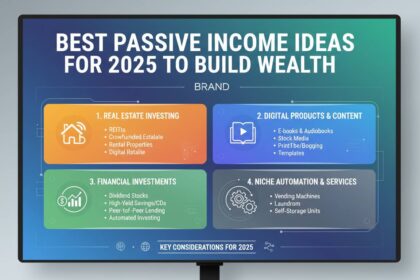

The economic landscape continues to shift in 2025, presenting Americans with unprecedented opportunities to generate passive income and build lasting wealth. As inflation stabilizes and interest rates find new equilibrium, investors are reassessing their portfolio strategies to create sustainable revenue streams that work for them rather than requiring constant active management. This comprehensive guide explores the most effective passive income avenues available today, examining their potential returns, associated risks, and practical steps for implementation. Whether you are a seasoned investor looking to diversify or someone beginning your wealth-building journey, understanding these income-generating mechanisms has become essential for achieving long-term financial security in an increasingly competitive economic environment.
Understanding Passive Income in 2025
Passive income represents money earned with minimal ongoing effort after the initial investment of time, money, or both. Unlike traditional employment income that requires trading hours for dollars, passive income streams continue generating revenue regardless of your daily activities. The concept has gained substantial traction among Americans seeking financial independence, with recent surveys indicating that nearly half of working-age adults now actively pursue some form of passive income opportunity.
The current economic climate offers unique advantages for passive income seekers. Interest rates have created attractive yields in fixed-income investments that were unavailable just a few years ago. Simultaneously, technological advancements have lowered barriers to entry for digital income streams, enabling individuals to launch automated businesses and create digital products with minimal upfront capital. The convergence of these factors has produced a favorable environment for building diversified passive income portfolios.
Financial experts emphasize the importance of understanding that passive income rarely means no effort. Building sustainable passive income requires upfront work, whether researching investments, creating digital assets, or setting up automated systems. The key distinction lies in the ongoing time commitment after initial setup. As financial advisor Jennifer Martinez of Capital Wisdom Partners explains, "The most successful passive income strategies require significant initial research and setup, but they can provide decades of revenue with minimal maintenance. The old saying about making money while you sleep truly applies to well-constructed passive income portfolios."
Dividend Investing: Building Wealth Through Stock Ownership
Dividend investing remains one of the most reliable passive income strategies available to American investors in 2025. This approach involves purchasing shares in companies that distribute a portion of their profits to shareholders on a regular basis, typically quarterly. The strategy offers both income through dividend payments and potential capital appreciation as stock values grow over time.
The S&P 500 dividend yield currently hovers around 1.5% to 1.8%, representing yields significantly higher than the near-zero rates of the early 2020s. However, some individual companies offer substantially higher yields, with dividend aristocrats—companies that have increased dividends for at least 25 consecutive years—providing reliable income streams backed by proven financial performance. Industries including utilities, consumer staples, and financial services traditionally offer the most stable dividend payments.
Investors can build dividend income through individual stock purchases or exchange-traded funds focused on dividend-paying companies. Dividend reinvestment plans (DRIPs) allow investors to automatically purchase additional shares with dividend payments, compounding returns over time. This approach has proven particularly effective for long-term wealth accumulation, with historical data showing dividend-paying stocks outperforming non-dividend stocks over extended periods.
The tax treatment of dividend income deserves consideration for maximum returns. Qualified dividends receive favorable tax rates, currently capped at 20% for high-income earners, while ordinary dividends are taxed at regular income rates. Understanding these tax implications helps investors make informed decisions about account types, such as Roth IRAs or traditional IRAs, where dividend income can grow tax-free or be deferred until withdrawal.
Real Estate Investment Opportunities
Real estate continues offering compelling passive income opportunities in 2025, though the landscape has evolved significantly from the property-flipping boom of previous years. Investors now have more options than ever to participate in real estate markets without the traditional burdens of property management, ranging from publicly traded REITs to crowdfunded real estate platforms.
Real Estate Investment Trusts (REITs) provide the most accessible entry point to real estate income. These companies own, operate, or finance income-producing real estate across various sectors, including commercial properties, residential complexes, healthcare facilities, and data centers. REITs are required by law to distribute at least 90% of taxable income as dividends, making them particularly attractive for income-focused investors. The FTSE Nareit All Equity REITs index has delivered solid returns in recent years, combining dividend income with capital appreciation potential.
For those seeking direct property ownership without hands-on management, turnkey rental properties have gained popularity. These are fully renovated homes purchased specifically for rental income, with property management companies handling tenant placement, maintenance, and rent collection. This arrangement allows investors to receive monthly cash flow while avoiding the day-to-day responsibilities of landlord duties. However, investors should carefully evaluate management fees, which typically range from 8% to 12% of collected rent, as these significantly impact net returns.
Real estate crowdfunding platforms have democratized access to commercial real estate investments that were previously available only to wealthy individuals and institutional investors. Platforms like Fundrise, CrowdStreet, and RealtyMogul allow investors to participate in commercial property developments and existing income-producing properties with minimum investments often under $500. While these platforms offer attractive returns, they typically require longer commitment periods and carry less liquidity than publicly traded REITs.
High-Yield Savings and Money Market Accounts
The interest rate environment of recent years has transformed high-yield savings accounts and money market accounts into viable passive income vehicles for conservative investors. These FDIC-insured accounts now offer yields exceeding 4% annually, providing returns that significantly outpace traditional savings accounts while maintaining principal protection.
High-yield savings accounts function similarly to standard savings accounts, allowing limited monthly withdrawals while earning competitive interest rates. Online banks typically offer the highest yields because they operate with lower overhead costs than traditional brick-and-mortar institutions. Money market accounts often provide similar returns with check-writing privileges, though they may require higher minimum balances. Both account types remain fully insured by the Federal Deposit Insurance Corporation up to $250,000 per depositor, making them among the safest passive income investments available.
The primary limitation of these accounts lies in their tax treatment. Interest earned is taxed as ordinary income at your marginal tax rate, unlike qualified dividends that receive preferential treatment. Additionally, inflation can erode purchasing power if nominal returns fall below inflation rates, though current yields appear competitive with present inflation levels.
Financial planning professionals often recommend high-yield accounts for emergency funds and short-term savings goals rather than long-term wealth building. However, for risk-averse investors or those building capital for other investments, these accounts provide a no-maintenance income stream with guaranteed returns. As market conditions evolve, maintaining flexibility to reallocate funds to higher-yielding opportunities remains prudent financial management.
Index Funds and Automated Portfolio Investing
Index funds have revolutionized passive investing by offering broad market exposure with minimal fees. These funds track specific market indices, such as the S&P 500 or total stock market funds, automatically adjusting their holdings as companies enter or leave the tracked indices. This approach eliminates the need for active stock selection while historically delivering returns that outperform most actively managed funds over time.
The growth of robo-advisors has further simplified automated investing. These digital platforms create diversified portfolios based on your risk tolerance and financial goals, automatically rebalancing holdings and optimizing for tax efficiency. Leading platforms like Betterment, Wealthfront, and Vanguard's Digital Advisor charge minimal fees, often under 0.25% annually, making professional portfolio management accessible to investors with modest account balances.
Tax-advantaged retirement accounts provide optimal containers for index fund investing. Traditional IRAs and 401(k)s offer tax-deferred growth, while Roth accounts provide tax-free withdrawals in retirement. Employer-sponsored 401(k) plans often include matching contributions, representing immediate returns that far exceed any investment performance. Taking full advantage of employer matches should precede other investment decisions for those with access to retirement plans.
The long-term nature of index fund investing aligns perfectly with passive income goals. Consistent contributions combined with compound growth create substantial wealth accumulation over decades. While these funds do not provide immediate income, they can be structured to generate regular withdrawals in retirement or converted to income-producing assets as financial situations evolve.
Digital Products and Automated Online Businesses
The creator economy has opened remarkable opportunities for generating passive income through digital products. E-books, online courses, templates, and software tools can be created once and sold repeatedly without additional production costs. This scalability makes digital products particularly attractive for those with expertise or creative abilities.
Online courses have emerged as a particularly lucrative digital product category. Platforms like Udemy, Skillshare, and Teachable facilitate course creation and sales, handling payment processing and customer service. Successful courses can generate consistent sales month after month with minimal ongoing effort beyond occasional updates. The initial investment consists primarily of time spent creating quality content and potentially investing in basic equipment for professional production.
Print-on-demand services have similarly democratized product-based businesses. Artists and designers can upload artwork to platforms like Redbubble, Society6, or Printful, which handle printing, shipping, and customer service. Each sale generates royalties without inventory investment or fulfillment responsibilities. This model has proven particularly effective for designers seeking to monetize creative work without operating traditional e-commerce businesses.
Automated e-commerce through dropshipping and fulfillment services represents another digital passive income avenue. While these businesses require more initial setup than digital products, they can be largely automated after establishing supplier relationships and store systems. Success requires significant upfront effort in selecting products, establishing supplier connections, and configuring automated marketing and sales systems.
Peer-to-Peer Lending and Alternative Investments
Peer-to-peer lending platforms connect borrowers directly with individual lenders, often offering returns significantly higher than traditional savings accounts. These platforms facilitate personal loans, business loans, and sometimes real estate financing, with interest rates determined by borrower creditworthiness and market demand. Returns for lenders typically range from 4% to 10% depending on risk assessment and loan terms.
The primary risk in peer-to-peer lending involves borrower default. Unlike bank deposits, these investments lack FDIC insurance, meaning defaults directly impact returns. Platforms mitigate this risk through credit assessment and diversification tools, but investors must accept the possibility of partial or complete loss of principal on some loans. Spreading investments across many loans reduces the impact of any individual default.
Bond investments provide another avenue for passive fixed income. Treasury bonds, corporate bonds, and municipal bonds each offer different risk-return profiles and tax treatments. Treasury securities carry full faith and credit guarantees, while corporate bonds offer higher yields in exchange for accepting credit risk. Municipal bonds often provide tax-free income, particularly beneficial for investors in high tax brackets.
The current bond environment offers attractive yields following rate adjustments of recent years. Individual bonds can be held to maturity, guaranteeing returns of principal if held to term, while bond funds provide professional management and liquidity. Financial advisors often recommend bonds for income-focused portions of portfolios, with allocation typically increasing as investors approach retirement.
Frequently Asked Questions
What is the best passive income investment for beginners in 2025?
High-yield savings accounts and index funds represent the most accessible starting points for beginners. High-yield accounts offer guaranteed returns with no risk, while index funds provide long-term growth potential with minimal complexity. Both require no special expertise and can be established through major financial institutions or brokerage firms.
How much money do I need to start generating passive income?
The required capital varies significantly by investment type. High-yield savings accounts require only a few hundred dollars to open. Index funds can begin with any amount that allows purchasing fractional shares or meeting minimum investment requirements. Real estate investments typically require substantial capital, though REITs and crowdfunding platforms allow participation with much smaller amounts.
Are passive income investments taxable?
Most passive income is taxable. Dividend income, interest payments, and rental income are generally taxed as ordinary income. However, tax-advantaged accounts like IRAs and 401(k)s can shield these incomes from immediate taxation. Roth accounts provide particularly valuable tax advantages for passive income in retirement.
How long does it take to see returns from passive income investments?
Timeline varies by investment type. Savings accounts and bonds pay interest regularly, typically monthly or semi-annually. Dividends are paid quarterly. Real estate investments may take time to generate positive cash flow after accounting for mortgage payments and expenses. Index funds and other growth investments may take years to generate meaningful income, though they appreciate in value immediately.
What are the risks associated with passive income investments?
Risks include loss of principal, market volatility, inflation erosion, and illiquidity. No investment is completely risk-free. Diversification across multiple income streams helps mitigate individual investment risks. Understanding each investment's specific risks before committing capital is essential for long-term success.
Can I replace my full-time income with passive income?
While possible, achieving full-time passive income typically requires substantial capital accumulation or building successful automated businesses over many years. Most financial experts recommend building passive income as a supplement to primary income during working years, gradually transitioning toward greater reliance on passive sources as wealth accumulates.